


August 20, 2026
Customer Acquisition Cost Calculator: Boost Your Marketing ROI
A customer acquisition cost calculator is the tool that finally pulls you out of the land of guesswork and shows you exactly how much you’re spending to land a single new customer. It’s the only way to know for sure if your marketing dollars are actually earning their keep. Without it, you’re just throwing money at the wall and hoping something sticks.
Why a Basic CAC Formula Is Not Enough
So many businesses stop at the simple formula: total marketing spend divided by new customers. Sure, it gives you a number, but that number doesn’t tell you a story or offer a roadmap for what to do next. Honestly, relying on that surface-level metric is one of the fastest ways to burn through your budget without ever figuring out why it's not working.
A proper customer acquisition cost calculator gives you the granular details you need to make smart, data-backed decisions. It forces you to look past the blended average and start asking the right questions about your strategy.
Pinpointing Your Most Profitable Channels
Imagine a startup spending $10,000 a month on marketing and bringing in 100 new customers. Their blended CAC is $100, which might look pretty good on a report. But when you break it down with a real calculator, the picture changes completely:
- Google Ads: They spent $6,000 to acquire 30 customers. That's a CAC of $200.
- SEO/Content: They spent $4,000 to acquire 70 customers. The CAC here is just $57.
All of a sudden, it’s crystal clear where the real value is. This is the kind of insight that lets them shift their budget, pouring more into the high-performing SEO channel while they either fix or cut the bleeding from their ad campaigns.
Avoiding Unsustainable Spending
Without that channel-specific view, the business might just decide to double its overall budget to $20,000, thinking they'll get 200 customers. But if they blindly scale up that inefficient Google Ads campaign, they'll just drain cash and watch their returns get worse and worse. A good calculator acts as a financial guardrail, preventing you from scaling the very things that are holding you back.
To get this right, your customer acquisition costs have to include all the related expenses—from ad spend and software tools to the salaries of your sales and marketing teams. The best way to manage this is by breaking down costs by channel. You might find that social media ads cost you $120 per customer, while your SEO efforts bring in new business for just $100 each. You can find more great insights on tracking these costs over at GoCustomer.ai.
A great calculator doesn't just spit out a number; it gives you direction. It turns CAC from a boring reporting metric into a core part of your growth engine—showing you what works, what doesn't, and exactly where your next dollar should go.
Gathering Your Essential Calculator Inputs

Any calculator is only as good as the numbers you feed it. To build a genuinely useful customer acquisition cost calculator, you have to be meticulous. Every single dollar spent on winning new business needs to be accounted for.
If you miss a few key expenses, you'll end up with a dangerously optimistic CAC. That leads to flawed budgets and bad decisions down the road.
The best way to start is by splitting your costs into two buckets: Sales Costs and Marketing Costs. This simple separation is key to figuring out which side of your growth engine actually needs a tune-up.
Tracking Your Sales Costs
This part goes way beyond just base salaries. You need the "fully loaded" cost of your sales team—every expense directly tied to their efforts to close deals. Think of it as the total investment required to keep your deal-closing machine running.
To get the full picture, make sure you're tracking:
- Salaries and Wages: The gross pay for every person on the sales team, from SDRs to VPs.
- Commissions and Bonuses: This is a direct cost of acquisition. It’s non-negotiable.
- Sales Tools and Software: Add up the monthly or annual fees for your CRM (like Salesforce), sales intelligence platforms, and anything else the team uses to get the job done.
- Overhead Costs: A proportional slice of the office rent, utilities, and other general expenses that should be allocated to the sales department.
Once you add all that up, you'll have a much more honest view of what it really costs to support your sales function for a given period.
The biggest mistake I see businesses make is ignoring "soft" costs like software subscriptions or a percentage of overhead. These add up fast and can seriously inflate your true CAC, revealing inefficiencies you’d otherwise completely miss.
Compiling All Marketing Expenses
Next up, you need to pull together every marketing-related expense from that same period. This can get a little messy because costs are often spread across different platforms, vendors, and internal teams. The goal is to capture any and all spending meant to generate leads and attract new customers.
If you want a deeper dive into the fundamental principles, this is a great article on Customer Acquisition Cost Calculation.
Your marketing cost checklist should absolutely include:
- Advertising Spend: This is the obvious one. Tally up your total budget spent on platforms like Google Ads, Meta (Facebook/Instagram), LinkedIn Ads, and any other paid channel.
- Salaries for Marketing Staff: Just like with sales, you have to include the full salaries of your marketers, content creators, SEO specialists, and managers.
- Content Creation Costs: Using freelancers for blog writing, video, or design? Those invoices count. Don't forget costs for stock photos or video assets, either.
- Marketing Software and Tools: This covers everything from your email marketing platform and SEO tools (like Ahrefs or Semrush) to social media schedulers and analytics software.
- Agency or Consultant Fees: If you're working with a marketing agency or hiring consultants for specific projects, their fees are a direct marketing expense.
Pulling these numbers together requires some legwork—you'll likely be digging through accounting software, ad platforms, and payroll systems.
To make sure you don't miss anything, I've put together a quick checklist of the data points you'll need.
Essential Data Points for Your CAC Calculator
| Cost Category | Specific Expense Examples | Why It's Important |
|---|---|---|
| Sales Team Costs | Salaries, commissions, bonuses, sales training | Captures the full human cost of closing deals, not just base pay. |
| Sales Tools & Software | CRM subscriptions, sales intelligence tools, dialers | These tools are essential for efficiency but represent a significant recurring cost. |
| Marketing Team Costs | Salaries, benefits, freelance fees, agency retainers | Includes the in-house and outsourced talent driving your marketing efforts. |
| Advertising Spend | Google Ads, social media ads, display ads, sponsored content | This is the most direct cost of reaching new audiences and generating leads. |
| Marketing Tech Stack | SEO tools, email marketing platform, analytics software | The software that powers modern marketing comes with a price tag that can't be ignored. |
| Content Creation | Videographers, writers, graphic designers, stock photo licenses | High-quality content isn't free; its production costs are part of acquiring customers. |
| Overhead Allocation | Pro-rated rent, utilities, office supplies for sales & marketing | A portion of your general business expenses must be attributed to customer acquisition. |
Getting all this data organized is half the battle. If your data is a mess, having a well-structured marketing database can make this process a whole lot smoother.
Once you have your two big numbers—Total Sales Costs and Total Marketing Costs—you’re ready to actually build the calculator.
Building Your CAC Calculator in a Spreadsheet
Alright, you've done the legwork and gathered all your essential cost data. Now it's time to put those numbers to work. We're going to build your customer acquisition cost calculator right in a spreadsheet—no fancy formulas or coding skills required. It doesn't matter if you're using Google Sheets or Excel; the steps are the same.
The whole point here is to create a living, breathing tool you can update monthly or quarterly. This gives you a real-time pulse on how efficiently your marketing machine is running. We'll start with a simple, blended CAC and then level up to a more powerful, channel-specific view.
Setting Up Your Data Input Sheet
First things first: open a fresh spreadsheet and create a simple area for data input. This is where you'll plug in all those numbers you just collected. Think of it as the control panel for your entire calculator.
You’ll want to create cells for each of your key cost categories, plus one for the total number of new customers you brought in during that same period.
Here’s a clean layout you can steal:
- Total Sales Salaries
- Total Sales Commissions
- Sales Tool Costs
- Total Marketing Salaries
- Total Ad Spend
- Marketing Tool Costs
- Freelance/Agency Fees
- New Customers Acquired
A simple structure like this keeps everything organized. It makes it dead simple to see exactly what's driving your costs and turns your monthly update into a quick copy-and-paste job.
The key to a useful calculator is consistency. Define a specific time period—like a calendar month—and stick to it. Mixing data from a 30-day period with a 45-day period will give you skewed, unreliable results every single time.
Crafting the Core Formulas
With your inputs all lined up, it's time for some simple math. Don't worry, we're just talking basic addition and division here.
First, create a cell for your Total Acquisition Costs. The formula is about as straightforward as it gets—you're just adding up all the individual cost cells from the previous step. In most spreadsheet apps, it will look something like this:
=SUM(B2:B8)
(This assumes your costs are sitting in cells B2 through B8).
Next up is the final CAC formula. This is the heart of your entire customer acquisition cost calculator. In a new cell labeled Blended CAC, you'll divide your Total Acquisition Costs by the number of New Customers Acquired.
=B9/B10
(Assuming your total costs are in B9 and new customers are in B10).
The idea of a formal CAC calculator really took hold in the early 2020s as more companies demanded clarity on where their money was actually going. The standard approach is pretty much what we're doing here: define a period, add up all the relevant spend, and divide by the new customers from that window. You can see this standard calculation in action over at ajelix.com.
This simple infographic really nails the powerful logic behind calculating your core CAC.
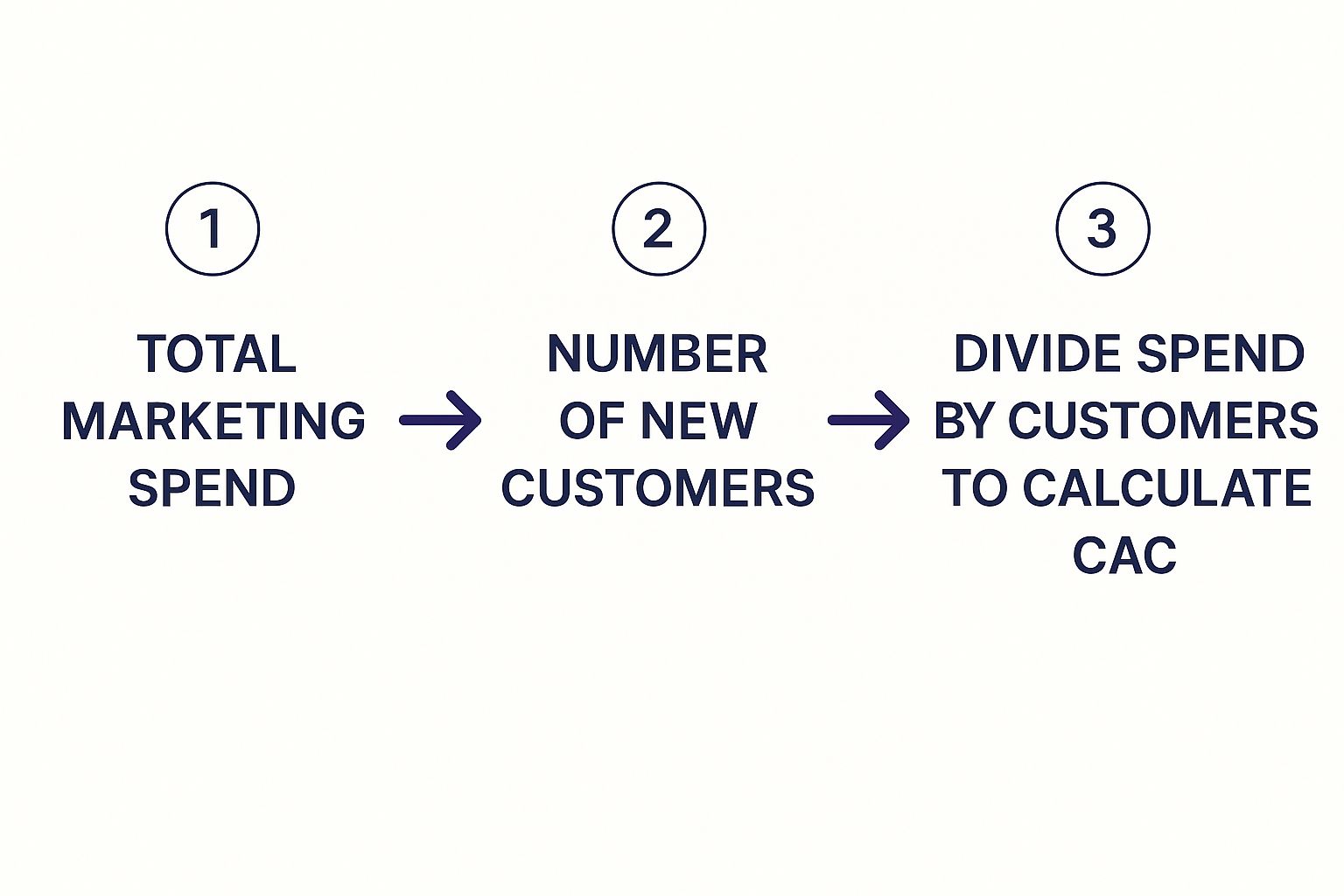
As the chart shows, it all boils down to three simple steps: sum your spend, count your customers, and divide the two. That's your cost per customer.
Creating a Channel-Specific Calculator
A blended CAC is a good starting point, but the real magic happens when you break it down for each marketing channel. This is how you figure out if you should pour more money into SEO, pull back on paid ads, or go all-in on content.
To pull this off, you’ll need to expand your spreadsheet. I'd recommend creating a new section or even a separate tab that breaks down your costs and customer numbers by channel.
You'll have to figure out how to allocate general costs, like marketing salaries, across your channels. A common way to do this is to distribute them based on the direct spend for each channel.
For example, your table might look something like this:
| Channel | Direct Spend | Allocated Costs | Total Cost | New Customers | Channel CAC |
|---|---|---|---|---|---|
| Google Ads | $5,000 | $2,000 | $7,000 | 35 | $200 |
| SEO | $2,000 | $1,500 | $3,500 | 60 | $58.33 |
| Social Media | $3,000 | $1,500 | $4,500 | 25 | $180 |
The formula for each Channel CAC is the same as before: Total Cost for that channel divided by the New Customers from that channel. This kind of granular view instantly shows you which channels are your winners and which are dragging you down, giving you some real ammunition for your next budget meeting.
So, you’ve run the numbers through your calculator and now you have a CAC staring you in the face. What's next? A single metric, on its own, is just a number. Its real power comes from context.
Understanding your CAC is the first step. Analyzing it is where you unlock real growth. The most important relationship to understand is the one between what you spend to get a customer (your CAC) and what that customer is actually worth to you over time.
The LTV to CAC Ratio: Your Ultimate Health Metric
This is where Customer Lifetime Value (LTV) enters the picture. LTV is the total revenue you can reasonably expect from a single customer throughout their entire relationship with your business. When you put LTV and CAC together, you get the true north for sustainable growth.
The LTV to CAC ratio answers the most critical question of all: "Are we spending our acquisition budget profitably?"
It's pretty simple—for a business model to work, the value a customer brings in has to be significantly higher than what it cost you to get them. While the "ideal" number can shift depending on your industry, a widely accepted benchmark for a healthy LTV to CAC ratio is 3:1. For every dollar you spend on acquisition, you should be getting three dollars back in lifetime value.
A 1:1 ratio means you’re just breaking even on every new customer, and that’s a fast track to nowhere. On the flip side, a ratio higher than 5:1 might actually mean you're underinvesting in marketing and could be growing much faster.
Turning CAC Insights into Actionable Strategy
This is where your calculator becomes a real decision-making engine. Let's imagine a fictional e-commerce company, "Urban Bloom," sits down to review its data from the last month.
Here’s what they find:
- SEO Channel: The CAC is $45, with an average LTV of $180. That's a 4:1 LTV:CAC ratio.
- Paid Social Channel: The CAC is a whopping $120, with the same LTV of $180. That's a 1.5:1 LTV:CAC ratio.
Suddenly, the path forward becomes crystal clear. Their SEO channel is a high-performing engine. The obvious move is to double down on what’s working—funnel more budget into content creation and link-building to capture more of that profitable traffic.
The paid social channel, however, is a massive red flag. It’s bringing in customers, sure, but the cost is far too high to be sustainable. The goal here isn't necessarily to slash the channel entirely but to get smarter. They could start by refining ad targeting, A/B testing new creative, or optimizing their landing pages to bring that $120 CAC down. For a deeper dive, they could even explore something like https://frozencrow.com/what-is-marketing-mix-modeling/ to untangle how different channels influence each other.
A Quick Guide to Interpreting Your Results
| If Your CAC Is… | It Might Mean… | Your Next Move Should Be… |
|---|---|---|
| Low on a Specific Channel | This channel is highly efficient and profitable for you. | Allocate more budget here. It's time to scale what's working. |
| High Across All Channels | Your overall acquisition strategy may be too expensive. | Time to review your spending, target audience, and value proposition. |
| Increasing Month-over-Month | You could be seeing ad fatigue, new competition, or seasonal shifts. | Dig into the specific channels driving the increase and start optimizing. |
| Decreasing Month-over-Month | Your optimization efforts are paying off. Good job. | Identify what changes drove the improvement and replicate them. |
Customer acquisition cost is simply a measure of what you spend to secure a new customer. To find it, you just divide your total sales and marketing expenses over a period by the number of new customers you brought in. For example, if you spend $40,000 on marketing and get 160 new customers, your CAC is $250.
While building your own calculator gives you total control, sometimes you just need a quick answer. For a great all-in-one resource, you can use a dedicated Customer Acquisition Cost calculator to analyze your costs and fine-tune your marketing. Remember, your calculator isn’t just a reporting tool—it’s a strategic guide for growing your business the right way.
Common CAC Calculation Mistakes to Avoid

A customer acquisition cost calculator is a fantastic tool, but it's only as smart as the data you feed it. Small oversights can lead to massive strategic errors, giving you a false sense of confidence in your marketing performance. When it comes to CAC, precision is everything.
I’ve seen a few common mistakes trip people up time and time again.
One of the biggest is ignoring "fully loaded" costs. It’s easy to just count your direct ad spend, but what about the salaries, commissions, and benefits for your sales and marketing teams? These payroll expenses are often the single largest chunk of an acquisition budget, and leaving them out gives you a dangerously incomplete picture.
Another classic pitfall is misattributing customers. Think about it: a customer might see a Facebook ad, read three of your blog posts, and then finally convert through a Google search. If you only give credit to that final Google click, your SEO channel will look like a hero while your paid social campaigns look like a waste of money. This completely skews your future budget decisions.
Using Inconsistent Time Periods
This one sounds obvious, but it happens all the time. Consistency is your best friend when calculating CAC.
If you compare a single month of marketing spend against a full quarter of new customer data, you'll end up with a number that means absolutely nothing. You have to align your cost period with your customer acquisition period. It’s always apples to apples.
This kind of error usually pops up when teams are pulling reports from different systems without double-checking the date ranges. A simple checklist can save you from this headache.
Key Takeaway: The most reliable insights come from comparing identical timeframes. Whether you calculate CAC monthly or quarterly, make sure every single input—from ad spend to new customer counts—is pulled from that exact same period.
Focusing Only on Acquisition
Finally, don't get tunnel vision and obsess over CAC in a vacuum.
Sure, a low CAC looks great on a spreadsheet. But it’s a vanity metric if it only brings in low-value customers who churn out a month later. The real story is told by the LTV:CAC ratio, which connects your acquisition costs to the long-term value those customers actually bring in.
To get an even clearer picture of your entire pipeline, you also need to understand what are leads in sales versus actual paying customers. Tracking both helps you see exactly where prospects are dropping off.
Avoiding these common mistakes will ensure your customer acquisition cost calculator becomes a reliable guide for real, sustainable growth.
A Few Common Questions About CAC
Even with a perfect customer acquisition cost calculator, you're bound to run into a few questions. I see them pop up all the time. Let's walk through some of the most common ones so you can use this metric to make genuinely smart decisions for your business.
How Often Should I Calculate My Customer Acquisition Cost?
For most companies, calculating CAC on a monthly basis is the sweet spot.
This gives you just enough data to see real trends taking shape without getting lost in the weeds of daily noise. A monthly check-in is perfect for spotting a failing ad campaign early or noticing when a channel is suddenly crushing it so you can double down.
You can definitely run the numbers quarterly for high-level strategic planning or board meetings, but the monthly rhythm is what gives you the tactical edge to actually optimize your spending.
What Is a Good LTV to CAC Ratio?
This one varies a bit by industry, but a solid benchmark for a healthy LTV to CAC ratio is 3:1 or higher.
Put simply, this means for every dollar you spend bringing a new customer in the door, you should be getting at least three dollars back over their lifetime with your business.
A ratio below 1:1 is a huge red flag—you're literally losing money on every sale. On the flip side, if you're seeing something like 5:1 or higher, it might actually mean you're not investing enough in growth and could be leaving money on the table.
Should I Include Salaries in My CAC Calculation?
Yes. One hundred percent.
To get a true picture of your acquisition costs, you absolutely must include the "fully loaded" costs of your sales and marketing teams. This isn't just their base pay; it's also commissions, benefits, payroll taxes, and any performance bonuses.
If you skip these payroll costs, your CAC will look artificially low, and that's dangerous. It can trick you into over-investing in channels that only seem profitable because you’ve ignored the very real human cost of running them. Accuracy is everything if you want your calculator to be a reliable tool.
Ready to transform your marketing strategy with data-driven insights? Frozen Crow Inc. offers free marketing audits to help you understand your numbers and build a roadmap for sustainable growth. Get started today by visiting https://frozencrow.com.


