


August 20, 2026
What Are Leads in Sales? Essentials You Need to Know
In the world of sales, everything starts with a simple concept: the lead. Think of it as the first spark of interest from a person or a company in what you're selling. This initial curiosity is the starting point for every customer relationship and, ultimately, every dollar of revenue.
It's the very first step in a long dance.
What Exactly Is a Sales Lead?

Let's cut through the jargon. A sales lead isn't just a name and an email address in your CRM. It's a clue—a signal that a potential sale might be just over the horizon.
Imagine your sales team as detectives. A lead is the first promising piece of evidence they get. Someone has essentially raised their hand, signaling they might have a problem that you're uniquely equipped to solve.
This signal can show up in a lot of different ways. Maybe someone downloaded a whitepaper from your site, filled out a contact form to ask a question, or signed up for your newsletter. Each of these actions is a breadcrumb, creating a trail that points back to a potential customer. Your job is to follow that trail.
The Foundation of Your Sales Pipeline
Without a steady stream of leads, your sales pipeline dries up. Fast. They are the essential raw material that fuels all your growth. Understanding what leads are in sales is so critical because it defines the very top of your sales funnel, where every single customer journey begins.
A lead isn't a guaranteed sale; it's a possibility. It’s an invitation to start a conversation and discover if there’s a genuine match between their needs and your solutions.
Lead generation is so vital that a whopping 50% of marketers consider it a top priority. On average, organizations are pulling in around 1,877 leads per month, which shows just how intense the focus is on attracting potential buyers. You can dig into more insights about lead generation statistics and trends to see how the landscape is shaping up.
So, what makes a random contact a "lead"? It boils down to a few key characteristics.
Key Characteristics of a Sales Lead
| Characteristic | Description | Example |
|---|---|---|
| Contact Information | The basic data needed to start a conversation, like a name, email, or phone number. | Jane Doe, jane.doe@example.com, (555) 123-4567 |
| Expressed Interest | An action showing the person is curious about your product, service, or industry. | Downloading an ebook, attending a webinar, or requesting a demo. |
| Potential Need | An indication that the individual or their company faces a problem your solution can address. | A marketing manager from a small business looking for social media tools. |
| Qualification Data | Information that helps you determine if they are a good fit (e.g., company size, budget, role). | The lead works at a B2B tech company with over 100 employees. |
These components help transform a generic contact into a tangible opportunity. Once you have this information, the real work of nurturing that lead into a customer can begin.
Here’s the rewritten section, designed to match the expert, human-written style of your examples.
Not All Leads Are Created Equal
Throwing the same aggressive sales pitch at every single person who shows a flicker of interest is a recipe for disaster. You’ll burn through your contact list, waste a ton of time, and leave a trail of annoyed prospects in your wake.
The secret to a smarter sales process is recognizing that not everyone is at the same point in their buying journey. Someone who downloaded a free guide is just kicking the tires. The person who just requested a pricing demo? They’re ready for a serious conversation.
When you learn to spot these differences, you can tailor your approach and meet people where they are. This isn't about being passive; it's about being strategic. You match your energy to their intent, nurturing the curious without scaring off those ready to pull the trigger.
From Casual Interest to Ready to Buy
To get a real handle on your pipeline, you need to start sorting leads based on how they've actually interacted with your business. This is where a well-organized marketing database organizes this crucial information, helping you separate the window shoppers from the serious buyers.
Here's a simple breakdown of how a lead typically progresses:
- Information Qualified Lead (IQL): Think of this as the very beginning of the relationship. They've handed over their email for something valuable—like an ebook or a webinar—but that’s it. There’s no real buying signal here yet.
- Marketing Qualified Lead (MQL): Now things are getting interesting. An MQL has shown they’re more than just a little curious. Maybe they’ve hit your pricing page a few times, binged your case studies, or keep opening your marketing emails. These are warm leads, and they're definitely worth your marketing team's attention.
- Sales Qualified Lead (SQL): This is the handoff. An SQL has raised their hand and basically said, "I'm ready to talk." They've taken a high-intent action like asking for a custom quote or booking a one-on-one demo. These are hot leads primed for a direct conversation with sales.
Hot, Warm, and Cold Leads Explained
Another great way to think about this is with a simple temperature check. It's a quick, intuitive way for sales teams to figure out where to focus their energy each day.
By sorting leads this way, you can instantly gauge their potential value and pour your effort into the ones most likely to close. It makes the entire sales process more focused and a whole lot more predictable.
For example, a cold lead might fit your customer profile perfectly, but they’ve never heard of you. A warm lead knows who you are and has engaged a bit, maybe by following you on social media. And that hot lead? They’re actively looking for a solution right now and have shown direct interest.
It should be obvious that your follow-up for each of these needs to be completely different.
How Leads Move Through Your Sales Funnel
The sales funnel isn't just some abstract concept from a business textbook. It's the real, living journey a potential customer takes—from their very first "hello" with your brand all the way to pulling out their credit card.
Think of it like a coffee filter. You start with a lot of ground-level interest at the top, but as you move down, only the most qualified and genuinely interested prospects make it through.
This journey is the key to understanding what leads are in sales. A lead at the top of the funnel (we call this TOFU) is just starting to realize they have a problem. They're typing broad questions into Google, just exploring possibilities. Your job here isn't to sell, but to help.
As they drift into the middle of the funnel (MOFU), their research gets serious. They’re comparing you against your competitors, weighing pros and cons, and looking for concrete solutions.
From Awareness to Decision
The real action kicks in at the bottom of the funnel (BOFU). At this final stage, a lead is ready to buy. They've done their homework and have a pretty good idea of what they want. They just need that final nudge of confidence to commit. This is where your messaging gets sharp, direct, and focused on why you are the perfect fit for them.
This visual breaks down how that process looks, from capturing that initial spark of interest to closing the deal.
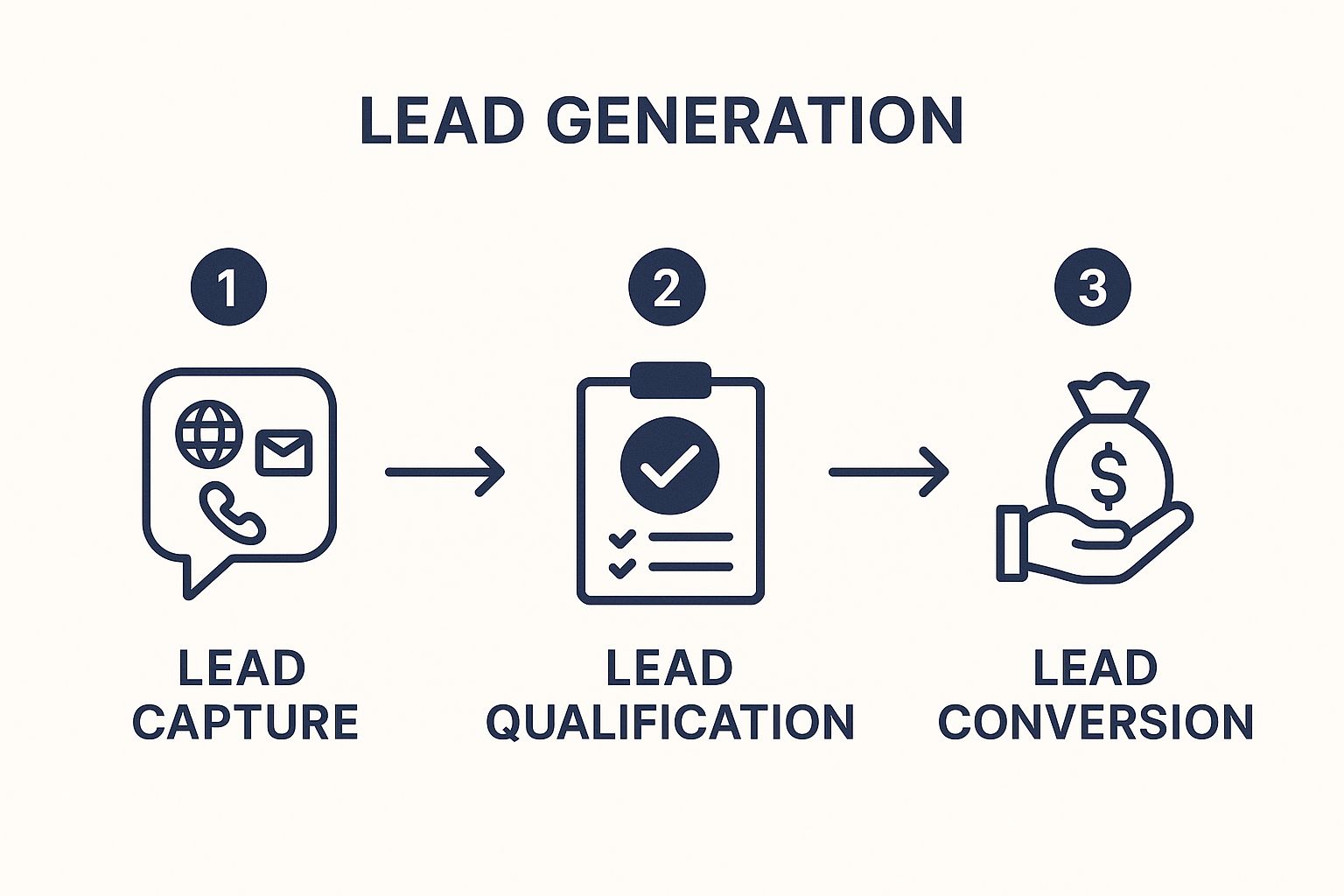
As you can see, solid lead management is all about guiding people through these stages, not just hoarding a list of names.
When you know exactly where a lead is in their journey, you can give them the right information at the perfect time. This doesn't just boost your odds of making a sale—it helps you forecast revenue, fix broken parts of your process, and stop wasting time on people who simply aren't ready.
To get the most out of every lead, it's worth digging into proven sales funnel optimization strategies. This is how you plug the leaks in your funnel and make sure you're turning as many curious browsers into loyal customers as possible.
Attracting and Qualifying Leads Today

Remember the old days of sales? The salesperson held all the cards, guiding a mostly uninformed buyer through a purchase. Well, those days are long gone. The modern buyer is now firmly in the driver's seat, armed with a mountain of information and a pretty clear idea of what they need before ever picking up the phone.
This isn't just a small shift—it's a complete flip of the script. Today's buyers complete nearly 70% of their purchase journey completely on their own. This means that by the time a lead actually reaches out, they’re not just curious; they're educated, opinionated, and way further down the path to making a decision.
Finding Your Future Customers
So, how do you generate leads in a world where you're no longer the gatekeeper of information? It boils down to a two-pronged approach: you either pull them in with value or you reach out directly with a message they can't ignore.
- Inbound Strategies: This is the art of attraction. Think of it as leaving a trail of breadcrumbs for your ideal customer. By creating genuinely helpful content—blog posts, SEO-optimized guides, social media posts—you solve their problems and naturally draw them to your brand. The goal is to become the resource they find when they're looking for answers.
- Outbound Strategies: This is the proactive approach. It involves identifying people who fit your ideal customer profile and reaching out to them directly. This could be through targeted email campaigns, old-school cold calling, or direct messages on professional networks like LinkedIn. Smart outbound is about precision targeting, not just blasting a huge list.
Of course, the most successful businesses often blend both. A great example is using targeted paid search ads to get in front of people actively looking for a solution. Understanding the ins and outs of https://frozencrow.com/ppc-for-lead-generation/ is a huge advantage here.
To help you visualize the difference, let's break down the two main approaches to lead generation.
Inbound vs Outbound Lead Generation Methods
| Method | Inbound Lead Generation | Outbound Lead Generation |
|---|---|---|
| Approach | Attracts customers by creating valuable content and experiences tailored to them. It's about being found. | Proactively reaches out to potential customers with a direct message or offer. It's about finding them. |
| Tactics | Blogging, SEO, social media marketing, content offers (eBooks, webinars), video marketing. | Cold calling, email outreach, direct mail, trade shows, targeted advertising. |
| Pros | Builds trust and credibility over time. Attracts more qualified leads who are already interested. Cost-effective in the long run. | Delivers faster, more predictable results. Allows for precise targeting of specific accounts or individuals. |
| Cons | Can take a significant amount of time to show results. Requires consistent content creation and effort. | Can be perceived as intrusive or "spammy" if not done well. Often has a lower conversion rate and can be more expensive up front. |
Each strategy has its place, and the right mix depends entirely on your industry, audience, and business goals.
Filtering the Noise with Qualification Frameworks
Once you've got a stream of leads coming in, the next big challenge is figuring out who's actually worth your sales team's time. This is where lead qualification saves the day. Instead of having your team chase down every single person who fills out a form, you use a framework to spot the most promising opportunities.
Qualification isn't about adding red tape; it's about building a system to filter out the noise. It lets your sales team focus their energy only on the opportunities with the highest chance of closing.
One of the most battle-tested frameworks out there is BANT. It’s a simple but powerful acronym that helps you quickly gauge a lead’s potential by asking the right questions:
- Budget: Does this person actually have the money to buy your solution?
- Authority: Are you talking to the real decision-maker, or just someone doing research for their boss?
- Need: Is there a clear, painful problem that your product or service is built to solve?
- Timeline: Are they looking to buy in the next few weeks, or are they just casually browsing for something they might need next year?
By weaving questions around these four pillars into your initial conversations, your team can quickly separate the hot prospects from the tire-kickers. To make sure your whole process is dialed in, it’s worth staying up-to-date on the best practices for effective lead generation. This ensures everything from attraction to qualification is running as smoothly as possible.
Turning Good Leads into Great Customers
Getting a lead in the door is just the first step. The real magic happens in what you do next. Effective lead management is all about transforming that initial spark of interest into a real, lasting customer relationship—and in that race, speed is your secret weapon.
Think about this: responding to a new lead within the first five minutes can boost your chances of converting them by a mind-boggling 900%. This isn't just a random stat; it's a core principle known as speed-to-lead. A prospect's interest is at its absolute peak the moment they reach out. Wait even an hour, and you can practically watch that enthusiasm fade.
Building Trust with the Right Tech
Speed gets their attention, but it's consistent, personalized communication that builds the trust you need to actually close a deal. This is where modern sales tools stop being a "nice-to-have" and become a genuine superpower for your team.
- Customer Relationship Management (CRM) Systems: A good CRM is like your team's shared brain. It tracks every single email, call, and interaction, ensuring no detail gets lost in the shuffle. This means every follow-up conversation feels relevant and informed, not like you're starting from scratch.
- Sales Automation Platforms: These tools are workhorses. They handle all the repetitive but necessary tasks like sending follow-up emails or scheduling meetings. This frees up your sales reps to focus on what they do best: talking to people, solving problems, and building relationships.
These technologies aren't just for early adopters anymore. Digital channels are on track to handle 80% of all B2B sales engagements, and the sales automation market is projected to soar to $16 billion. It's a massive shift that shows just how vital technology has become for managing leads effectively. You can learn more about the rise of sales automation and its impact.
The whole point of lead management isn't just to make a sale. It's to create a seamless, valuable experience that makes every single lead feel understood and prioritized from the very first hello.
By building a structured workflow powered by the right tools, you create a safety net so no opportunity ever slips through the cracks. This systematic approach is also something you can scale, whether you keep it in-house or explore other options, like those in this guide to outsource lead generation.
Common Questions About Sales Leads

Even with a solid grasp of the sales funnel, a few practical questions always pop up. Let's dig into some of the most common ones to make sure you know how leads really work out in the wild.
What’s the Difference Between a Lead and a Prospect?
Think of it like this: a lead is anyone who’s raised their hand, showing some initial interest. Maybe they downloaded an ebook or signed up for a newsletter. They're on the radar, but that's about it.
A prospect is a lead who’s been vetted. You've looked at them and confirmed, "Yep, this person fits our ideal customer profile and has a problem we can actually solve."
So, while every prospect starts its life as a lead, not every lead is going to make the cut. Making this distinction is key to keeping your sales team focused on opportunities that can actually close.
How Do You Measure the Quality of a Lead?
This is where a lead scoring system becomes your best friend. It’s a way to stop guessing and start measuring. You automatically assign points to leads based on who they are and what they do.
- Who they are (Demographics/Firmographics): Do they have the right job title? Is their company the right size? +10 points.
- What they do (Behavior): Did they visit your pricing page? +15 points. Did they download a technical case study? +20 points.
Leads with higher scores are waving a big flag that says, "I'm interested!" This tells your sales team exactly who to call first, separating the window shoppers from the serious buyers.
The real goal of lead scoring isn’t just to rank people—it’s to create a predictable, repeatable way for your sales team to know exactly where to spend their energy for the biggest impact.
Why Would a Sales Team Ignore Marketing Leads?
Ah, the classic sales vs. marketing standoff. This almost always comes down to a communication breakdown. Sales gets a lead they feel is ice-cold, and they start to ignore everything marketing sends over. Marketing, meanwhile, thinks they're crushing their goals.
The fix? Both teams need to sit down and agree on a single, crystal-clear definition of a "Sales Qualified Lead" (SQL).
When sales and marketing build the qualification rules together, the handoff becomes seamless. Sales trusts that every lead they get is genuinely ready for a conversation, and the whole process gets a lot more efficient.
Ready to turn your lead generation strategy into a powerful growth engine? The team at Frozen Crow Inc. provides expert digital marketing services to help you attract, qualify, and convert high-quality leads. Let's build your sales pipeline together. Visit us at https://frozencrow.com to learn more.


