


August 20, 2026
Data Warehousing in Marketing: Boost Customer Insights & ROI
Here’s the simple truth: data warehousing in marketing is all about creating a central, organized library for every piece of data you have. Instead of information being scattered across dozens of different tools, a data warehouse pulls it all together.
This creates a single source of truth, letting you perform deep, reliable analysis you just can't get otherwise.
What Is Marketing Data Warehousing, Really?
Imagine your marketing data is a bunch of sticky notes. You’ve got a note from your CRM on your desk, an email campaign report in your inbox, and social media stats on another screen. Trying to piece together a customer's story from these disconnected scraps is frustrating and, frankly, impossible.
This is the reality of data silos—isolated systems that don't talk to each other.
A marketing data warehouse is the fix for this chaos. Think of it as a central digital library built specifically for analysis. It doesn't just store data; it organizes, cleans, and structures information from all your sources, making it ready for your team to find those game-changing insights. This structured environment is a huge leap from a simple database. You can explore our guide to understand the key differences in a marketing database.
For the first time, you can see the complete customer journey and connect dots you never even knew existed.
The Shift from Silos to a Single Source of Truth
Moving from data silos to a central warehouse isn't just a technical upgrade; it fundamentally changes how your team works. It’s a strategic shift from reactive reporting to proactive, data-driven decisions.
And the demand for this kind of clarity is exploding. The global data warehousing market was valued at $33.76 billion in 2024 and is on track to hit nearly $70 billion by 2029. You can find more details on this growth from The Business Research Company.
This transition empowers marketers to stop guessing and start asking much deeper, more strategic questions.
A data warehouse serves as a single source of truth that marketing and sales departments use to align teams, build and optimize their strategies, and inform their decisions. It’s the foundation for turning raw data into actionable intelligence.
To really see the difference, it helps to put the two approaches side-by-side. The table below shows just how different life is when you move from scattered data to a unified system.
Data Silos vs a Marketing Data Warehouse
| Aspect | Traditional Data Silos | Unified Data Warehouse |
|---|---|---|
| Data Accessibility | Fragmented. Requires tons of manual work to combine data from CRM, Google Analytics, ad platforms, etc. | Centralized and always ready. Provides a single point of entry for all your marketing data. |
| Customer View | Incomplete and disjointed. You only see isolated interactions within each platform. | A complete 360-degree view. Lets you track the entire customer journey across all touchpoints over time. |
| Reporting Accuracy | Often inconsistent and prone to errors due to manual data blending and conflicting metrics. | Highly accurate and consistent, since all reports pull from the same standardized data source. |
| Strategic Insight | Limited to basic performance metrics within each channel, making deep analysis nearly impossible. | Enables advanced analytics, including cross-channel attribution, predictive modeling, and customer lifetime value. |
This comparison highlights how a data warehouse doesn't just solve common frustrations—it unlocks entirely new strategic capabilities for your team.
The Strategic Wins for Your Marketing Team

So, what does a data warehouse actually do for your marketing team? Forget the technical jargon for a second. The real magic is how it transforms scattered information into a powerful competitive edge, letting you build a smarter, more profitable marketing strategy.
Without a single source of truth, marketers are often stuck making decisions based on gut feelings and incomplete data. A data warehouse completely changes the game. It gives you the clarity to run campaigns with confidence and precision.
Achieve a True 360-Degree Customer View
The first and biggest win is getting a genuine 360-degree customer view. This isn't just about knowing a customer's name and their last purchase. It’s about connecting every single touchpoint they've ever had with your brand, no matter where it happened.
Imagine this: you can see that a customer first found you through a blog post, later clicked a Facebook ad, browsed three specific products on your site, abandoned their cart, and then finally converted after getting a follow-up email. That complete timeline is pure gold.
This unified profile lets you understand their behavior, preferences, and intent on a much deeper level. It's the foundation for personalization that actually feels helpful, not creepy.
Unlock Hyper-Personalization That Works
Let's be honest, generic marketing messages don't cut it anymore. Customers expect you to recognize their individual needs and where they are in their journey. A data warehouse makes this happen by feeding your marketing tools with rich, clean data.
Instead of basic segments like "all customers in California," you can get incredibly specific:
- Behavioral Segments: Target users who viewed the "running shoes" category three times last month but never bought anything.
- Predictive Segments: Identify customers at a high risk of churning based on their recent login activity and support tickets.
- Lifecycle Segments: Build separate, tailored campaigns for brand-new customers, loyal advocates, and quiet users who might be slipping away.
This level of detail means you’re sending the right message to the right person at exactly the right time.
Finally Crack Cross-Channel Attribution
One of the oldest headaches in marketing is proving which channels are really driving results. We all know last-click attribution is misleading—it gives 100% of the credit to the final touchpoint and ignores everything that came before it.
A data warehouse gives you the power to implement much smarter attribution models. By pulling in data from every single touchpoint, you can finally see the entire customer journey from start to finish.
A marketing data warehouse provides the historical, cross-channel data necessary to move beyond simplistic attribution models. It allows you to see how different channels work together, revealing the true ROI of your content, social, and paid media efforts.
This clarity helps you stop guessing and start investing your budget where it actually counts. If you want to go even deeper, this kind of comprehensive data is essential for advanced methods like marketing mix modeling.
Enable Smarter Reporting and Predictive Analytics
When all your data lives in one clean, organized place, reporting becomes faster, more accurate, and way more insightful. No more spending hours manually mashing spreadsheets together. Your analytics tools can plug right into the warehouse, giving everyone on the team a reliable dashboard they can trust.
But it gets even better. This unified data is the fuel for powerful predictive analytics. By analyzing historical trends across all your channels, you can start to:
- Forecast future sales with much greater accuracy.
- Pinpoint which customer segments are likely to grow.
- Spot emerging market trends before your competitors do.
Ultimately, data warehousing in marketing shifts your team from being reactive to proactive. You can start anticipating what your customers need and make strategic moves that drive real, sustainable growth.
Understanding Your Data Warehouse Architecture

To make data warehousing in marketing actually work, you need a solid grasp of its structure. The best way to think about it is like building an intelligent, automated library for your marketing team. Every component has a specific job, and they all work in concert to turn raw, messy information into strategic wisdom.
Let's pull back the curtain and look at how this powerful system is built, piece by piece. Once you see the architecture, you'll understand why it’s so much more than just a big digital filing cabinet.
The Key Components of a Modern Data Stack
A marketing data warehouse isn’t a single piece of software you buy off the shelf. It's an ecosystem of technologies working together. Each layer plays a critical part in gathering, cleaning, storing, and finally making sense of your data.
-
Data Sources
Think of these as the constant stream of book deliveries arriving at your library. It’s the raw information pouring in from every place your customers interact with you—your CRM (like Salesforce), web analytics (Google Analytics), ad platforms (Google Ads, Facebook Ads), and email tools (Mailchimp). -
ETL or ELT Pipelines
This is your expert librarian. ETL (Extract, Transform, Load) or the slightly different ELT (Extract, Load, Transform) is the process that fetches data from all those sources, cleans it up, standardizes the format, and gets it organized on the shelves. It’s a make-or-break step that ensures your data is reliable and ready for analysis. -
The Data Warehouse
Here it is—the central library itself. This is a massive, highly organized repository built specifically for running fast and complex queries. Unlike a normal database, it’s designed to hold historical data from dozens of different sources, making it the perfect foundation for deep, insightful analysis. -
Business Intelligence (BI) and Analytics Tools
Finally, these are the search engines and research desks for your library. Tools like Tableau, Power BI, or Looker plug right into your data warehouse. They empower your team to build dashboards, run reports, and visualize insights without ever having to write a line of complex code.
This layered setup is exactly what makes the whole system so powerful and adaptable.
The Rise of Cloud Data Warehouses
Not too long ago, building a data warehouse meant a huge upfront investment in physical servers and a dedicated IT crew to babysit them. This put the technology way out of reach for most businesses. But today, cloud-based solutions have completely changed the game.
Modern platforms like Google BigQuery, Amazon Redshift, and Snowflake are now the industry standard, and for good reason. They offer incredible processing power on a pay-as-you-go basis, which means no more buying expensive hardware.
Modern cloud data warehouses separate storage from computing. This means you can scale your processing power up or down in seconds to handle massive queries without overpaying for storage, making advanced analytics more accessible than ever.
This shift to the cloud is what’s fueling the market’s explosive growth. The long-term outlook for data warehousing in marketing highlights just how critical it's become, with the global market projected to jump from nearly $35 billion in 2024 to $126.8 billion by 2037. That growth is all thanks to the scalability and flexibility of cloud models. You can explore the full market analysis on Research Nester to get a deeper look.
A Look at Popular Warehouse Platforms
While you have plenty of options, a few major players really dominate the cloud data warehouse scene. Each has its own unique strengths, but they are all engineered to handle the sheer scale and complexity of modern marketing data.
| Platform | Key Strength | Ideal For |
|---|---|---|
| Google BigQuery | Serverless architecture and machine learning integration | Teams wanting ease of use, real-time analytics, and a seamless connection to the Google Cloud ecosystem. |
| Amazon Redshift | High-speed performance for massive datasets | Organizations already deep in the AWS ecosystem that need to run complex queries on petabytes of data, fast. |
| Snowflake | True separation of storage and compute, multi-cloud flexibility | Businesses looking for ultimate scalability and cost-efficiency, with the ability to run on AWS, Azure, or Google Cloud. |
Picking the right platform really comes down to your existing tech stack, budget, and what you’re trying to achieve with your marketing. But the core architectural principles hold true for all of them. By understanding how these pieces fit together, you can build a system that turns scattered data points into your most valuable marketing asset.
A Phased Roadmap to Build Your Data Warehouse
Building a marketing data warehouse can feel like a huge, tech-heavy project. But it's really a strategic marketing initiative. The goal isn't just to hoard data; it's to build an engine that answers your most important business questions. Approaching it in phases keeps you on track, delivering value quickly without getting lost in the technical weeds.
This roadmap breaks the whole thing down into manageable stages. By putting your marketing goals first and the technology second, you'll end up with a powerful analytics setup that actually boosts your bottom line.
Phase 1: Define Your Business Objectives
Before you write a single line of code or even look at a software demo, you have to define what success looks like. This is easily the most critical phase because it anchors the entire project to real marketing outcomes. Don't start by asking, "What data can we collect?" Instead, ask, "What questions do we need to answer?"
Here are a few questions to get the ball rolling:
- What are our top three marketing goals for the next year? (e.g., improve customer retention by 15%, increase Customer Lifetime Value, prove the ROI of our content).
- Which marketing decisions are we currently making based on gut feelings instead of hard data?
- What's the one report we've always wished we could build, but can't because the data is all over the place?
The answers you come up with here become the blueprint for your entire data warehouse design.
Phase 2: Audit and Select Your Data Sources
With clear goals in hand, it's time to figure out what raw materials you need. This means auditing every platform that holds a piece of your customer journey puzzle. Make a complete list of your marketing tools and pinpoint the specific data points you'll need from each one to answer the questions from Phase 1.
Your audit will likely include sources like:
- CRM System: Customer info, deal stages, and sales interactions.
- Web Analytics: Website traffic, user behavior, and conversion funnels.
- Ad Platforms: Campaign performance, ad spend, impressions, and clicks.
- Email Marketing Tools: Open rates, click-through rates, and list engagement.
This step gives you a realistic scope for the project and helps you prioritize which data sources to plug in first to get the biggest bang for your buck.
Phase 3: Choose the Right Technology Stack
Okay, now it’s time to talk tech. With your goals and sources mapped out, selecting the right technology becomes much simpler. This is where a lot of teams get overwhelmed, but your prep work makes all the difference. Your choice of a data warehouse, an ETL tool, and a BI platform should directly support the use cases you've already identified.
Your technology stack should be chosen to solve your specific marketing problems, not the other way around. Focus on platforms that integrate easily with your existing sources, offer scalable pricing, and are user-friendly enough for your team to adopt.
Think about your team's technical skills, your budget, and how a new platform will fit into your company's existing cloud environment.
When it comes to picking a data warehouse platform, there's a lot to consider beyond just the brand name. It’s about finding the right fit for your marketing team’s needs, budget, and technical comfort level.
Key Considerations When Choosing a Data Warehouse Platform
| Consideration | Why It Matters for Marketing | Example Platforms |
|---|---|---|
| Scalability & Performance | Your data will grow. The platform must handle more data and complex queries without slowing down, especially during big campaigns. | Snowflake, Google BigQuery |
| Integration Ecosystem | It needs to connect seamlessly with your martech stack (CRM, ad platforms, analytics tools). Poor integrations mean manual work and data gaps. | Amazon Redshift, Snowflake |
| Ease of Use for Marketers | A platform with a steep learning curve will create a bottleneck. Look for SQL-friendly interfaces and good documentation. | Google BigQuery, Databricks |
| Pricing Model | Understand if you're paying for storage, compute time, or both. A predictable model prevents surprise bills after a month of heavy analysis. | All major platforms offer different models. Compare pay-as-you-go vs. reserved instances. |
| Security & Compliance | You're handling customer data. The platform must meet industry standards like GDPR and CCPA to protect you and your customers. | All major cloud providers have robust security features. |
Ultimately, the best platform is the one that empowers your team to get answers from their data without needing a data scientist for every little question.
Phase 4: Design and Implement Your Data Model
This is the architectural phase. You’re literally designing how the data will be organized inside your warehouse. A good data model means that when a marketer asks, "What was the ROI of our last holiday campaign across all channels?" the system can return a fast, accurate answer.
This involves structuring your data into tables that make sense for marketing analysis. You'll define how different data sets relate to each other (like connecting a user's web session to their CRM profile) and establish standardized naming conventions so everyone is speaking the same language. A well-designed model is the secret to reliable reporting.
The flow is simple in concept: data is pulled from your marketing channels, cleaned up and structured, and then loaded into the warehouse where your analytics tools can finally get to it.
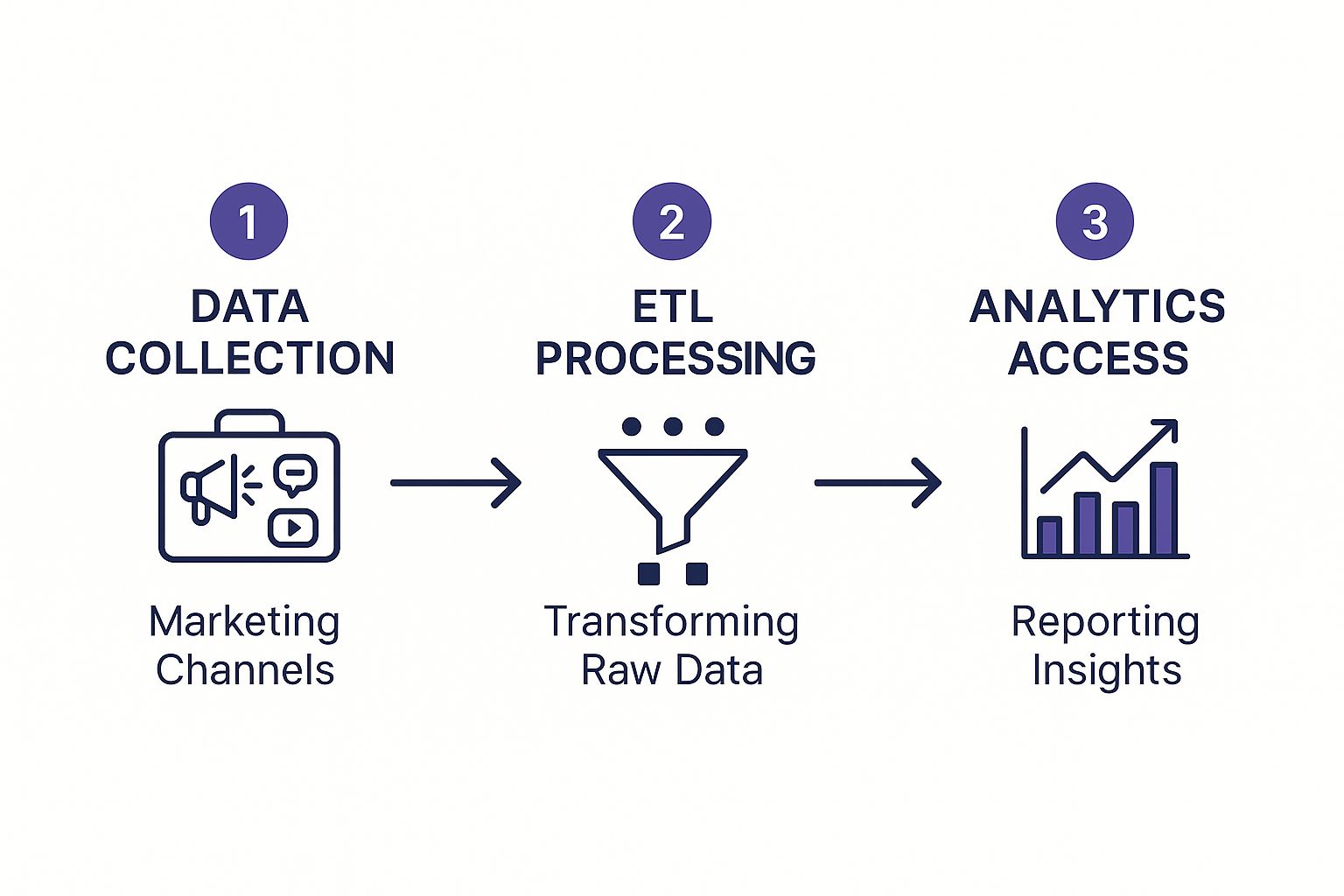
This visual really highlights the transformation step—that's where raw, messy data becomes a trusted asset you can actually make decisions with.
Phase 5: Connect Analytics Tools and Activate Insights
Finally, this is where your strategy comes to life. With the data warehouse built and populated, you can connect your Business Intelligence (BI) tools like Tableau or Power BI. This is the moment you hand the keys to the kingdom over to your marketing team.
Start by building the exact dashboards and reports you identified back in Phase 1. Getting those quick wins demonstrates the project's ROI and builds momentum. From there, train your team so they can confidently explore the data, test their own hypotheses, and uncover insights on their own. This is how you turn a marketing department into a data-driven powerhouse.
Putting Your Data Warehouse to Work

Once the architecture is solid, the fun part begins. A marketing data warehouse isn't just a digital attic for old campaign data; it's an engine built to answer your most valuable questions and drive real business growth. This is where the theory gets real, and all that data finally becomes your sharpest marketing tool.
The best marketing teams use their data warehouses to get way beyond surface-level metrics. They’re building sophisticated strategies that actually move the needle on revenue, customer loyalty, and market share. Let’s break down the high-impact use cases that separate the good marketers from the great ones.
Supercharge Your Customer Segmentation
Forget basic demographic segmentation. That’s yesterday’s news. A data warehouse lets you build incredibly specific customer segments based on what people actually do, not just who they are. By pulling together data from your website, CRM, and sales history, you unlock a whole new level of precision.
Imagine creating segments like these:
- High-Intent Browsers: Users who’ve checked out a specific product page more than three times this week but still haven’t bought.
- Loyal Advocates: Customers with more than five purchases under their belt who have also left at least one positive review.
- Potential Churn Risks: Subscribers who haven't opened an email or logged in for the last 90 days.
This kind of detail allows for messaging that’s ridiculously relevant. You can fire off a special discount to that high-intent group or launch a re-engagement campaign aimed squarely at the churn risks. This targeted approach only works when you have all the data points you need—clean and ready to go—in one place.
A data warehouse turns segmentation from a broad demographic exercise into a precise behavioral science. You can finally speak to small, highly specific audience groups with messages that resonate because they are based on their actual actions.
Finally Solve Multi-Touch Attribution
For years, marketers have pulled their hair out trying to prove which channels really lead to conversions. The old "last-click" model is simple but deeply flawed, giving 100% of the credit to the final touchpoint while totally ignoring everything that came before. Data warehousing in marketing finally provides the historical, cross-channel data needed to fix this mess.
By stitching together every single touchpoint—from the first blog post they read to the last retargeting ad they clicked—you get a complete picture of the customer journey. This lets you use smarter attribution models like linear, time-decay, or even custom data-driven models that give credit where credit is due.
This clarity is a game-changer for your budget. You can confidently pull money from channels that only look good on paper and double down on the ones that are proven to bring in and nurture valuable customers from start to finish.
Predict Customer Lifetime Value with Accuracy
Customer Lifetime Value (CLV) is a golden metric for sustainable growth, but it’s often just a rough guess based on incomplete data. A data warehouse provides the deep, historical dataset you need to predict CLV with far more confidence.
By analyzing patterns across thousands of customers, you can spot the key behaviors and traits of your most valuable accounts. For instance, you might discover that customers who use your mobile app within the first 30 days have a 2x higher CLV.
Armed with that knowledge, your marketing gets a lot smarter:
- Acquisition: You can target your ad spend to find more people who look just like your existing high-CLV customers.
- Onboarding: You can design onboarding flows that nudge new users toward the specific actions you know lead to long-term value.
- Retention: You can identify high-CLV customers who are at risk of leaving and proactively reach out with special offers or support.
This predictive power helps you put your marketing dollars where they’ll generate the highest long-term return. Many of these campaigns can even be automated. You can learn more about setting up these kinds of systems in our guide to marketing automation for small business.
Create a Unified View of Campaign Performance
How many times have you had to cobble together reports from five different platforms just to figure out how a single campaign performed? It’s a universal headache for marketers, and a data warehouse is the cure. It pulls data from your ad platforms, email tool, social media, and CRM into one clean, cohesive view.
This allows you to build a single master dashboard you can actually trust. You can easily compare the ROI of a Google Ads campaign against an email promotion, see how different channels are influencing each other, and report on performance without crossing your fingers. This unified view doesn't just save you hours of manual grunt work—it gives you the strategic clarity to make smarter, faster decisions.
Common Questions About Marketing Data Warehouses
Stepping into the world of marketing data warehouses always kicks up a few big questions. It's a major strategic move, so it’s only natural to want the full picture before you dive in. Getting clear answers helps cut through the noise and gives you the confidence to move forward.
Here are the most common questions we hear from marketers, with straightforward answers to help you make the right call for your team.
Data Warehouse vs. CDP: What's the Difference?
This is easily the most common point of confusion, and for good reason. Both handle customer data, but they're built for completely different jobs. The distinction is critical.
Think of it like this: a Customer Data Platform (CDP) is your marketing team’s highly-caffeinated personal assistant. Its whole purpose is to create unified, real-time customer profiles and immediately push them to your email platform, ad tools, or website for in-the-moment activation. A CDP is all about action.
A data warehouse, on the other hand, is the company's entire historical library. It’s designed to store massive amounts of data from every department—marketing, sales, product, finance—for deep, long-term analysis. A data warehouse is built for strategic insight.
A CDP is purpose-built for real-time marketing activation, focused on a unified customer profile for immediate use. A data warehouse is a broader, historical vault for deep, cross-functional business analysis. In a modern setup, they actually work together.
A CDP answers, "Who is this customer right now, and what message should I send them?" A data warehouse answers, "What trends can we see across all our customers over the past five years, and how should that change our entire business strategy?"
How Much Does a Marketing Data Warehouse Cost?
There's no single price tag here—costs can swing wildly. A small business might spend a few thousand dollars a month, while a large enterprise could easily invest six figures. It all boils down to a few key factors:
- Data Volume: How much data are you storing? Most cloud providers charge for storage, usually per gigabyte or terabyte.
- Query Complexity: How much processing power do you need? Running complex analytical queries is what really drives up the bill, as it consumes computing resources.
- Platform Choice: Modern cloud platforms like Snowflake, Google BigQuery, and Amazon Redshift run on pay-as-you-go models, which is a game-changer.
The good news is that the days of sinking huge upfront investments into hardware are long gone. The cloud has made this technology far more accessible. The smartest way to start is to start small. Focus on your most critical data sources and one or two high-impact problems you want to solve first. This lets you prove the ROI and get buy-in before you scale up your investment.
Do I Need a Data Engineer to Manage It?
For any serious, scalable system? Yes, you'll need access to data engineering skills. Modern tools have become more user-friendly, but the core work of building and maintaining a reliable data warehouse is still a highly specialized job.
A data engineer is the one doing the critical work behind the scenes that makes all your analytics possible. This includes:
- Building Reliable Data Pipelines: Creating the processes that pull data from all your different sources.
- Ensuring Data Quality: Cleaning, standardizing, and validating data so you can actually trust your numbers.
- Optimizing Performance: Fine-tuning the warehouse to make sure your queries run fast and don’t cost a fortune.
Trying to DIY this without any technical expertise usually ends in unreliable data, broken reports, and a lot of wasted time and money. Marketing teams typically solve this by hiring a dedicated marketing analyst with these skills, working with a central data team, or bringing in outside help for the initial setup and ongoing support.
At Frozen Crow Inc., we help businesses harness the power of their data to drive measurable growth. Our data and analytics solutions provide the clarity you need to move from guesswork to confident, data-driven marketing. Book your free marketing audit today!


