


August 20, 2026
What Is Marketing Mix Modeling? Your Ultimate Guide
Ever wondered how much your TV ads actually contribute to sales compared to your social media campaigns? Or if that big price drop last quarter did more for revenue than your entire email marketing budget? It's a notoriously tricky puzzle to solve.
This is where Marketing Mix Modeling (MMM) comes in. Think of it as a high-level statistical analysis that helps you figure out which ingredients in your marketing "recipe" are creating the flavor—or in this case, the revenue—that you want.
Understanding Marketing Mix Modeling

Imagine you're a chef trying to perfect a signature dish. You've got dozens of ingredients: spices, vegetables, proteins. A little too much salt can ruin the whole thing, while a tiny pinch of a secret spice might be what makes it a bestseller.
Marketing Mix Modeling does the same thing for your marketing strategy. It's a powerful way to untangle the complex web of all your efforts—from TV and radio to digital ads and pricing—to see what's truly driving results.
Instead of looking at individual clicks or conversions, MMM takes a "top-down" view by analyzing aggregated data over a long period. This unique perspective allows it to measure the impact of both online and offline channels, something most other analytics methods just can't do.
How MMM Works at a High Level
At its core, the process is about gathering historical data on sales, marketing spend, and even external factors like economic trends or competitor actions. The model then crunches these numbers to find correlations and figure out the contribution of each element.
This approach helps answer the big, strategic questions that keep marketers up at night:
- How much did our last TV campaign really add to the bottom line?
- What's the true ROI of our paid search spend versus our social media efforts?
- If we get a 15% budget increase, where should we put that money for the best results?
It’s this kind of strategic insight that makes effective budget planning possible. It moves you beyond simple click-tracking to give you a complete picture of what's working. While knowing the nuts and bolts of digital channels is crucial—as our guide on what is search engine optimization explains—MMM provides the overarching framework to measure its impact alongside everything else you're doing.
MMM doesn’t just look at individual channels in isolation; it reveals how they work together. It helps marketers understand the entire "recipe" of their strategy, not just a single ingredient, enabling smarter, data-driven decisions that foster sustainable growth.
The Core Ingredients of a Marketing Mix Model
Every good model starts with good data. Simple as that. For Marketing Mix Modeling, your data inputs are the raw ingredients that determine whether you get meaningful insights or just a bunch of noise. Think of it as building a case—you need solid evidence to tell the complete story of your marketing's real impact.
To build a model that actually works, you need to pull together data from three different areas. Each piece of the puzzle gives you a different angle, and when you combine them, you get a clear, panoramic view of what's really driving your business.
Your Marketing and Sales Data
This is the most obvious stuff—the actions you took and the results you got. This data forms the central question your model is trying to answer: how did our spending and effort actually translate into sales?
You’ll want to gather a solid history, usually at least 2-3 years' worth of data, to give the model enough information to spot real trends instead of just random blips.
- Marketing Inputs: This is all your activity and spending data. You need detailed spend for every channel—paid search, social media ads, TV spots, direct mail, you name it. Don't forget to include non-paid efforts too, like email sends or organic social posts.
- Sales Outputs: This is your north star metric, the outcome you're trying to move. It could be total revenue, the number of units sold, new subscriptions, or even foot traffic to your stores. Whatever success looks like for you, that's what you track here.
External Factors Beyond Your Control
Here’s where things get interesting. No business exists in a bubble. Your results are constantly being pushed and pulled by outside forces you can't manage. If you ignore them, your model will get confused and might give your marketing credit (or blame) for something it didn't do.
Imagine you see a huge sales spike. You might think your new campaign was a home run. But what if it happened the same week your biggest competitor had a massive product recall? The model needs that context to tell you what really happened.
Factoring in external data keeps your insights grounded in reality, not just wishful thinking.
Key external factors to include are:
- Seasonality: The predictable rhythms of your business, like the holiday rush or the slow summer months.
- Economic Conditions: Big-picture trends like inflation, unemployment, or consumer confidence that impact how much people are willing to spend.
- Competitor Actions: Big campaigns, price drops, or new product launches from your rivals that can directly chip away at your market share.
Before you start building your model, it's crucial to gather the right data. Here's a breakdown of the key inputs you'll need.
Key Data Inputs for Marketing Mix Modeling
| Data Category | Examples | Role in the Model |
|---|---|---|
| Sales & Revenue | Daily/Weekly Sales, Revenue, Units Sold, New Subscribers | The primary outcome (dependent variable) the model explains. |
| Marketing Spend | Paid Search Spend, Social Media Ad Spend, TV Buys, Radio Ads | Measures the direct investment in different channels. |
| Marketing Activity | Email Campaigns Sent, Organic Posts, PR Mentions | Captures the impact of non-paid marketing efforts. |
| Promotions & Pricing | Discounts Offered, Sales Events, Price Changes | Isolates the effect of pricing strategies on demand. |
| External Factors | Holiday Periods, Inflation Rate, Competitor Spend | Accounts for outside influences you don't control. |
| Operational Data | Store Foot Traffic, Website Visits, App Downloads | Provides context on customer behavior and channel interaction. |
Having these categories covered ensures your model is robust and can attribute performance accurately across all the different forces at play.
Building Your Data Foundation
Pulling all this information together is the first real step in any MMM project. It's not just a marketing task—it requires getting marketing, finance, and sales in the same room to create a single, unified dataset. This process is valuable on its own, as it forces the whole organization to align around one version of the truth.
For younger companies, organizing this data can feel like a huge hurdle, but it's the bedrock of any scalable growth plan. Setting up a solid data collection process is a non-negotiable part of any serious marketing strategy for startups. A clean, well-organized data foundation is what transforms a complex statistical model from an academic exercise into a powerful, money-making tool. Get the ingredients right, and you'll be ready to uncover some game-changing insights.
The Evolution of Marketing Mix Modeling

To really get why Marketing Mix Modeling is so powerful today, you have to look at where it came from. This isn’t some shiny new trend that popped up with the internet. It’s a battle-tested method with a history stretching back decades, which is why it’s still such a credible and resilient strategic tool.
The story of MMM starts way before computers were on every desk. Its origins go back to the early 1950s, when marketers first started wrestling with a big question: how can we actually measure the dollar-for-dollar impact of our ads? This thinking was built on Neil Borden's "marketing mix" concept—the original 4Ps of product, price, place, and promotion.
Fast forward to the 1980s. With more computing power available, big consumer brands like Coca-Cola jumped on board, using early MMM to figure out how to best spend their huge marketing budgets across traditional media. You can get a great sense of the foundational history of MMM and its early adopters and see how those first models were pieced together.
Adapting to the Digital Transformation
Then, the internet happened. Suddenly, the marketing mix exploded with a ton of new, highly trackable channels: paid search, social media, email, you name it. Early on, the digital world got obsessed with last-click attribution, which gave all the glory to the very last thing a customer did before buying.
But that was a pretty narrow way of looking at things. It completely missed how a TV ad might have led someone to search on Google, or how a social media campaign built the brand trust that resulted in a sale weeks down the line. This is where MMM’s big-picture view became more critical than ever.
Marketing Mix Modeling evolved to bridge the gap between the offline and online worlds. It provided a unified framework to measure the contributions of all channels, from a billboard to a banner ad, ensuring that both traditional and digital efforts received proper credit for their role in the customer journey.
Modern MMM in a Privacy-First Era
And the evolution isn't over. With third-party cookies crumbling and privacy laws getting stricter, MMM is having another major comeback. Because it works with aggregated, privacy-friendly data, it gives marketers a sustainable way to measure what’s working without tracking individual users.
Today’s MMM is far more sophisticated, pulling in advanced stats and machine learning to give us insights that are faster and more detailed than ever before. But the core principles are the same as they’ve always been.
- Holistic Measurement: It’s still the only real way to see the combined impact of everything you’re doing in marketing.
- Strategic Focus: It helps answer the million-dollar questions about where to put your budget and how to plan for long-term growth.
- Future-Proof Analytics: Its privacy-first approach makes it an essential tool for any modern marketer.
From its start as a concept in the 1950s to its current role as a sophisticated, data-driven engine, MMM has consistently proven its ability to adapt. Its long history is the best testament to its core value: helping businesses understand what really drives growth.
How Marketing Mix Modeling Actually Works
To really get what marketing mix modeling is all about, you have to look under the hood. The best way to think about it isn't as some scary, complex math problem, but more like a detective investigating a case. The mystery? What's actually driving your sales. The model follows a logical process, gathering clues and connecting the dots to finally reveal the truth.
This whole investigation kicks off by collecting all the "evidence"—your data. Just like a detective gathers witness statements and forensic reports, the model needs historical data on your sales, marketing spend across every channel, and even external factors like economic trends or competitor actions. This first step is absolutely crucial; it builds the complete picture of the world your marketing operates in.
This chart shows how all those different data streams—sales, media spend, and outside influences—are gathered and prepped before the real modeling begins.
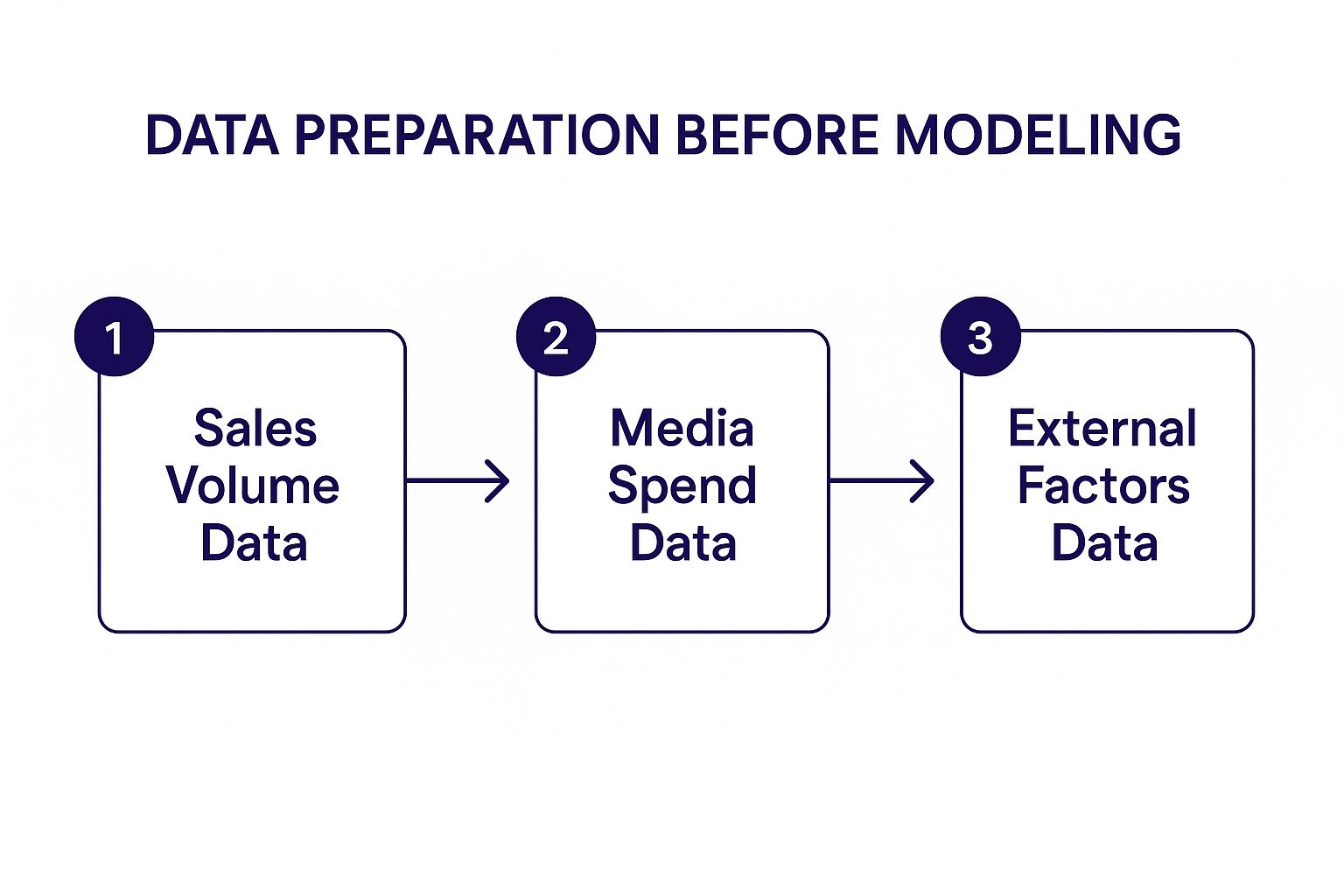
It’s a great visual reminder that no single data source tells the whole story. The model's real power comes from blending your internal business metrics with the realities of the market. Once all the clues are gathered and cleaned up, the core investigation can start.
Building the Statistical Model
With the evidence in hand, our detective now uses a proven method—statistical analysis, usually some form of regression—to link each piece of evidence to the final outcome. The model carefully examines the historical relationship between a specific marketing activity (like a big TV ad campaign) and your sales numbers, while simultaneously accounting for all the other factors in play.
This isn't just about finding a simple correlation. The process is designed to understand the subtle, real-world effects of marketing that basic analytics often miss. It factors in key concepts that reflect how advertising actually works in the wild.
The magic of an MMM is its ability to put a number on complex marketing dynamics. It goes way beyond "we spent X and got Y" to explain how and why certain channels drive growth, factoring in the lingering effects of ads and the point where you’re just throwing money away.
Two of the most important concepts the model figures out for you are adstock and diminishing returns. Grasping these is vital for getting a realistic view of how your marketing is performing.
Understanding Key Modeling Concepts
Adstock is just a technical term for a simple idea: an ad's impact sticks around for a while. When someone sees one of your commercials, its effect doesn't just disappear the next day. This "memory" or carryover effect is something the model calculates, showing you the sustained value of your campaigns long after they’ve officially ended.
Diminishing returns is another critical marketing reality. That first $10,000 you spend on a new channel might bring in a massive return. But the next $10,000 will probably yield a bit less, and the $100,000 after that even less. The model finds this saturation point for each channel, telling you precisely when spending more money stops being effective.
- It identifies your top performers: The model clearly shows which channels are giving you the highest ROI.
- It reveals the underperformers: It also shines a light on where your budget is being spent inefficiently.
- It optimizes your future spend: It gives you a data-driven roadmap for moving your budget around to get the biggest bang for your buck.
By weighing all these factors, the model delivers its final report. And it's not just a messy pile of data; it's a clear set of actionable insights. It tells you which channels are your heroes, which ones are draining your resources, and exactly how you can adjust your strategy to drive better, more predictable growth for the business.
Unlocking Real Business Growth with MMM
https://www.youtube.com/embed/LIQbP8Gv6cQ
Alright, let's move past the theory. What does Marketing Mix Modeling actually do for your business? In short, it turns a mountain of complex data into real, tangible growth. This isn't just about analytics for analytics' sake; it's about making smarter, data-backed decisions that directly improve your bottom line and finally prove marketing's value.
The most immediate win is strategic budget allocation. Think of MMM as a financial advisor for your marketing spend. It clearly shows you which channels are your heavy hitters and which ones are just dragging the team down. This insight gives you the confidence to shift funds away from underperforming activities and double down on what truly works, squeezing every last drop of value out of your return on investment (ROI).
It also gives you the power to create sales forecasts you can actually rely on. When you understand exactly how each marketing lever pulls on revenue, you can predict future outcomes with far greater accuracy. Marketing stops being a cost center and starts becoming a predictable engine for growth.
Gaining a Holistic Performance View
One of the most powerful things about MMM is its ability to give you the complete, 30,000-foot view of your entire marketing ecosystem. While the granular tools are useful for day-to-day tweaks, they often miss the forest for the trees. MMM is what lets you step back and see how all the pieces—from TV ads to social media posts—truly work together.
This isn't just a hunch. Industry surveys show that a whopping 60-70% of large companies are already using MMM for their planning. The results? They're reporting spend efficiency gains between 10% and 30%. Modern models get there by analyzing the complex interplay between channels, accounting for things like cross-channel synergies and diminishing returns.
This big-picture perspective is the perfect complement to more focused analytics. While MMM gives you a strategic overview of what's effective, it works hand-in-hand with more specific analyses, like measuring social media marketing ROI, to make sure every single marketing dollar is pulling its weight. For smaller teams, you can even streamline how these insights are applied through smart marketing automation for small business.
Marketing Mix Modeling doesn't just tell you what happened. It tells you why it happened and what's likely to happen next. It provides the strategic clarity needed to justify budgets, optimize spend, and drive sustainable business growth.
Ultimately, MMM becomes the tool that connects your team's daily activities directly to business results. It provides the hard evidence you need to prove marketing’s contribution in the boardroom, turning messy data into a clear story of success.
Marketing Mix Modeling in the Real World

The theory is one thing, but seeing what marketing mix modeling can actually do in the trenches is where it gets interesting. Let's walk through a few real-world scenarios where MMM answers the tough, high-stakes questions that keep marketers up at night.
Picture a direct-to-consumer e-commerce brand trying to figure out its next budget. The team is stuck in a classic debate: dump more money into paid search for quick wins, or play the long game with influencer marketing to build the brand?
This is where an MMM analysis cuts right through the noise. Instead of relying on gut feelings, the model lays out the hard numbers. It would likely show that paid search delivers a fantastic, immediate return but starts to plateau pretty quickly. On the other hand, it would pin a real number on the slow-burn effect of influencer campaigns, showing exactly how they lift baseline sales over months by making the brand more familiar and trusted.
From Insights to Actionable Strategy
Armed with that kind of clarity, the brand can finally move past the "performance vs. brand" argument and make a genuinely strategic call. The leadership team might decide to:
- Allocate 70% of the new budget to paid search to make sure they smash their quarterly sales targets.
- Invest the remaining 30% in influencer marketing, planting seeds for future, sustainable growth.
- Keep the model running to monitor both channels, ready to adjust the mix if the market shifts.
This isn't a compromise; it's a balanced strategy. They’re getting the immediate results they need without mortgaging the company's future.
By quantifying the distinct roles of different marketing channels, MMM provides a clear roadmap for budget allocation. It transforms a contentious debate into a data-driven strategy that aligns the entire team around a common goal.
Optimizing for Seasonal Peaks
Seasonal planning is another area where MMM is an absolute powerhouse. Think about a big retailer gearing up for the make-or-break holiday shopping season. They need to know the perfect cocktail of TV ads, social media promos, and in-store discounts to squeeze every last drop of revenue out of that critical period.
Their MMM, built on years of past holiday data, can run simulations of different spending plans. The model might reveal that big-splash TV ads are crucial for building awareness in early November, but it’s the targeted social media ads that give shoppers that final nudge in the last two weeks.
This allows the retailer to time their campaigns perfectly, hitting customers with the right message at the right time. No more wasted ad spend, just maximum impact.
A Few Common Questions About Marketing Mix Modeling
As you get your head around what Marketing Mix Modeling can do, a few questions always pop up. Answering them helps put MMM in its proper place and sets the right expectations for how to use it.
How Is MMM Different from Attribution Modeling?
Think of it this way: MMM is like looking at the whole forest, while attribution is like examining a single tree.
MMM takes a "top-down" view. It uses big-picture, aggregated data—like total weekly ad spend and sales revenue—to see how every channel contributes, including offline stuff like TV or radio. This makes it the perfect tool for high-level, strategic decisions, like how to set your annual budget.
Attribution modeling, on the other hand, works from the "bottom-up." It drills down into user-level data, like individual clicks and page views, to give credit to specific digital touchpoints. It’s a tactical tool for optimizing your digital campaigns on the fly. They answer very different questions but are incredibly powerful when you use them together.
The real difference is this: MMM tells you how much to invest in each channel for the best overall return. Attribution tells you how to spend that money once it’s in a specific digital channel.
Is MMM Still Relevant Today?
Absolutely. In fact, it's probably more important now than ever before.
While digital platforms give us tons of granular data, MMM is still the only proven way to measure the impact of offline channels and see how they work together with your online efforts.
But the biggest advantage today is its privacy-friendly approach. MMM works with aggregated, anonymous data, so its accuracy isn't touched by the death of third-party cookies or new privacy regulations. That makes it a reliable and future-proof way to measure marketing effectiveness for the long haul.
How Often Should We Update Our Model?
For most businesses, refreshing the model with new data quarterly or semi-annually is a good rhythm. This keeps it current and ensures it reflects any recent shifts in your strategy or the market itself.
A complete model rebuild, however, is a bigger lift and is usually only needed every 1-2 years. You'd also want to do a full rebuild after a major business event—like launching a new product or entering a new country—to make sure the model's core assumptions are still solid.
At Frozen Crow Inc., we transform complex data into clear, actionable strategies that drive real growth. Our team specializes in building data-driven marketing plans that optimize your spend and maximize ROI. Discover how our expertise can provide the clarity you need to make smarter marketing decisions by exploring our services.


