


November 17, 2026
IT Services for Startups Guide
IT services for a startup are so much more than just a help desk. Think of them as the strategic framework that supports your growth, keeps you secure, and lets you scale. This foundation frees you up to focus on what really matters—your product and finding market fit—while knowing your operations are built to last.
For too many founders, this is the line between meteoric growth and an early flameout.
Why IT Is Your Most Critical Co-Founder
Picture yourself building a skyscraper. Would you obsess over the penthouse design but completely ignore the foundation? Of course not. Yet, that’s exactly what countless founders do with their technology. They treat IT as a cost, a problem for another day, never realizing they're building their entire business on shaky ground.
The right IT services for startups act as that invisible foundation. It's the silent co-founder working 24/7 to make sure your business can handle the pressure and reach the next level.
Without a solid tech plan, your day-to-day becomes a mess of preventable fires. Email goes down. Critical data gets lost. Security holes leave you wide open for disaster. A weak foundation doesn't just cause a few cracks; it fundamentally limits how big you can grow.
From Cost Center to Competitive Edge
When you start seeing IT as a strategic partner, the entire game changes. It stops being about fixing broken laptops and starts being about making sure your core business can run smoothly and securely. This shift in mindset unlocks real advantages that both investors and customers will notice.
- Scale Faster: A scalable IT infrastructure means you can bring on new users, employees, and features without everything grinding to a halt.
- Lock Down Security: Proactive cybersecurity protects your big ideas and your customer's data, which is fundamental for building trust and avoiding a catastrophic breach.
- Boost Investor Confidence: A clear IT strategy shows you're mature and managing risk properly, making your startup a much more attractive bet.
This isn’t just a theory; it’s backed by major investment trends. Venture capital is pouring into startups where IT is a core enabler, especially in high-growth areas. The AI industry alone is expected to hit a market value of $243.7 billion in 2025, while digital health startups pulled in $10.1 billion in funding in early 2024. This flood of capital shows just how essential robust IT is for the most promising companies today. You can dive deeper into startup ecosystem statistics to see how technology underpins all that growth.
A well-architected IT environment does more than just stop problems—it creates opportunities. It gives you the data, reliability, and security you need to make smarter decisions and outrun the competition.
Ultimately, getting your IT services right from day one is one of the most powerful moves a founder can make. It builds a resilient, efficient, and secure company that’s actually ready for the road ahead. This isn't just about tech; it's about building a business that lasts.
Building Your Startup's Tech Foundation
Every startup needs a digital headquarters. It's the operational backbone supporting every employee, every customer chat, and every single line of code. Getting this foundation wrong creates friction, slows you down, and bleeds cash. But getting it right? That gives you a powerful platform for growth.
Think of it this way: you could buy and maintain your own office building from day one, complete with a server room, security guards, and a maintenance crew. Or, you could lease a premium, fully-serviced office space that gives you everything you need for one predictable monthly fee.
For a startup, the second option is almost always the smarter move. That’s exactly what cloud services deliver.
Platforms like Amazon Web Services (AWS), Google Cloud, and Microsoft Azure provide enterprise-grade computing power without the crippling upfront cost. You get access to world-class infrastructure and only pay for what you actually use. This pay-as-you-go model is a complete game-changer, letting you stay nimble and pour precious capital into product development and marketing instead of pricey hardware.
Unpacking Cloud Services and Infrastructure
Cloud computing is so much more than just storing files online. It's about renting the exact digital tools you need, right when you need them.
This flexibility is a massive advantage for startups. You can scale your operations up for a big product launch and then scale right back down afterward, ensuring you never pay for resources that are just sitting idle. For a deeper dive, exploring the top benefits of cloud computing for startups can highlight how this model directly fuels efficiency and growth.
Essentially, this approach shifts your IT from a massive capital expenditure (CapEx) to a much more manageable operational expenditure (OpEx).
The market is already there. The global IT services industry is on track to hit revenues of around $1.50 trillion in 2025, driven by fierce demand for cloud solutions from growing businesses just like yours. The trend makes one thing clear: the cloud is now the standard for modern business.
To help you navigate this, it’s useful to understand the three main service models. Each one offers a different level of control and is suited for different needs.
Comparing Cloud Service Models for Startups
This table breaks down the key differences between Infrastructure as a Service (IaaS), Platform as a Service (PaaS), and Software as a Service (SaaS). Understanding these will help you pick the right tools for the job without overpaying or taking on unnecessary technical burdens.
| Cloud Model | What You Manage | Best For Startups Who… | Example Providers |
|---|---|---|---|
| IaaS (Infrastructure as a Service) | Servers, storage, networking, operating systems | Need maximum control over their virtual infrastructure and have strong in-house technical skills. | AWS EC2, Google Compute Engine, Microsoft Azure |
| PaaS (Platform as a Service) | Applications and data | Want to focus on building and deploying applications without managing the underlying hardware or OS. | Heroku, Google App Engine, AWS Elastic Beanstalk |
| SaaS (Software as a Service) | Nothing—just use the software | Need ready-to-use software for specific business functions like CRM, email, or project management. | Salesforce, Google Workspace, Slack |
Choosing the right mix of IaaS, PaaS, and SaaS allows you to build a custom tech stack that's powerful, scalable, and cost-effective from day one.
Networking and Seamless Connectivity
Once your cloud foundation is in place, you need to connect your team to it reliably. In the age of remote and hybrid work, your network is the digital highway system that keeps the business moving.
This isn’t just about having Wi-Fi. It’s about creating a secure, fast, and stable connection for every team member, no matter where they’re logging in from.
Good connectivity means your developers can access code repositories without lag, your sales team can run smooth video demos, and your entire staff can collaborate in real time. A well-designed network, often handled as part of broader IT services for startups, prevents the frustrating bottlenecks that absolutely kill productivity and morale.
The results speak for themselves.
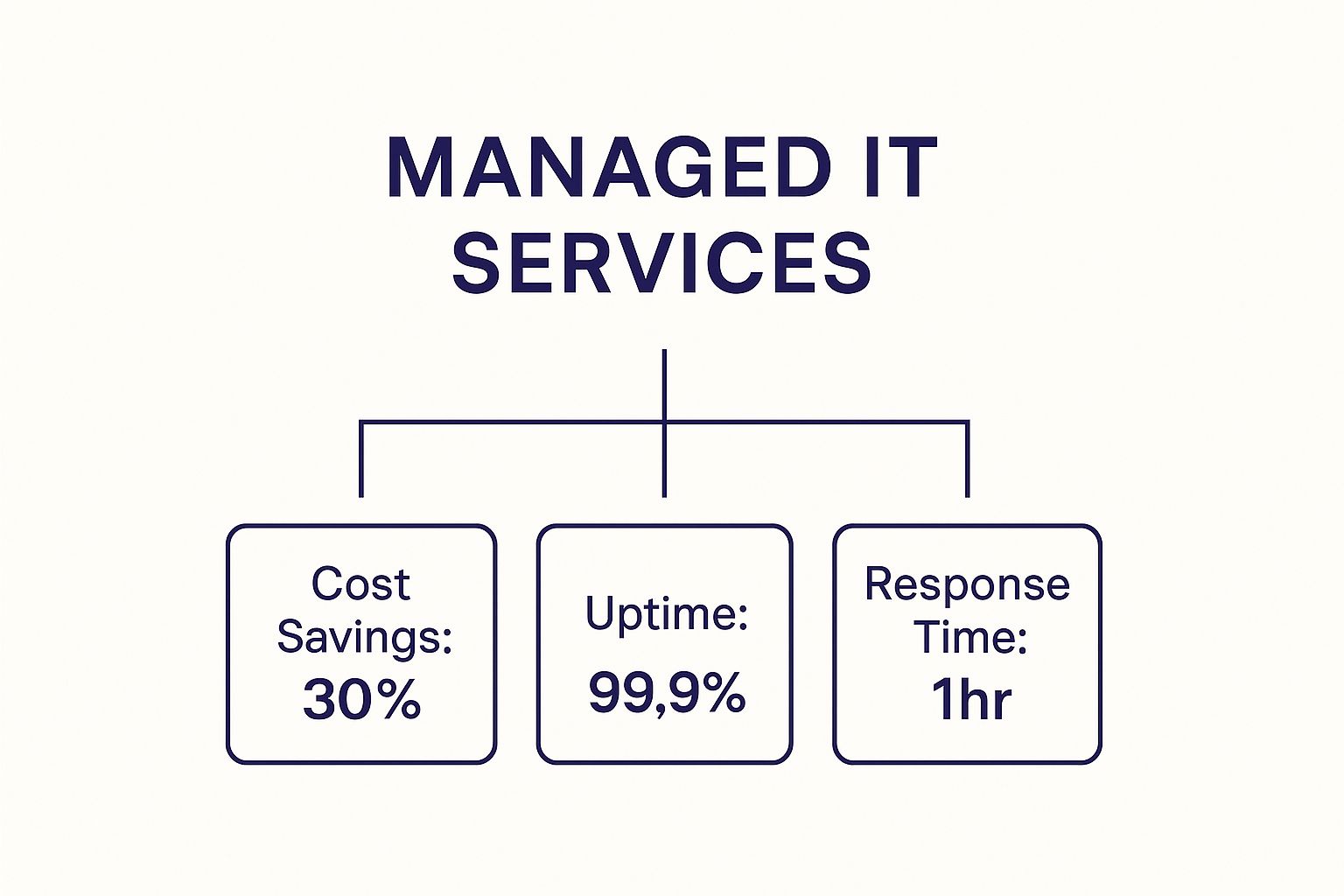
As the data shows, investing in professional IT management directly translates to serious cost reductions, near-perfect system availability, and lightning-fast support when issues pop up.
Safeguarding Your Data—Your Most Valuable Asset
Finally, let's talk about your data. For any startup, your data—customer lists, intellectual property, financial records—is often your most valuable asset. Managing it properly isn't just a technical task; it's a core business function that protects your company's future.
This goes way beyond just backing up a few files. It requires a clear strategy for:
- Secure Storage: Using encrypted and resilient cloud solutions to protect data from both hardware failure and prying eyes.
- Organized Management: Putting systems in place that make data easy to find, use, and analyze. This is how you turn raw information into smart business decisions.
- Automated Backups: Setting up regular, automated backups to ensure you can recover quickly from anything, whether it's an accidental deletion or a full-blown ransomware attack.
Your approach to data management is a direct reflection of your company's maturity. A proactive, organized strategy shows investors and customers that you're a serious, trustworthy business built for the long haul.
Your website is often the front door for collecting this valuable data. To make sure it's built on a solid foundation, check out our insights on professional website development for startups.
By integrating these pillars—cloud, connectivity, and data management—you create an operational backbone that doesn't just support your startup. It actively accelerates its growth.
Cybersecurity That Protects Your Big Idea
It’s a dangerous myth a lot of founders buy into: "Cybersecurity is a problem for big companies." The hard truth is that startups are prime targets precisely because they often lack the defenses of larger businesses, making them low-hanging fruit for cybercriminals. Thinking you're too small to be a target is a mindset that can kill your big idea before it ever gets off the ground.

This isn’t just an IT problem; it’s a core business function. It's about protecting your intellectual property, your customer data, and the trust you're working so hard to build. A single breach can torch your finances and permanently wreck your reputation with users and investors.
Understanding the Real Threats Startups Face
Cyber threats aren't always the complex, Hollywood-style attacks you see in movies. More often than not, they are simple, opportunistic strikes that exploit common weaknesses. For a startup, the most damaging attacks are usually the most basic.
- Phishing Scams: Deceptive emails or messages designed to trick your team into handing over login credentials. One click on the wrong link can give an attacker the keys to your entire kingdom.
- Ransomware: This is nasty stuff. Malicious software encrypts your critical data, holding it hostage until you pay up. For a startup on a tight timeline, losing access to product code or customer lists is a potential death sentence.
- Data Breaches: Whether it’s from a weak password or an unsecured cloud server, a breach exposes your customers' private info and your company's secrets. This opens the door to legal nightmares and a massive loss of trust.
These threats are very real, and they're growing. The 2025 global startup landscape shows just how crucial solid IT services for startups are. With regions like Singapore and China seeing ecosystem growth rates of 44.9% and 45.9% respectively, the competition is fierce. A security failure can knock you out of the race fast. You can dive deeper into these global startup ecosystem trends to see what you're up against.
Building Your Layered Defense Strategy
Good cybersecurity is like securing a building. You don't just lock the front door and call it a day. You have locks on individual offices, security cameras, and a system for managing who gets which keys. This layered approach makes it significantly harder for attackers to get in.
The goal of a startup's cybersecurity strategy isn't to become an impenetrable fortress. It's to make your company a difficult, time-consuming target, encouraging attackers to move on to easier victims.
A solid defense starts with a few key pillars that any startup can put in place.
Endpoint Protection: The Bodyguards for Your Devices
Every laptop, phone, and tablet your team uses is an "endpoint"—a potential entry point for an attack. Endpoint protection is like hiring digital bodyguards for each device. This goes way beyond basic antivirus software.
Modern endpoint solutions actively monitor device activity for suspicious behavior, block malicious websites, and can even quarantine an infected device from the network to stop an attack from spreading.
Network Security: Locking Your Digital Doors
Your office network, whether it's in a physical space or in the cloud, is the front door to your business. Network security is all about putting strong locks on that door. This means using firewalls to filter out malicious traffic and secure Wi-Fi to keep unauthorized users out.
For remote teams, a Virtual Private Network (VPN) is a non-negotiable. A VPN creates a secure, encrypted tunnel for all internet traffic, protecting sensitive company data when your people are working from a coffee shop or airport.
Access Management: Handing Out the Right Keys
You wouldn't give every new hire a master key to the entire office, right? The same logic applies to your digital assets. Identity and Access Management (IAM) is the practice of ensuring people only have access to the data and systems they absolutely need to do their jobs.
This simple concept, known as the "principle of least privilege," dramatically reduces your risk. Key practices here include:
- Strong Password Policies: Enforcing complex passwords and making sure they get changed regularly.
- Multi-Factor Authentication (MFA): Requiring a second form of verification—like a code from a phone app—before granting access. It’s one of the single best things you can do for security.
- Regular Audits: Periodically checking who has access to what and revoking permissions that are no longer needed.
By building these layers into your operations from day one, you create a security-first culture that protects your data, your customers, and your big idea.
Choosing the Right IT Support Model
Your critical app just crashed minutes before a huge client demo.## Choosing the Right IT Support Model
Your critical app just crashed minutes before a huge client demo. The office Wi-Fi has decided to take an unscheduled vacation. Who does your team call?
That single question gets to the heart of your IT support model. This isn’t just about hiring a “tech person”—it’s a strategic decision that can either empower your team to do their best work or create constant friction that grinds productivity to a halt.

For a startup, getting this right is non-negotiable. It directly impacts your ability to scale. Let’s break down the three main paths you can take to find the perfect fit for your budget and growth stage.
The Dedicated In-House Expert
Hiring a full-time IT pro means you have someone on deck who lives and breathes your company’s tech stack. They’re part of your culture, understand your quirks, and can provide instant, hands-on support. Over time, they build up a deep institutional knowledge that’s incredibly hard to replicate.
This model starts making sense once you hit a certain size—usually around 50 or more employees. It's also a good fit if your business is built on highly specialized, proprietary tech that needs constant attention.
But for an early-stage company, this is a massive investment. You're not just paying a salary; you're on the hook for benefits, training, and the near-impossible task of finding one person who’s a master of everything from cybersecurity to cloud architecture.
The Managed Service Provider Model
Think of a Managed Service Provider (MSP) as having an entire IT department on speed dial, all for a predictable monthly fee. It’s like a gym membership for your technology—you get access to a full team of specialists and powerful tools you could never afford to buy on your own.
For most startups, this is the most cost-effective and scalable option by a long shot. An MSP doesn’t just fix things when they break; they provide proactive monitoring to stop problems before they start. They handle your security, manage your daily IT headaches, and free up your team to focus on what they do best: building your business.
For many founders, this is the move that professionalizes their operations and gives them expert guidance from day one. You can see how dedicated small business IT consulting services can build a strategic roadmap for this.
Choosing an MSP lets a startup tap into enterprise-grade expertise and tools without the enterprise-grade price tag. You're essentially renting a world-class IT team instead of trying to build one from the ground up.
The debate over outsourcing vs. in-house IT is a classic one, and partnering with an MSP is one of the most powerful forms of strategic outsourcing a startup can make.
The Hybrid Approach
As your startup grows and matures, you might land on a hybrid model. This approach is the best of both worlds. You bring a generalist in-house—maybe an IT coordinator—to handle the daily tickets and act as a point person, while leaning on an MSP for the heavy lifting and specialized skills.
This structure is a game-changer for companies big enough to need someone on-site every day but who still want access to deep expertise in things like advanced cybersecurity or cloud infrastructure. It saves you from having to hire multiple, expensive specialists.
- In-House Role: Focuses on immediate user support, onboarding new hires, and managing IT assets.
- MSP Role: Handles complex server management, 24/7 security monitoring, strategic planning, and disaster recovery.
Ultimately, the best IT services for startups come down to your unique situation. By taking a hard look at your size, budget, and technical needs, you can pick a support model that doesn’t just fix problems—it actively fuels your growth.
For a startup on the rise, technology can play two very different roles. It can be a simple utility, like keeping the lights on, or it can be your sharpest competitive edge. The secret is moving beyond just keeping systems running. The right it services for startups don't just fix problems—they help you cut through complex rules and turn your raw data into a growth machine.
This is the point where your tech stops being an expense and starts generating a real return. It’s about being smart, compliant, and data-driven right from the start.
Mastering IT Compliance From Day One
A lot of founders hear acronyms like GDPR, CCPA, or HIPAA and think, "That's a problem for later." This is a huge mistake. Compliance isn't some enterprise-level luxury; it's a fundamental requirement for any company that touches user data. Ignoring it is like building a house and ignoring the local building codes—it’s going to cause massive problems down the line.
Think of compliance as the rulebook for handling other people's information. Regulations like GDPR (General Data Protection Regulation) in Europe are incredibly strict about how you collect, store, and use personal data. Getting it wrong can lead to crippling fines, a trashed reputation, and a total loss of customer trust. For a young company, that's often a death sentence.
Building a compliance-first culture isn't about getting tangled up in legal jargon. It's about showing respect for your users' privacy, and that's one of the best ways to build a loyal customer base.
So, how do you bake compliance into your company’s DNA without a team of lawyers?
- Map Your Data Flow: Get a clear picture of exactly what user data you collect, where it lives, and who can access it.
- Embrace Privacy by Design: Don't treat privacy as an afterthought. Build it directly into your product from the very first line of code.
- Create Clear Policies: Write simple, straightforward privacy policies and data handling rules that your team can actually understand and follow.
Nailing these steps early on builds good habits that scale as you grow, making future audits a whole lot less painful.
From Raw Data to Smarter Decisions
Beyond just playing by the rules, the data flowing through your systems is a goldmine. Every click, every support ticket, and every feature interaction tells a story. Strategic IT gives you the tools to read that story and use it to make better, faster decisions. This is how you stop running on gut feelings and start making data-driven moves.
Imagine trying to navigate a new city without a map. Sure, you might eventually get where you're going, but it’ll be slow, frustrating, and full of wrong turns. Data analytics is your map. It gives you a clear, objective view of what’s really happening in your business—what’s working, what isn't, and where your biggest opportunities are hiding.
For a startup, this means using analytics to:
- Track Key Performance Indicators (KPIs): Keep a close eye on metrics like customer acquisition cost (CAC), lifetime value (LTV), and churn rate. These numbers give you a real-time pulse on the health of your business.
- Understand User Behavior: Dig into how people are actually using your product. Where do they get stuck? Which features do they love? These insights are pure gold for refining your roadmap.
- Optimize Marketing and Sales: Use data to figure out which channels are bringing in your most valuable customers. That way, you can double down on what works and cut what doesn't.
Turning information into action is one of the most powerful things modern tech can do for a business. For a deeper dive into the possibilities, our guide to IT solutions for business explores how to build a tech stack that fuels this kind of smart analysis.
Your Action Plan for Implementing IT Services
Knowing you need IT services for startups is the easy part. Actually putting them in place without creating a messy, disconnected tech stack? That's a whole different challenge. It's easy to get overwhelmed by the options.
The secret is to think in phases. You need to align your IT investments with where your startup is right now, not where you hope it will be in five years.

This plan breaks the whole process down into three manageable stages. Think of it as a blueprint for building a tech foundation that can actually scale with your ambition.
Stage 1: The Launch Phase
Right now, it's all about speed and looking professional. Your tech needs are simple, but they're absolutely critical. The goal isn't to build a fortress; it's to get the essentials locked down so your team can start working securely and efficiently.
Your launch-phase checklist is short and sweet:
- Secure Business Email and Collaboration Suite: Get a professional email domain set up with Google Workspace or Microsoft 365. This isn't just about email—it's your command center for calendars, video calls, and cloud storage.
- Basic Endpoint Security: Every single company laptop needs solid antivirus and anti-malware software. No exceptions. This is your first and most important line of defense.
- Password Management: Roll out a team-wide password manager from day one. It's the single most effective step you can take to enforce strong passwords and dramatically cut your risk of a breach.
Stage 2: The Growth Phase
Okay, you've got traction. Your team is growing, and customers are signing up. The scrappy, "make it work" solutions that got you here are starting to creak under the pressure. Now's the time to build structured, scalable systems.
This is all about putting processes in place that can handle a bigger, more complex operation without everything falling apart.
Your priorities shift to things like:
- Implementing IT Policies: It's time to write down the rules. Formalize how data is handled, what devices can be used, and your core security protocols. A simple IT section in an employee handbook is a perfect start.
- Choosing a Support Model: Who handles IT issues? You need to decide between hiring someone in-house, partnering with a Managed Service Provider (MSP), or maybe a hybrid of both.
- Securing Your Network: If you're in an office, lock down your Wi-Fi. If your team is remote, deploy a Virtual Private Network (VPN) to keep data safe while it's in transit.
The growth phase is where your early IT decisions really get put to the test. If you build for scale now, you'll prevent massive operational headaches and security nightmares down the road.
Stage 3: The Scale Phase
You're not just surviving anymore—you're scaling, and fast. The customer base is booming, the team is expanding, and you're probably handling sensitive data that puts you on the radar of regulators. Advanced IT services are no longer a luxury; they're essential for managing risk and staying competitive.
To get a feel for what's possible, it's worth exploring some comprehensive IT service offerings designed to handle this kind of growth.
At this point, your focus expands to the big picture:
- Formalizing Disaster Recovery: You need a documented, tested plan to get your systems back online fast after a major outage or a cyberattack. Hope is not a strategy.
- Achieving Compliance: If you handle personal data, it’s time for formal audits to ensure you meet regulations like GDPR or CCPA. This is about protecting your customers and your business from huge fines.
- Leveraging Data Analytics: You're sitting on a goldmine of data. Now's the time to implement the tools to turn all that operational and customer information into insights that drive smarter decisions.
Frequently Asked Questions About Startup IT
Diving into the world of startup tech can feel like a distraction, especially when your real focus is on building a great product and winning over customers. Let’s cut through the noise and get straight to the answers for the most common IT questions we hear from founders.
How Much Should a Startup Budget for IT?
There's no one-size-fits-all answer, but a solid rule of thumb is to set aside 3% to 6% of your total operating budget for technology. In the very beginning, this might just be a few hundred bucks a month for your essential software subscriptions and a basic cloud setup.
As your startup grows, that percentage usually stays pretty consistent. The dollar amount, however, will naturally climb to cover more advanced needs—think robust cybersecurity tools, infrastructure that can actually handle your growth, and professional support. The main takeaway is to treat IT as a fundamental operational cost, not a "nice-to-have."
Your IT budget isn't just another line item; it's a direct investment in your company's stability, security, and ability to scale. Cutting corners here almost always creates bigger, more expensive headaches down the road.
When Is the Right Time to Hire an IT Provider?
Honestly, it's probably sooner than you think. The biggest mistake is waiting for a crisis—a server crash, a security breach, or a key employee locked out of their accounts during a product launch. The real signal is when you or your team members are burning more than a few hours a week wrestling with tech issues.
Look for these signs:
- You're managing more than 10 people: At this stage, things like onboarding new hires, managing devices, and keeping permissions straight get complicated fast.
- You handle sensitive customer data: The moment you start collecting any kind of personal information, you need professional security and compliance guidance. The risks are just too high to DIY.
- Your team is working remotely: A distributed workforce introduces a whole new level of complexity. Securing multiple networks and devices requires a lot more than basic consumer tools can offer.
A good Managed Service Provider (MSP) gives you access to enterprise-level expertise without the hefty salary of a full-time hire. They're the perfect partner for a startup hitting its growth spurt.
Can We Just Use Consumer-Grade Tools?
Using personal Dropbox accounts and the Wi-Fi router from Best Buy might work when it's just you and a co-founder in a garage. But that approach falls apart quickly and becomes a massive security and productivity bottleneck.
Business-grade it services for startups aren't just about a brand name; they offer critical features that consumer-grade tools simply don't have. We're talking about centralized administration (so you can control who has access to what), serious security protocols that actually protect company data, and service-level agreements (SLAs) that guarantee you'll have support when things go wrong.
Moving to professional tools like Google Workspace or Microsoft 365 isn't just an expense; it's a statement. It tells your team, your customers, and your investors that you're building a real, secure, and scalable business.
Ready to build a technology foundation that fuels your growth instead of holding you back? At Frozen Crow Inc., we combine strategic IT consulting with powerful digital marketing to give your startup the competitive edge it needs. Schedule your free audit today and let’s build something great together.


