


November 17, 2026
What Is a Marketing Database? Your Ultimate Guide
Let's be clear about one thing right away: a marketing database is not just a fancy contact list. It's so much more. Think of it as the central command center for your entire marketing operation—the brain behind the brawn.
Your Marketing Database Is More Than a Contact List
It’s easy to get the two confused. A contact list is static; it tells you who your customers are. A marketing database is dynamic. It tells you who they are, what they do, how they think, and what they're likely to do next.

This intelligent system pulls together all the scattered pieces of customer information from every interaction they have with your brand. We're talking about a rich, 360-degree view built from data points like:
- Website visits and which specific pages they browsed
- Email engagement—who opened, who clicked, and who ignored
- Purchase history, including what they bought and how often
- Social media interactions like follows, likes, and comments
By pulling all this information into one place, you shift from simply knowing a name and an email to truly understanding the person behind the screen. This is the core of what's known as database marketing, and it gets results. Companies that master it often see their marketing ROI jump by as much as 30% over old-school tactics.
Marketing Database vs Simple Contact List
To really drive the point home, let's look at a quick side-by-side comparison.
| Feature | Simple Contact List | Marketing Database |
|---|---|---|
| Data Type | Static: Name, email, phone | Dynamic: Behavioral, demographic, transactional data |
| Primary Use | Basic communication (e.g., email blasts) | Personalized, segmented marketing campaigns |
| Data Sources | Single source, usually manual entry | Multiple sources, automated integration |
| Insights | Minimal; tells you who | Deep; tells you who, what, when, and why |
| Function | A simple directory | An active strategic tool |
See the difference? One is a phone book; the other is an intelligence dossier.
To really get a feel for its power, you have to see how it works in practice. For instance, putting in the work for building a B2B email database isn't just about collecting contacts—it's about creating a powerful asset that directly fuels your sales pipeline. For any business that’s serious about growth, it’s not just a nice-to-have; it’s essential.
Discover What's Actually Inside Your Database
To really see what a marketing database can do, you have to look under the hood. It’s so much more than a glorified spreadsheet of names and emails. Think of it as a living, breathing profile of your audience, built from different data points that come together to paint a complete picture. These pieces are the foundation of any smart, data-driven marketing plan.
A well-built database usually breaks information down into four key categories. Each one gives you a different lens to look at your customers through. When you combine them, you get that 360-degree view everyone talks about, letting you market smarter, not just harder.
The Four Pillars of Customer Data
The real magic happens when you start pulling in and connecting different types of information. Let's break down the essential data pillars that make it all work.
-
Demographic Data (The "Who"): This is your baseline, the objective, factual stuff about a person or company. For a B2C business, you’re looking at things like age, gender, location, and maybe income level. For B2B, it’s all about company size, industry, and the job titles of your contacts.
-
Behavioral Data (The "How"): This is where you track how people actually interact with your brand. It includes which website pages they visited, what articles they read, any videos they watched, or the specific features they used in your software. This data is pure gold because it reveals what people are truly interested in.
A marketing database isn't just a place to store data; it's a tool to activate it. By understanding customer behavior, you can stop shouting generic messages and start having personalized conversations that actually connect and convert.
-
Transactional Data (The "What"): This is the hard data on what people buy. It covers things like past purchases, average order value, cart abandonment, and subscription status. This is how you spot your best customers and even start predicting what they might buy next.
-
Engagement Data (The "Interaction"): This part measures how your audience responds to your marketing. We’re talking about email open and click-through rates, social media likes and shares, and ad clicks. It’s your report card—it tells you what messages are hitting the mark and which ones are falling flat.
This infographic gives you a great visual of how a marketing database pulls all this information into one central place to drive real business results.
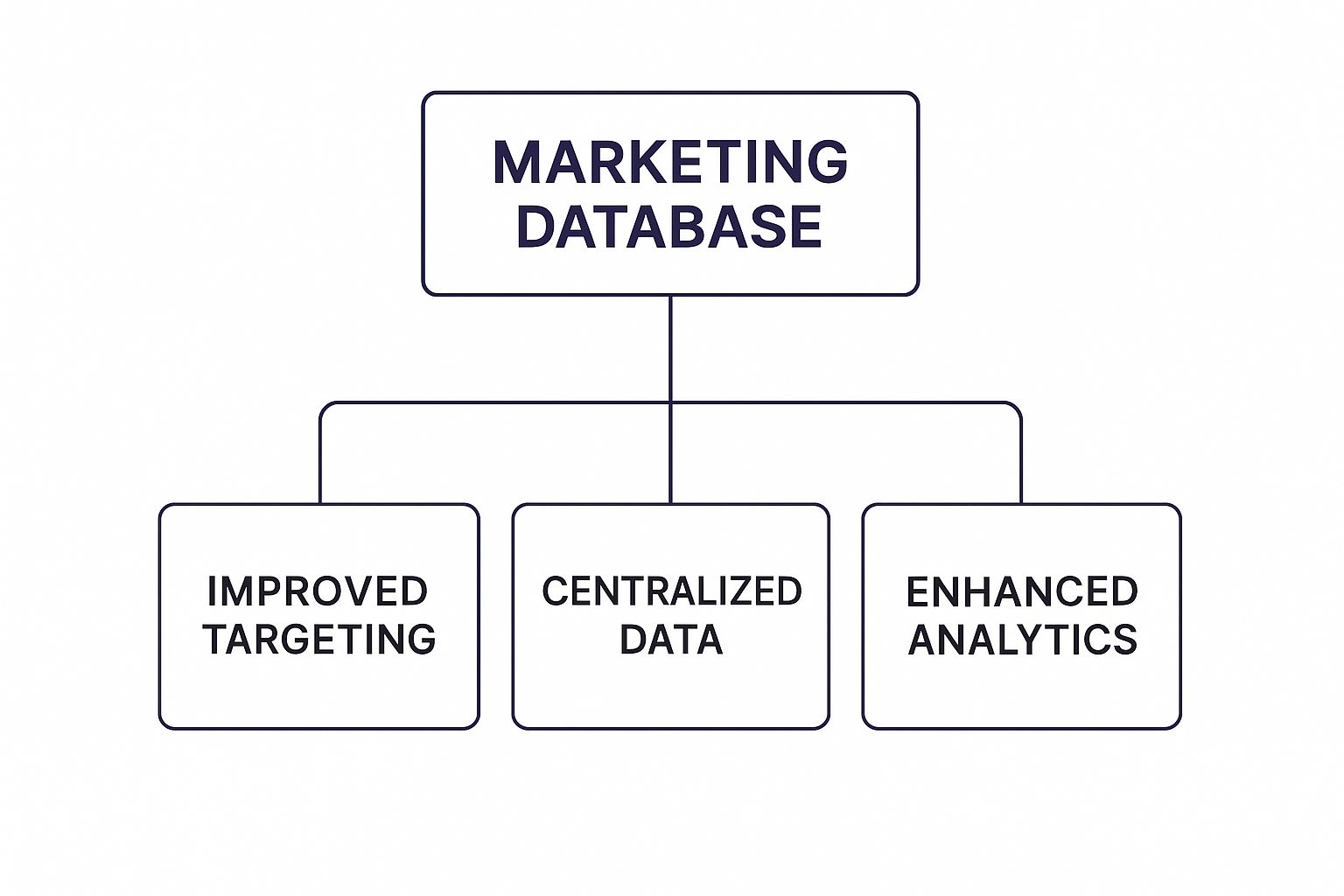
By bringing all your data together, you immediately open the door to better targeting and much deeper analytics. But it goes beyond just storage. A powerful marketing database is your key to using advanced customer segmentation techniques, which let you group and understand your audience on a whole new level.
Put Your Data to Work and Watch Your Business Grow

Knowing what a marketing database is made of is one thing. Actually using it to get real-world results is where the magic happens. Think of a well-organized database as the engine for your business, turning raw information into smarter decisions, better customer relationships, and a healthier bottom line. It’s what lets you stop shouting into the void with generic campaigns and start having meaningful conversations with your customers.
This isn’t just a trend; it's a fundamental shift in how smart businesses operate. The numbers don't lie. A massive 87% of marketers admit that data is their company’s most neglected asset. On the flip side, businesses that go all-in on data-driven marketing see a five to eight times greater ROI than those who don't. The opportunity here is huge.
From Data Points to Dollars
So, how does this actually play out?
Let’s imagine a small e-commerce shop that sells handmade leather goods. Digging into their marketing database, they spot a group of customers who used to buy high-end items but haven't made a purchase in over six months.
Instead of hitting them with the same old weekly newsletter, they launch a targeted campaign to win them back.
- Step 1: Segmentation: First, they create a specific segment of "high-value, at-risk" customers based on past purchases and their last login date.
- Step 2: Personalization: Next, they craft a personalized email showcasing new products similar to what those customers bought before. They also throw in a special "we miss you" discount.
- Step 3: Nurturing: For anyone who doesn't bite right away, they follow up with a subtle ad campaign on social media featuring testimonials about how long their products last.
This entire play—pinpointing a specific audience, tailoring the message, and gently nudging them back—is only possible because they had clean, organized data to work with. It's how you turn a customer you might have lost forever into a repeat buyer.
This is a straight line from organized data to more money in the bank. It's all about using what you know to build stronger connections. If you want to get even smarter about your marketing spend, you should also check out our guide on what marketing mix modeling is and how it can shape your entire strategy.
How to Build Your First Marketing Database
Building your first marketing database can sound like a huge, intimidating project, but it really doesn't have to be. For startups and small businesses, the trick is to start simple and let it grow with you. You don't need some complex, enterprise-level system right out of the gate; you just need one central place for all your customer data to live—a place you can actually use.
If you break it down into a few manageable steps, you can create a powerful asset that fuels real growth without getting lost in the technical weeds.
Choose the Right Platform
First things first: you need to decide where this data is going to live. The options run from simple, everyday tools to much more powerful systems. The key is to pick something that fits where you are right now in terms of needs and budget.
- Customer Relationship Management (CRM): Tools like HubSpot CRM or Zoho are fantastic starting points. They’re built to help you organize contacts, keep track of interactions, and see what’s happening in your sales pipeline, all in one spot.
- Email Marketing Platforms: If email is your main game, services like Mailchimp or ConvertKit often come with solid audience management features that can serve as a basic database.
- Marketing Automation Tools: For businesses that are ready to scale, these platforms can centralize your data while also running more complex campaigns on autopilot. You can learn more in our guide to marketing automation for small business.
Don't overcomplicate it. Start with what you can comfortably manage. You can always level up to a more advanced system as your business and your data needs expand.
Integrate Your Key Data Sources
Once you've picked your platform, it’s time to start feeding it information. The goal here is to connect all the different places where you interact with customers so that data flows into your new database automatically.
Think about connecting sources like your website's contact forms, sales data from your e-commerce store, and even your social media accounts. Doing this pulls everything together, giving you a single, unified view of each customer's journey—what they’re interested in, what they buy, and how they engage with you.
A database is only as good as the data you put in it. Start by connecting your most valuable sources first. This ensures you're building a foundation with clean, relevant, and genuinely useful information from day one.
Establish Data Hygiene and Compliance
Finally, you need a plan to keep your data clean, accurate, and legal. Good data hygiene is just a fancy way of saying you should regularly check for and fix common errors. We're talking about duplicate contacts, outdated email addresses, and messy formatting. Clean data simply works better and leads to stronger campaign results.
Just as important is data privacy compliance. Take some time to get familiar with regulations like GDPR and CCPA. The golden rule is to always get clear consent before you collect someone's data and make it easy for them to change their preferences later. This isn't just about avoiding fines; it’s about building trust with your audience.
Putting Your New Database Into Action

A marketing database is really just a storage unit until you open the doors and put what’s inside to work. The real magic happens when you turn all that raw data into targeted, effective campaigns that actually connect with specific groups of people. It’s the bridge between knowing your customers and showing them you get what they need.
This isn't just some passing trend; it's a fundamental shift in how businesses operate. In fact, nearly 94% of small businesses plan to spend more on digital marketing, and a huge chunk of that is going toward data-driven campaigns powered by a central customer database.
Real-World Examples Of A Marketing Database
To see how this plays out in the real world, let's walk through a few scenarios. Think of these as mini-blueprints for turning data into action.
-
The SaaS Startup: Picture a software company with a free trial. Their database keeps tabs on who logs in daily versus who signed up and ghosted them. They can easily create a segment of "at-risk" trial users and send them automated, helpful emails with tips on a key feature they haven't touched. This simple action can re-engage them right before the trial is up.
-
The Local Service Business: A plumbing company segments its customer list by zip code. When a cold snap is in the forecast for a specific neighborhood, they send a targeted text blast to homeowners in that area offering a discount on pipe insulation. Just like that, weather data becomes proactive sales.
-
The Online Retailer: An e-commerce store uses purchase history to make its recommendations smarter. If someone buys running shoes, the database automatically triggers a follow-up email a few weeks later showing off high-performance socks and hydration gear. This makes a second purchase feel natural, not pushy.
Every one of these actions—from nurturing a trial user to recommending the right socks—is impossible without an organized marketing database. It’s the engine that lets you move from generic marketing blasts to precise, timely communication that actually drives results.
Once your database is humming along, it becomes the backbone for effective marketing reporting, giving you a clear view of what’s working so you can double down. These campaigns also feed directly into your sales funnel, which is a critical piece of any solid lead generation advertising strategy.
Got Questions About Marketing Databases? Let's Clear a Few Things Up.
As soon as businesses start talking about database marketing, a few key questions always pop up. It's totally normal. Getting straight answers is the best way to move forward without hitting those common roadblocks, so let’s tackle the big ones.
Is a CRM the Same as a Marketing Database?
This is easily the most common point of confusion. Lots of people use the terms interchangeably, but they really are two different tools built for two different jobs.
Think of it this way: a Customer Relationship Management (CRM) platform is built for your sales team. Its whole world revolves around managing one-on-one conversations, tracking deals through your pipeline, and nurturing individual relationships. It’s all about personal interaction.
A marketing database, however, is built for one-to-many communication. It takes a much broader view. While it holds similar data, its purpose is to spot trends across your entire audience, create smart segments, and power automated campaigns at scale. In short, a CRM manages individual relationships, while a marketing database fuels your overall marketing strategy.
What’s This Going to Cost Me?
The price can swing wildly—and that's actually good news, especially if you're a small business or startup. You absolutely do not need a massive budget to get started. The cost really just depends on the tools you pick, how much data you're handling, and what you need to connect.
Here's a rough idea of what to expect:
- Basically Free: You can start for next to nothing. A free CRM or even the built-in audience tools in your email marketing platform can get you off the ground. Perfect for early days.
- A Modest Investment: Once you need more power, a dedicated CRM with some marketing automation features is a great next step. This might run you anywhere from a few hundred to a couple of thousand dollars a year.
- The Enterprise Level: For massive operations, you have platforms with deep analytics and custom everything. These can run into the tens of thousands, but they're overkill for most businesses.
The trick is to start with what you actually need right now. You can always scale up as you grow.
How Often Do I Need to Clean My Data?
This isn't a one-and-done task. Data gets old, fast. People change jobs, update their email addresses, and move. It's a natural process called data decay, and it happens faster than you'd think. Industry experts estimate that B2B data goes stale at a rate of 2.1% every month, which adds up to a whopping 22.5% per year.
That's why you have to make data hygiene a regular habit.
A good rule of thumb is to do a full-on data cleanup at least twice a year. If you're bringing in a high volume of new leads, you're better off doing it quarterly. Staying on top of it ensures your campaigns are actually reaching real people and you're not just throwing your marketing budget into a black hole.
At Frozen Crow Inc., we help businesses build powerful marketing systems from the ground up. If you're ready to turn your customer data into your most valuable asset, let's talk about creating a strategy that drives real growth. Explore our digital marketing and IT services today.


