


August 20, 2026
Digital Marketing for Startups: Boost Growth Today
You've poured everything into your idea. Now, how do you get it in front of the right people? That's where digital marketing comes in—it's the engine that turns a great product into a profitable business. For a startup, this isn't just about advertising; it's the entire system for connecting with your first customers, competing with established players, and making every single dollar count.
Why Digital Marketing Is a Startup's Growth Engine

Let's be clear: digital marketing isn't just another department for a startup. It is the growth engine. While your product might be a world-class vehicle, a smart digital strategy is what gives it fuel and direction. It completely levels the playing field, letting a small, scrappy team reach a global audience without needing a Super Bowl-sized ad budget.
Think of it like this. Old-school marketing was like shouting into a megaphone in a crowded stadium, hoping someone would listen. Digital marketing is more like having a one-on-one conversation with every single person who's actually interested in what you have to say, wherever they are.
Building Your Foundation for Growth
The real power of digital marketing for startups is in its precision. Every click, every share, and every sign-up can be tracked. This gets rid of the guesswork that used to plague marketing, allowing founders to make smart decisions and put their limited resources where they'll have the biggest impact.
Instead of dropping thousands on a magazine ad and just hoping for the best, you can run targeted campaigns with crystal-clear goals. A solid digital footprint also builds the credibility and trust you desperately need to attract those crucial early adopters and investors. We actually dive deeper into this in our full guide on building a marketing strategy for startups.
"For new ventures, digital channels are the great equalizer. They provide direct access to customers, immediate feedback loops, and the ability to pivot strategy in real-time based on performance data."
Tapping Into a Growing Market
The importance of getting this right can't be overstated, especially when you look at the numbers. The global digital marketing industry is on track to hit $1.3 trillion by 2033—proof that this is the central nervous system of modern business.
It's all about understanding which levers to pull. For instance, getting a handle on influencer marketing for startups can unlock a powerful and authentic way to get your brand noticed. At the end of the day, a smart digital strategy isn't just a plan; it's your roadmap to real, sustainable growth, one measurable step at a time.
As a startup founder, your two most precious resources are time and money. Trying to be everywhere at once is the fastest way to burn through both with nothing to show for it.
The real goal isn't to cast a wide, expensive net. It's about finding the specific ponds where your ideal customers are already swimming. You have to be strategic, picking the digital marketing channels that actually make sense for your budget, your goals, and your timeline.
Think of it like this: you wouldn't use a hammer to drive a screw. Each marketing channel is a specialized tool built for a specific job. You don't need every tool in the shed right away—just the essential few that will help you build a solid foundation.
Let's break down the core channels from a startup's point of view.
This visual gives a great snapshot of where startups are focusing their efforts, highlighting the importance of a dedicated website versus just leaning on social media, and what it really costs to get a new customer through digital ads.
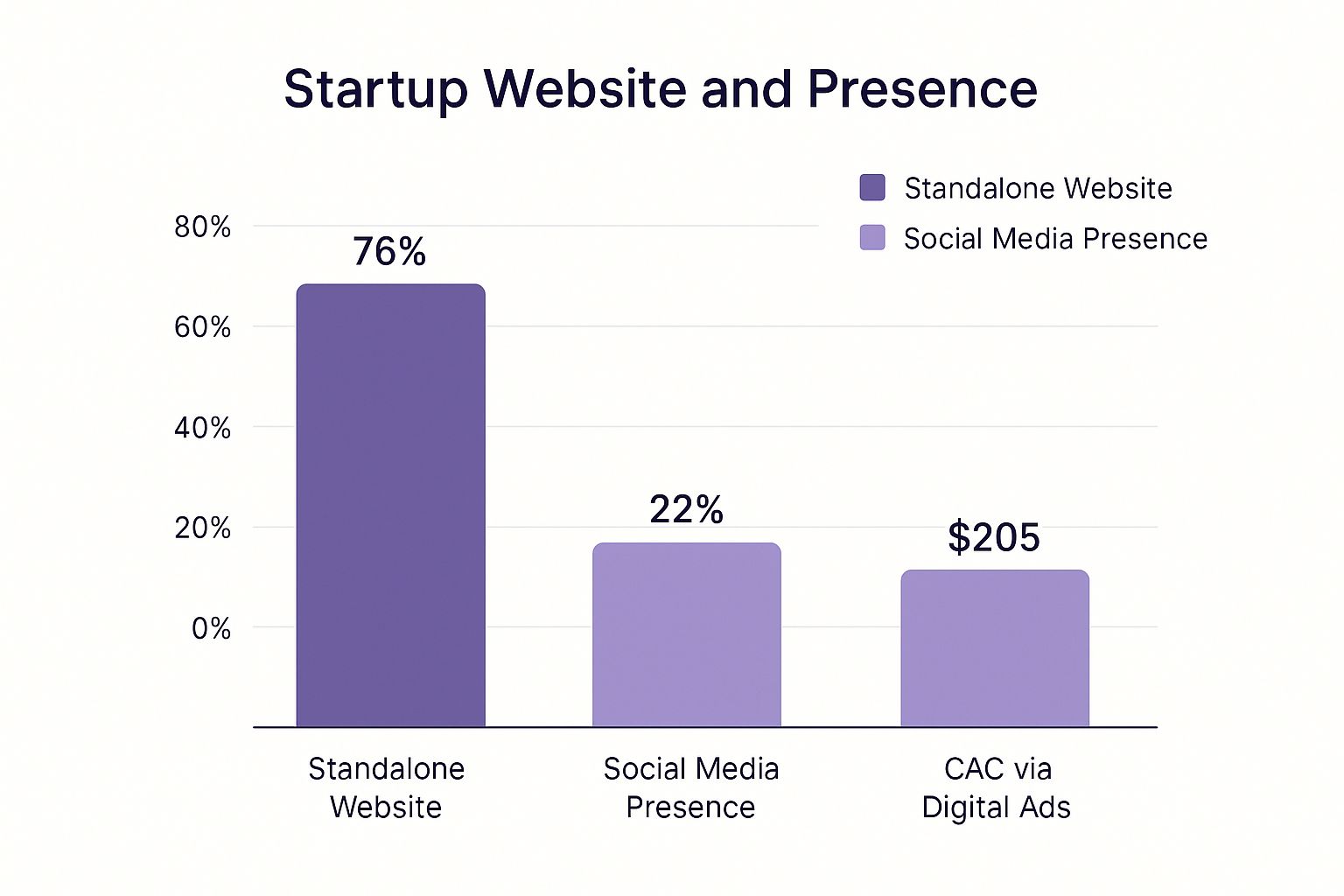
The data here is telling. While most startups get the value of a standalone website, a surprising number still rely only on social media. That's a huge missed opportunity for owning your brand and tapping into the long-term power of SEO.
To help you decide where to start, we've broken down the key channels and how they fit into a startup's journey.
Comparing Key Digital Marketing Channels for Startups
Choosing your first marketing channels can feel overwhelming. This table is designed to cut through the noise and give you a clear comparison based on what matters most to an early-stage company: budget, speed, and long-term payoff. Use it to find the right mix for your launch and growth phases.
| Channel | Primary Goal | Typical Startup Budget | Time to See ROI | Best For |
|---|---|---|---|---|
| SEO | Sustainable, long-term organic traffic and authority building. | Low to medium (time-intensive) | 6-12 months | Startups with a long-term vision looking to build a compounding asset. |
| Content Marketing | Building trust, educating the audience, and generating leads. | Low to medium | 3-6 months | B2B, SaaS, and any startup in a complex or niche industry. |
| Social Media | Community building, brand awareness, and direct audience engagement. | Low to high (depending on ad spend) | 1-3 months | B2C brands, companies with visual products, and personality-driven founders. |
| PPC Advertising | Immediate traffic, lead generation, and market testing. | Medium to high | Days to weeks | Startups needing quick validation, e-commerce stores, and time-sensitive promotions. |
| Email Marketing | Nurturing leads, customer retention, and driving direct sales. | Low | Immediate | Virtually all startups; essential for building relationships with an owned audience. |
Each channel has its place, but the right ones for you depend entirely on your specific goals. A B2B SaaS company will likely lean into SEO and Content Marketing early, while a new D2C clothing brand might go all-in on Social Media and PPC to get initial sales.
Now, let's dig a little deeper into what each of these channels actually involves.
Search Engine Optimization (SEO): The Long-Game Compounder
Search Engine Optimization (SEO) is all about making your website irresistible to search engines like Google. When someone searches for a problem you solve, you want to be right at the top of the results.
For a startup, SEO is not a quick win. It's like planting a tree. You have to put in the work upfront, and it takes time to see real growth. But once that tree matures, it provides a steady stream of free, organic traffic for years. It's a true long-term asset.
The payoff for this patience is huge. The very first result in a Google search gets nearly 40% of all clicks. That number can jump even higher if you snag a featured snippet. It’s pretty clear why getting to the top is a game-changer for new businesses that need a reliable flow of high-intent customers. You can dig into more of this in these findings about digital marketing statistics.
Content Marketing: The Engine of Trust
Content Marketing is what fuels your SEO machine. It’s the practice of creating and sharing genuinely useful articles, videos, guides, and infographics that your target audience actually wants.
Instead of a hard sales pitch, you’re providing real value and building trust. For instance, a software startup could write a definitive guide on solving a common industry pain point. Just like that, they're not just another vendor—they're an expert.
This approach nails a few critical goals for any startup:
- Builds Authority: Great content positions you as a go-to leader in your space.
- Generates Leads: Offering valuable content like an ebook or webinar in exchange for an email is a classic, effective lead-gen tactic.
- Powers SEO: Every blog post is another chance to rank for keywords your customers are searching for.
Social Media Marketing: The Community Builder
While SEO and content are about getting found, Social Media Marketing is about going where your audience already hangs out. The secret isn't to be on every single platform—that's a recipe for burnout. It's about picking the one or two where your ideal customers actually spend their time.
A B2B tech startup will almost certainly get more mileage out of LinkedIn. A direct-to-consumer fashion brand? They belong on Instagram or TikTok.
The real goal for a startup on social media isn’t chasing vanity metrics like follower counts. It’s about engagement. It’s about building a real community and sparking conversations that create true brand loyalty.
Pay-Per-Click (PPC) Advertising: The Speed Dial
When you need results now, you turn to Pay-Per-Click (PPC) advertising. Platforms like Google Ads or social media ads let you pay to put your brand directly in front of a highly targeted audience.
This is the fastest way to get clicks. It's an incredible tool for startups that need to generate their first wave of traffic, test if their product resonates, or drive sign-ups for a launch.
Unlike SEO, the results are almost instant… but they also disappear the second you turn off the spend. Think of it as the ultimate speed lever—perfect for getting crucial data and quick wins while your long-term organic strategies are still taking root.
Email Marketing: The Relationship Nurturer
Last but not least, Email Marketing is still one of the most powerful tools in the box. It’s your direct line to people who have already raised their hand and said they're interested.
By collecting emails (ethically, of course) through your content and website, you can nurture those early leads, share company updates, and guide them toward becoming loyal, paying customers. It consistently delivers one of the highest ROIs in marketing for one simple reason: you own the list. You're not at the mercy of some platform's ever-changing algorithm.
Crafting Your Lean Startup Marketing Plan

An incredible idea without a plan is just a dream waiting to be forgotten. The best digital marketing for startups doesn't just happen—it's built on a deliberate, focused strategy. Forget about some hundred-page document you write once and then shove in a drawer. What you need is a lean, one-page blueprint that guides every decision and keeps your team laser-focused on what actually drives growth.
Think of it as the architectural drawing for your growth engine. Before you start building, you have to know exactly who you're building for, what the finished machine will look like, and how you’ll know if it's even working.
Define Your Ideal Customer Persona
You can't sell to everyone. It's the classic startup mistake, and it burns through cash and time like nothing else. The first, most critical step is to nail down your ideal customer persona—a detailed, semi-fictional profile of the one person who will get the absolute most value from what you offer.
This isn't just about basic demographics like age and location. You need to get inside their head. What are their biggest frustrations? What goals are they trying to hit? What apps are they scrolling through on their lunch break? The more detail you can add, the easier it becomes to create marketing that feels like it’s speaking directly to them.
A well-defined customer persona acts like a compass for your entire marketing strategy. Every piece of content you create, every ad you run, and every feature you build should be aimed directly at solving this person's problem.
Set Your SMART Marketing Goals
Once you know who you're talking to, you have to decide what you want to achieve. Vague goals like "get more traffic" or "increase sales" are completely useless. For a plan to be effective, your goals have to be SMART:
- Specific: Nail down exactly what you want to accomplish. Instead of "get more leads," go for "acquire 50 qualified leads from organic search."
- Measurable: You have to be able to track your progress with real numbers. How will you know when you’ve hit your target?
- Achievable: Be ambitious, but stay grounded in reality. Aiming for a million users in your first month is just setting yourself up for failure.
- Relevant: Does this goal actually move the needle for your startup's bigger business objectives?
- Time-bound: Give yourself a deadline. "Generate 1,000 email subscribers by the end of Q3" creates the urgency you need to stay focused.
Setting SMART goals turns your marketing from a bunch of random activities into a focused campaign where every action has a clear purpose. These goals are also essential for figuring out key metrics later on. To get a better handle on the numbers, it's worth exploring how to use a https://frozencrow.com/customer-acquisition-cost-calculator/ to make sure your goals are financially sustainable.
Articulate Your Unique Value Proposition
In a crowded market, simply explaining "what you do" isn't nearly enough. You have to communicate why you’re different and why that difference matters. This is your Unique Value Proposition (UVP). It’s a short, punchy statement that explains the specific benefit you deliver, how you solve your customer's biggest problem, and what makes you the obvious choice over the competition.
A great UVP should instantly answer a potential customer's core question: "What's in it for me?"
Let's look at an example for a project management tool aimed at remote teams.
- Weak UVP: "The best project management software."
- Strong UVP: "Trello helps teams move work forward. Collaborate, manage projects, and reach new productivity peaks. From high rises to the home office, the way your team works is unique—accomplish it all with Trello."
This UVP works because it focuses on the outcome (moving work forward, hitting new productivity peaks) and speaks directly to its audience (teams everywhere). Your UVP needs to be front and center on your website and in all your marketing. As you build out your plan, look into clever SEO growth hacks for tech startups on a budget to make sure people can actually find it.
A brilliant plan is just a starting point. True growth happens when that strategy gets put into action.
This is where the blueprint becomes reality. The secret to digital marketing for startups isn't launching some massive, perfect campaign right out of the gate. It's all about being agile, running experiments, and sticking to a constant cycle of doing, learning, and improving.
Think of yourself as a scientist in a lab. Your marketing plan is your hypothesis. Now it's time to run small, low-risk experiments to see what actually sticks. This approach protects your limited budget and gives you priceless data to guide your next move, ensuring every action is smarter than the last.
Your First Steps in SEO
For any startup, Search Engine Optimization is a day-one activity. The good news? You don't need to be an expert to start making a real impact.
Begin with the basics of on-page SEO. This just means optimizing your individual web pages so they can rank higher and pull in more relevant traffic from search engines. It’s all about making your content crystal clear to both humans and Google.
Here are the first three things to knock out:
- Keyword Optimization: For each page, make sure its main keyword appears naturally in the page title, the first paragraph, and at least one subheading. Don't ever force it—readability is king.
- Meta Descriptions: Write a snappy meta description (that's the little blurb under the title in search results) for your most important pages. This is your thirty-second pitch to convince someone to click your link instead of a competitor's.
- Internal Linking: Start connecting relevant pages on your site to one another. If a blog post mentions a specific feature, link out to your features page. This helps search engines map out your site and keeps visitors clicking around longer.
These first few steps lay the foundation for long-term organic growth without costing you a dime.
Launching Your Content Marketing Engine
Content is the fuel for almost everything you do in digital marketing. To keep from getting overwhelmed, start with a simple, achievable plan. The goal isn't to churn out content every single day. Instead, create one high-impact "hero" asset that you can slice, dice, and promote for weeks.
A "hero" asset is a big, meaty piece of content that delivers a ton of value to your ideal customer. Think of a comprehensive guide, an original research report, or a super-detailed case study.
The most effective content for a startup is something that solves a major pain point for its target audience. It positions your brand as a helpful expert, not just another company trying to make a sale.
Once you have your hero asset, you can break it down into bite-sized pieces for all your different channels.
- Write a detailed blog post that summarizes the key takeaways.
- Design an infographic with the most eye-popping data points.
- Create a series of social media posts, each highlighting a single tip or stat.
- Record a quick video explaining the core concepts.
This strategy maximizes the return on your initial time investment, giving you a ton of material to share everywhere.
Building Your Initial Social Media Presence
Social media is where you build a community and give your brand a human voice. The single biggest mistake startups make is trying to be on every single platform. Don't do it.
Instead, pick the one platform where your ideal customer hangs out the most and focus on mastering it. Your first real mission is to engage your first 100 true followers. These aren't just random accounts; they're your potential customers, industry peers, and the first evangelists for your brand.
To get there, focus on these simple steps:
- Optimize Your Profile: Use a clear profile picture (your logo), write a short bio that nails your Unique Value Proposition, and, of course, add a link back to your website.
- Provide Value, Don't Just Pitch: Live by the 80/20 rule. 80% of your content should be genuinely helpful, educational, or entertaining. Only 20% should be promotional.
- Engage Authentically: Don't just post and ghost. Reply to comments, ask questions, and jump into conversations happening in your industry.
The power of social for startups is real, especially when it comes to guiding purchase decisions. Research shows that 76% of users say social content has influenced what they buy, and that number jumps to a staggering 90% for Gen Z. This is exactly why 59% of marketers are planning to grow their influencer partnerships. You can dig deeper into how social media is shaping consumer behavior.
Embracing the Cycle of Iteration
The final—and most critical—part of putting your strategy into action is getting comfortable with the feedback loop. Digital marketing is never "set it and forget it." It’s a living, breathing process that demands constant attention and tweaking.
This iterative cycle is simple but incredibly powerful:
- Act: Launch a small campaign based on your strategy (e.g., publish that blog post, run a tiny social ad).
- Measure: Use your analytics tools to track the key metrics. Did the blog post get any traffic? Did the ad actually get clicks?
- Learn: Dig into the data to figure out what worked and what flopped. Was the headline a dud? Was the ad targeting completely off?
- Refine: Use what you learned to make your next move better. Tweak the headline, adjust the ad targeting, and run the experiment again.
By constantly running through this cycle, you systematically de-risk your marketing and slowly but surely improve your results. This agile approach is the secret to how startups with small budgets can punch above their weight and win.
Driving Early Wins with Local SEO

It’s easy to get caught up in grand visions of going global, but for most startups, your first and most loyal customers are right in your own backyard. Local Search Engine Optimization (SEO) is a seriously powerful strategy that far too many founders overlook in the race to scale.
Think of it as your secret weapon for gaining immediate traction. It lets you build a strong community foothold before the big competitors even know you exist.
For any business with a physical storefront or a defined service area, local SEO isn't just a tactic—it's a lifeline. It puts your brand in front of people at the exact moment they’re searching for a solution nearby. This is a cornerstone of smart digital marketing for startups because it delivers tangible, quick returns that build that critical early momentum.
And the numbers don't lie. A staggering 46% of all Google searches are for local information. Even better, 88% of people who search for a local business on their phone will call or visit within 24 hours. That's a direct line from a local search to a real-world customer. You can dig into more stats like these in this breakdown of key digital marketing statistics at SEO.com.
Optimize Your Google Business Profile
If local SEO were a boxing match, your Google Business Profile (GBP) would be the undisputed heavyweight champion. It’s your digital storefront on Google Search and Maps, and for many, it’s the very first interaction they'll have with your brand.
Getting this right is non-negotiable.
A complete, active profile isn't just a listing; it’s a dynamic platform that builds trust and gives customers everything they need to choose you. To turn your GBP into a customer-generating machine, get these things right:
- Fill Out Everything: Don't skip a single section. Add your services, products, hours, and accessibility info. The more you give Google, the more it will reward you.
- Show, Don't Just Tell: Upload high-quality photos regularly. Show off your space, your products, and your team. Give people a real feel for who you are.
- Use the Q&A Feature: Get ahead of the game by populating this section with common questions and clear answers. It saves customers time and shows you're on top of things.
Gather Crucial Early Reviews
For a new business, social proof is everything. Positive reviews on your Google Business Profile are one of the most powerful signals you can send, both to potential customers and to Google’s algorithm. They prove you’re a legitimate, trusted business.
Don't be shy about asking your first happy customers to leave a review. Make it easy for them with a direct link. Just as important: respond to every review, good or bad. It shows you’re listening and that you care.
As you start collecting this feedback, you're also gathering incredibly valuable customer data. Thinking about how to organize and use these insights is a great next step, which is where concepts like data warehousing in marketing come into play.
"A well-managed Google Business Profile, fueled by positive customer reviews, is the single most effective tool for a startup to dominate its local market and drive immediate foot traffic."
By mastering these local SEO fundamentals, you can lock in some quick, meaningful wins. This creates the solid foundation you need for every other marketing effort you'll tackle down the road.
Measuring the Metrics That Truly Matter
Running a digital marketing strategy without tracking data is like flying a plane blindfolded. You feel like you're moving, but you have no clue if you're actually headed in the right direction. For a startup, every dollar and every hour is precious. That makes measurement non-negotiable.
The trick is to ignore the vanity metrics. These are the flashy numbers like social media followers or page views that feel good but don't tell you a thing about your business's health. Instead, you need to zero in on the Key Performance Indicators (KPIs) that connect your marketing activities directly to growth.
Think of it as building your own "startup marketing dashboard." This isn't about staring at dozens of complicated charts. It's about monitoring a handful of core numbers that tell you the real story of what’s working, what isn't, and where to put your resources next.
Moving Beyond Data to Decisions
Raw numbers are just that—numbers. The real magic happens when you interpret that data to decide what to do next. To really get your marketing humming, you have to dig past the raw data and find the actionable insights that actually drive growth. This means asking "why" behind the numbers and using those answers to sharpen your strategy.
Let's break down the essential metrics that belong on every startup's dashboard.
- Customer Acquisition Cost (CAC): This is the total cost of your marketing and sales efforts divided by the number of new customers you brought in. It tells you exactly how much you're spending to land each new customer.
- Customer Lifetime Value (LTV): This metric forecasts the total revenue you can expect from a single customer over their entire relationship with your company. It's the long-term view of a customer's worth.
- Conversion Rate: This is the percentage of visitors who take the action you want them to, whether that's signing up for a demo or buying a product. It shows how effective your website and campaigns are at getting people to act.
These three metrics work together to paint a crystal-clear picture of whether your business is built to last.
The Golden Ratio for Startup Growth
The relationship between LTV and CAC is arguably the single most important metric for any startup. It answers the one question that matters: are my customers worth more than it costs to get them?
A healthy business model needs an LTV to CAC ratio of at least 3:1. This means for every dollar you spend to acquire a customer, you expect to get at least three dollars back over their lifetime. If your ratio is closer to 1:1, you're just buying customers at a loss—a dangerous game for any new company.
By constantly watching your LTV/CAC ratio, you can make smart calls about your marketing budget. A strong ratio is a green light to scale up your ad spend. A weak one is a signal that it's time to fix your strategy or pricing.
Finally, your Conversion Rate is the secret weapon for improving this entire equation. Doubling your conversion rate effectively cuts your Customer Acquisition Cost in half, and you don't have to spend another dime on ads. That's why focusing on website optimization and creating killer calls-to-action is one of the highest-impact moves you can make in digital marketing for startups. It just makes every other part of your engine run better.
Essential Startup Marketing KPIs
Not all metrics are created equal. For startups, focusing on the right Key Performance Indicators (KPIs) is the difference between guessing and knowing. This table breaks down the metrics that truly matter for measuring success and making smarter decisions.
| Metric | What It Measures | Why It's Critical for Startups | How to Improve It |
|---|---|---|---|
| Customer Acquisition Cost (CAC) | The average cost to acquire one new customer (Total Marketing Spend ÷ New Customers). | It determines the short-term financial viability of your marketing channels. A high CAC can drain your runway fast. | Optimize ad spend, improve conversion rates, focus on higher-value channels, and leverage organic growth. |
| Customer Lifetime Value (LTV) | The total revenue a customer is projected to generate over their entire relationship with your brand. | It shows the long-term value of your customers, justifying initial acquisition costs and informing retention strategies. | Improve customer retention, increase average order value through upselling/cross-selling, and build brand loyalty. |
| LTV to CAC Ratio | The relationship between the lifetime value of a customer and the cost to acquire them. | This is the ultimate health check for your business model. A ratio below 3:1 may signal an unsustainable strategy. | Boost LTV through retention programs and reduce CAC by optimizing your marketing funnel and improving conversion rates. |
| Conversion Rate | The percentage of visitors who complete a desired action (e.g., purchase, sign-up, demo request). | It measures the effectiveness of your messaging, UX, and offer. It's a key lever for improving marketing ROI. | A/B test landing pages, simplify forms, improve your call-to-action (CTA), and enhance website speed and mobile experience. |
| Monthly Recurring Revenue (MRR) | The predictable revenue a subscription-based business expects to receive each month. | For SaaS and subscription models, it's the primary indicator of growth, stability, and business momentum. | Acquire new customers, reduce churn, and increase revenue per user through upgrades and add-ons. |
| Churn Rate | The percentage of customers who cancel or do not renew their subscription during a given period. | High churn is a silent killer for startups. It erodes growth and dramatically increases the pressure on customer acquisition. | Improve onboarding, offer proactive customer support, gather user feedback, and consistently deliver value. |
Focusing on these KPIs gives you a clear, honest look at your marketing performance and provides the insights you need to build a sustainable, high-growth company.
A Few Common Questions We Get
When you're building a startup, marketing can feel like a maze. There are a million questions, and everyone seems to have a different answer. Let's clear up a few of the most common ones we hear from founders.
How Much Should We Actually Budget for Marketing?
The old rule of thumb is 10-20% of projected revenue, but let's be real—that’s a huge variable for a new company. It's not a rule you need to live by.
A much smarter way to start is to think lean. Focus on a few low-cost, high-impact activities first. Think foundational SEO to get your digital storefront in order or organic social media to start building a community. You need to build some initial momentum without breaking the bank.
Once you see what's working and which channels are actually bringing in customers, that's when you reinvest. Let the data guide you. Funneling profits back into what's already proven to work, like paid ads, is how you scale intelligently.
The goal isn't just to spend money. It's to invest in activities that directly fuel growth. A small, focused budget on a single channel that works will always beat a huge, scattered budget that's just guessing.
Which Marketing Channel Should We Tackle First?
There's no magic bullet here. The "best" channel is simply wherever your ideal customer hangs out online. Trying to be everywhere at once is a recipe for disaster.
Your first job is to figure out where your audience spends their time.
- Building a B2B software tool? You should probably live on LinkedIn and write in-depth content that proves you know what you're talking about.
- Opening a local coffee shop? Mastering your Google Business Profile and local SEO is everything. That’s how people find you when they’re looking for a caffeine fix.
- Launching an e-commerce brand? You need to be on visual platforms like Instagram or TikTok. It's the only way to get your products in front of younger buyers.
Pick one or two channels, get really good at them, and then think about expanding.
How Long Until We See Results?
Marketing requires a bit of patience, but how much depends entirely on the channel.
Paid advertising, like Google Ads, can start sending traffic and data your way almost immediately. It’s fantastic for running quick tests and learning what messaging resonates with your audience.
On the flip side, things like SEO and content marketing are the long game. It often takes 6-12 months to see a real impact on your organic traffic. But the payoff is huge—those results are sustainable and they build on themselves over time, like a snowball rolling downhill. The best strategies blend quick wins for feedback with long-term plays for durable growth.
Ready to stop guessing and start growing? Frozen Crow Inc. offers a free marketing audit to identify your biggest opportunities. Let our experts build a data-driven strategy that delivers measurable results. Get your free audit and start your growth journey today!


