


August 20, 2026
How to Optimize Marketing Campaigns for Measurable Growth
If you want to get more out of your marketing campaigns, you have to stop making random adjustments and start using a systematic process. It’s all about auditing what you have, testing new ideas, and constantly improving. This is how you shift from guessing to making data-driven decisions that boost performance, cut waste, and actually grow your ROI across every channel.
Why Most Campaign Optimization Fails
Let's be honest. Trying to "optimize" a marketing campaign often feels like you're just randomly tweaking buttons and hoping something good happens. But that scattered approach doesn't just waste time—it burns through your budget.
Real optimization isn’t about chasing vanity metrics like post likes or racking up more followers. Success comes from focusing on what truly drives business growth. You need to look past the surface-level numbers and lock in on the metrics that directly hit your bottom line, like:
- Conversions: The total number of people who take the action you want, whether that's a purchase, a form submission, or a sign-up.
- Customer Acquisition Cost (CAC): How much you're actually spending, on average, to get one new customer in the door.
- Customer Lifetime Value (LTV): The total revenue you can expect from a single customer over their entire relationship with your brand.
Getting your head around these numbers and adopting a data-driven mindset is the first real step toward building a growth cycle that actually works.
Establishing a Growth Framework
A reliable optimization process isn't a one-and-done project. It’s a continuous loop that should be a core part of how you do business, keeping your marketing sharp and efficient.
This diagram lays out the simple but powerful cycle of moving from analysis to action.
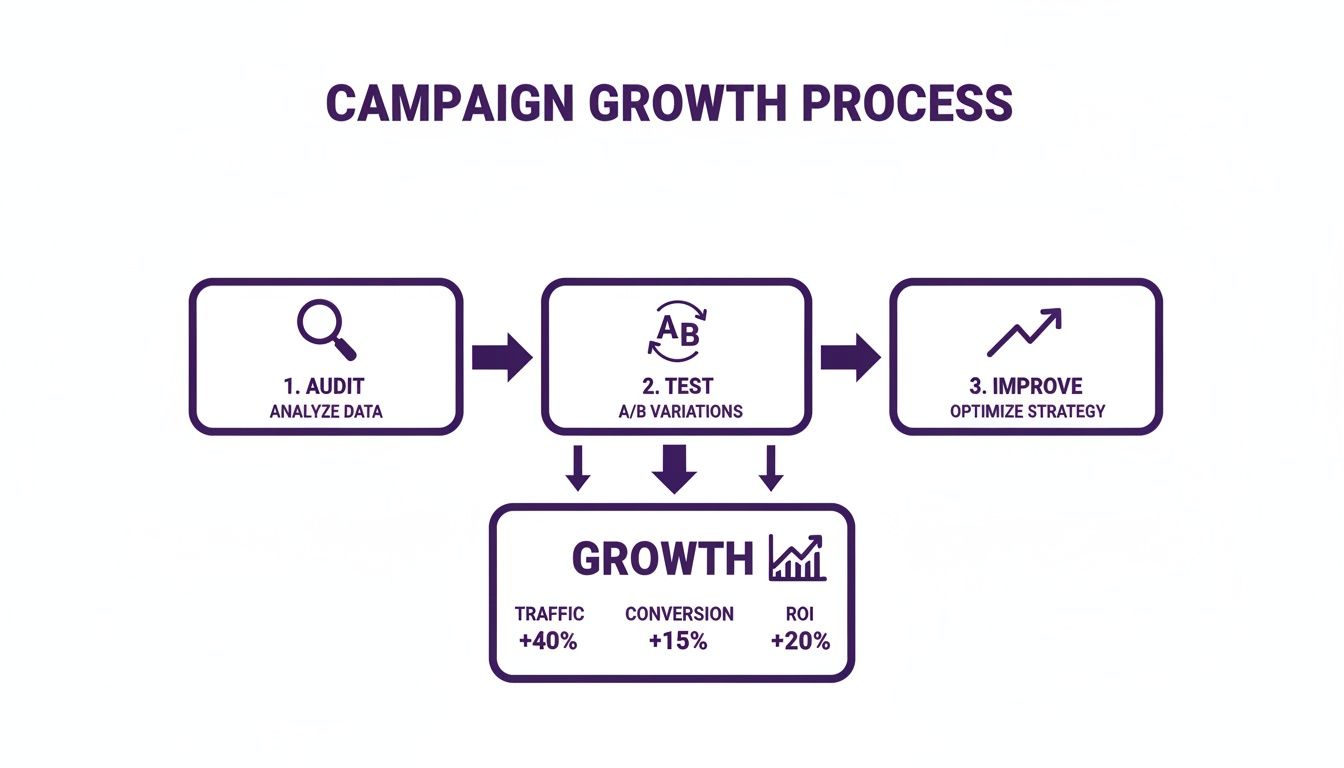
Each step feeds right into the next. The insights you gain from an audit fuel your experiments, and the results from those tests lead to real, meaningful improvements. It’s a system designed to make sure you’re always learning and adapting.
The core idea is simple: You can't improve what you don't consistently measure. Without a structured framework, marketers end up just reacting to performance dips instead of proactively driving growth.
This guide is built to give small and medium-sized businesses (SMBs) a practical framework for putting this process to work—without needing a massive, enterprise-level budget. We're going to break down actionable, channel-specific strategies that give you a clear path forward. Once you move beyond guesswork and embrace a system, you can turn your marketing from a cost center into a predictable engine for growth.
Auditing Your Marketing to Find Hidden Wins
Before you can even think about optimizing your campaigns, you have to get a clear picture of what’s actually happening on the ground. A marketing audit is your diagnostic tool. It moves you past gut feelings and assumptions to pinpoint exactly where your efforts are paying off, where they’re stalling out, and—most importantly—where you’re just wasting money.
It’s all about finding the leaky buckets before you pour more of your budget into them.
Think of it like a health check-up. You wouldn't start a new, intense fitness plan without getting your vitals checked first, right? The same logic applies here. A proper review gives you a solid baseline, revealing quick wins and helping you map out a smarter long-term strategy. You’ll probably be surprised by what you uncover. For a deeper look, check out our guide on what a marketing audit is and how to structure one from the ground up.
Assessing Your Paid Advertising Channels
When it comes to paid channels like Google and Meta Ads, the first place to look is your spending. Are you actually putting your budget behind the campaigns that deliver the highest Return on Ad Spend (ROAS)? It's time to dig into the numbers. Look closely at your Click-Through Rate (CTR) and Cost Per Acquisition (CPA) for every single campaign and ad set.
A low CTR is often a dead giveaway that your ad creative or copy just isn't connecting with your audience. On the flip side, if you have a high CTR but a dismal conversion rate, that’s a huge red flag pointing to a disconnect between what your ad promises and what your landing page delivers.
- Audience Targeting: Is your targeting way too broad? A classic mistake is trying to talk to everyone, which just dilutes your message and burns through cash. Look for chances to create smaller, more specific audience segments.
- Ad Creative Performance: Pull up your best- and worst-performing ads. Do you see any patterns? Maybe video ads are crushing your static images, or a certain type of headline consistently gets more clicks.
Evaluating SEO and Content Performance
Your organic presence is a massive, long-term asset. For SEO, an audit means getting granular about where your organic traffic is coming from. Fire up Google Analytics and Search Console to see which keywords are driving not just traffic, but valuable traffic—the kind that actually leads to conversions.
To really find those hidden wins, you need to be thorough. Using an ultimate site audit checklist is a great way to make sure you cover all the technical and on-page details. While you're at it, take a hard look at your backlink profile. Are you earning links from legit, authoritative sites, or are there toxic links dragging down your credibility?
A single underperforming but high-potential blog post, when updated and re-optimized, can sometimes drive more new leads than an entire new campaign. Auditing isn't just about finding problems; it's about spotting untapped potential.
This kind of systematic review is so important because no channel works in a vacuum. A truly integrated marketing approach can deliver 50% more ROI on average, and teams often see efficiency gains of over 31% just by getting their channels to work together. Yet, a shocking 70% of teams admit they don't have an integrated content plan, which is what holds them back from seeing these kinds of results. You can find more stats like this in a 2025 report from Marketing Dive.
To help you get started, here's a quick look at the core metrics you should be focusing on for each channel.
Key Metrics for Your Channel Audit Checklist
| Channel | Primary Metric | Secondary Metric | What It Tells You |
|---|---|---|---|
| Paid Ads (PPC) | Return on Ad Spend (ROAS) | Cost Per Acquisition (CPA) | The overall profitability and efficiency of your ad budget. |
| SEO | Organic Conversions | Keyword Rankings | How well your content is attracting and converting qualified traffic. |
| Email Marketing | Conversion Rate | Click-Through Rate (CTR) | The effectiveness of your email copy and offers at driving action. |
| Social Media | Engagement Rate | Referral Traffic | How well your content resonates with your audience and brings them to your site. |
| Content Marketing | Leads Generated | Time on Page | Whether your content is capturing valuable leads and holding visitor attention. |
This table isn't exhaustive, but it's a solid starting point. By regularly tracking these metrics, you can move from guessing to knowing, making sure every dollar and hour you invest is pushing you closer to your goals.
Running Marketing Experiments That Actually Work
So, you’ve audited your campaigns and found the weak spots. That’s the easy part. Now it's time to roll up your sleeves and move from just looking at data to actually doing something with it. This is where we stop guessing and start testing systematically to get those small, consistent wins that add up over time.
It’s all about building a real program for experimentation—one that gives you reliable insights you can confidently act on.

A good experiment always starts with a clear, testable hypothesis. A weak one sounds like, "Let's try a new ad." A strong one is specific, measurable, and gives you a reason why you think it'll work.
For instance, instead of just throwing something at the wall, you might hypothesize: "Using a customer testimonial in our Meta ad creative will increase our landing page conversion rate by 15% because it adds social proof." See the difference? Now you have a clear metric for success.
Crafting a Strong Hypothesis
Every solid experiment is built on this foundation. Your hypothesis needs to connect a specific change to an expected outcome, and it has to be grounded in some kind of logic. This simple structure is what turns random ideas into focused tests that teach you something, whether you win or lose.
I always come back to a simple framework:
- If I [make this specific change]…
- Then [this specific metric] will improve…
- Because [here’s the assumption I'm making].
This forces you to be critical about what you’re really testing and why. It also makes it way easier to figure out what happened when the results come in and understand the customer behavior behind them.
Designing a Valid A/B Test
The gold standard here is the A/B test (or split test). The concept is dead simple: you show two different versions of something—a webpage, an email, an ad—to two different groups from your audience and see which one performs better. If you want to dive deeper into the basics, we've got a guide on what A/B testing in marketing is and how to put it into practice.
But running a successful A/B test is more than just making a "B" version. For the results to mean anything, your test has to be statistically sound. That means letting it run long enough to gather enough data and hit statistical significance—you're usually shooting for a confidence level of 95% or higher.
Don't call a test early just because one version is ahead. Early results can be super misleading. You have to let the experiment run its full course to avoid making a decision based on random noise instead of what users actually prefer.
Practical Experiment Ideas for Every Channel
The core idea of testing is universal, but the tactics change depending on the channel. The absolute key is to isolate just one variable at a time. If you change the headline, the image, and the call-to-action all at once, you'll have no clue which change actually made a difference.
Here are a few channel-specific ideas to get your gears turning:
- Paid Ads (Meta/Google): Pit different headlines against each other. Test a video creative versus a static image. Try a new CTA button like "Shop Now" instead of "Learn More."
- Email Marketing: A/B test your subject lines—it’s the easiest way to improve open rates. You could also test the sender name (like "Jen from Frozen Crow" vs. "The Frozen Crow Team") or different discount offers.
- Landing Pages: Test a completely new page layout. Try simplifying your contact form by removing a few fields. See if embedding a customer video testimonial gives you a conversion lift.
By building a backlog of these small, focused experiments, you create an engine for continuous improvement. Every test—win or lose—gives you another piece of the puzzle, moving you one step closer to a marketing machine that's firing on all cylinders.
Using Data and AI for Smarter Optimization
Long gone are the days of making marketing decisions based on gut feelings. Today, it’s all about technology. The good news is that you don’t need a team of data scientists to make faster, smarter decisions—the tools are more accessible than ever.
It really starts with the data you already have. Think of tools like Google Analytics as more than just a traffic counter; they’re a roadmap of your customer’s entire journey. You can see exactly where people drop off, what content pulls them in, and which channels are actually delivering the goods.

When you start layering in other tools, the picture gets even clearer. Heatmaps, for instance, give you a visual cheat sheet, showing you what users are clicking on and what they’re completely ignoring. That’s gold when you’re trying to figure out why a landing page isn’t converting.
Putting AI to Work for You
Artificial intelligence has totally changed the game here. Platforms like Google and Meta now have incredibly powerful AI baked right in, handling things like smart bidding and audience targeting through features like Advantage+. This means the ad platforms themselves are working 24/7 to get you the most bang for your buck.
And it’s not just hype. The impact is real, with 58% of marketers pointing to AI as the number one reason they’ve been able to scale their campaigns. They’re automating everything from bidding to A/B tests. With more than half planning to sink more money into AI in 2025, it’s safe to say this isn't a passing trend.
AI isn't here to replace marketers; it's here to empower them. It handles the repetitive, data-heavy lifting, freeing you up to focus on the creative and strategic elements that drive real growth.
This is where you can start using AI for practical, day-to-day tasks. For one, you absolutely need clean data, and using a UTM builder tool makes tracking your campaign performance way less of a headache.
You can also use AI for things like:
- Content Ideation: Stuck on blog ideas or ad copy? AI can spit out dozens of variations in seconds.
- Email Personalization: Imagine crafting subject lines and body copy that adapt to what each user has done on your site. AI makes that possible.
- Audience Insights: Let an AI tool chew on your CRM data. It can uncover hidden patterns and pinpoint your most valuable customer segments you didn't even know existed.
By weaving these tools into your workflow, you’re not just saving time—you’re unlocking insights that would have been impossible to find manually. The trick is to see data and AI as your assistants, not as some complicated hurdle. They’re here to help you make smarter moves.
If you’re curious to dig deeper, our article on how predictive analytics for marketing works is a great next step.
Actionable Optimization Tactics for Key Channels
Theory is great, but real growth happens when you get your hands dirty and apply specific, proven tactics to each of your marketing channels. Think of this as your playbook for turning those audit insights into actual results. The goal isn't just to be busy; it's to be effective.

We're moving from the 30,000-foot view down to the granular changes that can move the needle almost immediately. Every channel has its own unique levers, and knowing which ones to pull makes all the difference.
Optimizing for Search Engine Intent
In SEO, traffic is just a vanity metric if it doesn't convert. True optimization means you have to get past chasing high-volume keywords and start focusing on user intent. You need to ask yourself: what is the searcher actually trying to do?
Instead of only targeting a broad term like "running shoes," a smart e-commerce store also goes after long-tail keywords like "best trail running shoes for wide feet." This brings in a highly qualified buyer who is much closer to making a purchase.
This isn't just about keywords, though. It’s about how you structure your content.
- Informational Intent: Someone is asking a question. Answer it with an in-depth blog post or a how-to guide.
- Commercial Intent: They're comparing options. Give them what they want with detailed product comparisons or unbiased reviews.
- Transactional Intent: They're ready to buy. Make your product and category pages dead simple to navigate, with crystal-clear calls-to-action.
When you align your content with what the user wants, you naturally improve rankings and, more importantly, attract visitors who are primed to become customers.
Refining Paid Ad Campaigns
When it comes to paid channels like Google and Meta Ads, success is a game of relevance and efficiency. Your main job is to constantly refine your audience targeting and improve your Ad Relevance Score.
A classic mistake I see all the time is using the same broad audience for every single campaign. Don't do that. Instead, build out specific retargeting flows. For example, you can create an audience of users who added an item to their cart but bailed. Then, hit them with ads featuring a small discount or a killer customer testimonial to nudge them over the finish line.
Your ad is an interruption. To be effective, it has to feel less like an advertisement and more like a helpful solution that appeared at the exact right moment.
This is precisely why a strong message match between your ad copy and your landing page is non-negotiable. If your ad screams "50% Off All Sweaters," the landing page better have sweaters at 50% off, front and center. Any friction kills conversions. Period.
Boosting Email and Social Engagement
For email marketing, segmentation and automation are your superpowers. Please, stop sending the same generic newsletter to your entire list. Segment subscribers based on their purchase history, how often they open your emails, or where they signed up.
A B2B company could set up an automated welcome series for new leads, educating them over several emails before ever asking for a demo. An e-commerce brand can create a "we miss you" campaign with a special offer for customers who haven't bought anything in 90 days.
Over on social media, it's time to shift your focus from vanity metrics like "likes" to creating valuable content that actually drives leads. Tweak your profile bios to include a clear call-to-action and a link to a relevant landing page. This simple change turns your social profile from a passive broadcast tool into an active part of your sales funnel. This move is huge, especially since content marketing often costs 62% less than traditional methods while generating three times as many leads. If you want to dive deeper, you can learn more about the impact of digital marketing on lead generation.
A Few Common Questions
Diving into campaign optimization always brings up good questions. We hear a lot of the same ones, so I wanted to tackle them head-on to give you some clarity as you start refining your marketing.
How Often Should I Actually Be Optimizing My Campaigns?
Honestly, there’s no magic number. It's less about a rigid schedule and more about creating a rhythm of continuous monitoring paired with deeper, periodic reviews. The right cadence really comes down to the channel and how fast you can get meaningful data back.
For something fast-paced like paid ads on Google or Meta, you should be glancing at performance daily. You're just looking for red flags—a sudden spike in spending or a tank in engagement. The real, deliberate tweaks, however, should happen weekly at most. This stops you from overreacting to the natural, random ups and downs of any given day.
On the other hand, channels with a much longer feedback loop, like SEO and content marketing, demand patience. A monthly review is a good pace to spot trends in your rankings and organic traffic. Then, I’d block off time for a full, deep-dive audit every quarter to step back and reassess the entire strategy. Email is its own beast; you should be analyzing performance after every single send to pull immediate insights that can make your very next email even better.
The real goal here is to build a consistent habit of reviewing and refining. Treating optimization as a proactive, ongoing process—not a reactive, one-off task—is what separates the campaigns that win from the ones that just fizzle out.
What Are the Most Important Metrics to Track?
It’s incredibly easy to drown in data. The trick is to be relentless about focusing on the metrics that tie directly to your business goals—not just the flashy "vanity metrics" that look good on a dashboard.
Think of these as your North Star metrics:
- Cost Per Acquisition (CPA): This is the bottom line. It tells you exactly what it costs to get a new customer in the door.
- Return on Ad Spend (ROAS): For paid campaigns, this is the most direct measure of profitability. Are you making more than you're spending?
- Conversion Rate: This shows how efficiently your funnel is working. What percentage of people who visit actually take the action you want them to?
- Customer Lifetime Value (CLV): This one gives you the long-term view, showing you what a customer is truly worth to your business over time.
Sure, things like Click-Through Rate (CTR) and Engagement Rate can be useful leading indicators, but they only matter if they eventually lead to a real conversion. At the end of the day, the best metric is the one that answers a simple question: are you profitably acquiring and keeping customers?
Can I Really Optimize Campaigns on a Small Budget?
Absolutely. In fact, when your budget is tight, optimization isn't just important—it's everything. Every single dollar has to work harder. A limited budget forces you to be smarter and more strategic, which is the whole point of optimization in the first place.
Your best bet is to start with low-cost, high-impact channels where your main investment is time, not cash. SEO and email marketing are perfect for this. Building organic traffic and nurturing an email list are powerful, long-term assets that don't require a huge ad spend.
When you do dip into paid ads, the key is to run small, highly targeted tests. Use a tiny budget to prove out your messaging, your creative, and your audience before you even think about scaling. The principle is the same no matter the budget: use data to find what works, then double down on it with your limited resources.
Ready to stop guessing and start building a clear, data-driven strategy? The team at Frozen Crow Inc. offers free marketing audits to uncover your biggest opportunities. Let us help you build a marketing engine that drives measurable growth.


