


October 13, 2026
What Is a Marketing Audit? A Guide to what is a marketing audit
Think of a marketing audit as a complete, top-to-bottom health check for every part of your marketing machine. It’s a deep dive designed to show you exactly what’s working, what's just burning through your budget, and where your biggest growth opportunities are hiding.
Defining Your Marketing Health Check

It’s a bit like taking your car to a trusted mechanic for a full inspection. You wouldn’t just have them check the tires and call it a day, right? You'd want them to look under the hood—at the engine, the brakes, the fluids, the whole system. A real marketing audit works the same way. It goes way beyond a quick glance at your social media stats or a basic website scan.
Instead, it’s a systematic review of everything from your high-level strategy and market position down to the nitty-gritty performance of individual channels like SEO, paid ads, and email campaigns. This isn't some new-age concept; it's a time-tested business practice. For decades, experts have used audits to get a clear picture of a company's marketing environment, goals, and day-to-day activities, as detailed in this overview from SmartBug Media.
It’s Not About Finding Fault
Let's get one thing straight: the point of an audit isn't to point fingers or just list everything that's broken. While it definitely uncovers weak spots, its real value is in providing clarity. It gives you a data-driven roadmap for what to do next.
An audit is what turns marketing from a jumble of disconnected tactics and gut feelings into a cohesive, measurable engine for growth.
A marketing audit replaces assumptions with certainty. It’s the essential first step to building a resilient marketing strategy that consistently performs and delivers a clear return on investment.
Instead of just hoping your ad spend is paying off, an audit shows you exactly which campaigns are driving the highest ROI. Rather than guessing which blog posts your audience likes, it tells you precisely which content is bringing in the most traffic and turning visitors into customers.
The Foundational Principles of an Audit
For an audit to actually be useful, it needs to follow a few core principles. This isn't a random spot-check; it's a structured process. Knowing the difference helps you tell a genuine, in-depth audit from a surface-level review.
To understand what a proper audit involves, let's break down its key characteristics.
Key Characteristics of a True Marketing Audit
| Characteristic | Why It Matters |
|---|---|
| Comprehensive | You can't fix an engine by only looking at the spark plugs. An audit must cover all your marketing activities to see how they work together (or against each other). |
| Systematic | A methodical, step-by-step approach ensures nothing is missed. It's an orderly process, not a chaotic hunt for problems. |
| Independent | An unbiased, outside perspective is crucial. An internal team can be too close to the work, but an independent party can spot issues you've overlooked. |
| Periodic | The market is always changing. Regular audits—at least once a year—ensure your strategy stays relevant and effective, adapting to new trends and business goals. |
These principles are what give an audit its power. It’s not just a report; it’s an actionable blueprint for making smarter decisions, outmaneuvering the competition, and ensuring every single dollar you spend on marketing is working as hard as it possibly can.
Why a Marketing Audit Is Non-Negotiable for Growth
So you know what a marketing audit is. The real question is why it matters. Think of it less like a routine check-up and more like one of the smartest strategic investments you can make. It’s the tool that shifts you from hopeful guesswork to data-driven certainty, building the foundation for a marketing plan that actually grows your business.
What if you found out you were burning thousands each month on a forgotten Google Ads campaign targeting the wrong people and bringing in zero leads? Or what if a few tweaks to an overlooked blog category could double your organic traffic in the next six months? These aren't just hypotheticals—they are the exact kinds of game-changing insights a real audit uncovers.
Without this deep dive, most businesses are just operating on assumptions. You might feel like your social media is doing great, but an audit can show you that while likes are up, you're getting almost no website traffic or sales from it. It's all about connecting the dots between your day-to-day marketing grind and what’s actually happening on the bottom line.
Align Your Efforts with Business Goals
One of the biggest traps in marketing is misalignment. It’s easy to get sidetracked chasing vanity metrics—likes, impressions, follower counts—that do nothing for the company's real goals, like boosting revenue or grabbing more market share. A marketing audit holds every activity, channel, and dollar accountable.
It forces you to answer the tough questions that connect marketing to the bigger business strategy:
- Resource Allocation: Is our budget actually going into the channels that give us the best ROI?
- Strategic Focus: Does our messaging and content really support our main business goals for the quarter?
- Performance Tracking: Are the KPIs we're obsessed with actually measuring growth, or are they just noise?
By getting clear answers here, an audit makes sure every piece of your marketing puzzle fits together, pushing the whole business forward in the same direction.
Adapt to Market Shifts with Confidence
The market never sits still. New competitors pop up, customer behavior changes on a dime, and algorithms get rewritten overnight. A strategy that killed it last year could be completely useless today. Flying blind in this kind of environment is just asking to waste time and money.
A regular marketing audit is your strategic compass. It gives you the clarity to pivot quickly and confidently, helping you survive market shifts—and even capitalize on them.
This process shines a light on new trends you can jump on and flags threats before they become full-blown crises. It might show you a competitor is suddenly eating your lunch on a keyword group you used to own, telling you it’s time for a strategic SEO counter-attack. Or maybe it reveals that engagement on a social platform is tanking, signaling that it's time to move those resources to a channel with more potential.
This is the kind of proactive thinking that separates businesses that thrive from those that get left behind. It’s the difference between reacting to the market and leading it.
The Core Components of a Comprehensive Marketing Audit
A proper marketing audit isn’t a quick once-over. It's a deep, multi-faceted investigation into every corner of your strategy. Think of it like a full vehicle inspection before a long road trip. You wouldn't just check the tire pressure and call it a day, right? You'd look under the hood, inspect the engine, check the electrical systems, and make sure the whole machine is sound.
That's exactly what a marketing audit does for your business. It examines several distinct but interconnected pillars to build a complete, honest picture of your performance.
This comprehensive approach is non-negotiable because marketing channels never operate in a vacuum. A slump in your SEO rankings might not be a content problem—it could be a technical issue bogging down your website. Low engagement on social media might have less to do with your posts and more to do with a messaging strategy that’s completely misaligned with your audience. By digging into each component, you can find the real source of your problems and uncover opportunities you never knew you had.
This flowchart shows how a structured audit gives you clarity, aligns your team, and ultimately clears the path for real growth.
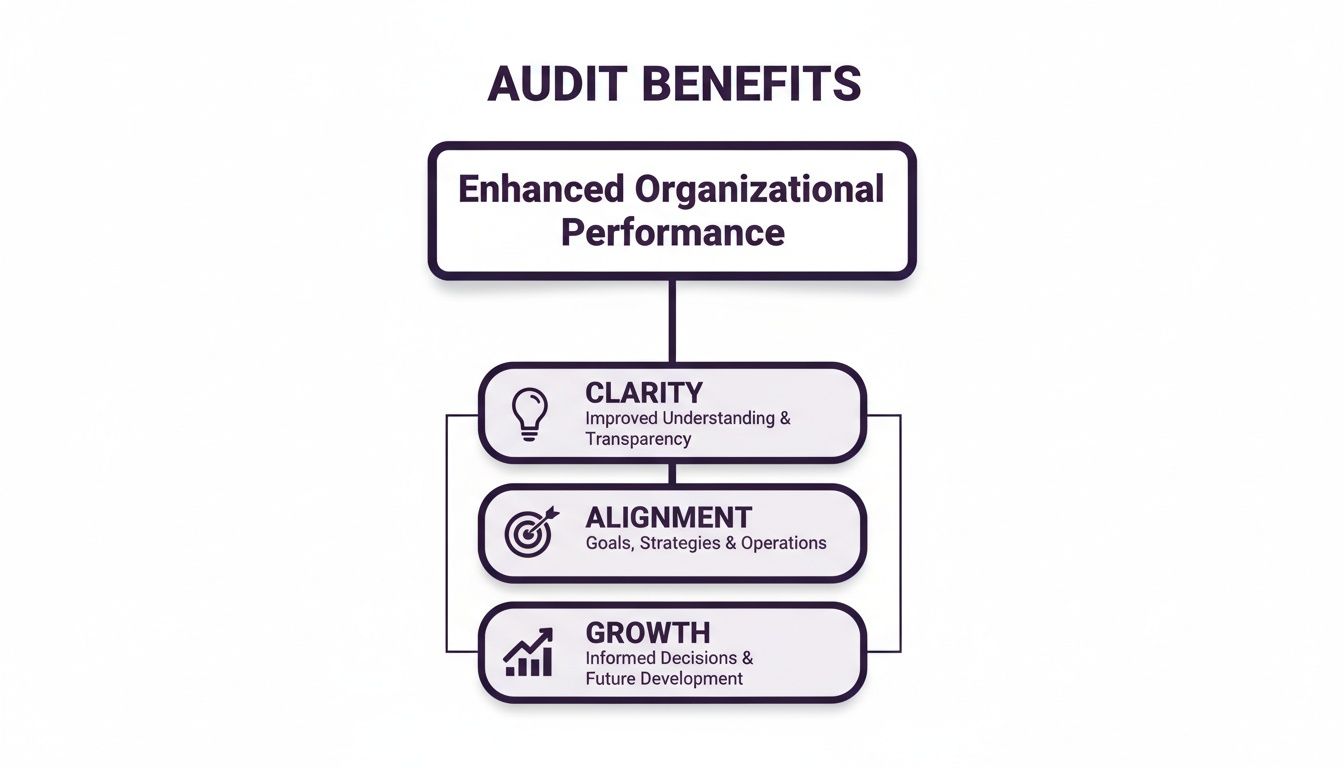
It’s all about moving from confusion to a focused strategy that actually drives results. Let’s break down the core pillars that get you there.
Your Marketing Environment and Strategy
Before you start grading your own homework, you need to understand the classroom you're in. This first step is all about zooming out to look at the external forces and your own internal strategy. It's about assessing the playing field before you critique your own game plan.
A huge piece of this puzzle is a deep dive into your competitors. What are they doing right? Where are they dropping the ball? Analyzing their strengths and weaknesses gives you critical context for your own results. For a full breakdown, check out our guide on https://frozencrow.com/how-to-conduct-competitive-analysis/. This foundational work ensures your audit is grounded in reality, not just wishful thinking.
Ask yourself these questions:
- SWOT Analysis: What are our real Strengths, Weaknesses, Opportunities, and Threats right now?
- Competitor Positioning: Who are our direct and indirect competitors, and how does their messaging and market share stack up against ours?
- Goal Alignment: Are our marketing goals clear, measurable, and actually connected to what the business needs to achieve?
Channel Performance Deep Dive
Okay, now it’s time to get your hands dirty. This is where you get into the tactical weeds, reviewing every single channel you're using—from organic search and email campaigns to your paid ads. You're not just glancing at vanity metrics; you're investigating the true efficiency and ROI of each one.
A thorough audit often includes specialized reviews, too. For instance, a dedicated social media audit can pinpoint exactly why your engagement is flatlining on one platform while another is taking off. This granular detail is crucial for figuring out which channels are genuine growth engines and which are just burning cash.
An effective channel audit tells the story behind the data. It answers why your cost-per-click is creeping up or why your email open rates suddenly tanked, moving you from simply observing a problem to actually solving it.
Website and User Experience
Your website is the central hub for nearly all your marketing efforts. It's where traffic from every other channel eventually lands. If that hub is slow, confusing, or broken, every dollar you spend elsewhere is compromised. This pillar looks at both the technical health of your site and how real humans experience it.
A technically sound website is fast, secure, and easy for search engines to crawl. But just as important is the User Experience (UX)—can visitors actually find what they need and do what you want them to do, like fill out a form or make a purchase, without getting frustrated?
- Technical Health: Does the site have broken links, sluggish page load times, or issues on mobile devices?
- Conversion Path: How easy is it for a new visitor to go from a blog post to a product page and through checkout? Is the path clear or a maze?
- User Flow: Where are people leaving your site? Are there specific pages with alarmingly high exit rates?
Content and Messaging Audit
Your content is your brand's voice. This part of the audit checks if that voice is clear, consistent, and—most importantly—actually connecting with your target audience. We’re talking about everything from blog posts and case studies to website copy and ad creative.
The goal here is simple: is your content doing its job? Is it attracting the right people, keeping them engaged, and convincing them to take the next step? Pumping out a high volume of content is useless if it isn't resonating with your audience or supporting your business goals. This is about making sure your messaging is a strategic asset, not just more noise.
Systems and Tools Evaluation
Finally, a complete audit peeks under the hood at the engine running your marketing machine: your tech stack. Are your CRM, analytics platforms, and automation tools set up correctly? Are they talking to each other?
An inefficient or poorly configured tech stack leads to bad data, wasted hours, and missed opportunities. This pillar ensures your tools are empowering your team, not holding them back. The audit sniffs out redundancies, data silos, and underused features so you can get the maximum value from your technology investments.
Your Step-By-Step Marketing Audit Process

Running a marketing audit can feel like a monster of a project. But if you break it down into a clear, step-by-step process, it stops being this intimidating task and starts looking like a roadmap to real results.
Think of it like building a piece of furniture. You wouldn’t just dump out the box and start forcing pieces together, right? You’d follow the instructions to build something sturdy that actually works. This five-stage approach gives you those instructions for your audit.
Stage 1: Define Your Scope and Objectives
Before you even think about looking at a single spreadsheet, you have to define the rules of the game. What are you actually trying to accomplish here? Without clear goals, your audit will be all over the place, leaving you with a mountain of data but zero real insights.
Start by asking the big questions:
- What's the main goal? Are we aiming to boost lead generation by 15%? Or maybe we need to slash our customer acquisition cost (CAC)?
- What's the scope? Are we doing a full-blown audit of every single channel, or are we just zeroing in on a problem area, like our paid ads or SEO performance?
- How do we measure success? We need specific Key Performance Indicators (KPIs). Is it conversion rate, cost per lead, organic traffic growth? Pick your metrics and stick to them.
Writing this stuff down gives you a compass for the whole project. It makes sure every step you take from here on out is pulling in the same direction.
Stage 2: Gather Your Data
With your objectives locked in, it’s time to collect your raw materials. This is all about pulling the relevant data from your different platforms to get a complete, honest picture of your marketing performance.
You'll need to dig into a few key sources:
- Analytics Platforms: Get your traffic, conversion, and user behavior data from tools like Google Analytics.
- Ad Platforms: Pull all the performance metrics—clicks, cost, conversions—from Google Ads, Meta Ads, and anywhere else you're spending money.
- CRM Software: Grab the data on lead quality, how long it takes to close a deal, and customer lifetime value.
- Social Media Insights: Collect engagement numbers, follower growth, and referral traffic from all your social channels.
This part can take some time, but don't rush it. Bad data leads to bad conclusions. Be thorough.
Stage 3: Analyze Performance
Okay, now the real detective work starts. You’ve got the data, so it's time to start looking for patterns, trends, and things that just don't add up. The goal here isn't just to report numbers, but to understand the story they’re telling.
Compare your performance against your own history and against industry benchmarks. How are we doing this quarter compared to last? Is our email open rate good, bad, or average for our industry? This is where you pinpoint what you're doing right and where things are going wrong. Studies consistently show that this kind of analysis helps companies spot major issues, like gaps between their strategy and what's actually happening on the ground. You can learn more about the impact of marketing audits on ijstr.org.
Stage 4: Synthesize Findings and Recommendations
An analysis is useless if it doesn't lead to action. This stage is all about turning what you found into practical, strategic recommendations. For every problem you uncover, you need to propose a clear solution.
A finding tells you what is happening (e.g., "Our website's bounce rate is 85% on mobile"). A recommendation tells you what to do about it (e.g., "We need to optimize mobile page speed and simplify the navigation to fix this.").
Group your insights together logically. This turns a messy list of observations into a clear story that highlights the biggest challenges and opportunities ahead.
Stage 5: Build a Prioritized Action Plan
Finally, you have to turn those recommendations into a real plan. This is where the rubber meets the road—it’s the step that connects your insights to actual execution. You need a detailed action plan that assigns tasks to specific people, sets deadlines, and prioritizes everything based on impact and effort.
A simple table is often the best way to lay this all out. When you clearly define each step, you create accountability and make sure your audit actually leads to business growth.
Sample Marketing Audit Action Plan
Here's a quick look at how you can organize your findings into a clear, actionable table.
| Finding | Recommendation | Priority (High/Med/Low) | Owner | Deadline |
|---|---|---|---|---|
| Blog gets traffic but low conversions. | Add targeted calls-to-action (CTAs) to top 10 blog posts. | High | Marketing Team | 2 Weeks |
| Cost per lead on LinkedIn Ads is 50% above target. | A/B test new ad creative and audience targeting. | High | Paid Media Manager | 4 Weeks |
| Email open rates have dropped by 20% in 6 months. | Segment the email list and clean out inactive subscribers. | Medium | CRM Team | 6 Weeks |
| No clear SEO strategy for non-branded keywords. | Conduct keyword research and build a new content plan. | High | SEO Lead | 8 Weeks |
This kind of plan ensures everyone knows what they're responsible for and when it needs to be done, turning your audit from a report into a roadmap for success.
Key Metrics and Red Flags to Look For
Knowing what to look for during a marketing audit is half the battle. Raw data is just noise until you can connect it to specific outcomes and spot the warning signs that signal bigger problems under the hood. It’s all about learning to read the story your numbers are trying to tell you.
This means getting past vanity metrics like raw website visitors or social media likes. You need to zero in on the key performance indicators (KPIs) and red flags that actually reveal the health of your marketing engine. A single metric on its own can be misleading, but when you look at them together, a much clearer picture starts to emerge.
Core Performance Metrics to Track
Think of certain metrics as the vital signs for your marketing health. They give you a high-level view of your efficiency and profitability, connecting what you spend directly to what you get back. Nailing these down is the first step before you dive any deeper.
Here are the foundational KPIs every single audit should put under the microscope:
- Customer Acquisition Cost (CAC): Simply put, this is the total cost of your marketing and sales efforts divided by the number of new customers you brought in. If your CAC is climbing, that's a huge red flag that your strategy is getting less efficient.
- Customer Lifetime Value (LTV): This is the total revenue you can reasonably expect from a single customer over the entire time they do business with you. The magic happens when your LTV is way higher than your CAC—ideally, a ratio of 3:1 or better.
- Return On Ad Spend (ROAS): This one's straightforward: divide the revenue from your ads by how much you spent on them. ROAS measures the direct profitability of your paid campaigns. A low ROAS means you're paying more to get customers than they're worth, at least in the short term.
These three numbers don't work in isolation; they tell a powerful financial story together. They help you understand not just if you're getting customers, but if you're doing it in a way that’s profitable and sustainable. For a deeper dive, our guide on how to measure marketing effectiveness breaks this down even further.
Common Red Flags and What They Mean
Once you get past the big-picture financial KPIs, your audit will start uncovering channel-specific warning signs. These red flags are symptoms of underlying problems that need to be fixed before they cause any real damage.
Think of it this way: a steady drop in organic traffic isn't just a number. It might be a symptom of a technical SEO issue, like poor mobile performance or a recent algorithm penalty you didn't notice. A good audit digs into these channel KPIs to spot the issues. For example, an audit might find that an automated welcome email series has engagement 15% below the industry average, signaling that the messaging or targeting is off, a common finding noted by the experts at SendView.
A red flag is never just a data point. It's an invitation to ask "why?" It prompts you to dig deeper, find the root cause, and fix the actual problem instead of just treating the symptom.
Here are a few common red flags we always watch for during an audit:
- High Bounce Rate on Key Pages: If people are hitting your pricing or product pages and then leaving immediately, something is wrong. It could be a mismatch between your ad and the landing page, a clunky design, or just plain confusing pricing.
- Low Email Click-Through Rate (CTR): When open rates are decent but nobody is clicking, it suggests your email content isn't hitting the mark or your calls-to-action are weak. The message got delivered, but it failed to inspire action.
- Stagnant or Declining Organic Traffic: If your search engine traffic has flatlined or is heading downward, that’s a major warning. This could be caused by new competitors, lingering technical SEO problems, or old content that just doesn't cut it anymore.
- Rising Cost Per Acquisition (CPA): When your CPA in paid campaigns starts to creep up, it's often a sign of ad fatigue—your audience is tired of seeing the same ad—or that the ad auction is getting more competitive (and expensive).
Turning Your Marketing Audit Into Action
An audit is a great starting point, but it's only half the battle. You’ve dug through the data, uncovered the weak spots, and identified the opportunities. Now you have a report full of insights, but the real work is just beginning. What matters is turning those findings into an actual plan that moves the needle.
Without a clear path forward, even the most detailed audit ends up as a file that collects digital dust. The whole point is to replace guesswork with a data-driven roadmap. It tells you exactly where to put your time, money, and effort to get the best possible results and build some real momentum.
Bridging the Gap From Insight to Implementation
For a lot of businesses, this is where things stall out. It’s one thing to know what needs to be fixed; it’s another to actually get it done. This is where having an experienced partner can make all the difference. At Frozen Crow Inc., we live in that space between analysis and action. Our process always starts with a comprehensive, no-fluff audit to give you a clear-eyed view of your marketing.
But we don’t just hand you a list of problems and wish you luck. We roll up our sleeves and work with you to:
- Prioritize what matters most based on the biggest potential impact.
- Build a straightforward execution plan with clear timelines and owners.
- Implement the changes, whether it’s a technical SEO fix or a full campaign overhaul.
- Set up solid tracking to actually measure the results of our work together.
From Audit to Execution with Frozen Crow Inc.
Think of our team as an extension of yours. We bring the specific expertise and resources needed to execute on the audit’s findings, letting you stay focused on running your business. We handle the complex stuff so that the insights from your audit translate directly into more traffic, more leads, and more sales. For example, if the audit shows your paid ads are underperforming, we can build a detailed framework for improving Google Ads performance to get things back on track.
An audit is the diagnosis; the action plan is the cure. Frozen Crow Inc. ensures you get both the right diagnosis and the most effective treatment plan for your marketing health.
We also help you put better systems in place for the long haul. By setting up smarter processes and using tools for marketing reporting automation, we make sure your team can keep a close eye on performance and adapt long after our initial project is done.
Ready to see what's really possible? Let us show you what a true, action-oriented marketing audit can do for your business.
Schedule your free, no-obligation consultation with Frozen Crow Inc. today and take the first step toward data-driven growth.
Your Top Marketing Audit Questions, Answered
Even after mapping out the process, a few practical questions always pop up. Things like timing, who should run the show, and what tech you actually need. Getting these sorted out makes the whole thing feel less like a chore and more like the opportunity it is.
Here are the straight-up answers to the questions we hear most often.
How Often Should We Be Doing This?
There’s no single magic number, but here’s a rhythm that works for almost everyone: a major, deep-dive audit at least once per year. Think of this as your annual physical—it’s where you check the health of your entire marketing system from top to bottom and set your strategy for the year ahead.
But don't stop there. We're big believers in quarterly check-ins. These are lighter, more focused reviews on specific channels or campaigns. They let you react to what's happening now instead of waiting a full year to fix something that's broken. This combo keeps you strategic without losing agility.
Can We Just Do The Audit Ourselves?
Absolutely. Running an in-house audit can be a fantastic way for your team to get their hands dirty with your own data. It builds ownership and a real gut-level understanding of how all the pieces connect. Nothing wrong with that at all.
That said, there's a huge upside to bringing in a fresh pair of eyes. An outside expert isn't emotionally attached to past campaigns or internal politics. They see things your team might miss simply because they're too close to it. That unbiased perspective is often where the most powerful insights come from.
A hybrid approach is often the sweet spot. Let an external expert handle the big annual audit to get that clear, objective strategy. Then, empower your internal team to run with the quarterly check-ins to keep the momentum going.
What Are the Must-Have Tools for an Audit?
You don't need a crazy-expensive tech stack to get started. While there are tons of specialized tools out there, a handful of core platforms will give you 90% of what you need for a powerful audit.
If you’re just starting, focus on mastering these four:
- Google Analytics: This is non-negotiable. It’s your source of truth for website traffic, user behavior, and how people are converting (or aren't).
- Google Search Console: This is where you get the real story on your organic search performance, from keyword rankings to technical site health.
- SEO Platforms (like Semrush or Ahrefs): You'll need one of these for the heavy lifting of competitive analysis, backlink checks, and deep keyword research.
- Your CRM (like HubSpot or Salesforce): This is a goldmine. Your CRM tells you everything about lead quality, how long it takes to close a deal, and what your customers are actually worth.
These platforms are the foundation. Nail these, and you'll have the raw data you need to find out what's really going on.
Ready to move from questions to answers? A professional audit from Frozen Crow Inc. provides the clarity and direction your business needs to grow. Get your free, in-depth marketing audit today.


