


August 20, 2026
Marketing Strategy for Small Business: A Clear Path to Growth
That sinking feeling you get when you're pouring money into marketing but can't quite see what's coming back out? It’s a frustration I’ve seen countless times. The good news is, a winning marketing strategy for small business isn't about outspending your competitors—it's about having a smarter, well-documented plan. This guide is your roadmap to turn marketing from a confusing expense into your most reliable engine for growth.
Why a Clear Marketing Strategy is Non-Negotiable
Just "doing marketing" without a plan is like trying to navigate a new city without a map. You'll waste a ton of time, energy, and money, and probably end up lost. You're just throwing darts in the dark, hoping something connects.
A documented strategy gives you direction. It's the clarity you need to make confident decisions, ensuring every dollar you spend and every hour you work has a purpose. Think of it as your north star, keeping your entire team aimed at the same goal, whether that's boosting online sales or just becoming the go-to name in your neighborhood.
From Guesswork to Growth
A real marketing strategy is what moves you from random, reactive tactics to focused, intentional action. Instead of chasing the latest social media trend, you’ll know exactly which channels your ideal customers actually use and how to reach them there.
- Clarity and Focus: It forces you to get crystal clear on who you are, who you're for, and what makes you the obvious choice.
- Efficient Resource Allocation: With a limited budget and even less time, a plan helps you put your resources where they’ll make the biggest impact.
- Consistent Messaging: It ensures your brand sounds like you everywhere, building the kind of trust and recognition that keeps customers coming back.
This structured approach is what separates the businesses that grow year after year from the ones that just tread water. For a deep dive into a key channel, a solid guide to Facebook marketing for small business can be an absolute game-changer.
The whole point of a marketing strategy is to build a sustainable competitive advantage. It's about knowing your customer's world inside and out, then making deliberate choices about where you'll compete and how you'll win.
The Confidence Gap in Small Business Marketing
So many small business owners I talk to feel a major disconnect between what they spend on marketing and what it actually accomplishes. It's a real problem. In fact, a staggering 73% of small businesses aren't even sure their marketing is working.
Despite that uncertainty, 63% plan to increase their marketing budgets anyway. That stat, which you can explore more on PostcardMania's blog, highlights a massive need for better tracking and data-backed decisions.
A solid strategy closes this confidence gap. By building in performance tracking from day one, you stop guessing and start knowing. You turn your marketing spend into measurable, predictable growth.
Starting With an Honest Marketing Audit

Before you can build a marketing strategy that actually moves the needle, you have to know where you stand. It's tempting to jump straight into new tactics, but launching campaigns without understanding your current position is a surefire way to waste time and money.
An honest marketing audit gives you that essential starting point. This isn't about getting lost in complex spreadsheets or hiring expensive consultants. It’s a straightforward look at what's working, what isn't, and where the real opportunities are hiding.
Evaluating Your Digital Foundation
For most small businesses, your website is the center of your marketing universe. It’s your digital storefront and your number one salesperson. So, that's where we'll start.
First, how quickly does your site load? It might seem like a small detail, but according to Google, 53% of mobile users will bail on a page that takes more than three seconds to load. You can use a free tool like PageSpeed Insights to get a quick diagnosis and some clear steps for improvement.
Next, think about the user journey. Can a first-time visitor immediately understand what you do and how to find what they need? Ask a friend who isn't familiar with your business to try and buy something or find your contact info. Watch where they get stuck—it’s one of the most valuable (and cheapest) forms of user research you can do.
An effective marketing audit isn’t about judging past mistakes. It's about finding what’s already working. You're searching for those bright spots—the one blog post that gets all the traffic or the social channel with surprising engagement—so you can double down on them for some quick wins.
Assessing Your Social Media Presence
Social media can feel like a bottomless pit for your time and energy. An audit helps you focus on what really matters: genuine connection, not just vanity metrics like follower counts. The goal isn't to be everywhere; it's to be effective where you are.
Take a critical look at the platforms you’re currently using:
- Content Performance: Scroll back through the last three months. Which posts got the most real engagement—comments, shares, saves? Look for patterns. Was it a behind-the-scenes video? A customer testimonial?
- Audience Engagement: Are people actually talking to you, or are you just shouting into the void? Real conversations in the comments or DMs are a sign of a healthy, engaged community.
- Profile Health: Is your bio crystal clear? Is there a link to your website? Does your branding look professional and match your website?
This process quickly reveals which platforms are worth your focus and which ones are just draining your resources. If you want to dig deeper into the process, other great resources explain what a marketing audit is in more detail.
To help you get started, I've put together a simple checklist to guide you through the basics.
Marketing Audit Checklist for Small Businesses
| Marketing Area | Key Questions to Ask | Simple Metric to Check |
|---|---|---|
| Website | Is it clear what we offer in 5 seconds? Is it easy to contact us or buy? | Website Bounce Rate (from Google Analytics) |
| SEO | When someone Googles our business name, do we show up first? | Search for your brand name in an incognito window. |
| Social Media | Which platform gets the most meaningful comments and shares? | Engagement Rate (Likes + Comments / Followers) on top 5 posts |
| Email Marketing | Do our emails get opened? Do people click the links inside? | Open Rate & Click-Through Rate (from your email provider) |
| Competitors | What are our top 2 competitors doing well on social media? | Look at the comment section on their most popular posts. |
This checklist isn't exhaustive, but it's a fantastic starting point. It forces you to look at real data instead of just going with your gut.
Understanding Your Competitive Landscape
Finally, you need to know who you're up against. A quick competitor check isn’t about copying what everyone else is doing. It’s about spotting gaps in the market and understanding what your potential customers already expect.
Pick two or three direct competitors and do a little recon. No fancy spy tools needed.
- Check out their website. What’s their main message right on the homepage? Sign up for their newsletter to see how they talk to their audience.
- Look at their social media. Where are they most active? What kind of content gets the most interaction? Pay close attention to the questions people ask in the comments—that’s free market research.
- See if they have a blog. What topics are they writing about? This gives you clues about the keywords they're trying to rank for and what their customers care about.
By running through this simple, three-part audit, you'll replace guesswork with clarity. You’ll have a solid, fact-based picture of your strengths and weaknesses, giving you the foundation you need to build a marketing strategy for small business growth that actually works.
Defining Who You Serve and Why It Matters
Let's cut to the chase: one of the biggest mistakes small businesses make is trying to be everything to everyone. It feels safer to cast a wide net, but it just waters down your message until it doesn't really connect with anyone. The most powerful marketing strategies I've seen are built on a laser-focused understanding of exactly who you're trying to reach.
When you know your ideal customer inside and out, every marketing decision gets easier. Suddenly, you know which social media channels to use, what kind of content will grab their attention, and how to write ad copy that feels like you're reading their mind. This clarity isn't just nice to have; it's the bedrock of a solid marketing strategy for small business owners.

Moving Beyond Simple Demographics
Knowing your customer is more than just listing their age and location. The real gold is in their psychographics—their goals, their daily frustrations, what motivates them, and even what they're afraid of. This is where we start building out customer personas.
A customer persona is basically a detailed, semi-fictional profile of your perfect buyer, pieced together from market research and real data you already have. Think of it as creating a character sketch for the person who desperately needs what you sell.
To get started, try answering these questions about them:
- What's their biggest daily frustration related to what you do? (e.g., "Finding a healthy, quick lunch option near the office is a nightmare.")
- What are they ultimately trying to achieve? (e.g., "They just want to eat better so they don't crash at 2 PM.")
- Where do they hang out online to find solutions? (e.g., "They're always scrolling through local food bloggers on Instagram and searching Google Maps for 'healthy salads near me.'")
- What would be the one thing that makes them choose you over a competitor? (e.g., "Being able to pre-order for a quick pickup would be a game-changer.")
Getting this granular helps you craft a message that actually hits home. If you want to dive deeper, we have a whole guide on how to create buyer personas with templates you can use.
Crafting Your Unique Selling Proposition
Once you have a crystal-clear picture of your customer, you need to give them a compelling reason to pick you. This is your Unique Selling Proposition (USP). It’s the one thing that makes you the obvious choice.
A strong USP isn't some fluffy tagline. It’s a direct answer to the customer's unspoken question: "Why should I buy from you?"
Your USP sits at the intersection of what your customers want and what your brand does exceptionally well. It's the specific value you promise to deliver that no one else can. It is your competitive edge, distilled into a single, powerful idea.
To figure out your USP, think about what truly makes you different. It might not be what you sell, but how you sell it.
- Is your customer service on another level? (Zappos built an entire empire on this.)
- Are your products made with superior, locally-sourced materials? (Think of a local bakery that only uses farm-fresh eggs.)
- Do you offer a hyper-specific service for a tiny niche? (Like a dog walker who only works with anxious rescue dogs.)
Putting It All Together: A Practical Example
Let's see how a solid customer persona and a sharp USP can completely change the game.
Imagine you own a small, independent bookstore.
- The Vague Approach: "We sell books for everyone." Your marketing is generic, and you're getting crushed by Amazon's prices and massive selection. It's a losing battle.
- The Strategic Approach: You get specific. Your ideal customer persona is "Literary Lisa," a 35-year-old professional who loves discovering new authors and wants a break from her screen. She's not just buying a book; she wants an experience and a sense of community.
Based on "Literary Lisa," you build your USP: "The only bookstore in town offering curated book recommendations and author events for readers seeking a genuine literary community."
Suddenly, your whole marketing plan snaps into focus.
- Your Content: You launch an email newsletter with staff picks and author interviews, feeding Lisa's desire for discovery.
- Your Events: You start hosting a monthly book club and author signings, creating the community she’s been looking for.
- Your Social Media: Your Instagram stops being a book catalog and starts showcasing the store's cozy vibe and handwritten recommendation cards, appealing directly to her need for an authentic experience.
By defining exactly who you serve, you stop competing on price and start competing on value. You pull in the right people, build a loyal following, and create a brand that actually stands for something.
Choosing the Right Channels for Your Business
Now that you have a sharp picture of who you're talking to, the next question is where to find them. This is where so many small business owners go wrong. They get caught up in the idea that they need to be on every single platform, all at once. That’s a surefire recipe for burnout and getting mediocre results everywhere.
The smarter play? Be selective. Instead of stretching yourself thin across a dozen channels, you’ll see far better results by going deep on just two or three where your ideal customers are already hanging out.
Let Your Audience Guide Your Channel Choice
Go back to your customer persona work—that's your roadmap. If you figured out your ideal customer is a 45-year-old B2B professional, pouring your marketing budget into TikTok probably isn’t the best move. On the flip side, if you’re selling to a younger, visually-driven crowd, a heavy focus on LinkedIn might just miss the mark entirely.
The whole point is to show up where your audience is already looking for answers. This isn't just about demographics; it's about their behavior.
Let's make this real:
- You're a local plumber or landscaper: Your world revolves around Search Engine Optimization (SEO). It's non-negotiable. You absolutely have to show up when someone in your town searches "emergency plumber near me." Local SEO and a well-kept Google Business Profile become your most powerful tools.
- You sell handmade jewelry or custom cakes: Visual platforms like Instagram and Pinterest are your best friends. They're built for visual discovery and can drive a ton of traffic and sales for e-commerce brands.
- You're a financial advisor or marketing consultant: You're selling expertise, so channels like LinkedIn and Email Marketing are gold. LinkedIn lets you build professional authority, while a great newsletter gives you a direct line to nurture leads over time by consistently providing value.
A Quick Breakdown of the Core Channels
Let's look at the pros and cons of a few heavy hitters for small businesses. Don't feel like you need to tackle all of them. Just pick one or two that feel like a natural fit for your business and the people you're trying to reach.
| Channel | Best For | Key Pro | Key Con |
|---|---|---|---|
| SEO & Blogging | Businesses whose customers are searching for solutions online. | Creates a long-term asset that drives free, targeted traffic for years. | It's a slow burn; it can take 3-6 months to see real traction. |
| Email Marketing | Businesses focused on customer loyalty and repeat purchases. | You own your list. It's a direct line to your audience, no algorithm in the way. | Building that list from scratch takes time and a good reason for people to sign up. |
| Brands with strong visuals or a compelling story to tell. | High engagement rates and great e-commerce tools (like Instagram Shopping). | The algorithm is tough, and it demands a steady stream of high-quality visuals. | |
| Businesses targeting specific demographics, especially with local offers. | The ad-targeting capabilities are incredibly powerful with a massive user base. | Organic reach is nearly dead, so you'll likely need an ad budget to be seen. |
Putting Together a Simple Content Plan
Once you’ve picked your channels, you have to feed them. A content plan doesn't have to be some monstrous, complicated document. At its core, it's just about consistently answering your customers' biggest questions and solving their problems.
Start by brainstorming topics based on the customer pain points you identified earlier. What do they struggle with? What information would genuinely make their lives easier? If you're a local accountant, you might write about "5 Common Tax Mistakes Small Businesses Make" or "How to Actually Read a Profit & Loss Statement."
Your content's job is to build trust and establish your authority long before a customer is ready to buy. By generously sharing your expertise, you become the obvious choice when they finally need your product or service.
A business blog is one of the most effective ways to make this happen. Research shows small businesses that blog get 55% more website traffic, yet a surprising 28% aren't doing it. That gap is a massive opportunity to get ahead of the competition just by being helpful and consistent. You can dig into more stats about the impact of blogging for small businesses at Sixth City Marketing.
To keep yourself on track, use a simple content calendar. It can be a basic spreadsheet that maps out what you'll post, where you'll post it, and when. This simple tool turns your big ideas into an actual action plan and helps you build the momentum you need to see real results.
Setting a Budget and Measuring Real Growth
Let's be honest: a marketing strategy without a budget is just a wish list. And marketing without measurement is like throwing money into a black hole. For any marketing strategy for small business to actually work, it needs to be tied to financial reality and focused on real, tangible results.
This is the part where we move from big ideas on a whiteboard to making smart investments in your company's future.
Many small business owners see marketing as just another expense on the P&L sheet. I urge you to reframe that thinking. You're not just spending money; you're investing it to bring in new customers and grow your revenue. That small shift in perspective changes everything.
How to Set a Realistic Marketing Budget
There’s no magic number here, but a common rule of thumb for small businesses is to allocate somewhere between 7-12% of your total revenue to marketing. If you’re in a serious growth phase or a cutthroat market, you might need to push that closer to 15-20%.
But percentages are just a starting point. A much more practical way to build your budget is to work backward from your goals.
- Goal-Based Budgeting: Figure out what you want to achieve first. Let’s say your goal is to land 50 new customers this quarter. If you know from past efforts that your average Customer Acquisition Cost (CAC) is about $100, then your budget is simple math: 50 customers x $100 each = $5,000.
- Channel-Specific Allocation: Don't just throw all your funds into one big pot. Be strategic. You might put 50% into Google Ads because it delivers high-intent leads, 30% into content creation for its long-term SEO value, and 20% into email marketing to keep your current customers coming back.
You don't need a massive war chest to get started. Dedicate a small, manageable amount to one or two channels, track the results like a hawk, and once you see a positive return, you can reinvest those profits with confidence.
Moving Beyond Vanity Metrics
Likes, shares, and follower counts are nice for the ego, but they don't pay the bills. True growth is measured by Key Performance Indicators (KPIs) that connect directly to your bottom line. You have to get comfortable with the numbers that show if your marketing is actually making you money.
Essential Marketing KPIs for Small Business Growth
Here are the core metrics every small business owner should have on their radar. This table breaks down what they mean and how to calculate them without needing a data science degree.
| KPI | What It Measures | Simple Formula |
|---|---|---|
| Customer Acquisition Cost (CAC) | The average cost to gain one new paying customer through your marketing efforts. | Total Marketing Spend / Number of New Customers Acquired |
| Conversion Rate | The percentage of website visitors or leads who take a desired action (e.g., make a purchase, fill out a form). | (Number of Conversions / Total Visitors) * 100 |
| Customer Lifetime Value (CLV) | The total revenue you can expect from a single customer over the course of your business relationship. | (Average Purchase Value) x (Average Purchase Frequency) x (Average Customer Lifespan) |
| Return on Investment (ROI) | The profit generated from your marketing campaigns compared to the cost. | ((Revenue from Marketing – Marketing Cost) / Marketing Cost) * 100 |
Tracking these isn't as intimidating as it sounds. A simple spreadsheet and the free version of Google Analytics can give you everything you need to start making smarter decisions. If you really want to dig in, our guide on how to calculate marketing ROI offers a more detailed walkthrough.
Using Data to Drive Decisions
Your data is telling you a story about what your customers want and how they behave. Tools like Google Analytics are your window into that story.
Here’s a look at a typical Google Analytics dashboard showing where traffic comes from.
This simple snapshot shows you exactly which channels are sending people your way. You can immediately spot your top performers (where you should invest more) and the ones that are lagging (where you might need to change things up).
Data removes the guesswork. When you know that every dollar you put into Google Ads brings back five dollars in revenue, increasing your ad spend is no longer a scary decision—it’s a logical business move.
Think of your measurement process as a continuous loop: set a budget, run your campaigns, track your core KPIs, and then use that data to refine your strategy for the next round. This is how a static plan becomes a dynamic engine for sustainable growth.
Executing Your First 90 Days
A documented marketing strategy is just a piece of paper until you actually put it into action. This is where so many small business owners get stuck, staring at a mountain of tasks and feeling completely overwhelmed.
The key is to forget the mountain and focus on the first few steps. Break it all down into a manageable 90-day plan. The goal here is to build momentum with steady, measurable progress, not to boil the ocean. This phased approach keeps you from burning out and ensures you’re making smart, intentional moves right from the start.
The First 30 Days: Foundational Setup
Your first month is all about laying a solid groundwork for everything that follows. Forget about launching massive campaigns for now. Instead, focus on getting your systems and intelligence in place. Think of it as building the engine before you ever try to drive the car.
This is the prep work that makes everything else you do actually work.
- Complete Your Audit: Finalize that marketing audit we talked about earlier. You absolutely need a clear, documented baseline of where you're starting.
- Solidify Personas: Lock in your top 1-2 customer personas. I mean it—print them out, give them names, and stick them on the wall so anyone involved in marketing knows exactly who they’re talking to.
- Set Up Analytics: Make sure Google Analytics is correctly installed on your site. Just as important, set up conversion goals to track the actions that matter, like form submissions or newsletter sign-ups.
This whole process is a simple loop: you invest, you track what happens, and you use those insights to grow smarter.
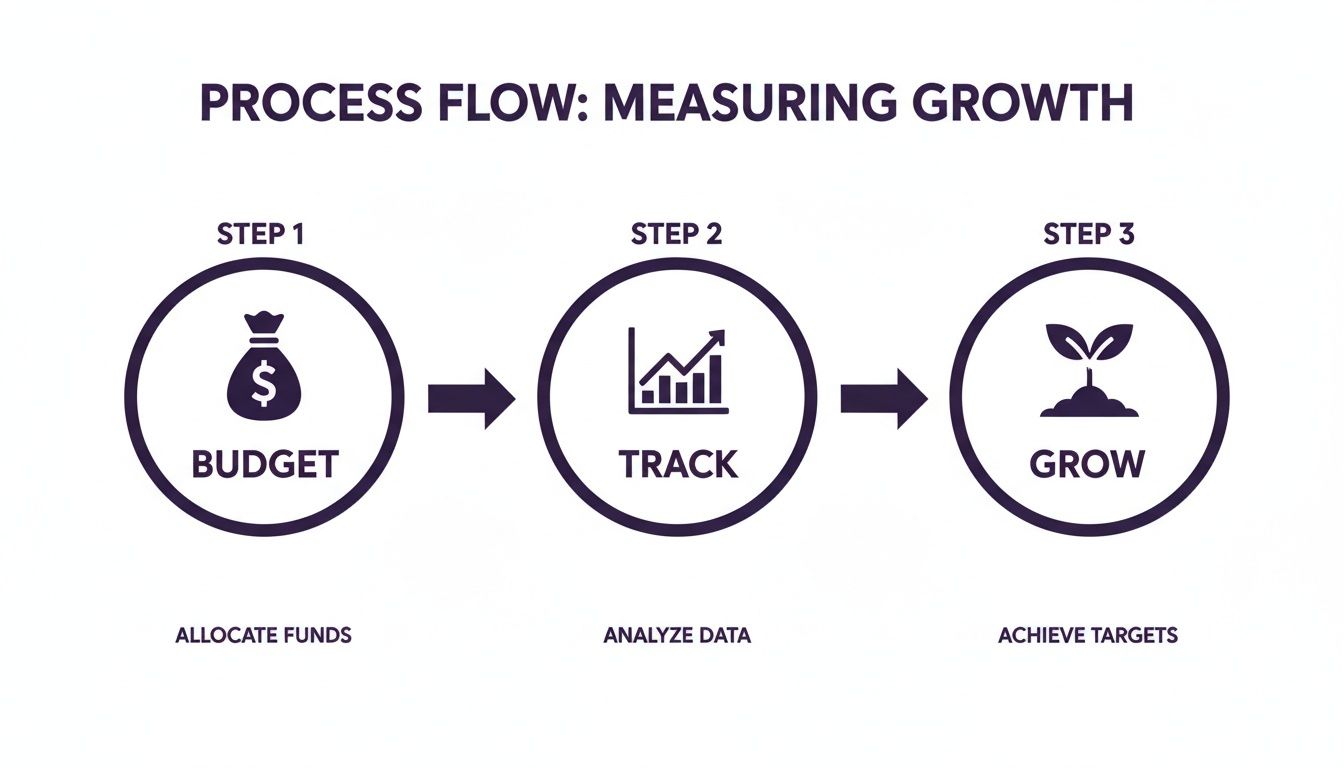
This visual really drills home the core loop: budget, track, and grow. It’s a cycle, not a one-time event.
The Next 30 Days: Consistent Execution
With your foundation secure, month two is all about execution. This is where you flip the switch on the channels you selected and start consistently publishing the content you planned.
The watchword for this phase is consistency. It’s far more important than perfection.
The goal is to establish a rhythm. It’s so much better to publish one good blog post every week than to publish four amazing ones in the first week and then go silent for the rest of the month.
During this period, your primary activities shift from planning to doing.
- Publish Content: Whatever your content calendar says, do it. If you planned two blog posts and four social media updates per week, hit that target. No excuses.
- Build Your Email List: Start actively promoting your email newsletter. Add sign-up forms to your website and create a simple lead magnet—a checklist, a short guide, a template—to give people a reason to subscribe.
The Final 30 Days: Analysis and Optimization
By the last 30 days of this initial push, you’ll finally have your first batch of meaningful data to look at. This is gold.
Now, you can start making small, informed adjustments to your marketing strategy for small business. We're not talking about a massive overhaul here. This is about finding early wins and trimming what obviously isn’t working.
Dive into your analytics and start asking questions. Which blog post drove the most traffic? Which social media channel got the best engagement? Which email subject line had the highest open rate?
Use these early indicators to refine your approach for the next 90-day cycle. Double down on what resonates with your audience and pull back on the rest.
Common Questions We Hear All the Time
Seriously, How Much Should My Small Business Spend on Marketing?
There’s no magic number, but a solid rule of thumb is to put 7-12% of your total revenue toward marketing. If you’re just starting out or you're in a big growth push, you might need to dial that up to 15-20% to really make some noise.
The exact percentage isn't the point, though. The real key is tying every dollar you spend back to a specific business goal and then tracking your return obsessively. That's how you make sure your budget is actually working for you.
What’s the Best Marketing Channel if I’m on a Shoestring Budget?
For the best bang for your buck over the long haul, it’s tough to beat SEO and content marketing. Building out a blog that genuinely answers the questions your customers are asking is a surefire way to drive free, organic traffic for years.
And don't sleep on email marketing. It’s incredibly cheap and one of the best ways to nurture the leads you already have, encouraging repeat business and turning one-time buyers into loyal fans.
Look, the smartest marketing play for a small business isn't about being everywhere. It's about picking the one or two channels where your customers live and absolutely owning them.
How Long Before I Actually See Results from This New Strategy?
It really depends on the channel you’re using. With paid ads, you can start seeing traffic and getting data almost instantly. It's a quick win.
On the other hand, organic strategies like SEO and content marketing are more of a slow burn. You're building an asset, and that often takes 3-6 months before you see significant traction. The two most important things here are consistency and patience. Keep an eye on early indicators like traffic growth and keyword rankings to know you're headed in the right direction.
Ready to stop guessing and start growing? The team at Frozen Crow Inc. specializes in building data-driven marketing strategies that actually move the needle. We'll even start with a free marketing audit to show you where your biggest opportunities are hiding.


