


November 17, 2026
How to Create Buyer Personas That Get Results
Let’s be honest for a second: most buyer personas are completely useless.
They're usually just a collection of stock photos and vague details like "Marketing Mary loves yoga and owns a golden retriever." They get created, saved as a PDF, and then promptly forgotten in a shared drive somewhere. This is what happens when creating a persona becomes a box-ticking exercise instead of a real strategic investigation.
This kind of hollow persona fails because it has zero depth. It’s built on flimsy assumptions and basic demographics, not the real-world frustrations and motivations that actually drive someone to buy something. A persona that can’t tell you why a customer acts the way they do is never going to help you make smarter decisions.
Why Most Buyer Personas Fail (And How Yours Won't)

The secret to creating personas that actually work is to ground them in reality. It’s about moving past simple demographics and digging into the psychographics—the attitudes, goals, and pain points that make your audience tick. A truly useful persona is a composite sketch of a real segment of your customer base, not a character you made up.
Moving From Fiction to Fact
Instead of just jotting down a job title, a powerful persona profile answers questions that get to the heart of the matter.
For instance, you should be able to answer things like:
- What daily frustrations does this person deal with at their job?
- What does a "win" or professional success actually look like to them?
- What specific information do they need to feel confident enough to make a buying decision?
Answering these questions turns your persona from a cardboard cutout into a powerful tool that gets your entire company on the same page.
"Buyer Personas are archetypes of real buyers that allow marketers to craft strategies to promote products and services to the people who might buy them."
This alignment is where the real magic happens. When your product, marketing, and sales teams all genuinely understand "Marketing Mary's" challenges, they can finally work together seamlessly. The product team builds features she actually needs, marketers create content that solves her specific problems, and salespeople can tailor their pitch directly to her goals.
The Real-World Impact of Being Customer-Centric
This customer-focused approach isn't just some feel-good strategy; it delivers measurable business results. Time and time again, data shows that companies who invest in deeply understanding their audience blow their competitors out of the water.
In fact, over 60% of companies that updated their buyer personas in the last six months beat their lead and revenue goals. Why? Because current, accurate personas lead directly to better-targeted campaigns and messaging that actually connects with people.
On top of that, customer-centric organizations are just plain more profitable. According to Deloitte, they are 60% more profitable than companies that aren't focused on the customer.
By learning how to create buyer personas the right way, you’re not just making a document—you’re building a foundational asset for long-term, sustainable growth. You can see more detailed stats on how personas drive revenue over at salesgenie.com.
Uncovering Insights From Your Customer Data
Great buyer personas aren't born from creative writing sessions in a conference room. They’re built on a foundation of real data. When you guess, you end up with generic profiles that don't actually connect with anyone. A data-driven approach, on the other hand, ensures your personas are accurate, actionable, and truly represent the people you want to reach.
The trick is to blend two different types of information to see the whole picture. You need the quantitative data—the "what"—and the qualitative insights—the "why." Combining these two is what turns a flat character sheet into a powerful marketing tool.
Start With Your Quantitative Data
Your existing analytics platforms are a goldmine of information just waiting to be tapped. This is the hard data that tells you what your audience is doing at scale, giving you a broad overview of their behaviors.
Here’s where to look:
- Website Analytics: Tools like Google Analytics are fantastic for this. They'll show you key demographics, how people found your site, and what content they care about most. If a specific blog post is getting tons of traffic while another gets ignored, that's a huge clue about what resonates with your audience.
- CRM and Sales Data: Your customer relationship management (CRM) system is packed with valuable details. Look for patterns in company size, industry, and job titles among your best customers. This is the core of your existing customer base, and understanding them is a fundamental principle of database marketing. You can learn more about what is database marketing in our detailed guide.
- Social Media Insights: Platforms like Facebook and LinkedIn offer powerful audience analytics. You can see who follows you, what they engage with, and what their general interests are, which helps you paint a much broader picture of their online lives.
Key Takeaway: Quantitative data gives you the skeleton. It provides the foundational facts—age, location, technology used—but it doesn't tell you their story. For that, you need to dig deeper.
Dig Deeper With Qualitative Insights
Once you have the numbers, it's time to add the human element. Qualitative research is where you uncover the motivations, frustrations, and goals that the data alone can't explain. This is where the magic happens and your personas start to feel like real people.
The single best way to get these insights? Just talk to people. A great first step is learning how to conduct effective user interviews, as these conversations will yield the richest details for your personas.
Here are a few powerful methods we've used:
- Customer Interviews: Set up one-on-one chats with your best customers, brand new ones, and even people who chose a competitor over you. Ask open-ended questions like, "Can you walk me through the last time you dealt with [the problem your product solves]?" This gets them talking about their real-world pain points.
- Surveys: Use tools like SurveyMonkey or Typeform to ask targeted questions to a wider group. Don't just focus on demographics; ask about their goals and challenges. A simple question like, "What's the biggest challenge you're facing in your role right now?" can unlock incredibly valuable answers.
- Sales Team Feedback: Your sales team is on the front lines every single day. They hear customer objections, goals, and questions constantly. Set up regular meetings to tap into their knowledge. They can give you direct quotes and common themes that are pure gold for persona development.
To build a complete picture, you'll need to pull from a variety of sources. Here’s a quick breakdown of where to look and what you'll find.
Key Data Sources for Persona Development
| Data Type | Information Gained | Example Tools & Methods |
|---|---|---|
| Quantitative | Demographics (age, location), behavioral patterns, traffic sources, conversion data, company size, industry. | Google Analytics, CRM (e.g., Salesforce), Social Media Analytics, Sales Reports. |
| Qualitative | Motivations, goals, pain points, daily challenges, direct quotes, decision-making processes. | Customer Interviews, Surveys (e.g., SurveyMonkey), Sales Team Feedback, Support Tickets, Online Reviews. |
By combining the hard numbers from your analytics with the human stories from interviews and feedback, you create a well-rounded, data-backed persona that truly reflects your ideal customer.
Finding Patterns in Your Research
So, you’ve done the hard work. You've gathered surveys, transcribed interviews, and pulled analytics reports. Now you're staring at a mountain of raw data, and it probably feels a little overwhelming. The real magic isn't just in collecting this stuff—it's in turning that jumble of information into a clear story about who your customers really are.
This is where you put on your detective hat. Your job is to sift through everything and start looking for the connections—the recurring themes, common pain points, and shared goals that tie different customers together.
This whole process is about moving from messy, raw data to clean, distinct persona segments.
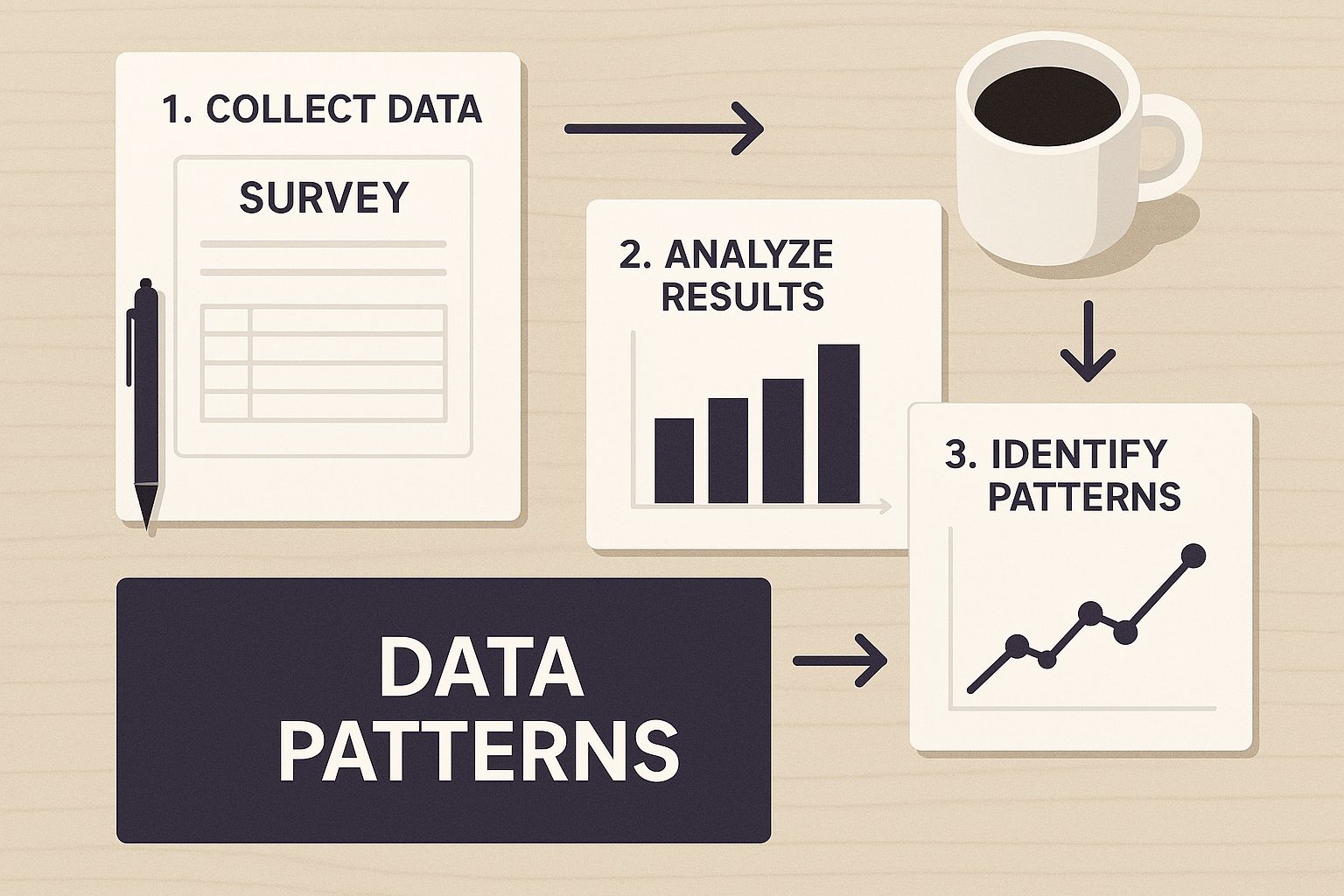
The big takeaway here? You’re building these segments based on why people do things, not just who they are on paper.
Sifting Through the Noise
I always start with the qualitative data—the interviews and open-ended survey answers. As you read through the transcripts and notes, you’ll notice certain words, problems, and aspirations popping up again and again.
Let's imagine you run an e-commerce store selling high-end kitchen gadgets. As you review your research, you might spot a few distinct patterns emerging from customer comments:
- A bunch of people keep mentioning things like "saving time on weeknight meals."
- Another cluster of customers talks about "impressing guests" or "mastering new cooking techniques."
- Then there's a third group focused on "finding durable, long-lasting tools that won't need replacing."
These aren't just random quotes. They're clues pointing to three completely different motivations for buying the exact same products. This is the gold you're looking for. For now, ignore the demographics and focus purely on the why behind their behavior.
Pro Tip: I find it helpful to use a simple spreadsheet or a tool like Miro to start categorizing quotes and observations. I'll make columns for things like Goals, Challenges, Motivations, and Common Objections. It's a great way to visually group similar data points and see the patterns take shape.
From Patterns to Segments
Once you’ve spotted these core patterns, you can start grouping your research participants into rough segments. Think of them as initial buckets that represent the major splits in your audience.
Going back to our kitchen gadget store example, you’d have:
- The "Time-Saver" Segment: These folks are all about efficiency. Their main goal is getting a decent meal on the table, fast.
- The "Entertainer" Segment: This group sees cooking as a creative outlet and a way to connect with people. They're motivated by impressing others and exploring their culinary skills.
- The "Quality Investor" Segment: These are the practical buyers. They care about performance and long-term value, and they're willing to pay more for tools that are built to last.
See how much more useful that is than a vague grouping like "women aged 30-50"? These segments tell you what matters to each group, which is the secret to writing copy and creating offers that actually resonate.
This kind of segmentation is fundamental to smart marketing. To do it right, especially as you scale, you need a solid system for organizing your customer information. For a deeper look at managing large datasets to uncover these kinds of insights, you might want to explore the concepts behind data warehousing in marketing. It’s all about creating a central source of truth to make this analysis easier.
By focusing on these behavioral and psychographic divides, you sidestep the common trap of creating personas that are either too generic or overlap too much. Each segment should represent a genuinely different way of thinking, buying, and using your product. That clarity is what transforms a persona from a document that gathers dust into a tool your team actually uses.
Bringing Your Personas to Life
All that segmentation work gave you the foundational pillars of your audience. Now it's time to actually build the house. This is where we turn those data-driven segments into rich, narrative-driven profiles that your team can actually get behind and remember.
Forget dry bullet points and sterile data sheets. The real magic is in the storytelling.
A truly great persona feels like a real person, mainly because they’re built from the real words and experiences you captured during your research. A well-crafted narrative is what separates a persona that gets used daily from one that gets shoved in a folder and forgotten. It’s the difference between just saying someone “targets efficiency” and actually showing how that plays out in their chaotic workday.
Crafting a Day in the Life
One of the most powerful tricks I’ve learned for making a persona stick is to write a "day in the life" scenario. It’s a short story that walks through your persona's daily routine, highlighting their biggest headaches, the tools they lean on, and the specific moments where they make decisions related to what you offer.
For instance, instead of just listing "Struggles with project management" as a pain point, paint a picture:
Sarah, a marketing manager, kicks off her day juggling three different spreadsheets just to track campaign progress. By 10 AM, she's already pulling her hair out, trying to figure out which team member missed a deadline. This is the third time this week she's had to manually chase down updates before her big weekly report is due.
This little story makes her problem tangible. You can almost feel her frustration, right? It gives your team a real-world context for why she needs a better solution, which is the cornerstone of effective marketing.
Building the Complete Profile
A comprehensive persona profile is way more than just a name and a job title. Think of it as a dashboard that gives your team an at-a-glance understanding of who they’re building for, marketing to, and selling to. Every single element should be a direct reflection of the patterns you uncovered in your research.
At a minimum, you'll want to include these essential components to make your persona profile genuinely useful.
| Component | Description | Example |
|---|---|---|
| Goals & Motivations | What really drives them? It could be personal (like earning a promotion) or professional (improving team efficiency by 15%). | Goal: "Launch three new integrated campaigns this quarter without increasing headcount." |
| Frustrations & Pains | What specific obstacles are constantly getting in their way? Use direct quotes from your interviews here for maximum impact. | Frustration: "I waste hours every week chasing down status updates and manually compiling reports." |
| Direct Quotes | Including a few powerful, verbatim quotes makes the persona instantly more authentic and believable. | "I just need a tool that my whole team will actually use without a month of training." |
| Watering Holes | Where do they go for information and advice? List specific blogs, social media influencers, or publications they trust. | Blogs: MarketingProfs, HubSpot Blog. Influencers: Ann Handley, Rand Fishkin. |
This kind of detail is what transforms your personas from a nice-to-have document into a practical guide for your entire organization.
To see how these profiles fit into the bigger picture, it helps to understand their path to purchase. Mapping out their entire experience using customer journey mapping software can show you exactly where and when your persona-driven content will have the biggest impact.
Putting Your Personas to Work

You’ve done the hard work and built out a set of detailed buyer personas. That’s a huge step, but it’s definitely not the finish line. The real power of a persona isn’t the document itself; it’s how you weave it into the fabric of your company.
A persona profile that just collects dust in a shared drive is a massive wasted opportunity. The goal is to make these profiles the lens through which every single team sees your customers.
When you get this right, your personas become a powerful compass for decision-making across the entire business. They should inform everything from the subject lines in your next email blast to the features you prioritize in your Q3 product update. This is how you stop just knowing your customer and start actively serving them in a way that fuels real growth.
Shape Your Marketing and Content
Your marketing strategy is the first and most obvious place to let your personas shine. Instead of shouting into the void with generic content, you can now craft messages that hit home with the specific motivations and pain points of each segment. The difference in effectiveness is night and day.
- Content Marketing: Is "Startup Steve" losing sleep over budget and proving ROI? Great. Create blog posts and case studies that scream cost-effectiveness and show hard numbers. For "Enterprise Emily," who’s all about security and scalability, you should be developing in-depth whitepapers and webinars that address those high-level concerns.
- Email Campaigns: Ditch the one-size-fits-all emails. Segment your lists by persona and send "Startup Steve" a quick, actionable tip sheet. Meanwhile, "Enterprise Emily" gets a detailed guide on integrating your solution with her company’s existing tech stack.
- Social Media: Go where they are. You’ll probably find "Steve" scrolling LinkedIn for business hacks, while "Emily" is more likely to be found in a niche industry forum, asking tough questions.
When you truly get inside your personas' heads, you can build incredibly effective Conversion Rate Optimization Strategies because you’re speaking their language and directly addressing their hesitations.
Empower Your Sales and Product Teams
But the magic of a good persona doesn't stop with marketing. Your sales and product development teams can use these insights to become exponentially more effective, creating a customer experience that feels cohesive and intentional from start to finish.
The results can be staggering. A fintech company we know used their new personas to completely overhaul their pricing and messaging. This shift was a key driver in helping them nail a planned 29% revenue increase and a 15% lift in new customer acquisition.
Key Takeaway: Personas create a shared language for your company. When marketing, sales, and product are all singing from the same hymn sheet, the customer journey becomes seamless and far more compelling.
Your sales reps can now refine their pitch, anticipating the exact objections a certain persona will have and highlighting the benefits that truly matter to them. Instead of a generic demo, they can focus on the three features that solve that person's biggest headaches.
At the same time, your product team gets a cheat sheet for their roadmap. When they’re stuck between building two new features, the deciding question becomes, "Which one would 'Startup Steve' get more value from?" This simple gut check ensures you're building a product people actually want, cutting down on wasted engineering hours and boosting user love.
Even after you’ve nailed down the process, a few questions always seem to pop up when teams start building out their buyer personas. Let’s tackle some of the most common ones to make sure you’re headed in the right direction.
Getting these details sorted out early helps sharpen your strategy and keeps everyone focused on what actually moves the needle.
How Many Buyer Personas Should We Actually Create?
There's no magic number, but quality always beats quantity. For most businesses, starting with three to five core personas is the sweet spot. This is usually enough to cover your most important audience segments without overwhelming your team.
If you create too many, you risk diluting your marketing efforts until they become generic and ineffective. The best way to start is by zeroing in on your most impactful groups—think your most profitable or largest customer segments. You can always build out more nuanced, secondary personas down the road as your business evolves and you gather more data.
Key Takeaway: Start small and go deep. It's far better to have three incredibly detailed personas that your team actually uses than ten shallow ones collecting dust in a folder.
How Often Should We Update Our Personas?
Think of your buyer personas as living documents, not a "set it and forget it" project. They need to evolve right along with your market and your customers. A good rule of thumb is to give them a formal review and refresh at least once a year.
That said, certain events should trigger a more immediate update.
You’ll want to revisit your personas after big shifts like:
- A major new product launch
- Expanding into a new geographic market
- Noticing a real change in customer behavior or feedback
- A new competitor shaking things up
Regular check-ins ensure your personas stay accurate and relevant, making them a powerful tool for your entire organization.
What's the Real Difference Between a Persona and a Target Audience?
This is a really important distinction, and it's one people get mixed up all the time.
A target audience is a broad, high-level look at the group you're trying to reach. It’s usually defined by general demographics. For example: "males aged 25-40 in urban areas who are interested in tech." It tells you who you're marketing to in a very general sense.
A buyer persona, on the other hand, is a much sharper, semi-fictional deep dive into a single individual from that audience. It gives that person a name, a backstory, specific professional goals, personal motivations, and the unique challenges they're facing. The persona doesn't just tell you who to target—it shows you how to connect with them on a human level.
At Frozen Crow Inc., we build our strategies around a deep understanding of your audience. If you're ready to move beyond guesswork and connect with customers who truly matter, let's talk. Discover how our data-driven approach can elevate your brand at https://frozencrow.com.


