


August 20, 2026
What Is View Through Conversion and How It Impacts Ad ROI
Think of the last time you saw an ad for something online. You probably didn't click it. But what if that ad stuck in the back of your mind, and a few days later, you went straight to the brand's website and made a purchase?
That’s a view-through conversion (VTC). It’s when someone sees your ad, skips the click, but converts later through a different path. This is the metric that proves your display and video ads are doing their job, even when they don’t get an immediate interaction. It’s how you measure the quiet, lingering impact of your brand.
Decoding the Digital Window Shopper
It’s just like walking past a store. You spot a jacket in the window, think "that's nice," but keep going. The image stays with you. A week later, you decide you really want that jacket, so you go directly to the store and buy it. You never "clicked" on the window display, but it was absolutely responsible for the sale.
View-through conversions track that exact behavior in the digital world. It’s the online equivalent of seeing a billboard and visiting the store later. It’s a simple but powerful truth: not all influence starts with a click.
Why It Matters More Than You Think
If you only measure click-through conversions (CTCs), you're flying blind. You're only seeing a tiny piece of the puzzle. People have become conditioned to ignore banner ads, or they’re in the middle of watching a video where clicking just isn't an option. But a great visual ad plants a seed.
Here’s why tracking those seeds is so important:
- It Proves Brand Recall: VTCs show that your ads are memorable enough to stick in someone's head and inspire them to act later.
- It Justifies Your Brand Spend: They connect the dots between your top-of-funnel awareness campaigns and the bottom-of-funnel sales they eventually generate.
- It Prevents Bad Decisions: Without VTC data, you might kill a high-performing awareness campaign simply because it isn’t driving clicks, even if it's silently fueling future conversions.
Ever since Google Ads introduced the metric back in 2009, its value has only become more obvious. For some e-commerce brands, the effect is staggering. According to one analysis, as much as 95% of purchases can be linked back to a customer who first saw an ad before converting. You can find more details on this at finch.com.
That number says it all. If you’re ignoring VTCs, you’re ignoring the vast majority of your campaign’s real impact.
How View-Through Conversion Tracking Actually Works
So, how do ad platforms really know that someone saw your ad, didn't click, and then bought something a week later? It’s not magic, but it’s a pretty clever system of digital breadcrumbs that connects the dots behind the scenes. The whole thing relies on two simple pieces of tech: tracking pixels and browser cookies.
Think of a tracking pixel as a tiny, invisible tripwire. When your display or video ad loads on someone's screen, this pixel "fires" and places a small file, a cookie, onto their browser. This cookie is like a digital sticky note that says, "This person saw Ad A on this date." It’s totally anonymous and doesn't grab personal info, but it creates a unique ID for that user’s browser.
The moment that ad is seen, a clock starts ticking.
The Role of the Attribution Window
That little cookie doesn't hang around forever. Its lifespan is set by the attribution window, sometimes called a "lookback window." This is simply the period of time a conversion can be credited back to that initial ad view.
The attribution window is what bridges the gap between someone seeing your ad and eventually making a purchase. For instance, a 30-day view-through conversion window means the ad platform will keep an eye out for a conversion from that user for 30 days after they saw the ad.
A shorter window, like 1 to 7 days, often gives you a much more realistic picture. The more time that passes, the murkier the water gets—it becomes harder to say for sure that your ad was the main reason they bought.
This whole process is a pretty straightforward journey: someone sees an ad, doesn't click, and then later buys your product.
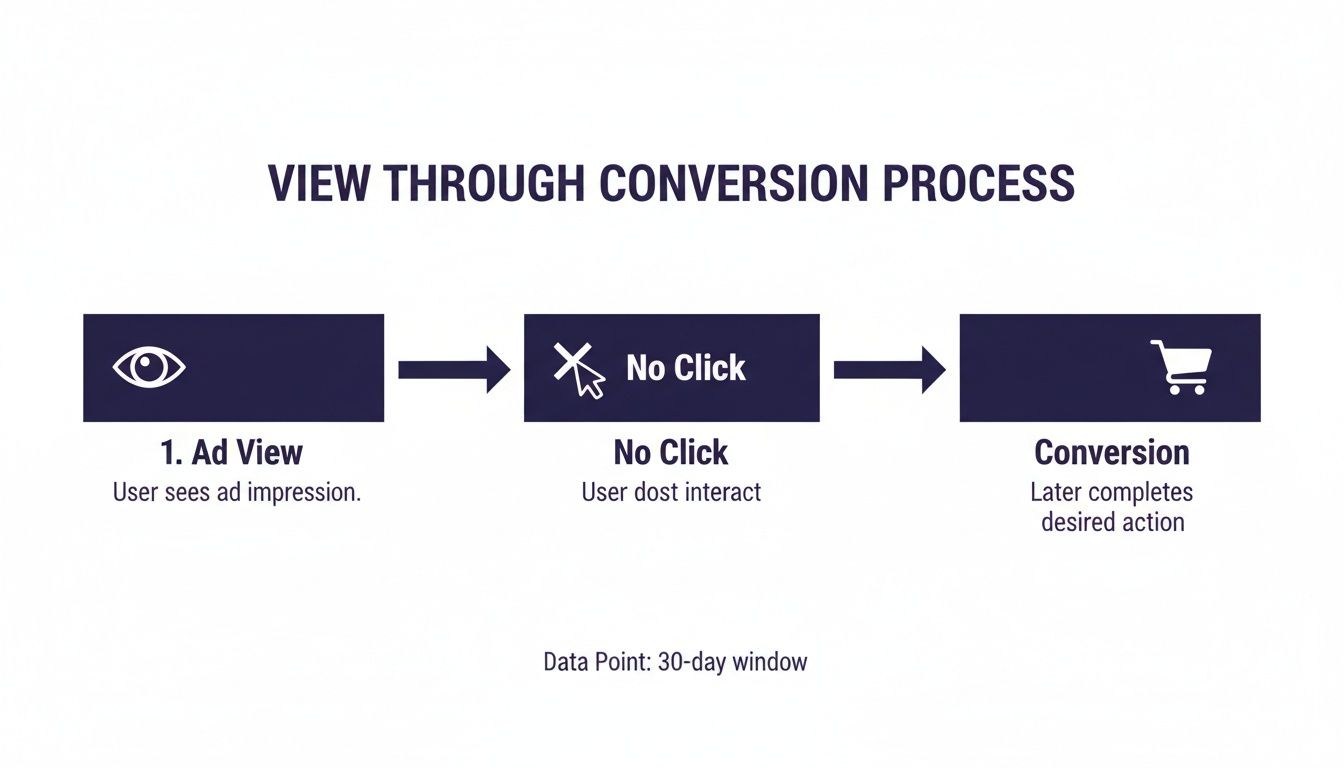
As you can see, the journey doesn't need a click. The initial view is all it takes to start the attribution clock. When that same person later visits your website—maybe by typing it in directly or through a different channel—another tracking pixel on your confirmation or "thank you" page spots the original cookie. If the purchase happens inside the attribution window, a view-through conversion gets chalked up on the board.
The major ad platforms each have their own spin on this:
- Google Ads: You can customize your view-through window, usually anywhere from 1 to 30 days. This data pops up in your campaign reports as long as you've set up your conversion actions correctly. If you need a hand with that, our guide on Google Ads conversion tracking walks you through it.
- Meta Ads (Facebook & Instagram): Meta defaults to a much shorter 1-day window for ad views. This makes sense, given the fast-paced, "what's next" nature of scrolling through a social feed.
Getting a handle on these mechanics is the key to actually understanding your data and appreciating the quiet, but very real, impact your ads are having.
VTC vs. CTC: Uncovering the Full Customer Journey
Trying to understand the difference between a view-through conversion (VTC) and a click-through conversion (CTC) isn't about picking a winner. It's about seeing the whole story of how customers find their way to your brand. Each one measures a totally different—but equally vital—part of that journey.
A click-through conversion is simple and direct. Someone sees your ad, clicks it, lands on your site, and immediately buys something or fills out a form. It's clean, easy to track, and proves the ad worked on the spot.
A view-through conversion, on the other hand, is all about delayed influence. A person sees your ad, doesn't click, but the image or message sticks in their mind. A few days later, they come back to your site on their own—maybe by typing your URL directly or searching for your brand name—and then they convert.
The Direct Handshake vs. The Lingering Echo
Think of it like this: a CTC is like asking someone for their number and getting it right there. A VTC is more like making a great impression at a party; they don't ask for your number then, but a week later they look you up because they remembered the great conversation. Both get you the same result, but the paths couldn't be more different.
If you only look at clicks, especially for display and video ads, you’re getting a dangerously incomplete picture. Those top-of-funnel campaigns are built for brand awareness and recall, not necessarily to get an immediate click. Most people just don't click on banner ads, but that doesn't mean the ads aren't working their magic.
When you ignore what a view-through conversion tells you, you risk cutting the budget for the very ads that are quietly building your brand and filling your sales pipeline for tomorrow.
This distinction is so important because people behave differently depending on the platform. Studies show that a huge number of users who see an ad will often convert later without ever clicking. This is especially true for video ads where clicks are naturally rare. This behavior alone proves why you need a more complete way to measure success.
Why You Need Both Metrics
These two metrics aren't in competition; they work together to map out the entire customer journey, from the first glance to the final purchase. One measures active, immediate intent, while the other tracks the passive influence that builds over time. To really get a handle on this, it helps to compare different attribution models, like first touch vs last touch attribution.
Here’s a quick rundown of their roles:
- Click-Through Conversion (CTC): Measures instant action. It tells you which ads are compelling enough to make someone stop everything and engage right now.
- View-Through Conversion (VTC): Measures brand recall and delayed impact. It shows you which campaigns are memorable enough to plant a seed that grows into a future conversion.
To make the comparison even clearer, let's break down the key differences side-by-side.
View-Through vs. Click-Through Conversions at a Glance
| Attribute | View-Through Conversion (VTC) | Click-Through Conversion (CTC) |
|---|---|---|
| User Action | User sees the ad but does not click. | User clicks the ad. |
| Conversion Path | Converts later through a different channel (e.g., direct, organic). | Converts in the same session, directly after the click. |
| Measurement Focus | Measures the ad's influence and brand recall. | Measures the ad's direct response and persuasiveness. |
| Typical Campaign Type | Display, Video, Social Media (Awareness Campaigns). | Search, Shopping, Retargeting (Performance Campaigns). |
| Strategic Value | Shows the long-term, brand-building impact of your ads. | Highlights which creative and calls-to-action drive immediate sales. |
By analyzing both, you get a 360-degree view of your marketing. You can finally see which ads drive instant sales and which ones are building the brand recognition that fuels long-term, sustainable growth. For a deeper dive, our guide on what is marketing attribution can help connect all the dots.
Common Mistakes That Can Wreck Your VTC Attribution
Getting a handle on view-through conversions is a huge step toward seeing the bigger picture of your campaign performance. But this is where things can get tricky. Having the data is one thing; knowing what it actually means is something else entirely. If you're not careful, you can fall into a few common traps that lead to bad decisions and wasted ad spend.
Mistake #1: Giving VTCs Way Too Much Credit
This is the big one. It's so tempting to see a pile of view-through conversions and assume your display campaign is an absolute rockstar. But that's a dangerously simple view of a very complex customer journey.
Think about it: a user might have seen your ad, sure. But they also could have gotten an email from you, seen a social media post, or even had a friend mention your brand before they finally decided to buy.
A view-through conversion is a signal of influence, not a direct cause of a sale. It proves your ad was a touchpoint, but it almost never works alone.
This is why you need a balanced perspective. If you give a single ad view from 28 days ago 100% of the credit for a purchase, you’re completely ignoring every other marketing touchpoint that helped nudge that customer along. Your data becomes skewed, and you start making decisions based on a fantasy.
Mistake #2: Setting Bogus Attribution Windows
Another classic error is getting the attribution window wrong. The attribution window is simply the period of time after an ad is seen when a conversion can be credited back to it. This isn't a one-size-fits-all setting. If your window is too long or too short for how people actually buy your product, you'll get garbage data.
For example, using a 30-day window for a cheap, impulse-buy item is probably overkill. Let's be real, that person forgot about your ad a week ago. On the flip side, a tiny 1-day window for something complex like B2B software is just as bad. Nobody makes a five-figure decision in 24 hours; those sales cycles take weeks, sometimes months.
Here’s how this can go wrong:
- Too Long: A massive window on a short sales cycle will start grabbing credit for conversions that your ad had almost nothing to do with. It inflates your numbers and makes you think a campaign is more effective than it really is.
- Too Short: A tiny window on a long sales cycle means you'll miss out on crediting legitimate conversions. You'll end up undervaluing campaigns that are doing the hard work of building awareness and consideration over time.
Mistake #3: Forgetting About Impression Quality and Fraud
Finally, you have to remember that not all impressions are created equal. A huge pitfall is just accepting your VTC numbers at face value without questioning the quality of the impressions that generated them.
Was the ad actually viewable on the screen, or was it buried "below the fold" where no human ever scrolled? Even worse, were those impressions just bots?
Impression fraud is a real problem that can make your VTC count soar, tricking you into thinking a campaign is a huge success when it's just serving ads to an army of robots. You have to keep an eye out for weird spikes in impressions and stick to platforms that give you solid viewability and fraud detection tools.
Digging into these details is crucial, especially when you consider all the other challenges that come with attribution. As you get deeper, you'll start to see the trouble with attribution is often in the details we overlook. By sidestepping these common mistakes, you can make sure your VTC data is telling you a story that’s not only accurate but also one you can act on.
How to Use VTC Insights to Actually Improve Your Campaigns
Knowing what a view-through conversion is helps you report on performance, sure. But the real magic happens when you use that data to make smarter marketing decisions. VTC insights are where the theory hits the road, helping you sharpen your creative, defend your budget, and build a much more effective marketing machine.
Don't just look at VTCs as one giant number. You need to segment your data. Break it all down by campaign, ad group, and even the individual ad creatives. This is how you pinpoint exactly which visuals and messages are sticking in your audience's head, even if they don't inspire an immediate click.
Think about it: a high number of VTCs on one specific ad is a huge signal that its message is memorable and building real brand recall.
Justifying and Refining Your Brand Awareness Efforts
Let's be honest, top-of-funnel campaigns on platforms like the Google Display Network or YouTube often get a bad rap for low click-through rates. This is precisely where VTC data becomes your secret weapon. Strong view-through performance gives you concrete proof that these campaigns are successfully influencing future customers.
Use VTCs to defend your brand awareness budget. A campaign with tons of VTCs and few CTCs isn’t a failure; it’s a brand-building asset that’s filling your pipeline for tomorrow.
This data also tells you what to do next. If one of your video ads pulls in twice as many VTCs as another, you know which creative style is actually connecting. You can then double down on what works, creating more ads that stay with your customers long after they've scrolled past.
Suddenly, VTCs aren't just a reporting metric. They're a strategic tool for creative optimization.
Weaving VTCs into a Complete Strategy
At the end of the day, VTC data should never live on an island. It’s one piece of a much larger puzzle. The goal is to integrate these insights into a full attribution strategy where every single touchpoint gets the credit it deserves for pushing a sale over the line.
Here are a few ways to put this into practice:
- Build Smarter Retargeting Audiences: Take the data from your high-VTC campaigns and use it to build more powerful retargeting lists. You already know these people have seen your brand; now you can hit them with a more direct, action-oriented message.
- Look for a Lift in Branded Search: Keep a close eye on your branded search volume. A successful display campaign with a high VTC count will almost always lead to an increase in people searching directly for your company's name.
- Balance All Your Metrics: Look at VTCs alongside other key indicators like reach, frequency, and cost per mille (CPM). This gives you a much fuller picture of a campaign's overall health and influence.
When you combine these different data points, you create a powerful feedback loop. Your awareness campaigns generate VTCs, which then inform your direct-response and search strategies, building a smarter and more connected marketing ecosystem.
How We Turn VTC Data into Actual Business Growth
At Frozen Crow, we live by a simple rule: data is worthless unless it drives results. View-through conversions are a perfect example. They hold a ton of potential, but only if you know how to turn those insights into a real, honest-to-goodness growth plan. Our entire approach is built to transform this tricky metric into a strategic advantage for your business.
It always starts with getting the tracking right. We do a deep dive into your entire analytics setup to make sure every single impression and conversion is being captured accurately. Without a rock-solid data foundation, any strategy you build is just a shot in the dark.
Once the tracking is airtight, we build a strategy that’s both balanced and integrated. We know that brand awareness campaigns, which are often measured by VTCs, are the fuel for your direct-response efforts—the ones that bring in immediate click-through conversions (CTCs). They aren't two separate things; they're two essential parts of the same engine.
Turning Insights into Actionable Strategy
Let’s look at a classic scenario we see all the time: a display campaign is racking up a ton of view-through conversions but getting almost no clicks. A lot of businesses would look at that, call it a failure, and slash the budget. We see an opportunity. That data is telling us the ad creative is incredibly memorable and has successfully built brand recall.
This isn't a dead end; it's a huge insight. That brand recall is an asset, and now we can put it to work.
We take that knowledge and use it to inform every other part of your marketing. Here’s how we connect the dots:
- Supercharging Retargeting: We grab the audience that saw that high-VTC ad and build a hyper-specific retargeting campaign just for them. Since we already know the brand is fresh in their minds, we can hit them with a much stronger, more direct call-to-action to finally close the deal.
- Informing Search Campaigns: A great awareness campaign almost always creates a lift in branded search traffic. People see your ad, remember your name, and Google you later. We anticipate this and make sure your paid and organic search strategies are primed and ready to capture all that new, high-intent demand.
- Optimizing Your Creative: The ads that drive the most VTCs are a goldmine. They tell us exactly what messaging and visuals are clicking with your audience. We then take those winning elements and apply them across all your channels for a more consistent and powerful brand presence.
This is how we transform what looks like a simple reporting metric into a dynamic, multi-channel growth strategy. A high VTC count isn't just a number; it's a signal that tells us exactly where to focus our efforts next.
This approach creates a smarter, more efficient marketing cycle where everything works together. Your awareness efforts measurably feed your performance campaigns, and the data from each step makes the next one even stronger. By connecting VTC data to your bigger business goals, you can finally understand and quantify the full financial impact of your advertising. To learn more, check out our guide on how to calculate incremental revenue from your marketing.
This is how we move beyond just reporting on numbers and start creating scalable, sustainable success for our clients.
Got Questions About View-Through Conversions?
Diving into view-through conversions can bring up some solid questions. It's a metric that feels a bit less tangible than a click, so let's clear the air with answers to the most common things we hear from marketers.
Are View-Throughs as Good as a Click?
It’s less about which one is "better" and more about what they each tell you. A click is a direct signal of intent—someone wanted to know more right now. A view-through is a signal of influence; your ad made an impression that led to an action later on.
Think of it this way: a click-through conversion (CTC) gets a lot of the glory because it's easy to track a straight line from A to B. But VTCs are the unsung heroes, showing you how effective your brand awareness campaigns are at planting seeds that sprout into direct visits or organic searches down the road. They're both critical pieces of the puzzle.
How Do I Pick the Right Attribution Window?
Your attribution window needs to mirror your real-world sales cycle. There's no one-size-fits-all answer here.
If you’re selling something that's an impulse buy or a low-cost item, a short window of 1–7 days makes a lot of sense. But for bigger decisions—like buying enterprise software or a new car—you need a much longer window, maybe 30+ days, to accurately capture the journey. A good starting point is your ad platform's default, but keep a close eye on your data and tweak it based on how long it actually takes your average customer to pull the trigger.
Key Takeaway: Get the window wrong, and your data gets messy. Too long, and you'll take credit for sales you didn't influence. Too short, and you'll completely miss the impact of your ads, making your campaigns look less effective than they are.
Can This Data Be Wrong or Inflated?
Absolutely, and it's smart to be skeptical. Things like bot impressions from ad fraud or a user simply scrolling past your ad too quickly can definitely inflate your VTC numbers. An impression doesn't always equal a meaningful view.
This is why you can't look at VTCs in a vacuum. You have to cross-reference them with other key metrics. Watch out for strange spikes in impressions and keep an eye on reach and frequency. Most importantly, see if your VTCs line up with an increase in things like branded search volume. If more people are seeing your ads and then searching for your brand by name later, you've got a much more reliable sign that your campaigns are actually working.
Ready to turn complex data into a clear roadmap for growth? The experts at Frozen Crow Inc. build integrated marketing strategies that translate every metric, including view-through conversions, into measurable business results. Get your free marketing audit today.


