


August 20, 2026
Top Customer Segmentation Strategies for E-commerce Success 2025
In a competitive market where personalization is paramount, treating all your customers the same is a direct path to obscurity. Generic, one-size-fits-all marketing campaigns are not just ineffective; they are a drain on your budget and a missed opportunity to build meaningful relationships. The key to unlocking sustainable growth lies in understanding that your customer base is not a monolith but a diverse collection of individuals with unique needs, behaviors, and motivations.
This is where powerful customer segmentation strategies come into play. By dividing your audience into distinct, manageable groups, you can move beyond guesswork and start delivering tailored messages, products, and experiences that resonate deeply. This approach transforms marketing from a broadcast into a conversation, fostering loyalty and driving conversions.
In this comprehensive guide, we will break down 10 essential segmentation models designed to give your business a competitive edge. You will learn how to implement each strategy with practical, actionable steps, moving from theory to tangible results. Mastering these techniques is the foundation for a modern, data-driven marketing approach that turns casual browsers into lifelong brand advocates and fuels precision growth.
1. Demographic Segmentation
Demographic segmentation is one of the most foundational and widely used customer segmentation strategies. It involves dividing your market into smaller categories based on quantifiable characteristics of a population. This method leverages statistical data like age, gender, income, education level, occupation, and family status to group customers. Because this data is often readily available through surveys, analytics platforms, and public records, it's an accessible starting point for any business.
The primary benefit of this approach is its simplicity and clarity. For example, a luxury car brand might target high-income individuals aged 45-65, while a fast-fashion retailer focuses on women aged 18-24. Similarly, toy manufacturer LEGO masterfully uses this strategy, creating distinct product lines like DUPLO for toddlers and Technic for teenagers and adults. This direct approach allows for efficient media buying and tailored messaging that resonates with a specific group's known preferences and purchasing power.
Key Variables and Implementation Tips
To effectively use demographic segmentation, focus on the variables most relevant to your product. The infographic below highlights the three most common starting points for e-commerce and SMEs.
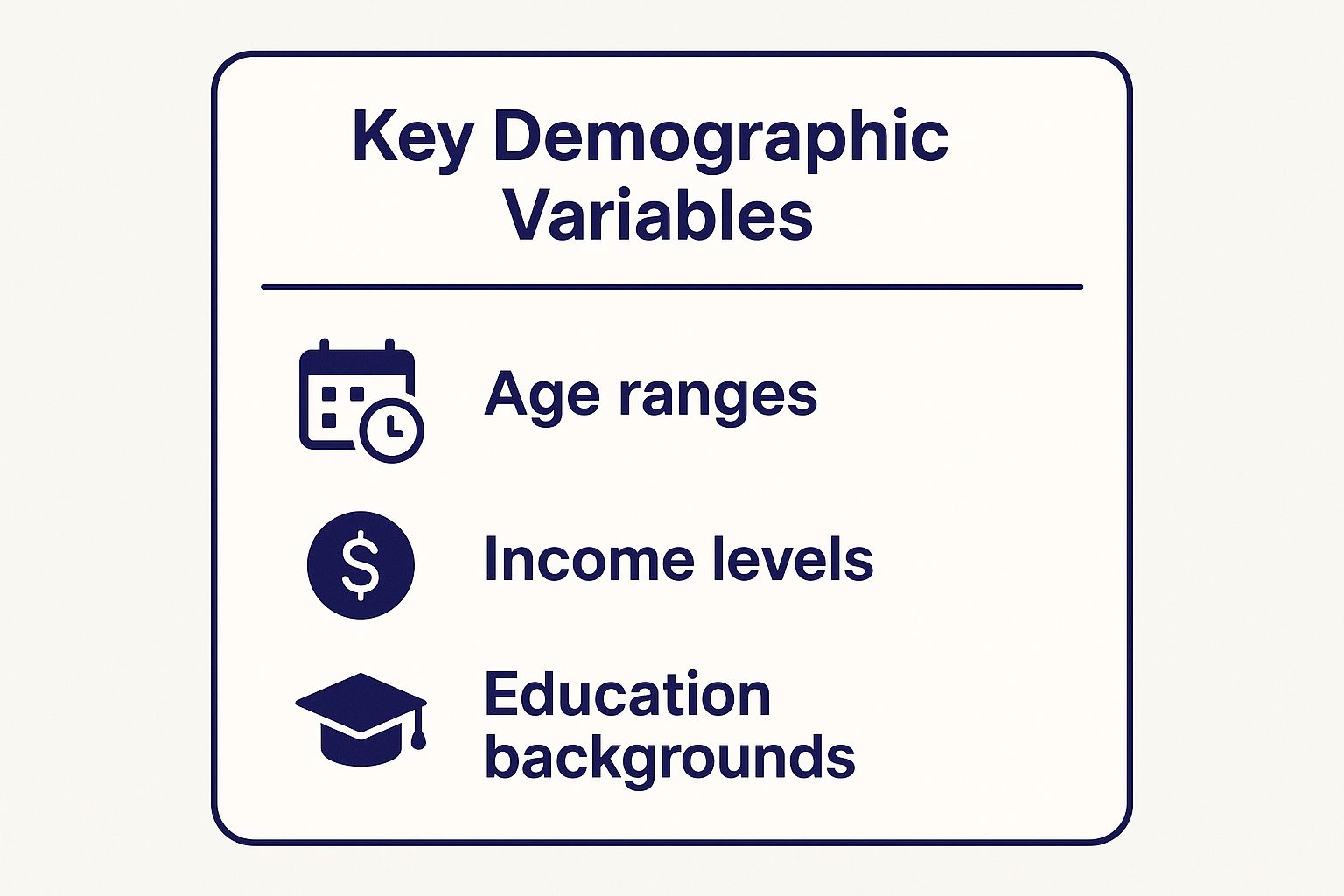
These variables provide a clear framework for initial audience targeting and product positioning. However, to unlock their true potential, combine them with other data types.
Actionable Tips:
- Enrich with Behavior: Don't rely on demographics alone. A 60-year-old and a 25-year-old might both be interested in sustainable products. Pair demographic data with behavioral insights (like purchase history) for a more nuanced profile.
- Avoid Stereotypes: Use data to validate assumptions, not reinforce them. Test marketing messages across different demographic segments to see what truly resonates, rather than assuming what they want to hear.
- Consider Life Stages: A "millennial" is not a monolithic group. A 25-year-old entering the workforce has vastly different needs than a 35-year-old starting a family. Segment based on life stage transitions for greater relevance.
2. Psychographic Segmentation
Psychographic segmentation moves beyond the 'who' of demographics to uncover the 'why' behind customer actions. It categorizes audiences based on psychological attributes like values, attitudes, interests, and lifestyles (AIOs). This powerful approach helps you understand what truly motivates your customers, allowing you to create messaging that connects on a deeper, more emotional level. It is one of the most effective customer segmentation strategies for building brand affinity and long-term loyalty.
For instance, a brand like Patagonia doesn't just sell outdoor gear; it appeals to consumers who value sustainability and environmental activism. Similarly, Apple targets innovators who prioritize design, simplicity, and creativity over raw specifications. These brands build communities by aligning with the core values and aspirations of their target audience, turning customers into advocates.

Key Variables and Implementation Tips
Effective psychographic segmentation requires looking beyond purchase data to understand your customer's worldview. By collecting information on their hobbies, values, and media consumption habits, you can build a much richer picture of their motivations.
Actionable Tips:
- Utilize Surveys and Interviews: Go directly to the source. Use surveys, focus groups, and one-on-one interviews to ask questions about lifestyle, personal values, and what they look for in a brand.
- Monitor Social Conversations: Analyze social media comments, shared content, and group affiliations to gain authentic insights into the interests and opinions of your audience segments.
- Create Detailed Personas: Bring your segments to life by developing detailed buyer personas. These fictional representations of your ideal customers are crucial for guiding marketing decisions. You can get more details in our complete guide on how to create buyer personas.
3. Behavioral Segmentation
Behavioral segmentation is one of the most powerful customer segmentation strategies because it groups customers based on their direct actions and interactions with your brand. Instead of focusing on who customers are, this method analyzes what they do, such as purchase history, product usage, spending habits, and brand loyalty. This approach allows businesses to move beyond assumptions and create marketing efforts that respond to demonstrated needs and predict future behavior.
The core advantage of this strategy is its direct relevance. For instance, Amazon excels at this by using your browsing and purchase history to generate "Frequently Bought Together" suggestions and personalized product recommendations. Similarly, Spotify creates its hyper-personalized "Discover Weekly" playlists by analyzing your listening habits. This focus on past actions enables businesses to deliver highly targeted and timely messages that feel uniquely personal, significantly boosting engagement and conversions.
Key Variables and Implementation Tips
To apply behavioral segmentation effectively, you must track customer interactions across all touchpoints. The video below provides a deeper dive into how these behavioral patterns can inform your marketing campaigns.
Understanding these actions is the first step toward proactive marketing. By segmenting based on behavior, you can tailor the entire customer journey. For more details on this, you can explore the concept of behavioral targeting.
Actionable Tips:
- Implement RFM Analysis: For e-commerce, segment customers based on Recency (how recently they purchased), Frequency (how often they purchase), and Monetary value (how much they spend). This helps identify your most valuable customers.
- Use Behavioral Triggers: Automate personalized communications based on specific actions. Send an abandoned cart email, a welcome series for new sign-ups, or a "we miss you" campaign for dormant users.
- Segment by Engagement: Group users by their interaction levels (e.g., frequent visitors, occasional browsers, one-time buyers). Create tailored campaigns to nurture each group toward the next stage of their lifecycle.
4. Geographic Segmentation
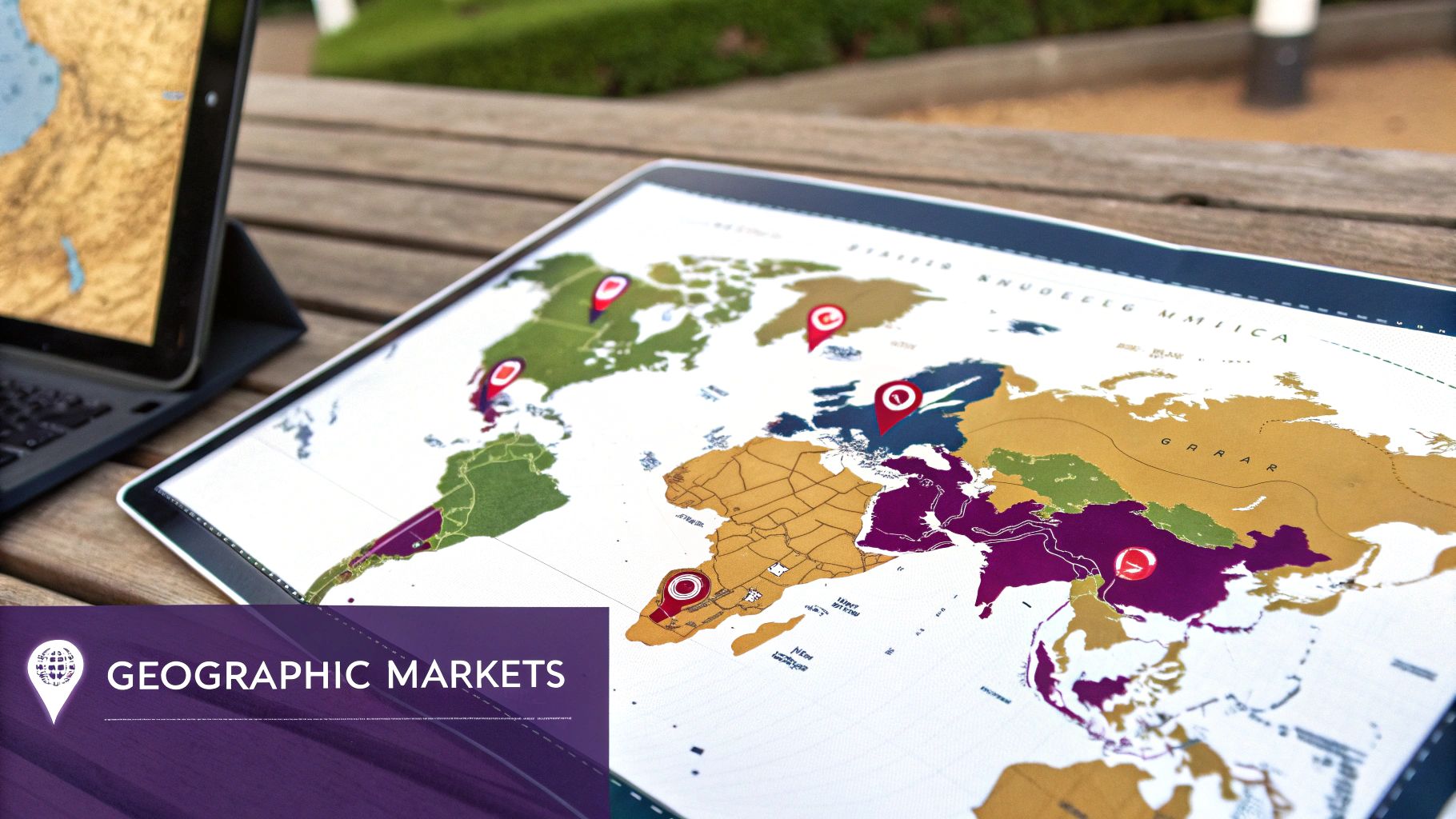
Geographic segmentation divides customers based on their physical location, such as country, state, city, climate zone, or even neighborhood. This strategy is built on the premise that a person’s needs, preferences, and purchasing habits are often influenced by where they live. It is crucial for businesses that operate across different regions, as it allows for marketing and product offerings tailored to local culture, climate, and consumer demand.
This approach is powerful because it addresses location-specific realities directly. For instance, a retailer like Home Depot stocks hurricane supplies in coastal areas and snowblowers in colder northern regions. Similarly, fast-food giant McDonald's adapts its menu to local tastes, offering the McSpicy Paneer in India and the Teriyaki Burger in Japan. This localization makes products more relevant and appealing, creating a stronger connection with customers in diverse markets.
Key Variables and Implementation Tips
To apply geographic customer segmentation strategies effectively, start by analyzing your sales data to identify regional patterns. This will reveal which areas are most profitable and which might require a different approach. Focus on variables like climate, population density (urban vs. rural), and local culture to guide your decisions on inventory, messaging, and promotions.
Actionable Tips:
- Leverage Geofencing: Use location-triggered mobile marketing to send targeted offers to customers when they enter a specific geographic area, such as near your physical store.
- Analyze Regional Sales Data: Dive into your analytics to identify which products sell best in different regions. Use these insights to optimize inventory and create localized marketing campaigns.
- Combine with Other Data: Enhance geographic segments by layering them with demographic or psychographic data. A high-income urban area will have different needs than a low-income urban area, even if they are geographically close.
5. Firmographic Segmentation (B2B)
Firmographic segmentation is the B2B equivalent of demographic segmentation, focusing on organizational attributes rather than individual consumer traits. It involves dividing a business market into segments based on company-specific characteristics like industry, company size, annual revenue, number of employees, location, and growth stage. This method is fundamental for B2B companies aiming to identify their most valuable accounts and tailor their outreach.
The core advantage of this strategy is its direct impact on sales and marketing efficiency. By understanding firmographics, a B2B company can focus its resources on businesses that are a perfect fit for its products or services. For example, Salesforce offers different CRM editions tailored to organizational scale, from "Essentials" for small businesses to "Unlimited" for large enterprises. Similarly, QuickBooks provides distinct accounting software for small businesses versus its "Enterprise" solution for larger, more complex companies.
Key Variables and Implementation Tips
To apply firmographic segmentation, B2B marketers must identify which company characteristics correlate most strongly with their ideal customer profile. This allows for precise targeting and more relevant value propositions.
Actionable Tips:
- Build Your Ideal Customer Profile (ICP): Define your perfect customer using firmographic data. An ICP for a cybersecurity firm might be "financial services companies with 500-2,000 employees located in North America."
- Leverage B2B Data Platforms: Use tools like LinkedIn Sales Navigator, ZoomInfo, or Dun & Bradstreet to gather accurate firmographic data and build targeted account lists.
- Segment by Sales Cycle: A startup's decision-making process is faster and less complex than a Fortune 500 company's. Tailor your sales approach and content based on the typical procurement complexity of each firmographic segment.
6. Needs-Based Segmentation
Needs-based segmentation groups customers according to the specific problems they are trying to solve or the functional outcomes they desire from a product. Instead of focusing on who customers are (demographics) or what they do (behavior), this approach centers on why they seek a solution. This strategy aligns perfectly with the "Jobs to be Done" framework, enabling companies to develop solutions that precisely address customer pain points.
The core advantage of this method is its direct link to value creation and product development. For example, Uber serves distinct needs like a quick commute, affordable food delivery, or airport transportation with specialized offerings. Similarly, Nike designs shoes for very specific athletic needs such as running, basketball, or skateboarding. This focus ensures that marketing messages and product features resonate deeply with a customer's primary motivation for purchasing, making it one of the most powerful customer segmentation strategies available.
Key Variables and Implementation Tips
To implement needs-based segmentation, you must shift from analyzing customer attributes to understanding their goals. This requires qualitative research to uncover the true "job" a customer is hiring your product to do. A solid database marketing strategy is essential for collecting and analyzing the data needed to identify these distinct needs.
Actionable Tips:
- Conduct 'Jobs to be Done' Interviews: Go beyond standard surveys. Ask open-ended questions to uncover the real-world situations, struggles, and desired outcomes that lead customers to seek a solution like yours.
- Map Needs to Features: Create a clear matrix that links identified customer needs directly to your product's features or service offerings. This helps validate your value proposition and guide your marketing.
- Recognize Overlapping Needs: A single customer may belong to multiple need-based segments at different times. A business traveler's needs (Wi-Fi, desk space) are different from their needs when on a family vacation (pool, free breakfast).
- Guide Your Product Roadmap: Use insights from your most valuable need-based segments to prioritize new features and product development, ensuring you are building what your best customers actually want.
7. Value-Based Segmentation
Value-based segmentation categorizes customers according to their economic worth to a business, focusing on metrics like customer lifetime value (CLV) or overall profitability. This strategic approach helps companies prioritize resources, recognizing that not all customers contribute equally to the bottom line. By identifying high-value customers, businesses can allocate marketing spend, service efforts, and product development resources more effectively to maximize return on investment.
This model is powerful because it directly links segmentation to financial outcomes. For instance, Sephora's Beauty Insider program rewards its highest-spending "Rouge" members with exclusive perks, encouraging loyalty and further spending. Similarly, airlines offer priority boarding and lounge access to frequent flyers, ensuring their most profitable customers feel valued and remain loyal. This focus on economic contribution helps create a sustainable model for customer relationship management and growth.
Key Variables and Implementation Tips
To implement value-based segmentation, a business must first quantify the value each customer brings. This typically involves calculating historical purchase value, purchase frequency, and predictive lifetime value to create distinct tiers.
Actionable Tips:
- Calculate CLV Accurately: Use a combination of historical transaction data and predictive analytics to forecast a customer's future value. This provides a forward-looking basis for your segments.
- Create VIP Tiers: Design loyalty or VIP programs that offer exclusive benefits, personalized service, or early access to your high-value segments. This nurtures loyalty and protects your most important revenue source.
- Monitor Value Migration: Customers can move between value segments over time. Regularly track this migration to identify at-risk high-value customers or up-and-coming valuable ones, allowing for proactive intervention.
- Inform Acquisition Strategy: Use insights from your top-tier customers to build lookalike audiences for new customer acquisition campaigns. This helps attract prospects who share traits with your most profitable clients.
8. Technographic Segmentation
Technographic segmentation groups customers based on the technology they use, from hardware and software to their overall digital maturity. This strategy involves categorizing audiences by their tech stack, adoption rates of new tools, and preferred digital channels. It is especially powerful in B2B marketing and for companies selling digital products, as it reveals technical compatibility, integration opportunities, and a prospect's readiness for a specific solution.
The primary benefit of this approach is its precision in a tech-driven world. For instance, a SaaS company like HubSpot can target businesses using a competitor's CRM with a tailored migration offer. Similarly, a collaboration tool like Slack can identify companies using outdated project management software and present itself as a modern alternative. This focus on a customer's existing technology ecosystem allows for highly relevant and timely marketing that addresses specific technical pain points or opportunities.
Key Variables and Implementation Tips
To effectively use technographic segmentation, you must understand the technology landscape of your target audience. Identifying the software, platforms, and tools they already rely on is the crucial first step. This data reveals integration needs, competitive vulnerabilities, and the customer's overall tech-savviness.
Actionable Tips:
- Use Tech Profiling Tools: Leverage platforms like BuiltWith or SimilarTech to analyze a company's website and identify the technologies they are using, from analytics software to e-commerce platforms.
- Segment by Adoption Curve: Group prospects based on where they fall on the technology adoption lifecycle (innovators, early adopters, laggards). This helps you tailor your messaging to their comfort level with new technology.
- Develop Integration Strategies: If you notice a large segment of your target audience uses a specific tool (like Google Workspace or Microsoft 365), prioritize building integrations to create a more seamless user experience.
9. Life Stage/Lifecycle Segmentation
Life stage or lifecycle segmentation is a dynamic approach that categorizes customers based on their current position in a relevant life cycle. This could be their personal life stage (e.g., student, newlywed, parent, retiree), their business lifecycle (startup, growth, maturity), or their journey with your brand. This strategy recognizes that a customer's needs, priorities, and purchasing behaviors evolve predictably as they progress through different phases.
The core benefit of this model is its proactive and anticipatory nature. Instead of just reacting to past behavior, it allows businesses to deliver timely, relevant solutions at each phase. For example, financial services firms offer student accounts, then first-time homebuyer mortgages, and later, retirement planning services. Similarly, baby product retailer Babylist expertly guides expectant parents through pregnancy, infant, and toddler stages with tailored content and product recommendations, building long-term loyalty by meeting their evolving needs.
Key Variables and Implementation Tips
To implement this customer segmentation strategy, you must first map out the key stages relevant to your audience and brand. Focus on identifying the trigger events that signal a transition from one stage to the next, such as a graduation, a new job, a first purchase, or a period of inactivity. This allows you to create a responsive and personalized customer experience.
By understanding where customers are in their journey, you can deliver the right message at the right time.
Actionable Tips:
- Map the Customer Journey: Clearly define the key stages a customer goes through with your brand, from awareness and initial purchase to loyalty and advocacy. Identify the distinct needs and pain points at each phase.
- Automate Nurture Campaigns: Create automated email or messaging sequences tailored to each lifecycle stage. A new customer might receive a welcome series, while a long-time customer could get exclusive loyalty offers.
- Develop Stage-Specific Offers: Design products, content, and promotions that align with a customer's current life stage. HubSpot, for instance, offers free tools for startups and then scales up its solutions as those businesses grow.
10. Attitudinal/Engagement Segmentation
Attitudinal or engagement segmentation groups customers based on their direct relationship with and feelings toward your brand. This strategy moves beyond transactions to categorize users by their brand awareness, sentiment, loyalty, and advocacy levels. It helps distinguish between brand evangelists who actively promote you, satisfied but passive customers, and detractors who may share negative feedback.
The primary benefit of this approach is its focus on the emotional connection that drives long-term value. For instance, Apple cultivates a community of brand evangelists who generate buzz for new products, while Harley-Davidson’s HOG (Harley Owners Group) unites its most engaged customers. This segmentation allows businesses to nurture their biggest fans, reactivate passive segments, and strategically manage negative sentiment, turning brand relationships into a powerful growth engine.
Key Variables and Implementation Tips
To implement attitudinal segmentation, you must measure how customers feel and interact with your brand beyond just making a purchase. Focus on gathering qualitative and quantitative data about their brand perception, loyalty, and level of interaction across different channels.
Actionable Tips:
- Use NPS and CSAT Scores: Regularly deploy Net Promoter Score (NPS) and Customer Satisfaction (CSAT) surveys. Use the results to identify your promoters, passives, and detractors and create targeted communication for each group.
- Monitor Social Engagement: Track social media mentions, comments, and sentiment. A customer who frequently shares your content is highly engaged and could be a potential brand ambassador.
- Create Advocate Programs: Develop exclusive communities or ambassador programs for your most loyal and vocal supporters. Reward their advocacy with early access, discounts, or special recognition, like Lululemon does with its fitness instructor ambassadors.
- Launch Win-Back Campaigns: Identify previously engaged customers who have become inactive. Target them with personalized win-back campaigns that acknowledge their past loyalty and offer a compelling reason to return.
Customer Segmentation Strategies Comparison
| Segmentation Type | Implementation Complexity 🔄 | Resource Requirements ⚡ | Expected Outcomes 📊 | Ideal Use Cases 💡 | Key Advantages ⭐ |
|---|---|---|---|---|---|
| Demographic Segmentation | Low – straightforward data collection and analysis | Low – uses easily accessible data sources | Clear customer profiles and measurable targeting | Consumer packaged goods, retail, financial services | Cost-effective, easy to understand, identifies underserved segments |
| Psychographic Segmentation | High – requires sophisticated research | High – surveys, interviews, focus groups needed | Deep emotional connections, brand loyalty | Luxury goods, lifestyle brands, cause-driven companies | Highly personalized messaging, brand differentiation |
| Behavioral Segmentation | Medium – depends on data infrastructure | Medium to High – requires tracking and analytics | Actionable, behavior-driven targeting, predictive | E-commerce, SaaS, subscription services | Objective data, enables marketing automation, predictive insights |
| Geographic Segmentation | Low – simple segmentation by location | Low – location data widely available | Regionally relevant marketing and logistics optimization | Retail chains, restaurants, real estate, tourism | Easy to implement, supports local marketing and expansion |
| Firmographic Segmentation | Medium – requires business data collection | Medium – uses business databases | Prioritized sales efforts, tailored B2B solutions | B2B software, professional services, enterprise vendors | Focused sales targeting, competitive positioning |
| Needs-Based Segmentation | High – needs extensive customer research | High – requires deep qualitative and quantitative study | Innovation-driven, solves specific customer problems | Product development, innovation strategy, customer-centric companies | Drives innovation, uncovers unmet needs, effective differentiation |
| Value-Based Segmentation | High – requires sophisticated analytics | High – needs financial and behavioral data | Optimized resource allocation, high ROI marketing | Subscription businesses, financial services, telecommunications | Maximizes profitability, supports tiered service models |
| Technographic Segmentation | Medium to High – technology usage data needed | Medium – technical tools for data collection | Technical compatibility insights, targeted tech marketing | SaaS companies, tech vendors, digital marketing agencies | Identifies tech readiness, improves product development |
| Life Stage/Lifecycle Segmentation | Medium – requires ongoing customer journey tracking | Medium – customer data and automation platforms | Timely, relevant engagement across lifecycle stages | Financial services, education, healthcare, subscription services | Anticipates evolving needs, reduces churn |
| Attitudinal/Engagement Segmentation | Medium – requires sentiment and engagement tracking | Medium – ongoing monitoring and surveys | Deepens customer-brand relationships, detects churn risks | Consumer brands, lifestyle companies, community-focused businesses | Identifies advocates, supports loyalty and re-engagement |
From Insight to Impact: Activating Your Segmentation Strategy
We've explored a wide array of powerful customer segmentation strategies, from the foundational demographic and geographic models to the more nuanced behavioral, psychographic, and value-based approaches. Each method offers a unique lens through which to view your audience, but the true potential isn't unlocked by choosing just one. The most impactful strategies emerge when you move beyond a single dimension and begin to layer these models together.
Imagine combining behavioral data (like purchase frequency) with psychographic insights (like personal values) and demographic details (like age). This multi-layered approach transforms a flat customer profile into a rich, three-dimensional persona. You no longer see just a "35-year-old female customer"; you see "Sarah, a 35-year-old eco-conscious professional who buys sustainable products quarterly and engages most with content about ethical sourcing." This level of detail is where marketing becomes truly personal and effective.
Your Actionable Roadmap to Segmentation Success
Understanding these concepts is the first step, but turning insight into impact requires a clear plan. Don't feel pressured to implement all ten strategies at once. Instead, adopt a focused, iterative approach to build a robust segmentation framework over time.
1. Start with a Strategic Foundation:
Begin by selecting one or two segmentation models that directly align with your immediate business goals. If your objective is to increase customer lifetime value, a combination of RFM (Recency, Frequency, Monetary) analysis and Value-Based Segmentation would be a powerful starting point. If you're launching a new product line, Needs-Based and Psychographic Segmentation can help you identify and connect with the most receptive early adopters.
2. Audit Your Data and Tools:
Assess what customer data you currently collect and what you can realistically acquire. Do you have access to purchase history, website interactions, and survey responses? Your available data will often guide your initial choice of segmentation strategy. Ensure your CRM, email marketing platform, and analytics tools can support the creation and activation of these new audience segments.
3. Implement, Test, and Measure:
Once you've defined your initial segments, put them into action. Create targeted campaigns with tailored messaging, offers, and content for each group. Critically, you must track performance against a control group. Monitor key metrics such as:
- Email open and click-through rates
- Conversion rates on landing pages
- Average order value (AOV)
- Customer lifetime value (CLV)
- Churn or attrition rates
4. Refine and Expand:
Customer segmentation is not a static, "set-it-and-forget-it" task. It is a dynamic process of continuous improvement. Use the performance data from your tests to refine your segments. As your business grows and your customers evolve, your segmentation model must adapt. Regularly revisit your approach to ensure it remains relevant and continues to drive meaningful business results. By embracing this cycle of implementation, measurement, and refinement, you transform segmentation from a theoretical exercise into a core engine for sustainable growth.
Ready to turn your customer data into a decisive competitive advantage? The experts at Frozen Crow Inc. specialize in developing and implementing bespoke customer segmentation strategies that drive measurable growth. We help you move from raw data to targeted campaigns that boost engagement and maximize ROI. Schedule your strategic consultation with Frozen Crow Inc. today!


