


August 20, 2026
Outsourced Marketing for Small Business A Growth Guide
When you hear "outsourced marketing," what comes to mind? For many small business owners, it's about handing off tasks. But it’s so much more than that.
Think of it as instantly plugging an entire expert marketing department directly into your business—strategists, content creators, ad specialists, the whole nine yards. You get all that firepower for a fraction of what it would cost to build an in-house team from scratch. This lets you get back to focusing on what you do best: running your business.
Why Smart Small Businesses Outsource Their Marketing
As a small business owner, you’re already the CEO, head of sales, and probably the chief coffee maker. Trying to squeeze "marketing guru" onto that list is a fast track to burnout and mediocre results. It’s tempting to DIY everything, but modern marketing is a beast. It demands deep, specialized skills in SEO, paid ads, content, data analysis, and more.
Imagine you're a brilliant chef who just opened a restaurant. You could try to cook every single meal, greet every guest at the door, manage the books, and wash all the dishes yourself. Sure, it's possible, but the quality of the food and the customer experience would take a nosedive. Fast.
Outsourcing your marketing is like hiring a seasoned front-of-house manager and a top-notch service crew. It frees you up to stay in the kitchen, perfecting your recipes and creating incredible food—the very thing that makes your business special.
It's a Partnership, Not Just a Hand-Off
This isn’t just about offloading tasks you don’t have time for. It’s a strategic move to embed a team of specialists into your company's DNA. This approach has become a cornerstone for businesses aiming for efficient, smart growth.
In fact, about 37% of small businesses globally now outsource at least one core process to tap into specialized talent and control costs. The whole business process outsourcing market is on a rocket ship, projected to hit an incredible $525 billion by 2030. That’s a massive economic shift, and you can track the trend yourself over on Exploding Topics.
By bringing in an outside team, you get a fresh set of eyes on your business. You also gain access to advanced tools and strategies that are often way too expensive for a small business to justify buying on its own.
This guide is your roadmap to understanding how to make this powerful approach work for you. We’ll break down the real-world benefits, look at the different ways you can partner with an agency, and walk you through how to pick the right one.
A well-crafted digital marketing strategy for a small business is non-negotiable, and outsourcing is one of the best ways to get the expertise you need to build and execute it. The goal is to turn marketing from just another expense into a powerful, revenue-generating engine for your business.
The Real-World Wins of Outsourcing Your Marketing
Let's cut to the chase. When you're thinking about outsourced marketing for a small business, the big question is always about value. Is it really worth it? Let’s move past the theory and talk about the real-world advantages of bringing an outside team into the fold.
The decision really comes down to three powerful pillars that directly impact your bottom line and your freedom to grow.
This infographic lays out the core benefits beautifully.
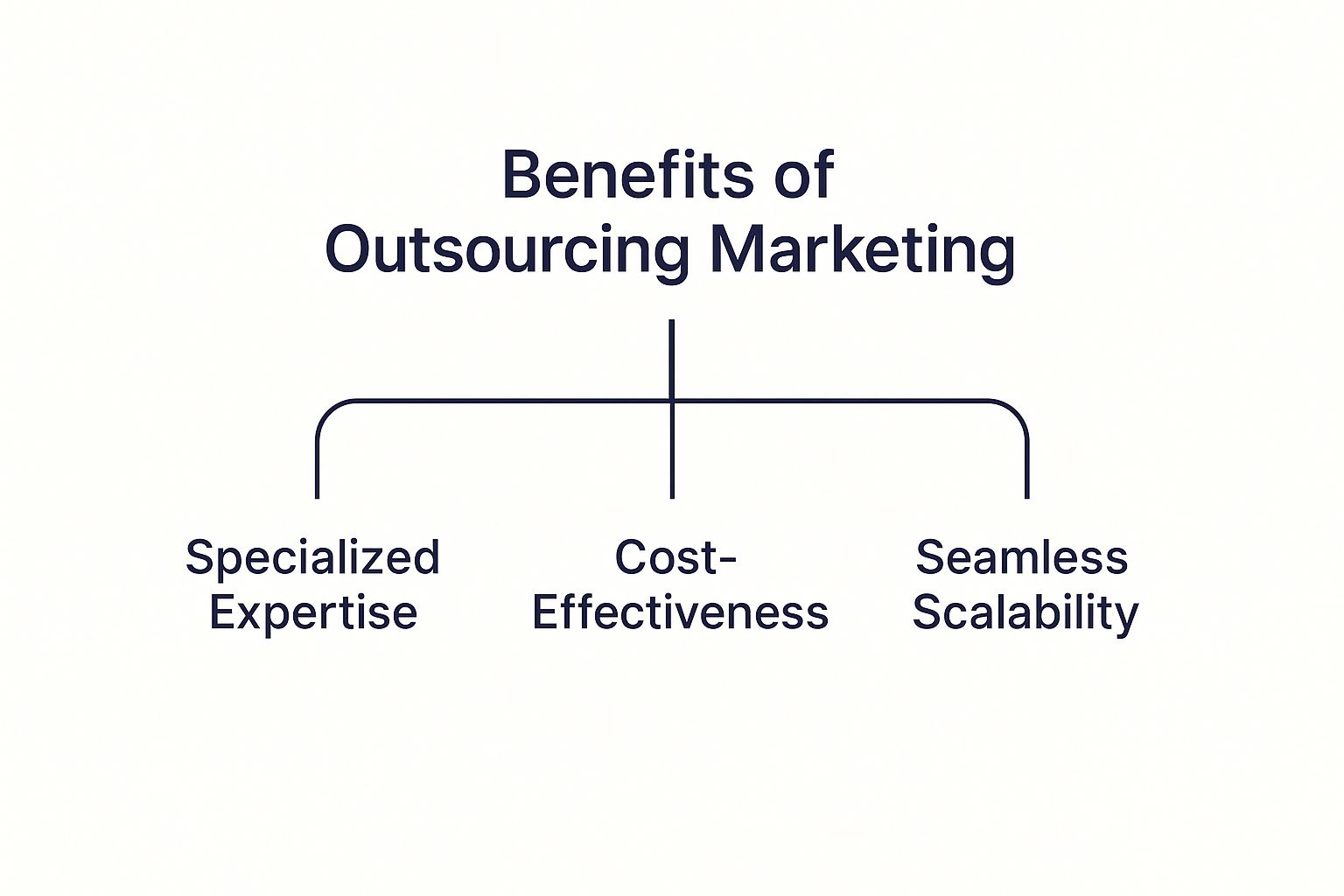
As you can see, it's all connected. The expert knowledge you gain drives down costs and gives your business the agility it needs to pounce on opportunities.
Instantly Plug Into Specialized Expertise
Modern marketing isn't one job—it's a dozen. A small business rarely has the budget for a full-time SEO strategist, a dedicated content writer, a social media guru, and a pay-per-click (PPC) ads specialist. The problem is, you often need all of them to actually win.
Outsourcing gives you that entire team, instantly. You stop hunting for the mythical "marketing unicorn" who can do it all (spoiler: they don't exist) and instead get a roster of specialists who live and breathe their craft.
Think of it this way: you’re not just hiring hands to do tasks; you’re renting an entire marketing department’s worth of brains and experience.
This team walks in the door already knowing the latest trends, tools, and strategies that are getting results right now. That means your business can start running sophisticated campaigns from day one, leveling the playing field against bigger competitors with huge in-house teams.
It’s Cheaper Than You Think
At first glance, an agency retainer might look like a big number on an invoice. But when you stack it up against the true cost of hiring just one senior marketer in-house, the math tells a very different story. It's a simple comparison, but a powerful one.
Let’s pull back the curtain on the hidden costs of a single employee:
- Salary and Benefits: This is the obvious one. You're looking at $70,000+ for an experienced marketing manager, plus thousands more for healthcare, retirement, and everything else.
- Recruiting and Training: Finding, interviewing, and getting a new hire up to speed costs real time and money.
- Software and Tools: The professional tech stack for analytics, email, SEO, and design can easily run into thousands of dollars a year. An agency’s fee usually bundles all of that in.
For less than the fully-loaded price of one employee, you get an entire team of specialists. This move turns a huge, fixed overhead cost into a predictable, manageable operating expense. You sidestep payroll taxes, benefits, and long-term commitments, making it a much smarter way to use your marketing budget.
Scale Up or Down on a Dime
Your business isn't static, so why should your marketing team be? You might need a massive push for the holiday season, a focused launch for a new product, or a quiet period to focus on operations. An in-house team is a fixed resource—scaling them up or down is slow, expensive, and a logistical nightmare.
This is where an outsourced team’s agility is a game-changer.
Imagine you're gearing up for a huge Black Friday sale. An outsourced partner can immediately ramp up your ad spend, content production, and email campaigns to meet the demand. They have the people and resources ready to go. Then, when the sale is over, they can scale right back down. No drama, no fuss.
Trying to do that internally is nearly impossible. You can’t just hire three marketing experts for a single quarter and then let them go. Outsourcing lets your marketing efforts expand and contract in perfect sync with your business goals, ensuring you only pay for what you need, when you need it. That kind of agility is a massive competitive advantage.
Finding Your Fit: Comparing 3 Outsourced Marketing Models

Deciding to bring in outside marketing help is a big step, but it's just the first one. Now you have to pick the right kind of partner. Not all outsourcing setups are the same, and the model you choose directly shapes your results, your budget, and how much time you'll spend managing things.
Think of it like building a house. You wouldn’t hire a master architect to fix a leaky faucet, and you wouldn't ask a plumber to design the whole blueprint. Each pro has their place. Let's break down the three main paths you can take to find the perfect fit.
H3: The Specialist: Niche Marketing Agencies
A niche agency is your master craftsman. They do one or two things, and they do them exceptionally well. This could be a firm that lives and breathes SEO, a group that’s all about PPC ads, or a team that geeks out on email marketing automation.
You call these folks when you have a specific, well-defined problem.
Let's say your company already puts out fantastic blog content, but it’s languishing on page ten of Google. An SEO-only agency is your go-to. They won't build your whole marketing machine, but they’ll apply their deep expertise to get your existing work seen by the right people. This model is perfect when your foundation is solid but one area needs a serious boost.
H3: The General Contractor: Full-Service Marketing Agencies
If the niche agency is a specialist, the full-service agency is the architect and general contractor all in one. They’re the strategic partner you hire to build a comprehensive marketing plan from the ground up—and then execute every single piece of it.
This is the way to go when you need more than just one task handled. A full-service partner takes on everything from market research and strategy to content creation, social media, SEO, and paid ads. They connect all the dots so your marketing feels like a cohesive, powerful engine, not a collection of random parts.
A full-service agency is ideal for a small business that needs to build its marketing function from scratch or for an established business looking to completely overhaul its existing strategy for a new phase of growth.
They give you an entire integrated team with a single point of contact, which makes your life a whole lot easier.
H3: The Hired Gun: Freelance Contractors
Freelancers are the skilled pros you bring in for specific, short-term gigs. They offer incredible flexibility and are often the most budget-friendly option for one-off tasks. Think of them as the expert electrician you hire to install new light fixtures—they come in, do a fantastic job, and they’re done.
You might hire a freelancer for things like:
- A new logo design or brand guide
- Writing a series of blog posts or a whitepaper
- Setting up an initial email nurture sequence
- Running a short-term social media campaign
This is a brilliant solution for businesses on a tight budget or with very specific, project-based needs. While trying to manage a dozen freelancers for a complex strategy can get messy, they are unbeatable for getting high-quality work done on a single task without any long-term strings attached.
Choosing the right model comes down to what you need right now. To make it a bit clearer, here’s a side-by-side comparison of the three options.
Outsourced Marketing Models Compared
| Model Type | Best For | Typical Cost Structure | Pros | Cons |
|---|---|---|---|---|
| Specialized Agency | Businesses with an in-house team needing to fill a specific skill gap (e.g., SEO, PPC). | Monthly Retainer or Project-Based | Deep expertise in one area, high-quality results for a specific function. | Limited scope, may not see the "big picture" of your overall strategy. |
| Full-Service Agency | Companies needing a complete, outsourced marketing department or a total strategy overhaul. | Monthly Retainer | Comprehensive strategy, single point of contact, cohesive execution. | Higher cost, less flexibility than freelancers. |
| Freelancer | Startups and SMBs needing help with specific, one-off projects on a tight budget. | Hourly Rate or Per-Project Fee | Cost-effective, highly flexible, access to specialized skills on demand. | Can be difficult to manage multiple freelancers, lacks strategic oversight. |
Each path offers a different blend of expertise, cost, and involvement. The key is to be honest about your resources, goals, and how hands-on you want to be.
The outsourcing world has come a long way. It's not just for administrative tasks anymore. Today, 50% of executives are outsourcing key functions like marketing, because they see the value in bringing in specialized skills for digital advertising and content. You can explore more about these outsourcing trends to see how other businesses are adapting. This shift allows even the smallest businesses to tap into elite talent, leveling the playing field like never before.
How to Choose the Right Marketing Partner
Picking a marketing partner is a massive decision for your business. It's not like hiring a plumber; it's more like bringing on a key executive who’s going to have their hands all over your company's growth. The right partner feels like a natural extension of your team, but the wrong one can burn through your budget and leave you with nothing but missed opportunities.
This isn't a decision to rush. You have to look past the slick sales decks and dig into how they actually work, what they can do, and how they define a win. Let's walk through a practical checklist to help you sort through the options and find a partner who is genuinely invested in seeing you succeed.
Verify Their Industry and Business-Size Experience
First things first: are they even relevant to you? An agency that pulls off miracles for giant enterprise software companies might be completely lost trying to market a local bakery. Their strategies, their tools, and even how they talk to clients could be a terrible fit.
When you're looking into outsourced marketing for a small business, you have to ask for concrete examples of their work with companies just like yours. This is non-negotiable.
You need proof that they get:
- Your customer: Who are they, really? What makes them tick, and where do they hang out online?
- Your sales cycle: Is it a five-second e-commerce click or a six-month B2B decision with multiple stakeholders?
- Your competitive environment: What are the real-world challenges and untapped opportunities in your specific market?
An agency that already has a solid track record in your world will get up to speed faster, make smarter moves from day one, and deliver way better results. They won't be learning the ropes on your dime.
Dive Deep into Case Studies and Client Conversations
Case studies aren't just glossy brochures; they're your evidence that an agency can actually deliver. But don't just glance at the pretty graphs. You need to find the story behind the numbers.
A good case study will lay it all out:
- The Initial Challenge: What was the client struggling with before the agency showed up?
- The Strategy and Actions: What specific things did the agency do to fix the problem?
- The Measured Results: What were the hard numbers? A jump in leads, a lower cost to get a customer, a surge in organic traffic—the real stuff.
The best partners are proud of their work and totally open about how they got there. If an agency gets cagey about sharing detailed results or won't let you talk to a current client, that’s a huge red flag.
Actually talking to one or two of their current clients is the ultimate gut check. It’s your chance to get an unfiltered look at what it's really like to work with them.
Ask the Right Questions During the Vetting Process
Once you have a shortlist, it's interview time. The goal here is to get past the sales pitch and understand how their operation really runs. Come prepared with a list of smart, open-ended questions.
Here are a few essentials to get you started:
- How will you measure success for my business goals, not just vanity marketing metrics?
- Walk me through your client onboarding process, from day one to the 90-day mark.
- Who will be my main point of contact, and what does the rest of your team look like?
- What's your process for making changes when a campaign isn't hitting its targets?
- What tools do you use, and will I have direct access to my own data?
Their answers will tell you everything you need to know about their strategic thinking, their transparency, and their communication style. To get a better feel for the roles involved, it helps to understand what a digital marketing agency does and how they organize their teams. This gives you the context to see if their model is the right one to build a real partnership.
Building a Successful Outsourced Partnership

Alright, you’ve picked your marketing partner. Big step. But this is the starting line, not the finish. The most common mistake I see small business owners make is thinking they can just hand over the keys and wait for the magic to happen.
A great partnership is a real collaboration. Both sides have to be engaged and pulling in the same direction.
Think of it this way: You’re the architect of your business. You hold the vision, the goals, and the blueprints for what success looks like. Your new marketing partner is the expert builder. They’ve got the tools, the skills, and the crew to bring that vision to life. One can't succeed without the other.
This mindset kicks in the second you sign the contract, starting with a solid onboarding process. This is where you pour the foundation for everything to come.
Setting the Foundation for Success
Onboarding isn't just about sharing logins and brand files. It's a strategic deep-dive where your new partner gets to know the DNA of your business. This is your chance to set the ground rules for how you’ll work together and kill any potential misunderstandings before they start.
A strong partnership is built on clarity. The first 30 days are critical for defining goals, setting up communication channels, and establishing a rhythm that will carry you forward for months, or even years.
There are a few things you absolutely have to nail down from day one. Skipping these steps is like trying to build a house without looking at the blueprints—it's going to get messy, fast.
Here’s what to prioritize right away:
- Define Clear Goals: Get way more specific than "more traffic." You need measurable objectives, like "increase qualified leads from organic search by 20% in Q3."
- Identify Key Performance Indicators (KPIs): Agree on the exact numbers you'll use to measure progress. Will it be Customer Acquisition Cost (CAC)? Conversion Rate? Return on Ad Spend (ROAS)? Decide now.
- Establish a Communication Rhythm: How often will you connect? A weekly 30-minute call? What tools will you use for daily updates? A shared Slack channel or a project management board can work wonders.
Maintaining a Healthy and Productive Partnership
Once you’re up and running, keeping the partnership healthy takes ongoing effort. It all comes down to open communication and mutual trust. As the business owner, your job is to give your marketing team the context they need to make smart calls.
This means sharing internal business updates, even if they don't seem like marketing news at first. For instance, if you know a supply chain delay is coming, tell your team. They can pause ads for that product and stop you from getting a flood of angry customer emails.
Giving consistent and constructive feedback is just as crucial. Don't wait for a monthly report to bring up a concern. If you see an ad that just doesn't feel like your brand, speak up right away. That constant feedback loop helps your partner learn your style and get things right, faster. Truly great results in outsourced marketing for small business come from this dynamic, two-way street.
How to Measure Your Marketing ROI
Bringing in an outsourced marketing team feels like a big step, but it shouldn't feel like a leap of faith. The question that really matters is always the same: "Is this actually working?" The answer is all about measuring your Return on Investment (ROI), which is just a fancy way of making sure you’re bringing in more money than you’re spending.
To get this right, you need to get familiar with two types of metrics. Think of them like your car’s dashboard. One set of gauges tells you if the engine is running smoothly and you have enough gas, while the other tells you if you've actually arrived at your destination.
Leading Indicators: Your Predictive Metrics
Leading indicators are the early signals that your strategy is starting to work. They aren't final sales figures, but they give you a strong hint that you're on the path to success. They show the engine is warming up and you're moving in the right direction.
Key leading indicators to keep an eye on include:
- Website Traffic: A jump in visitors is a great sign that your content and SEO efforts are getting people’s attention.
- Keyword Rankings: Climbing the search results for your most important terms means your visibility is growing, paving the way for more organic traffic.
- Social Media Engagement: More likes, shares, and comments mean your brand's voice is connecting with the right people.
These metrics are your early-warning system. They give you and your marketing partner the feedback needed to tweak your tactics long before the final sales numbers roll in.
Lagging Indicators: Your Bottom-Line Results
While leading indicators predict future success, lagging indicators prove it happened. These are the hard numbers that connect your marketing spend directly to your revenue. They're the "destination reached" confirmation on your GPS.
Lagging indicators are your proof points. They connect the dots between your marketing spend and actual business growth, giving you the confidence to reinvest in what works.
You’ll want to zero in on these critical lagging indicators:
- Leads Generated: This is the raw count of potential customers your campaigns have brought into your pipeline.
- Customer Acquisition Cost (CAC): This tells you exactly how much you’re spending, on average, to land a new customer.
- Conversion Rate: This is the percentage of people who take the action you want them to, like making a purchase or filling out a contact form.
Getting a handle on these numbers is non-negotiable. If you want to dive into the formulas and see a straightforward framework, check out our guide on how to calculate marketing ROI.
This focus on data is one of the biggest wins of outsourcing. It’s no surprise that 66% of small businesses with 50-500 employees now outsource some of their work to get this kind of expertise. Discover more insights about outsourcing trends for small businesses on Ossisto.com. By tracking both leading and lagging indicators, you can build a clear picture that proves the value of your investment.
Outsourced Marketing FAQs
Jumping into outsourced marketing is a big step, and it’s totally normal to have questions. Let's tackle some of the most common ones that pop up for small business owners. My goal here is to give you straight answers so you can feel confident about your next move.
How Much Should I Expect to Pay for Outsourced Marketing?
This is usually question number one, and the honest answer is: it depends. There’s no flat rate because the cost is tied directly to what you need and the kind of partnership you build.
For instance, if you just need a freelance writer to knock out a few blog posts each month, you might be looking at a few hundred dollars.
But if you're going all-in with a full-service agency to manage your SEO, run your paid ads, and handle your email marketing, a monthly retainer could be anywhere from $2,000 to $10,000+. The most important thing is finding a partner with transparent pricing that matches your budget and goals. You should only ever pay for services that are going to push your business forward.
How Quickly Will I See Results?
The timeline for seeing a real impact really hinges on the marketing channels we're talking about. It’s a mix of quick wins and steady, long-term growth.
- Paid Advertising (PPC): With channels like Google Ads, you can see the needle move pretty fast. We're talking more traffic and leads coming in within the first 30 to 90 days as campaigns get up and running.
- SEO and Content Marketing: Think of these as a long game. It usually takes about 4 to 6 months to start seeing real traction in your keyword rankings and a noticeable uptick in organic traffic.
Any good partner will map this out for you right from the start. They should be able to tell you what success looks like at the 30, 60, and 90-day marks for each specific strategy.
Will I Lose Control of My Brand?
Not a chance. At least, not if you work with the right people. A great marketing partnership is a true collaboration, not just a hand-off. You’re the expert on your brand’s personality, mission, and what you stand for. Your marketing team’s job is to take that core identity and turn it into campaigns that connect with people.
You always have the final say. A professional partner will have a clear system for feedback and approvals on strategy, messaging, and creative. Everything they produce should feel like it came straight from you.
They handle the heavy lifting and execution, but the heart of your brand stays completely in your control. The whole point is to make your brand louder and more effective, not to change it. Your input is what makes their work successful, which is why open communication is everything.
Ready to see how a dedicated marketing partner can kickstart your growth? At Frozen Crow Inc., we build data-driven strategies that deliver measurable results. Get your free marketing audit and start turning your marketing efforts into a powerful revenue engine. Learn more about our approach at https://frozencrow.com.


