


August 20, 2026
Pay Per Click Lead Generation: Boost Ad ROI with Proven Tactics
When you need leads now, pay-per-click advertising is the fastest way to get them. In simple terms, PPC for lead generation is all about using paid ads, like those on Google Ads, to send interested people to a specific landing page where they can give you their information.
It’s a direct line to your potential customers. Instead of waiting months for SEO to kick in, you get immediate visibility and traffic, letting you start the conversation right away.
Why PPC Is Your Next Growth Engine
If you're struggling to find a consistent flow of qualified leads, PPC can feel like flipping a switch. It's a controllable growth engine that puts your business directly in front of people actively looking for what you sell.
Think about it. When someone searches for "emergency plumbing services," they have an immediate, urgent need. A well-crafted ad doesn't just show up; it solves their problem at the exact moment they're asking for help. That kind of timing is tough to beat with any other marketing channel.
The Power of Precision and Control
The real magic of pay per click lead generation is just how much control you have. You get to decide exactly who sees your ads, what message they get, and precisely how much you're willing to spend.
This control breaks down into a few key areas:
- Audience Targeting: Forget just keywords. You can get laser-focused by targeting people based on their location, age, income, and even recent online behaviors. This ensures you're only spending money on your ideal prospects.
- Message Customization: Speak directly to where your customer is in their journey. Someone just starting to research needs a different message than someone who is ready to pull out their credit card. PPC lets you tailor the ad copy for both.
- Budget Management: No surprises here. You set the daily budget and the max you'll pay for a click. This financial guardrail makes your marketing spend predictable and prevents costs from spiraling.
One of the biggest mistakes I see is businesses sending expensive paid traffic to their generic homepage. It’s a conversion killer. In fact, research shows over 50% of B2B PPC ads make this costly error, which absolutely tanks their results.
Measuring What Matters Most
Finally, PPC is all about the data. Every impression, click, and conversion is tracked, giving you a crystal-clear view of your return on investment (ROI).
This isn't a "set it and forget it" game. It's a science. The data tells you what's working and what isn't, allowing you to constantly refine your campaigns for better and better performance. You can directly tie your ad spend to real, tangible growth.
Building Your Campaign Foundation For Success

A high-performing pay per click lead generation campaign isn’t something you just switch on. It's engineered, piece by piece, long before you even think about writing an ad. This is where the real work happens—the stuff that separates campaigns that print money from those that just burn it.
It all starts with getting inside your customer's head and understanding the exact language they use when they're actually ready to pull the trigger. Forget just grabbing a list of obvious keywords. We need to dig deeper, see what your competitors are up to, and find those high-intent search terms they're probably missing.
Uncovering High-Intent Keywords
Good keyword research isn't about chasing volume; it's about hunting for intent. Sure, a broad term like "CRM software" gets a ton of searches, but you're attracting everyone from college students to big-shot enterprise buyers. It’s noisy.
Contrast that with a long-tail keyword like "CRM for small construction companies." The search volume is tiny in comparison, but the person typing that in is a highly qualified, motivated buyer. They know what they need.
Think like your customer. What problem are they desperate to solve right now? The best keywords tap into that urgency.
- Spy on Competitor Ads: Use tools like the Google Ads Transparency Center to see the exact ads your competition is running. This is a cheat sheet showing you the pain points and selling points they think are working.
- Dig into "People Also Ask": Google’s own search results are a goldmine. Those questions are direct insights into what your audience is trying to figure out.
- Focus on Action-Oriented Phrases: Look for keywords that include "solution," "pricing," "alternative," or "local provider." These are buying signals, telling you the user is much further down the funnel.
This kind of research makes sure your ads show up in the moments that matter most, which is how you start capturing truly valuable leads.
Key Insight: A well-structured campaign is your secret weapon for a higher Quality Score. Google rewards advertisers who create a tight, relevant connection between the keyword, the ad, and the landing page. A logical structure isn't just for organization—it's a direct signal of relevance that lowers your ad costs.
Structuring Campaigns For Maximum Impact
Once you've got your keywords, you need to organize them. A messy structure is a recipe for disaster, forcing you to write generic ads that try to speak to everyone and end up connecting with no one. A clean, logical structure lets you get hyper-specific with your messaging.
Let’s say you’re a digital marketing agency offering SEO, PPC, and web design. If you throw all your keywords into one ad group, a search for "local SEO services" might trigger a generic "digital marketing" ad. That’s a bad experience and a complete waste of money.
A much smarter way is to build separate campaigns for each core service. From there, you break it down further into tightly themed ad groups.
| Campaign | Ad Group Examples | Keyword Theme |
|---|---|---|
| PPC Management | PPC for E-commerce | "e-commerce ppc management" |
| PPC for SaaS | "saas ppc agency" | |
| Local PPC Services | "ppc services near me" |
This granular approach means someone searching for "PPC for E-commerce" sees an ad that speaks directly to their needs. Your click-through rate goes up, and your conversion rate follows.
The paid search world is tough. We’re looking at a global spend of $351.5 billion, and 86% of industries saw their CPCs go up last year. In this kind of environment, a meticulously structured campaign isn't just a "best practice"—it's a requirement for survival. You can dig into more of this data in the full PPC statistics report.
Finally, you need to set a realistic budget and clear goals before you spend a dime. Figure out your target cost per acquisition (CPA) by knowing what a lead is actually worth to your business. This financial guardrail ensures your campaign is built to be profitable from day one.
Crafting Ads That Get Clicks and Landing Pages That Convert
Okay, you’ve got a solid campaign structure. Now for the part where the real magic happens. A killer keyword list and perfect targeting don't mean a thing if your ads are a snooze-fest and your landing pages leak leads like a sieve. This is where you actually connect with a potential customer, turning their search into a real business opportunity.
Think of your ad copy as a digital handshake. It’s got to be firm, confident, and make a great first impression. It’s not about being clever—it’s about being crystal clear and compelling enough to make someone stop scrolling and click.
Writing Ad Copy That Speaks to Your Audience
Your ad is a direct promise to solve a problem. The headline is everything; it’s often the only part people actually read, so it has to connect with their search intent instantly.
Let's say someone frantically searches for "emergency roof repair." A generic headline like "Best Roofing Company" is going to get ignored. But "24/7 Emergency Roof Repair – Fast, Free Estimates"? That’s a winner. It perfectly mirrors their urgent need and offers a clear, low-risk next step. The description copy should then pile on the value, hitting on benefits like speed, reliability, and any guarantees you offer.
To nail your ad copy every time, always:
- Mirror Their Language: Use the same words and phrases from their search query right in your headline. This creates immediate relevance and tells them they’re in the right place.
- Focus on Benefits, Not Features: Don’t say, “We use advanced software.” Instead, say, “Get Your Custom Quote in 60 Seconds.” See the difference? One is about you, the other is about them.
- Include a Strong Call-to-Action (CTA): Be direct and tell them exactly what to do. "Get Your Free Audit," "Request a Demo Now," or "Download the Guide" work wonders.
Don't just guess what works. You have to be systematic with your A/B testing. Create two ad variations with just one difference—maybe one headline focuses on speed while the other highlights price. Run them head-to-head and let the data tell you which message truly hits home with your audience.
The Landing Page: Your Secret Conversion Weapon
You did it—you earned the click. Now, the landing page has one, and only one, job: turn that click into a lead. This is, without a doubt, the most common failure point in pay per click lead generation. The absolute cardinal sin is sending paid traffic to your homepage. It’s a distracting mess of navigation links, blog posts, and different service offerings.
A dedicated landing page, on the other hand, is a clean, focused environment built for a single purpose.
A critical mistake I see all the time is a major disconnect between the ad and the landing page. If your ad promises a "free B2B marketing checklist," the landing page headline better reinforce that exact offer. Any mismatch creates instant confusion and sends visitors scrambling for the back button.
Every high-converting landing page needs these non-negotiable elements:
- A Compelling, Benefit-Driven Headline: It has to echo the promise you made in your ad.
- Clear and Concise Copy: Use bullet points. Make it scannable. Get straight to the point.
- Engaging Visuals: A relevant image or a short, punchy video can boost engagement significantly.
- Social Proof: Nothing builds trust faster than testimonials, client logos, or hard numbers from case studies.
- A Frictionless Form: Only ask for what you absolutely need. A form with ten fields will get crushed by a simple one with three.
For a much deeper dive into building pages that actually capture leads, check out these best practices for landing page design and make sure you’re not leaving money on the table.
Aligning Your Ad Message with the Landing Page Experience
This concept is called "message match," and it's the seamless connection between what your ad promises and what your landing page delivers. Getting this right is crucial for keeping your Quality Score high and your conversion rates climbing. If a user clicks an ad for "commercial HVAC repair," the landing page better be all about commercial HVAC repair, not a generic page about all heating and cooling services.
At the end of the day, PPC lead generation is about turning clicks into customers. Learning how to improve website conversion rates is fundamental to turning your ad spend into real business growth. By making sure your ad copy and landing pages work in perfect harmony, you create a smooth, persuasive journey that guides users from click to conversion, maximizing the return on every single dollar you spend.
Mastering Advanced Targeting and Bidding Strategies
Once you've got your campaign foundation built, it's time to get surgical. Great pay per click lead generation isn't about casting a wide net and hoping for the best. It’s about finding the right person at the exact moment they need what you're selling.
This is where advanced targeting and smart bidding turn a decent campaign into a lead-generating machine. Moving beyond basic keywords is how you start spending your budget with real intention.
Layering Audiences for Laser-Focused Targeting
Think of audience layering like building a police sketch of your perfect customer. Instead of just bidding on a keyword, you’re telling Google Ads, "Hey, only show my ad to people who searched for this keyword and also fit these specific criteria."
This simple shift is a game-changer for reducing wasted ad spend. It’s the difference between shouting into a crowded stadium and having a direct, quiet conversation with someone who's ready to buy.
Here are a few powerful layers you can start combining right away:
- Demographics and Geographics: The basics, but essential. A local roofer, for example, can target homeowners aged 35+ within a 20-mile radius who are actively searching for "roof repair."
- In-Market Audiences: This is huge. You can tap into audiences Google has already identified as actively shopping for products or services just like yours. They're literally in the market to buy.
- Affinity Audiences: This one's more about long-term interests and habits. It's fantastic for building brand awareness with a crowd that’s already predisposed to care about your industry.
For B2B, this kind of layering isn't just helpful—it's critical. We've seen it make or break campaigns. You can dive deeper into how these concepts work for business-to-business models in our PPC for B2B guide.
Unlocking the Power of Remarketing and Lookalike Audiences
Some of your best, most affordable leads are hiding in plain sight: they're people who have already visited your website. Remarketing lets you get back in front of those warm prospects who checked you out but didn't quite make it over the finish line.
By showing them a tailored ad, you stay top-of-mind and give them a gentle nudge to come back. This is consistently one of the highest-ROI strategies in any PPC account we manage.
Better yet, you can take your list of converted leads and hand it to the ad platforms to create a lookalike audience. The algorithms analyze the common traits of your best customers and then go find new people who look and act just like them online. It's like cloning your ideal customer base to expand your reach.
Expert Insight: Don't just run one generic remarketing campaign. Get granular. Someone who abandoned your pricing page is a much hotter lead than someone who only read a blog post. Create different ad messaging for each segment to skyrocket your relevance and conversion rates.
Choosing the Right Bidding Strategy
Your bidding strategy dictates how your budget gets spent, click by click. While going manual gives you total control, automated or "smart" bidding strategies use machine learning to do the heavy lifting, often driving better results while saving you a ton of time.
Knowing when to use each one is key.
- Manual CPC (Cost-Per-Click): You set the maximum you're willing to pay for any given click. This is perfect for brand-new campaigns where you need to gather data and keep a tight leash on costs.
- Maximize Conversions: You tell the platform, "Get me the most leads you can within my daily budget." This works best once you have a steady stream of data—at least 15-30 conversions a month is a good starting point.
- Target CPA (Cost-Per-Acquisition): You tell the system the exact price you want to pay for a lead, and it automatically adjusts bids to hit that average. This is the go-to for mature campaigns where profitability is the number one goal.
Just remember, all the clever bidding in the world won't save a campaign that sends high-intent traffic to a generic homepage. The chart below shows just how massive the performance gap is.
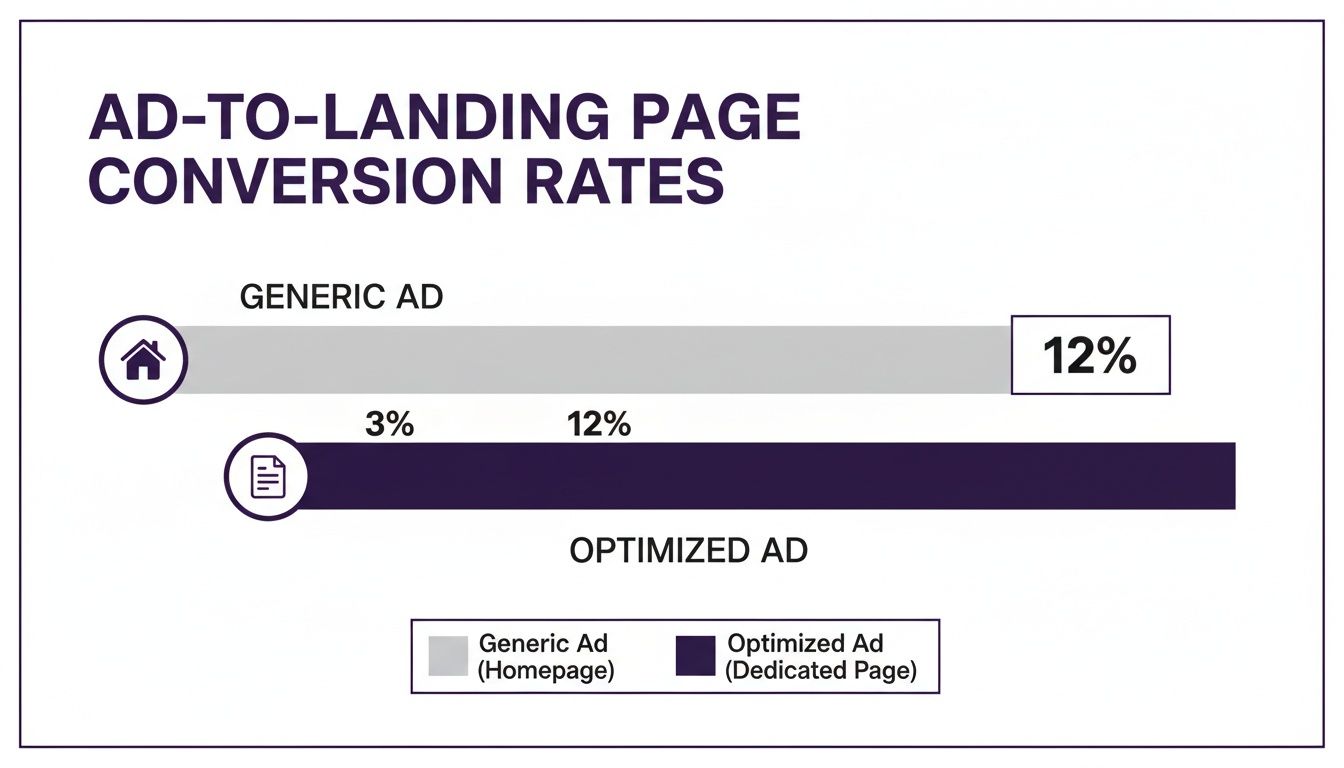
The data speaks for itself. Aligning your ad, targeting, and landing page is non-negotiable for success.
Key PPC Lead Generation Metrics And Industry Benchmarks
To give you a clearer picture of what "good" looks like, it helps to see how key metrics stack up across different industries. Performance can vary wildly, so context is everything.
| Metric | Google Ads Average (All Industries) | High-Performing Industry Example (Arts & Ent.) | Lower-Performing Industry Example (Attorneys) |
|---|---|---|---|
| Average Click-Through Rate (CTR) | 3.17% | 4.67% | 2.94% |
| Average Cost Per Click (CPC) | $2.69 | $1.64 | $6.46 |
| Average Conversion Rate (CVR) | 3.75% | 5.49% | 3.27% |
| Average Cost Per Acquisition (CPA) | $48.96 | $29.90 | $73.70 |
Source: WordStream benchmarks data.
As you can see, a $70 CPA might feel high in the entertainment world but would be an incredible result for a law firm. These benchmarks help you set realistic goals for your own campaigns.
Ultimately, the power of platforms like Google Ads is undeniable. Nearly 70% of marketers consider Google Search Ads their top channel for conversions. With an average cost per lead hovering around $70.11, mastering advanced targeting and bidding isn't just an option—it's how you ensure every dollar you spend is working to bring in a steady stream of high-quality leads.
How To Optimize and Scale Your Campaigns For Long-Term Growth
Getting your campaign live is just crossing the starting line. The real race is won in the day-to-day grind of optimization and smart scaling. This is what separates the pros who build predictable lead engines from the amateurs who just burn through cash.
The foundation of successful pay per click lead generation is simple: you can't improve what you don't measure. Before you touch a single ad or landing page, your conversion tracking has to be flawless. This isn’t a suggestion—it’s the absolute, non-negotiable bedrock for every decision you’ll make.
Without it, you’re just guessing. Solid tracking is what tells you which keywords, ads, and audiences are actually ringing the register.
Interpreting Data To Find Hidden Opportunities
Once your tracking is dialed in, the real fun begins. Diving into platforms like Google Ads and Google Analytics isn't about staring at vanity metrics like impressions. It’s about becoming a data detective, spotting the trends that point toward growth.
Look beyond the obvious metrics. Is your cost per lead dropping like a rock on mobile devices between 7 PM and 9 PM? That's a clear signal to set a mobile-specific ad schedule and boost your bids during that window. Are a few obscure, long-tail keywords converting at an insane rate, even with low volume? That's your cue to build out an entire ad group around that theme.
Don't just focus on what's working—pay just as much attention to what isn't. Your Search Terms report is a goldmine for finding irrelevant queries that are eating your budget. Aggressively adding these as negative keywords is one of the quickest ways to make your campaigns more profitable.
For a deeper dive into making these data-driven tweaks, our guide on how to optimize Google Ads breaks down the practical steps for refining your campaigns.
The A/B Testing Framework For Continuous Improvement
Guesswork has no place in a high-performing PPC account. The only way to know for sure if a new headline or a different call-to-action will actually work better is to test it systematically.
Don’t overcomplicate it. Just isolate one variable at a time and form a clear hypothesis. For instance: "Changing our landing page button from blue to orange will increase form fills by 10% because it stands out more."
Then, you run the test until you have enough data to make a confident call. Whether you were right or wrong, you’ve learned something valuable. The winner becomes the new control, and you move on to test the next element. This cycle is how you achieve steady, incremental gains over time.
Knowing When and How To Scale Responsibly
Once you've found a winning formula—a campaign that’s consistently bringing in leads at a profitable cost per acquisition (CPA)—the temptation is to just crank the budget to the max. But doing it recklessly can cause your CPA to skyrocket and kill your ROI.
Smart scaling is more than just throwing money at a campaign. It’s a measured, strategic expansion.
- Gradual Budget Increases: Never double your budget overnight. Bump it up by 15-20% at a time, then watch performance closely for a few days before touching it again.
- Expand Keyword Targeting: Use your best-performing ad groups as a template to target related, slightly broader keywords. This lets you capture more traffic without sacrificing relevance.
- Explore New Channels: Do your analytics suggest your audience hangs out on LinkedIn or Facebook? Use your PPC data to build a smart, informed strategy for expanding to a new platform.
Technology can also be a massive help here. To really make your process efficient as you grow, incorporating essential automations for businesses can streamline everything from lead follow-up to nurturing, ensuring no opportunity slips through the cracks.
In the world of PPC, data-driven optimization is your only real competitive edge. Recent benchmarks put the average cost per lead in Google Ads at $70.11, and for many businesses, a $2 return for every $1 spent is the baseline for success. These numbers show exactly why constant testing and smart scaling are critical for turning ad spend into a powerful growth driver.
Your Top PPC Lead Generation Questions, Answered
Jumping into PPC can feel like you're learning a whole new language, and it's totally normal to have questions. We hear a lot of the same ones from clients, so I've put together some straight-up answers to clear the air and help you move forward with your campaigns.
How Much Should I Actually Spend On PPC?
This is the million-dollar question, isn't it? The honest answer is, it really depends. We've seen a small local business get great results starting with $1,000 to $2,000 a month, while a national B2B company might be investing over $10,000 without blinking.
Instead of just picking a number, work backward from your goals.
Think about your target Cost Per Acquisition (CPA). Let's say a new customer is worth $1,000 in lifetime value to your business, and your sales team closes about 1 in 5 qualified leads. That means you can afford to pay up to $200 for a solid lead. This one number becomes your north star for measuring if your campaigns are actually profitable.
If you're brand new to pay per click lead generation, set aside a test budget you're comfortable with for the first 90 days. This initial phase is all about learning and gathering data—not about hitting home runs on day one. Once you see which campaigns are delivering leads inside your target CPA, you can start scaling up with confidence.
How Long Does It Really Take To See Results?
You can get clicks and traffic almost instantly, but seeing a steady stream of quality leads takes a bit of patience. It’s a process of dialing things in, not just flipping a switch. Managing your own expectations is half the battle.
Here’s a realistic timeline for a brand-new campaign:
- Month 1: The Data Collection Phase. This is all about listening. You’ll see impressions and clicks, but your costs and lead quality will be all over the place while the platform's algorithms figure things out.
- Month 2: The Optimization Phase. Now you have some real data to work with. You'll start cutting out keywords that just spend money, tweaking ad copy that isn't resonating, and adjusting bids based on what's actually driving leads.
- Month 3: The Stability Phase. By now, things should start to look a lot more predictable. Your Cost Per Lead (CPL) will stabilize, and you'll have a much clearer picture of your campaign’s true potential and ROI.
In really competitive spaces, this ramp-up might take closer to six months. The key is to see it as a long-term play. The goal is sustainable growth, not just a quick hit of traffic.
Key Takeaway: PPC is not an overnight success story. Think of the first three months as an investment in data. The insights you gain during this period are what will fuel profitable, scalable lead generation for years to come.
What Is a Good Cost Per Lead For My Industry?
A "good" Cost Per Lead (CPL) is completely relative. It changes dramatically from one industry to the next. For a local gym, a $30 CPL might be fantastic. But a personal injury law firm could see a $200+ CPL and consider it a massive win. It all comes down to the value of that lead.
Several things will move the needle on your CPL:
- Competition: High-value industries like legal, finance, and insurance are crowded, which drives up click costs and your CPL along with them.
- Target Audience: It's going to cost more to get your ad in front of a niche, high-level executive than it will to target a broader consumer group.
- Geographic Location: Bidding on keywords in a major city like New York is a whole different ballgame than in a smaller rural town.
- Quality Score: This is a big one. Google rewards ads and landing pages that are highly relevant with a better Quality Score, which directly lowers your ad costs and your CPL.
Instead of getting hung up on an industry benchmark, focus on your own numbers. A good CPL is any number that lets you acquire customers profitably.
At Frozen Crow Inc., we turn ad spend into a predictable engine for growth. Our team specializes in building and optimizing PPC campaigns that deliver real results, from the first audit to ongoing scaling. If you're ready to see what a data-driven approach can do for your business, schedule your free marketing audit today.


