


October 13, 2026
A Practical Guide to Mastering PPC for B2B Lead Generation
PPC in the B2B world is a completely different beast. We're not just selling a product; we're focused on generating high-value leads and driving sales for companies that sell to other companies. This means ditching the consumer-focused tactics and zeroing in on specific job titles and industries across platforms like Google, LinkedIn, and Microsoft Ads.
The messaging has to be precise, addressing complex business problems, not fleeting wants. The whole game is about capturing the attention of decision-makers somewhere along their often lengthy research and buying cycle.
Building Your B2B PPC Strategy from the Ground Up
Before you even think about putting a credit card on file, you need a solid foundation. This is what separates profitable B2B PPC campaigns from the ones that just burn cash. It’s not about guesswork; it's about building a strategic framework designed for the long haul.
Great PPC for B2B means looking past vanity metrics like clicks and impressions. We need to define clear objectives that are actually tied to the B2B sales cycle.
Your main focus should be on generating high-quality leads that have a real shot at becoming customers. That starts with defining what a Marketing Qualified Lead (MQL) and a Sales Qualified Lead (SQL) actually look like for your business. An MQL might be someone who downloaded a whitepaper. An SQL, on the other hand, is someone who just requested a demo. See the difference?
This whole process really breaks down into three core phases: defining your goals and audience, digging into the competitive landscape, and analyzing data to spot opportunities.
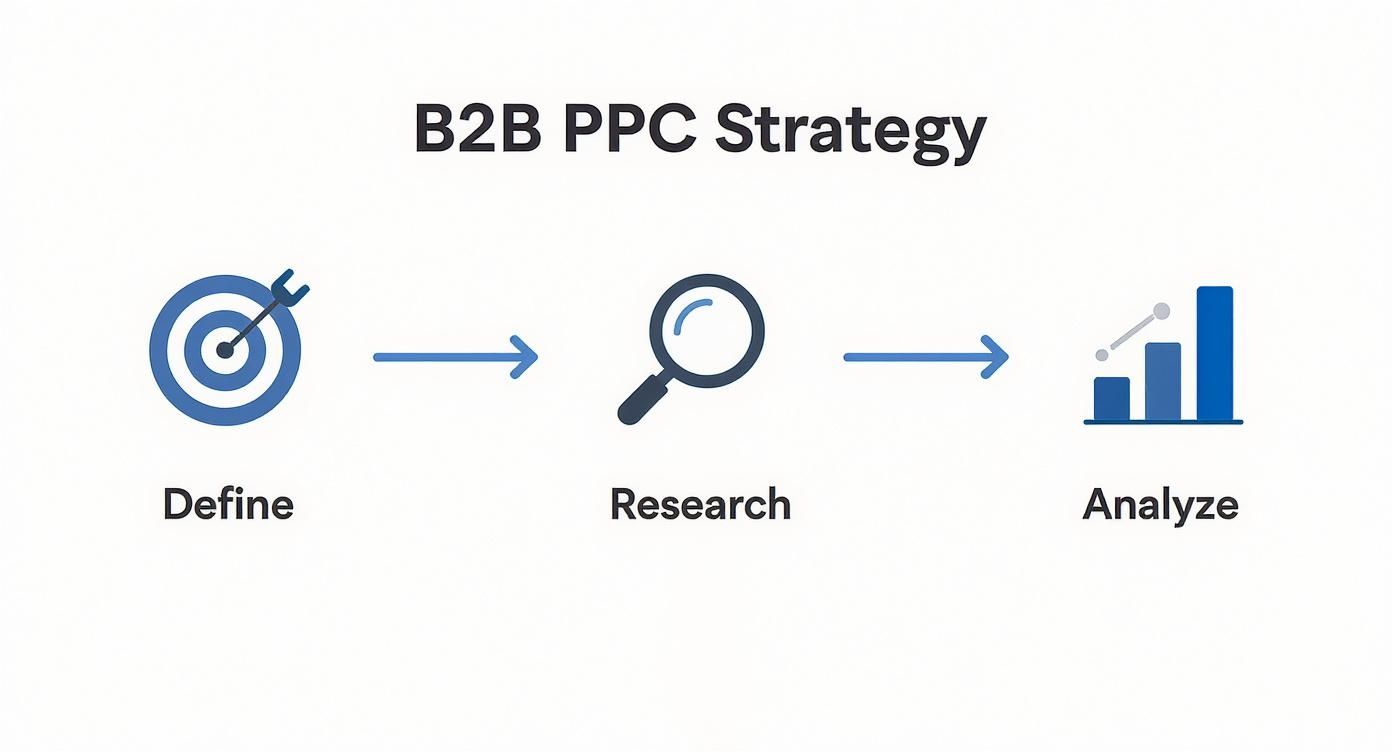
As you can see, a winning strategy always starts with crystal-clear definitions. Everything else—your research, your analysis, your campaign decisions—flows from there.
Map the B2B Customer Journey
Unlike a quick B2C purchase, the B2B journey is complicated. It involves multiple stakeholders, tons of research, and several touchpoints that can stretch over weeks or even months. Your job is to map this entire journey and pinpoint the exact moments where a PPC ad can actually make a difference.
Think about it in these stages:
- Awareness: The buyer is just starting to realize they have a problem. Here, you could target broad, informational keywords with ads that point to blog posts or ebooks.
- Consideration: Now they're actively researching solutions. They might be searching for "best [your solution] software" or comparing providers. Your ads need to lead them to case studies, webinars, or comparison guides.
- Decision: The buyer is ready to pull the trigger and choose a vendor. This is where you hit them with high-intent keywords like "[your brand] pricing" or "request a demo for [your service]."
Create Detailed Buyer Personas
To really nail this, you have to go way beyond basic demographics. I'm talking about creating detailed buyer personas that get to the heart of your ideal customers' pain points, motivations, and daily professional headaches. "Marketing professionals" is useless. "Marketing Manager at a mid-size tech company" is getting warmer.
A great B2B buyer persona should feel like a biography of a real person. It includes their job responsibilities, the metrics they're judged on, the software they use daily, and most importantly, the exact language they use to describe their problems in a search query.
Remember, your PPC efforts are just one piece of a much larger puzzle. It's worth exploring modern B2B lead generation strategies to see how you can build a comprehensive plan that ties all your marketing channels together.
Conduct Practical Competitive Analysis
Understanding your competitors isn’t about copying them. It’s about finding the gaps in the market that your business can own. Use tools like the Google Ads Transparency Center or other third-party platforms to dissect what your rivals are doing. Analyze their ad copy—what value propositions are they pushing? Look at their keyword strategy to see which terms they're bidding on aggressively.
Most importantly, click their ads. Go study their landing pages.
- What’s the offer?
- How long is their form? What information are they asking for?
- What trust signals are they using (testimonials, client logos, etc.)?
This kind of intelligence is gold. It helps you position your own offers and messaging way more effectively. The B2B digital ad market is only getting bigger and more competitive. In the U.S. alone, B2B digital ad spending is projected to hit $23.05 billion by 2026, with global search ad spending expected to reach an incredible $351.5 billion in 2025. This growth just proves that a sharp, well-researched strategy is no longer a "nice-to-have"—it's absolutely essential to compete.
Choosing The Right B2B Advertising Platforms
Picking the right ad platform is one of those make-or-break decisions in any B2B PPC strategy. They just aren't all created equal, especially when your goal is to get in front of professional decision-makers who are deep in a long, complex buying cycle. Where you put your money should really come down to your budget, where your audience spends their time, and what you’re trying to achieve.
Let’s get into the big three: Google Ads, Microsoft Ads, and LinkedIn Ads. Each one brings something different to the table, and honestly, the sharpest B2B marketers I know use a mix of them instead of just betting on one horse.

Google Ads: The High-Intent Search Giant
When a business professional hits a wall or starts actively hunting for a solution, where do they go? Google. Nine times out of ten, that's the first stop. This makes Google Ads the undisputed king for grabbing high-intent search traffic. If you're an industrial repair service and someone is frantically searching for "emergency commercial HVAC repair," you absolutely have to be there.
That's the entire magic of paid search marketing. The platform's reach is massive, giving you a direct line to the largest pool of potential buyers out there. But that popularity has a cost. The average Cost Per Click (CPC) for B2B on Google Ads is around $3.33, and the competition for valuable keywords can get brutal. It’s an incredibly powerful tool, but you need to run a tight ship to avoid burning through your budget on clicks from students or casual browsers.
Pro Tip: Don't just set your keywords and forget it. I always layer on audience targeting like In-Market segments for "Business Services" or build custom audiences based on people who’ve visited competitor websites. This little trick helps ensure your ads aren't just shown to people searching for the right terms, but people who also fit your ideal customer profile.
LinkedIn Ads: The Professional Targeting Powerhouse
When you know exactly who you want to reach, you go to LinkedIn Ads. Its targeting is in a league of its own for B2B marketers because all the data is self-reported by professionals building out their profiles.
Think about it. You can laser-target by:
- Job Title: Go straight to the VPs of Operations, IT Directors, or CFOs.
- Company Size: Zero in on businesses with 50-200 employees.
- Industry: Show your ads only to people in manufacturing or financial services.
- Specific Company Names: Run hyper-focused account-based marketing (ABM) campaigns targeting your list of dream clients.
This kind of precision is a game-changer for niche SaaS products or high-ticket consulting services where the decision-making committee is well-defined. You're not just waiting around for them to search for you; you're proactively putting your message right in their professional feed. For a deeper look at the mechanics, check out our complete guide on what is paid search marketing.
Microsoft Ads: The Overlooked Opportunity
It’s easy to write off Microsoft Ads (what we used to call Bing Ads) as just a smaller Google, but that’s a huge mistake. It's a bit of a hidden gem for B2B advertisers. The user base often skews a bit older, is more affluent, and tends to work in corporate environments where Microsoft products—like the Edge browser—are the default. This creates a valuable, and often less crowded, audience.
The single biggest selling point? Less competition. Fewer advertisers fighting over the same clicks means lower CPCs and, quite often, a much better return on ad spend (ROAS).
B2B PPC Platform Comparison
So, how do they stack up head-to-head for B2B? While your own results will vary, this table gives a general idea of where each platform shines.
| Platform | Best For | Targeting Strength | Average CPC | Lead Quality |
|---|---|---|---|---|
| Google Ads | Capturing active, high-intent demand from searchers. | Keyword Intent & Remarketing | Moderate-High | Good-Excellent |
| Microsoft Ads | Reaching an older, professional audience with less competition. | Demographics & Lower Cost | Low-Moderate | Good |
| LinkedIn Ads | Hyper-targeting specific job titles, industries, and companies. | Firmographics & Job Functions | High | Excellent |
Ultimately, Google is for capturing people who are already looking, LinkedIn is for finding the exact people you want to sell to, and Microsoft is a fantastic, cost-effective way to supplement both.
Building Your Multi-Platform Strategy
The smartest approach isn't about picking one winner; it's about making your budget work intelligently across several channels.
Think of it this way: a company selling project management software could use Google Ads to catch searches for "best project management tool for agencies." At the same time, they could run a LinkedIn campaign targeting anyone with "Project Manager" in their title at companies with over 100 employees. To top it off, they could import their successful Google campaigns into Microsoft Ads to scoop up additional, lower-cost leads from that professional user base.
This kind of integrated strategy ensures you’re covering all your bases, from active searchers to passive prospects, which is how you win in the B2B space.
Building a High-Performance Campaign Structure
A messy account structure is a surefire way to burn through your ad budget and get murky performance data. It’s like trying to build a house without a blueprint—you might end up with four walls and a roof, but it’ll be unstable, inefficient, and impossible to scale later.
Think of your campaign structure as that essential blueprint for your entire B2B PPC operation. It brings clarity, control, and scalability, making everything else you do that much more effective.
The whole game boils down to one word: relevance. Every piece of your structure, from the campaign down to the keyword, needs to be logically organized. The goal is simple: make sure your ad copy is a perfect match for what the searcher is looking for. This isn't just "best practice"—it's how you boost your Quality Scores, lower your costs, and pull in better leads.
The Hierarchy of a B2B Account
Before you start building anything, you have to understand how accounts are organized. It's a straightforward hierarchy.
- Campaigns: This is your top-level folder. Campaigns should be built around your main business offerings, different target personas, or even stages of the sales funnel. For instance, a SaaS company might create separate campaigns for its "Enterprise Security Suite" and its "Small Business Analytics Tool."
- Ad Groups: These live inside your campaigns, and this is where the real magic of relevance happens. Ad groups are just tightly-themed clusters of keywords that all point to a single, specific sub-topic.
- Keywords & Ads: Finally, inside each ad group, you have your keywords and the ads that show up when someone searches for them. The ad needs to speak directly to the keywords in its group.
Building Tightly Themed Ad Groups
This is the exact spot where I see most B2B advertisers go wrong. They’ll create one giant ad group for something like "CRM Software" and stuff it with dozens of keywords like "crm for small business," "enterprise crm solutions," "salesforce alternative," and "free crm trial."
What happens next? They write a generic ad that tries to speak to everyone but ends up connecting with no one.
A much smarter approach is to create separate, single-keyword ad groups (SKAGs) or, at the very least, extremely small, hyper-focused groups.
Let's stick with the "CRM Software" campaign example:
- Ad Group 1: Keywords could be
crm software for manufacturingandmanufacturing industry crm. The ad headline? "CRM for Manufacturing Plants." - Ad Group 2: Keywords here might be
best real estate crmandcrm for real estate agents. The ad copy would naturally highlight features that realtors actually care about. - Ad Group 3: For keywords like
saas crm platform pricingandcost of crm software, your ads would lead straight to a pricing page and talk about affordability.
By isolating keywords into these super-relevant ad groups, you ensure that the search query, your ad copy, and your landing page are all perfectly aligned. We call this "message match," and it's absolutely critical for boosting conversion rates, which average around 3.04% for B2B search campaigns.
Precision Audience Targeting
Keywords are just one piece of the puzzle. When you start layering audience targeting on top of your search campaigns, you add a powerful filter. This ensures you're not just reaching people who use the right words, but the right people at the right companies.
You can combine your keyword targeting with audiences like:
- In-Market Segments: Go after users Google has already identified as actively researching specific business services or software.
- Custom Intent Audiences: You can actually build your own audience by feeding Google a list of competitor URLs. This tells the platform to target people who browse sites similar to your top rivals.
- LinkedIn Targeting (on Microsoft Ads): This is a massive advantage for B2B on Microsoft Ads. Its native integration with LinkedIn data lets you target users by their company, industry, and job function—right inside your search campaigns.
This layering technique is a core tactic in advanced PPC for B2B. It helps you shield your budget from students, job seekers, and other looky-loos who might use your keywords but have zero buying intent.
Campaign Settings Checklist
Finally, you have to nail the settings at the campaign level. This is how you control your spend and make sure you’re set up for success from day one. Before you launch anything, run through this quick checklist:
- Location Targeting: Get specific. Target the actual cities, states, or countries where your customers are. Don't forget to exclude irrelevant locations.
- Ad Scheduling: Does your sales team clock out at 5 PM on weekdays? It might be a good idea to only run ads when someone is actually there to follow up on a hot lead.
- Negative Keyword Lists: This is completely non-negotiable. You need a robust list of negative keywords to stop your ads from showing up for junk searches. Common B2B negatives include terms like "jobs," "free," "salary," "internship," and "training." Start with a core list and make a habit of adding to it weekly as you review your search term reports.
A thoughtful, organized structure makes managing and optimizing your account infinitely easier. It lets you see what’s working and what isn’t at a glance, so you can allocate your budget with confidence.
Creating Ads and Landing Pages That Actually Convert
Getting the click is a great start, but let's be honest—it’s just the first step. The real work in a B2B PPC campaign, and where you actually make money, is convincing a busy professional to give you their information and become a lead. This is where your ad creative and landing page experience have to shine.
It all boils down to creating a seamless, persuasive journey from the ad all the way to the thank-you page. A disjointed experience kills conversions, wastes your ad spend, and leaves potential customers wondering if they clicked the wrong thing.
Anatomy of Compelling B2B Ad Copy
B2B ad copy needs to be direct, professional, and laser-focused on solving a real business problem. You’re not selling a lifestyle; you're selling a solution that boosts efficiency, drives revenue, or cuts down on risk.
Your headlines and descriptions must speak directly to the searcher's pain point and maybe even their job title.
- For a top-of-funnel search like "how to improve warehouse logistics," your ad might lead with a headline like: "Free Guide: 5 Warehouse Inefficiencies." You're offering immediate value without asking for a huge commitment.
- For a bottom-of-funnel search like "inventory management software demo," the ad needs to be way more direct: "Get a Live Demo of [Your Software]" or "See Our Pricing & Features."
The key is to perfectly match your ad's promise to the searcher's intent. An awareness ad should educate and build trust, while a decision-stage ad needs a clear call-to-action that nudges them toward a sales conversation.
The Critical Importance of Message Match
Once someone clicks your ad, the landing page they hit must be a direct continuation of that conversation. We call this message match, and it’s completely non-negotiable. If your ad promises a "guide to cybersecurity compliance," the landing page headline better be something like "Download Your Free Cybersecurity Compliance Guide."
Anything less creates a jarring, confusing experience. Unfortunately, this is a common stumble; a shocking 52% of B2B PPC ads still send traffic to generic homepages instead of purpose-built landing pages. This is a massive missed opportunity, since dedicated pages are known to convert significantly better.
Essential Elements of a High-Converting B2B Landing Page
Your landing page has exactly one job: turn visitors into leads. To get that done, it has to be clear, trustworthy, and incredibly easy to use. For a deeper dive, check out our guide covering the best practices for landing page design.
Every solid B2B landing page should have these core components:
- A Benefit-Driven Headline: Don't just state what your service is; explain what it does for the customer. "Our CRM" is weak. "Close More Deals with Our CRM" is what gets the click.
- Scannable Copy: Use bullet points, bold text, and short paragraphs. Business pros are short on time and need to grasp your value proposition in seconds.
- Powerful Trust Signals: This is huge in B2B. Prominently display logos of clients they’ll recognize, showcase compelling testimonials, or feature any industry awards and certifications you’ve earned.
- A Frictionless Lead Form: Only ask for the information you absolutely need to qualify a lead. Every extra field you add can tank your conversion rate. You can always gather more details later in the sales process.
Make the Conversion Worthwhile
Finally, you have to offer something valuable in exchange for their contact info. A vague "contact us" form often isn't compelling enough to get a busy decision-maker to act. Instead, you need to offer high-value, downloadable assets that help them solve their problem right now.
Consider offering things like:
- In-depth whitepapers or original research reports
- Comprehensive case studies showing real-world results
- On-demand webinars or product demo videos
- Free tools, calculators, or templates
By providing tangible value upfront, you not only boost conversion rates but also position your brand as a helpful authority in your space. To really dial things in, it's worth digging into conversion rate optimization (CRO) best practices to fine-tune every element of your funnel.
Measuring Performance and Optimizing for ROI
Getting clicks is easy. Tying those clicks to actual revenue? That’s the real work, and it's the most critical part of any B2B PPC strategy. This is where we stop talking about front-end metrics like CTR and start proving the real-world impact of our campaigns. It's about finally connecting the dots between a prospect's first click and a signed contract.
To do this right, you need to master three things: smart bidding and budgeting, airtight conversion tracking, and closing the loop with your CRM. Without all three, you’re flying blind—you might be getting leads, but you have no idea which ones are actually turning into paying customers.
Bidding and Budgeting for B2B Leads
Your bidding strategy is how you tell the ad platforms to spend your money. You could use manual CPC for total control, but for most complex B2B accounts, that’s a one-way ticket to burnout. This is where automated, conversion-focused bidding strategies come into play.
I’ve found two that consistently work best for B2B lead generation:
- Target Cost Per Action (tCPA): You tell the platform, "Get me as many leads as you can, but don't pay more than X for each one." This is perfect once you have a solid understanding of what a lead is actually worth to your business.
- Maximize Conversions: This one does exactly what it says on the tin. It uses machine learning to get you the highest possible number of leads within your daily budget. It’s a great way to kick things off.
My go-to approach is to start a new campaign with Maximize Conversions to let the algorithm gather data. Once the campaign is humming along and has at least 15-20 conversions in a 30-day period, I'll switch over to tCPA. This gives the system enough performance history to bid intelligently and hit your cost targets.
Setting Up Meaningful Conversion Tracking
If you aren't tracking conversions, you aren't really advertising. In B2B, a "conversion" usually isn't a purchase—it’s a meaningful step a prospect takes down the funnel. We need to track these smaller actions to get an early read on campaign performance, long before a deal closes.
Make sure you're tracking the actions that signal real intent:
- Demo request form submissions
- Whitepaper or e-book downloads
- "Contact Us" form completions
- Phone calls coming from your ads or landing pages
Getting this set up correctly is non-negotiable. If you need a hand with the technical side, this guide on setting up Google Ads conversion tracking is a great resource to ensure your data is accurate from day one.
The Power of CRM Integration
This is the holy grail. Tracking a form fill is one thing, but not all leads are created equal. You have to know which of those form fills turned into qualified opportunities and, ultimately, closed-won deals.
Connecting your ad platforms with your CRM (like Salesforce or HubSpot) is how you close the loop. This integration allows you to feed revenue data back into your ad accounts, revealing exactly which keywords, ads, and campaigns are generating the most valuable customers.
Without CRM integration, you can’t calculate a true ROI. It’s the only way to see the final revenue generated from your ad spend, letting you confidently double down on what works and kill what doesn't. You start optimizing for profit, not just leads.
Understanding B2B Attribution Models
Finally, let's talk about how we give credit. The B2B buyer’s journey is notoriously long and complex. A prospect might see a LinkedIn ad, click a Google search ad a week later, and finally request a demo through an email campaign.
The default "last-click" attribution model, which gives 100% of the credit to that final email, is totally misleading in this scenario. It ignores all the other crucial touchpoints that influenced the decision.
To get a more realistic picture, look at other models:
- Linear: Splits credit evenly across all touchpoints.
- Time Decay: Gives more weight to the touchpoints closest to the conversion.
- Data-Driven: Uses your account's own data to assign credit intelligently.
Choosing the right model helps you appreciate how all your channels work together. For instance, mobile often plays a huge initial role, now generating 52% of all PPC ad clicks and accounting for 70% of U.S. search ad impressions. It's frequently the first touchpoint, and a smarter attribution model will give it the credit it deserves.
Common Questions About B2B PPC
Even experienced marketers run into questions when they dive into the unique world of B2B advertising. The long sales cycles, high-value deals, and multi-touchpoint journeys create a different set of rules. Here are some straightforward answers to the questions we hear most often.
How Long Until I See B2B PPC Results?
The honest answer? Longer than you think. Patience is non-negotiable here. Unlike a B2C e-commerce campaign where you might see sales on day one, B2B PPC is a long game.
You can expect to see the first leads start trickling in within the first month. But the real progress comes over time. It realistically takes 3-6 months to gather enough meaningful data to truly understand what's working, optimize effectively, and calculate a reliable return on your investment. That initial phase is all about learning, not just earning. Think of it as data collection—finding out what resonates with your audience and refining your entire approach.
What Is a Good Cost Per Lead?
This is the classic "it depends" question because B2B cost per lead (CPL) is all over the map. For an enterprise SaaS product, a qualified lead could cost several hundred dollars and still be wildly profitable. For a smaller service or office supply company, you might be aiming for under $50. As a very general benchmark, the average cost per action (CPA) for B2B search campaigns often lands around $116.
Forget chasing a universal number. The only benchmark that matters is yours. A "good" CPL is one that drives a positive, scalable return for your specific business. To figure that out, you need to work backward from your customer lifetime value (LTV) and your close rate.
Should I Gate My Content for Lead Generation?
The gate-or-not-to-gate debate comes down to the asset's purpose and where it sits in your funnel. Slapping a form on every piece of content is a great way to kill engagement.
Here’s a simple rule of thumb:
- Gate This Content: High-value, bottom-of-funnel assets are perfect for gating. Think pricing guides, in-depth whitepapers, or demo requests. When someone is willing to trade their contact info for this, it’s a strong signal of purchase intent.
- Leave This Ungated: Top-of-funnel content like blog posts, articles, and infographics should be free and open. The goal here is to build brand awareness, trust, and authority. Maximize your reach first, then ask for their information later.
How Can I Compete with a Smaller Budget?
You absolutely don't need a massive budget to win in B2B PPC. You just have to be smarter and more focused than the competition. Don't try to outbid enterprise giants on broad, expensive keywords—it's a losing battle.
Instead, concentrate your efforts on a specific niche where you can dominate. Go after long-tail, high-intent keywords that signal someone is deep in the buying cycle. Use LinkedIn's laser-focused targeting to reach the exact job titles at the right companies, rather than casting a wide, expensive net.
Start with one, hyper-focused campaign. Prove it's profitable, get the data, and only then should you scale up.
Ready to stop guessing and start getting measurable results from your digital marketing? The experts at Frozen Crow Inc. can build and manage a data-driven PPC strategy that delivers high-quality B2B leads. Schedule your free marketing audit today!


