


August 20, 2026
Outsourcing marketing for small business: A Practical Guide to Growth
So, when does it make sense to bring in outside marketing help? It’s a question every small business owner faces eventually.
The short answer is: when you’re stretched too thin, lack the niche skills to really move the needle, or your current marketing efforts just aren’t cutting it anymore. Think of it less as an expense and more as a strategic investment in bringing an expert team into your corner so you can get back to running your business.
Deciding If Outsourcing Your Marketing Is the Right Move

If you're a small business owner, this probably sounds familiar. You're wearing a dozen hats at once, and the "marketing hat" feels like it's getting heavier by the day.
Keeping up with Google's latest algorithm update, feeding the social media machine, and figuring out if your ad spend is actually making you money—it’s a full-time job. And you already have one of those. This is exactly why so many businesses start looking into outsourcing marketing. It’s not about giving up control; it’s about getting a strategic partner.
The Shift from Expense to Investment
A common mistake is seeing outsourcing as just another bill to pay. A better way to frame it is as a direct investment in your company’s growth. You’re not just buying a list of services; you're buying immediate access to specialized knowledge, proven systems, and a team that geeks out on marketing all day, every day.
This frees up your most important asset: your time.
And you wouldn't be alone. In the US, 37% of small businesses already outsource at least one business process. When you look closer, digital marketing is one of the top five functions handed off by 34% of those companies. There’s a good reason for this trend—nearly half of small business owners admit they aren't even sure if their marketing is working.
The real power of outsourcing is turning marketing from a time-sucking chore into a predictable, results-driven engine for your business. It lets you get back to what you do best—running the company.
Identifying the Tipping Point
So, how do you know when it’s really time? There are a few clear signals that you've hit the tipping point where an external partner goes from a "nice-to-have" to a necessity for growth.
- You lack specific expertise. Modern marketing isn't one thing. It's SEO, PPC, email automation, content creation, analytics… skills you'll almost never find in a single person.
- Your team is at capacity. Your people are doing their best, but they're squeezing marketing in between their primary jobs. The result? Inconsistent campaigns that don't get traction.
- Your results have flatlined. You’re putting in the effort, but the leads, traffic, and sales just aren't where they need to be—and you’re not sure how to fix it.
If any of these sound painfully familiar, it’s probably time to start exploring the benefits of outsourcing your digital marketing. It might just be the most logical next step you can take.
Finding the Right Marketing Outsourcing Model for Your Business
Okay, you've decided outsourcing marketing is the right call for your business. That's a huge step. But now comes the real question: what kind of help do you actually need?
Choosing a partner isn't a one-size-fits-all deal. The structure of the relationship is just as important as the services they provide. Think of it like building a house: you could hire a general contractor to handle everything, bring in a specialized electrician for one job, consult an architect for the blueprint, or manage a mix of pros yourself.
Each path has its place. Let's break down the four most common models so you can figure out which one fits your goals, budget, and how hands-on you want to be.
The All-In-One Solution: A Full-Service Agency
Hiring a marketing agency is like bringing on that general contractor. It’s the most comprehensive approach, where a single team manages your entire marketing function—from big-picture strategy all the way down to the daily grind of SEO, content creation, and social media.
This model is a lifesaver for businesses that need a complete marketing overhaul or have zero marketing staff in-house. Imagine a local HVAC company trying to dominate local search and build a professional online presence. An agency is invaluable here. They handle it all, letting the owner get back to running the actual business.
Key Takeaway: An agency is your best bet when you need a wide range of expertise and want a single, accountable partner to manage the entire marketing process from start to finish.
The biggest hurdle? Cost. Agencies are the priciest option, no doubt. But you’re not just hiring one person; you’re getting a full team of specialists—a strategist, a writer, a designer, an SEO expert—often for less than the loaded cost of one or two senior-level employees.
Specialized Support: The Freelance Expert
If an agency is the general contractor, a freelancer is the master electrician or plumber you call for a specific, well-defined task. These are individual specialists who are brilliant at one particular thing, whether it's writing killer ad copy, designing stunning graphics, or managing complex PPC campaigns.
This is the perfect fit when you already have a decent in-house team but need to plug a specific skill gap. Let's say your team is great at strategy but struggles to consistently pump out high-quality blog content. Hiring a freelance writer is a smart, cost-effective fix. You get top-tier talent for that one need without the overhead of a full-time hire or the broad scope of an agency.
To see what's out there, it's worth exploring specific service offerings, like dedicated social media management packages, to get a feel for what a specialist can handle.
High-Level Strategy: The Fractional CMO
Think of a Fractional Chief Marketing Officer (CMO) as your architect. This is a seasoned, senior-level marketing executive you bring on part-time or on contract to steer the ship. They don’t get bogged down in day-to-day execution; instead, they build your marketing roadmap, set the big goals, and guide your existing team.
This is a game-changer for businesses like a B2B tech startup that might have a junior marketer on staff but desperately lacks experienced leadership. A fractional CMO can mentor that internal team, build a strategy that can scale, and report directly to the CEO. You get C-suite expertise without the C-suite salary.
The Best of Both Worlds: The Hybrid Model
The hybrid model is exactly what it sounds like—a custom-built team that mixes your internal staff with external freelancers or even a specialized agency. This approach gives you ultimate flexibility, letting you build a marketing department perfectly suited to your company’s unique DNA.
For example, you might have an in-house marketing manager who owns the strategy and brand voice, a freelance SEO whiz handling all things technical, and a small agency running your paid ad campaigns. This setup gives you strategic control, specialized expertise, and execution power exactly where you need them.
This structure often hits the sweet spot between cost, control, and access to top talent. As you weigh your options, getting a clear view of a marketing agency vs. in-house setup can really help clarify which elements you want to own and which you’re better off outsourcing.
To help you visualize where your business might fit, here’s a quick breakdown of how these four models stack up against each other.
Comparing Marketing Outsourcing Models
| Model | Best For | Typical Cost | Strategic Input | Scalability |
|---|---|---|---|---|
| Agency | Businesses needing a complete, hands-off marketing department with a wide range of skills. | $$$$ | High (Full strategy & execution) | High |
| Freelancer | Companies with an existing team that need to fill a specific skill gap or handle a defined project. | $$ | Low (Task-specific) | Low to Medium |
| Fractional CMO | Startups or SMBs needing C-level strategic guidance without the full-time executive cost. | $$$ | Very High (Strategy only) | High (strategic direction) |
| Hybrid | Businesses wanting maximum flexibility by combining in-house talent with external specialists. | $$-$$$ | High (Collaborative) | Very High |
Ultimately, there’s no single "best" model—only the one that’s best for you. Use your initial needs assessment as your guide. Be honest about your budget, your team's current capabilities, and how much control you want to maintain. That clarity will point you directly to the right partner.
How to Vet and Select Your Ideal Marketing Partner
So, you've figured out which outsourcing model feels right. Now for the make-or-break part: choosing the actual human (or team of humans) who will drive your marketing forward. This is less about finding a vendor and more about hiring a true extension of your team. Think of it as a blend of good chemistry and a solid, repeatable process. A little homework here will help you cut through the noise and find a partner who actually gets it.
The best place to start is by creating a clear, concise project brief or Request for Proposal (RFP). This isn't just some corporate formality; it’s your first and most important filter. The act of writing it forces you to get crystal clear on what you need, which in turn helps potential partners give you thoughtful, relevant proposals. A vague brief only attracts vague, cookie-cutter responses.
Your brief should nail down:
- Your Business: Who you are, what you do, and the customers you live to serve.
- Your Goals: What does a win actually look like? Get specific. Something like, "increase qualified leads from organic search by 30% in 12 months."
- Your Challenges: What’s getting in the way of your marketing right now? Be honest.
- Your Budget: Don't be shy. A realistic range attracts serious contenders and weeds out the ones who can't work within your means.
Decoding Proposals and Spotting Red Flags
Once the proposals start hitting your inbox, it's time to put on your detective hat. You have to look past the slick designs and trendy buzzwords. The best proposals don't just list a bunch of services; they show that the partner genuinely understands your business and has already started thinking about a strategy.
Keep an eye out for some classic red flags that scream "bad fit":
- Guaranteed #1 Rankings: Nobody—and I mean nobody—can guarantee the top spot on Google. This is an old-school overpromise that proves they don’t understand how modern SEO actually works.
- Vague, One-Size-Fits-All Strategies: If you could swap your logo with a competitor's and the proposal would still make sense, toss it. You're looking for custom thinking, not a template.
- A Lack of Questions: A great potential partner will read your brief and immediately have questions. If all you hear is crickets, it’s a sign they didn’t dig deep enough or just aren't that interested.
The most insightful partners don’t just sell their services; they start solving your problems right in the proposal. They show you how they think, which is far more valuable than a simple list of deliverables.
To help visualize which type of partner might suit your immediate needs, this decision tree can clarify the best path forward.
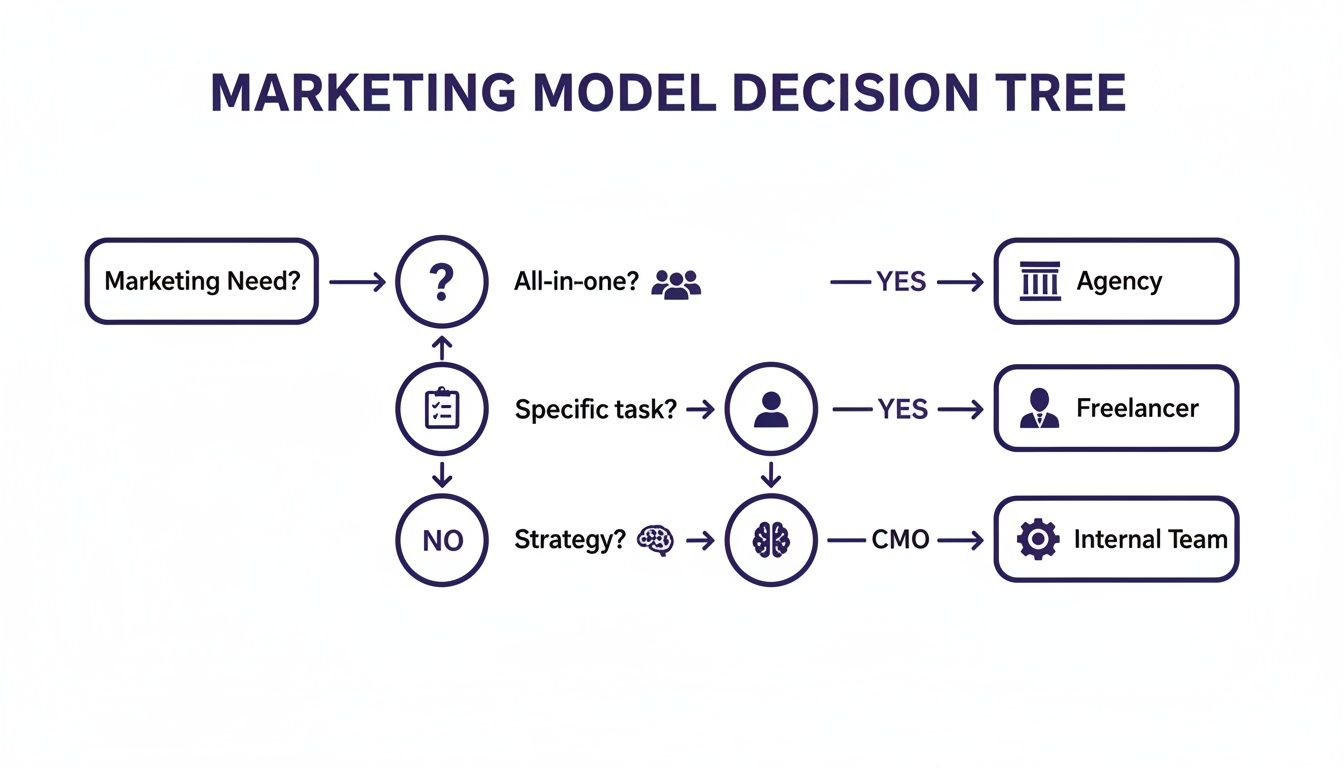
This visual guide is a great reminder that your choice—whether it's an agency, a freelancer, or a fractional CMO—should directly line up with the scale and strategic depth of your marketing goals.
Asking the Right Questions During the Interview
The interview is where you get to see the person behind the pitch. This is your chance to gauge their personality, communication style, and strategic brainpower. Come prepared with questions that force them off their canned sales script.
Instead of asking "What are your services?" try to dig a little deeper.
- "Walk me through a campaign you ran for a business similar to mine. What were the goals, what was your process, and what were the specific results?" This tests for real, relevant experience and a focus on outcomes, not just activities.
- "How do you handle campaigns that aren't performing as expected? Can you give me an example of a time you had to pivot your strategy?" This reveals their problem-solving skills and, just as importantly, their honesty. Anyone who claims every single campaign is a wild success is not being straight with you.
- "What will our communication and reporting look like? Who will be my main point of contact, and how often will we connect?" This is all about setting expectations for collaboration from day one.
- "How do you measure success beyond vanity metrics like likes and traffic?" You're listening for answers that connect marketing work directly to real business outcomes—things like leads, sales, and customer lifetime value.
Drilling down into these areas gives you a much clearer picture of what it would actually be like to work with them. This is also the time to scrutinize their case studies. Do they have proven, measurable success in your industry or with businesses of a similar size? A flashy portfolio full of Fortune 500 logos means very little if they don't understand the unique challenges and opportunities of a small business.
Ultimately, choosing the right marketing partner is one of the most important decisions you'll make. For an even more detailed breakdown, our guide on how to choose a marketing agency offers more checklists and insights. Take your time, trust your gut, and pick the partner who feels less like a vendor and more like your new head of marketing.
Setting Up Your New Marketing Partnership for Success

You’ve signed the contract and are ready to hit the ground running. This is where the real work begins—and where the real growth happens. Those first 90 days are foundational. They set the tone, expectations, and operational rhythm for everything that follows. A strong, collaborative start is the difference between a high-ROI relationship and a frustrating one.
Success here isn’t about launching a dozen campaigns on day one. It's about a methodical, transparent onboarding process that transforms your chosen partner from an external vendor into a deeply integrated extension of your team. This initial phase is all about alignment and arming them with the tools they need to win for you.
Creating a Seamless Onboarding Process
Think of your new marketing partner as your most important new hire. You wouldn't just point a new employee to their desk and expect them to figure it all out. The same principle applies here, but the process is even more critical because they don't have the benefit of sitting in your office every day.
A smooth onboarding process centers on a rapid transfer of knowledge. Your job is to give them a brain dump of everything that makes your business tick.
- Brand & Voice Guidelines: Hand over your logo files, color palettes, and any documents that define your brand’s personality and tone.
- Customer Personas: Who are your ideal customers? Share detailed personas, including their pain points, goals, and what makes them choose you.
- Access to Key Accounts: Grant them the right level of access to essential platforms like Google Analytics, your social media accounts, email marketing software, and your website's backend.
- Past Performance Data: Give them the keys to previous campaign reports. Sharing what worked—and what didn't—saves a ton of time and prevents them from repeating old mistakes.
To get your outsourced marketing efforts firing on all cylinders from day one, it's crucial to give your new partner clear direction. A great starting point is mastering this guide on writing a creative brief that eliminates confusion and inspires fantastic work.
Defining KPIs That Actually Matter
One of the biggest pitfalls I see when small businesses outsource marketing is chasing the wrong metrics. Likes, impressions, and follower counts look nice on a report, but they don't pay the bills. Real success is measured by Key Performance Indicators (KPIs) that connect directly to your bottom line.
Work with your new partner to define what success looks like in tangible business terms. This isn't a task to delegate; it's a strategic conversation.
Your goal isn't just to get more traffic; it's to get more of the right traffic that turns into profitable customers. A great partner will help you focus on business metrics, not vanity metrics.
Focus on KPIs that tell a story about business growth, like:
- Cost Per Acquisition (CPA): How much does it really cost to land a new paying customer through your marketing?
- Lead Quality Score: A rating system, often built with your sales team, to figure out which leads are most likely to close.
- Customer Lifetime Value (CLV): The total revenue you can expect from a single customer over their entire relationship with your business.
- Marketing-Attributed Revenue: How much direct revenue can be traced back to specific marketing campaigns?
Establishing a Communication Cadence
Clear and consistent communication is the bedrock of any successful partnership. Misunderstandings happen not because of a lack of effort, but because of a lack of process. Nail down a communication rhythm early on that works for both sides.
Decide on your go-to channels—maybe a shared Slack channel for quick questions, email for formal updates, or a project management tool like Asana or Trello to track progress. Then, get recurring check-ins on the calendar. A weekly 30-minute sync to review progress and a monthly deep dive on performance is a solid starting point.
This isn’t just about getting updates; it’s about fostering a true sense of team. When your internal staff sees the outsourced team as trusted colleagues, collaboration clicks into place, and the results follow.
Navigating Common Pitfalls and Contract Essentials
Bringing in outside marketing help is a huge step. It’s exciting! But even the most picture-perfect partnerships can hit a few bumps in the road. Knowing what to watch out for ahead of time is the key to building a relationship that lasts.
This isn’t about being pessimistic; it’s about being realistic. Hiccups are normal in any collaboration. The real test is how you and your partner work through them together—that's what ultimately drives your marketing forward.
Steering Clear of Common Roadblocks
One of the sneakiest issues we see is scope creep. It never starts with a big demand. It’s the "hey, could you just…" or "one quick thing" that slowly piles up, stretching your partner thin and pulling focus from the goals you actually agreed on. Your best defense? A rock-solid, incredibly detailed scope of work in your contract. More on that in a minute.
Another classic problem is a simple breakdown in communication. When assumptions take over, expectations get misaligned, and everyone ends up frustrated. You might think something is a five-alarm fire, while your agency sees it as a routine update. Set the rules of engagement early: who are the main points of contact? What’s a reasonable response time? What channels do you use for what kind of message? Getting this right keeps everyone in sync.
Finally, you’ve got to get real about results. Some marketing, like paid ads, can give you data almost instantly. But things like SEO and content marketing are long games—they’re marathons, not sprints. A great partner will be upfront about timelines and set clear milestones along the way. If things are moving slower than planned, they won't show up with excuses. They'll show up with data, analysis, and a plan for how to adjust.
The strength of a partnership isn't measured when things are going perfectly. It's measured by how both parties communicate and problem-solve together when faced with unexpected challenges.
Demystifying Your Marketing Contract
Think of your contract as more than just a legal document—it's the official playbook for your partnership. A well-written agreement is what protects you and your marketing partner, laying a clear foundation for how you'll work together. Don't just give it a once-over. Read and understand every single line.
Even with the best intentions, things can get tricky. Recent data shows that 23% of small businesses point to high costs as their top issue with outsourcing, with communication problems right behind at 21%. But despite these hurdles, 83% of small businesses plan to keep or even increase what they spend on outside help. You can dig into more of these outsourcing statistics on emapta.com. A solid contract is your best tool for getting ahead of these common friction points.
Here are the non-negotiables your agreement must include:
- Detailed Scope of Work (SOW): This is the absolute core of your contract. It needs to spell out exactly what the partner will deliver. Don’t settle for vague terms like "social media management." It should read more like: "Create and post 3x weekly on LinkedIn and Facebook, including custom graphics and a monthly performance report." Get granular.
- Ownership of Assets and Data: This is a big one. The contract has to state, without any ambiguity, that you own everything created for your business. That means all the creative, the content, the website files, ad campaign data, and customer lists. You paid for it, it belongs to you. Period.
- Performance Benchmarks and Reporting: How will you know if it's working? This section should define the key performance indicators (KPIs) you'll track, what the reports will look like, and how often you'll get them. For example, you might agree on a monthly dashboard review and a deeper quarterly strategy session.
- Termination Clause: What happens if things don't work out? This clause outlines how either party can end the agreement. Look for a fair notice period, usually 30-60 days, for ending the contract without cause. It also needs to specify the offboarding process—the final handover of all assets, data, and account access.
By getting these details sorted out from the very beginning, you're setting yourself up for something much more valuable than a simple client-vendor relationship. You’re building a real partnership grounded in trust, clarity, and a shared goal of seeing your business grow.
A Few Lingering Questions About Outsourcing Marketing
Taking the leap to outsource your marketing is a big move, and it's totally normal to have a few questions swirling around. Let's tackle some of the most common ones we hear from business owners. Think of this as the last gut-check before you dive in, so you can move forward feeling confident.
We’ll clear the air on everything from budgets and brand control to what you should actually expect once things get rolling.
How Much Should a Small Business Budget for Outsourced Marketing?
This is always the first question, and the honest answer is: it depends. But a solid rule of thumb is to set aside somewhere between 7-12% of your total revenue for marketing. If you're a newer business in a serious growth phase, you'll probably lean toward the higher end of that range. A more established company might be comfortable closer to the 7% mark.
The cost is really a reflection of the model you choose and what you need done.
- A full-service agency is the biggest investment, but you're getting a comprehensive, hands-off solution.
- Hiring specialized freelancers is much more budget-friendly and perfect for targeted, specific tasks.
- A fractional CMO lands somewhere in the middle, giving you top-tier strategy without the full-time executive price tag.
The best approach is to start with a number you’re comfortable with and find a partner who can show you a clear path to getting a positive return on that investment. It’s less about the exact dollar amount and more about what that money can generate for your business.
Will I Lose Control of My Brand by Outsourcing?
This is a huge—and completely valid—concern for most founders. The short answer? No, not if you set up the partnership correctly from day one. A great marketing partner doesn't replace your vision; they act as a brand steward to amplify it. They should feel like a natural extension of your in-house team, someone who’s just as invested in protecting the brand you poured your heart into.
The key to keeping brand control is all in the onboarding. A quality partner will insist on a deep dive, spending real time to understand your brand guidelines, your ideal customer, your core values, and your unique voice.
Regular, open communication is your safety net here. With weekly check-ins and a clear approval process for new creative and campaigns, you always have the final say. You're not just handing over the keys to the kingdom. You’re hiring an expert driver who knows the map but still follows your directions.
What Is the Difference Between a Freelancer and an Agency?
Choosing between a freelancer and an agency really comes down to the scope of your needs. I like to think of it like a home renovation project.
A freelancer is your master plumber. They are a dedicated expert with a deep, specialized skill—maybe they're an absolute wizard at SEO, a brilliant copywriter, or a PPC guru. You bring them in for a specific, well-defined job where you need top-tier talent.
An agency, on the other hand, is your general contractor. They show up with a full, coordinated crew that has a whole range of skills: strategy, design, analytics, content, and project management. They're built to manage the entire project from start to finish, which is ideal when you need a comprehensive, managed solution for your marketing.
How Soon Can I Expect to See Results?
Marketing is a game of patience, but the timeline for seeing a return really depends on the channels you're using. Any good partner will give you a realistic forecast with clear milestones for each marketing activity.
Some channels give you pretty quick feedback:
- Paid Advertising (PPC): Campaigns on platforms like Google Ads can start bringing in traffic and leads within days or weeks. This is where you'll see the most immediate data.
Other strategies are a much longer play:
- SEO and Content Marketing: This is a marathon, not a sprint. It often takes a solid 4-6 months to really build momentum, gain trust with search engines, and see a meaningful, sustainable lift in organic traffic.
A partner you can trust will be upfront about these timelines. A smart strategy almost always involves a mix of quick wins from paid ads and long-term, sustainable growth from channels like SEO.
Ready to stop juggling marketing and start seeing real growth? The team at Frozen Crow Inc. specializes in creating and executing marketing strategies that deliver measurable results for small businesses. We handle the complexities so you can focus on what you do best. Get your free marketing audit today!


