


August 20, 2026
How to Choose a Marketing Agency That Delivers Results
Before you even think about searching for a marketing agency, you need to do some serious work internally. This is the single most overlooked step, and skipping it is the fastest way to end up in a bad partnership.
You have to get crystal clear on your goals, take a hard look at what your team can actually do, and figure out a realistic budget. Get this foundation right, and you'll be looking for a true partner, not just another vendor.
Defining Your Needs Before Starting The Search
It’s tempting to just start Googling agencies and looking at pretty websites. Don't do it.
When you don’t know exactly what you need, every agency's pitch sounds amazing. The best, most fruitful agency relationships I've ever seen were built because the client did their homework first. They knew their business inside and out and could articulate exactly where they needed help.
From Vague Wants to Specific Goals
"We need more traffic" isn't a goal. It's a wish. The same goes for "we need to build our brand." To properly vet an agency, you have to translate those vague desires into something tangible.
This is where the SMART goal framework (Specific, Measurable, Achievable, Relevant, Time-bound) is actually useful, not just business jargon.
Instead of saying, "we need more leads," get specific. A real goal sounds like: "Increase qualified marketing leads from organic search by 25% within the next six months." Now that is a target an agency can build a real strategy around. Before you do anything else, think about what success actually looks like for your business. For many, a key part of this is finding ways to improve operational efficiency not just in marketing, but across the board.
Conduct a Candid Skills Audit
Alright, time for some real talk. What is your in-house team truly good at, and where are the gaps? Be brutally honest.
Maybe your team writes fantastic blog posts but knows nothing about technical SEO. Or perhaps they're wizards at organic social media but have never touched a paid ad funnel.
Mapping this out prevents you from paying an agency for skills you already have in-house. Get specific about what you're looking to hire out:
- Technical SEO: We need an expert for site audits, schema, and building a backlink strategy from the ground up.
- PPC Management: We need a pro to take over and optimize our $10k/month Google Ads budget.
- Content Strategy: We need a team that can build a B2B content calendar and deliver two in-depth articles per month.
This internal reality check is non-negotiable.
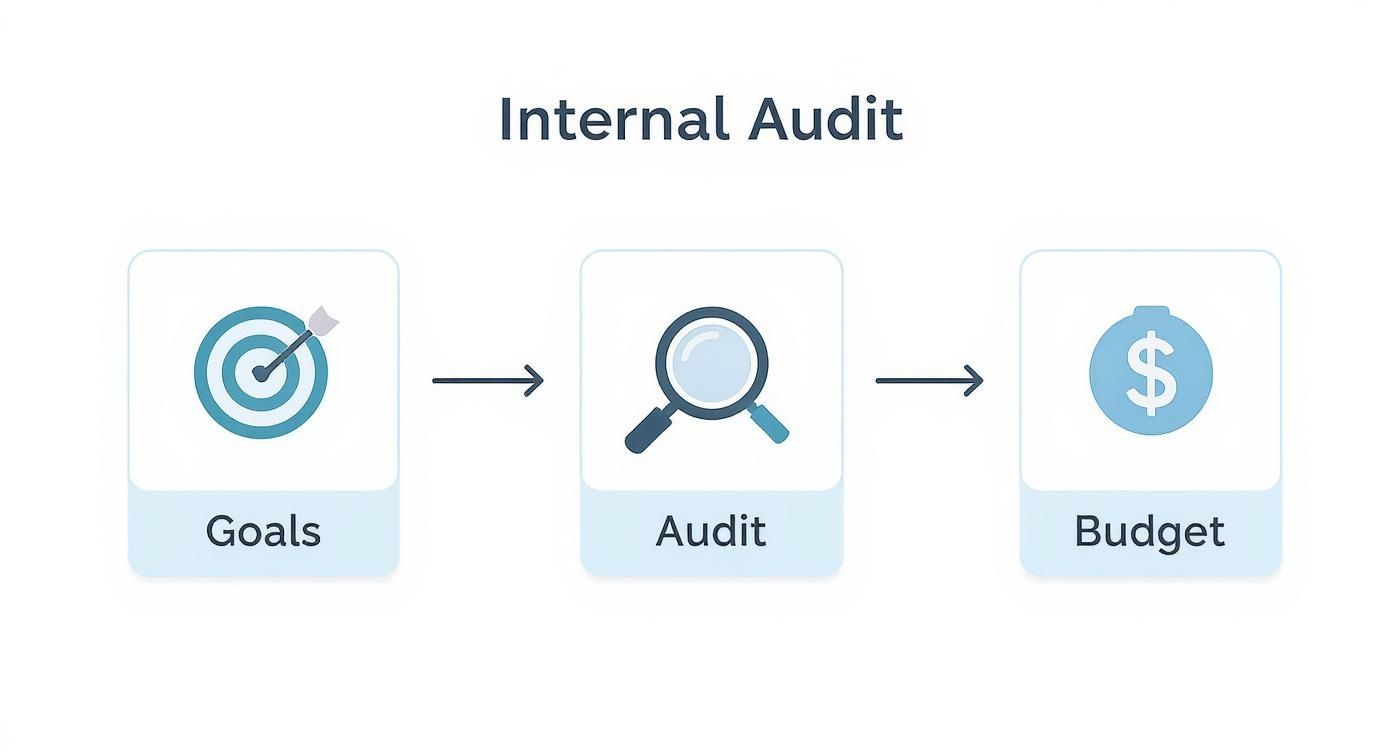
To make this process easier, I've put together a checklist to guide your internal assessment.
Agency Selection Self-Assessment Checklist
Before you reach out to a single agency, use this checklist to document your needs. Having these answers ready will make your search infinitely more productive.
| Assessment Area | Key Questions to Answer | Your Notes/Requirements |
|---|---|---|
| Business Goals | What is the #1 business objective we want marketing to achieve in the next 12 months? | |
| Marketing Objectives | What specific, measurable marketing outcome will support that business goal? (e.g., Increase leads by X%) | |
| In-House Skills | What marketing activities do we currently handle well? What are our team's core strengths? | |
| Capability Gaps | What specific marketing skills or functions are we completely missing? (e.g., Technical SEO, video production) | |
| Target Audience | Who is our ideal customer? What are their pain points and where do they spend their time online? | |
| Budget | What is the absolute maximum we can invest per month? What is our ideal monthly retainer? | |
| Success Metrics | What 3-5 KPIs will we use to measure the agency's success? (e.g., MQLs, CPA, ROAS) | |
| Past Experiences | Have we worked with an agency before? What went well? What didn't? |
Filling this out gives you a powerful one-page brief to guide your entire search and vetting process.
Set a Realistic Marketing Budget
This is the big one. You have to be upfront about what you can afford to invest.
I see so many companies try to hide their budget, thinking they'll get a better price. It never works. It just wastes everyone's time.
When you state your budget clearly, a good agency can tell you exactly what’s possible. They can say, "For $5,000 a month, we can deliver X, Y, and Z to hit your lead generation goal." Without that number, you'll get proposals that are either way out of your price range or too watered-down to actually work.
The digital marketing world is huge—it's on track to become a $1,443.27 billion industry by 2034. That means there's an agency at nearly every price point, but you need to know yours to find the right fit.
Here's the rewritten section, designed to sound like it was written by an experienced human expert.
Looking Under the Hood: How to Vet an Agency Beyond Their Sales Pitch

A slick sales deck and a good-looking website can make any agency look like a world-beater. But let's be honest, that's just the highlight reel. The real test is what lies beneath the surface.
To find a partner who will actually move the needle for your business, you have to dig deeper. You're looking for proof—proof of their strategic thinking, how they communicate when things get tough, and their ability to deliver results you can actually measure.
Anyone can promise the moon. The best agencies can show you the receipts.
Read Between the Lines of Their Case Studies
Case studies are an agency’s trophy case, but they're often polished to a high shine. Don't get distracted by big-name clients or flashy creative. You need to put on your detective hat and look for the real story.
As you dig into their work, ask yourself a few key questions:
- What was the actual problem? A great case study starts with the client's real-world business challenge, not just a list of services they provided.
- What was their thinking? You're looking for the "why" behind their strategy. Did they just "run Facebook ads," or did they build a campaign around a specific customer insight?
- Where are the numbers? Fuzzy outcomes like "boosted brand awareness" are a red flag. I want to see hard numbers, like "decreased cost-per-acquisition by 32%" or "grew organic leads by 150%."
- How long did it take? Getting a sense of the timeline helps you set realistic expectations for your own engagement.
An agency that can clearly connect its actions to real business outcomes is one that gets the big picture. They think like a business partner, not just a vendor.
Judge Them by Their Own Marketing
This one’s my favorite. How does the agency market itself? It's the ultimate "practice what you preach" test.
If you’re hiring them for SEO, their own site should rank for terms that matter. If you’re looking for a killer social media team, their own channels should be buzzing with engagement.
Think of an agency's own marketing as their living, breathing portfolio. If they can't get results for the business they know best—their own—how can you trust them with yours?
Consider your own journey. How did you find them in the first place? Was their website a breeze to use? That first impression tells you a lot about the kind of experience they create for their clients' customers. A neglected blog or a clunky website is a massive warning sign.
Talk to Their Clients—Past and Present
On-site testimonials are hand-picked and always glowing. The real dirt comes from talking to actual client references. A confident agency won’t hesitate to connect you with current and former clients.
When you get them on the phone, go beyond "Were you happy with them?" and ask the tough questions:
- Communication: How were they when a campaign wasn't working? Were they responsive and proactive, or did you have to chase them for answers?
- Reporting: What did their reports actually show you? Were they just a data dump, or did they clearly tie marketing activity to your business goals?
- Expertise: Who did you really work with day-to-day? Was the senior strategist from the sales pitch actually involved, or were you handed off to a junior account manager?
- Results: What was the single biggest impact they had on your business?
This kind of unfiltered feedback is gold. It gives you a peek behind the curtain that you'll never get from a proposal.
Ultimately, choosing an agency is a huge investment of money, trust, and time. The ability to prove their value is everything. Recent data shows that top-tier agencies command higher rates because they deliver superior outcomes. In 2024, for example, 36% of digital agencies charged between $175–$199 per hour, while another 32% billed at $200–$249 per hour. This tells us the market puts a premium on proven performance, so your focus should be on the ROI, not just the price tag. You can dive deeper into the latest numbers in the 2025 digital agency industry report to see how results are shaping the industry.
Asking the Right Questions to Uncover True Fit

This is it—the moment of truth. You’ve narrowed down your list, checked out their work, and now it’s time to actually talk to them. This interview stage isn't for listening to a rehashed sales pitch. It’s your chance to see how an agency really thinks on its feet.
Your goal here is to get past the canned answers and dig into their strategic depth, their real-world problem-solving skills, and whether their culture genuinely fits with yours. A great agency relationship is built on clear communication and aligned expectations, and that foundation gets laid right here.
Beyond the Basics: Onboarding and Strategy
Every agency on the planet will tell you they have a great onboarding process. Your job is to find out what that actually means. A vague promise of a "kickoff call" just doesn't cut it. You need to understand the nuts and bolts of how they'll integrate with your team from day one.
Ask them to walk you through their first 90 days with a new client. What specific information do they need from you? What milestones can you expect to hit, and when? A top-tier agency will have a well-defined playbook, not just a fuzzy promise to "get started."
Next, you need to probe their strategic thinking. Don't let them get away with just listing off their services. Instead, hit them with this: “What is the system you use to help businesses like mine grow, and how do you prove it's working?”
This one question is a game-changer. It immediately separates the agencies selling disjointed tasks from those who deliver integrated, outcome-focused systems. An agency that just sells tasks will rattle off a list of services; a true strategic partner will describe a process.
Your Team and Theirs: Communication is Everything
One of the biggest letdowns in agency relationships happens when the seasoned expert who sold you the contract vanishes, replaced by a junior account manager. You have to get absolute clarity on who you will actually be working with day-to-day.
Don't be shy about asking these direct questions:
- Who will be my day-to-day point of contact? Get their name and title.
- Who is the strategist leading the account? What’s their background and level of experience?
- Can I meet the core team I'll be working with before I sign anything? A transparent agency will have no problem with this.
This isn’t about being difficult; it's about making sure the expertise you're paying for is the expertise you’ll actually get.
An agency’s communication style is a direct reflection of its internal culture. If they are proactive, transparent, and organized during the sales process, they’ll probably be the same way as a partner. If they’re chaotic and hard to reach now, don't expect that to magically change later.
On that note, nail down the rhythm of communication. How often will you have formal meetings? What do their reports look like—is it just a data dump, or is it a strategic analysis with clear next steps? A great partner doesn't just report on what they did; they explain what they learned and how they’ll use that intel next month.
Uncovering How They Handle a Crisis
Let's be real: no marketing campaign is perfect. There will be dips in performance, failed experiments, and unexpected algorithm updates from Google or Meta. How an agency responds to adversity is far more telling than how they talk about their wins.
Don't be afraid to ask the tough questions. Here's a great one: "Tell me about a time a campaign for a client was underperforming. What did you do?"
Their answer will tell you everything you need to know about their accountability and problem-solving process.
Do they start blaming external factors, or do they own the results and present a clear plan to course-correct? You're looking for an agency that sees challenges as opportunities to learn and optimize, not as problems to hide. That mindset is the difference between a reactive vendor who just checks boxes and a proactive partner who’s truly invested in your growth.
Navigating Contracts and Pricing Models

Alright, you've sat through the pitches and grilled the finalists. Now come the proposals and contracts. This is the moment the partnership gets real, and frankly, it’s where a lot of businesses stumble by just skimming the paperwork.
The fine print isn't just a legal formality; it's the operating manual for your entire relationship. Getting this part right protects your investment, aligns expectations, and lays a foundation of transparency. It’s your last, best chance to make sure everything promised in the slick sales deck is actually what gets delivered.
Decoding Common Agency Pricing Models
Not all pricing models are built the same. The right one for you comes down to your specific goals, how predictable you need your budget to be, and the kind of work you need done.
Let's cut through the jargon and look at the most common models you'll run into. Each has its pros and cons, so understanding the fit is everything.
Comparing Common Agency Pricing Models
Here’s a quick breakdown to help you compare the financial structures agencies typically propose. Think about which one aligns best with your company's cash flow and growth objectives.
| Pricing Model | How It Works | Best For | Potential Pitfall |
|---|---|---|---|
| Monthly Retainer | You pay a fixed fee each month for an agreed-upon scope of ongoing services like SEO, content, or social media. | Businesses needing consistent, long-term marketing support and predictable budgeting. | Scope creep. If deliverables aren't crystal clear, you can end up with an overworked agency or unmet expectations. |
| Project-Based | A one-time flat fee for a specific, defined project with a clear start and finish, like a website redesign. | Companies with a single, well-defined need and a concrete outcome in mind. | Can be inflexible if the project scope changes mid-stream, often requiring a new contract or change order. |
| Performance-Based | Fees are tied directly to hitting specific KPIs—think percentage of ad spend, cost per lead, or even revenue share. | Businesses comfortable with risk that want to directly link marketing spend to tangible results. | Can incentivize agencies to chase short-term metrics that might not build long-term brand health. |
| Hourly Rate | You pay for the exact number of hours the agency works on your account. Often used for consulting or unpredictable scopes. | Situations where the scope is fuzzy or for quick, ad-hoc tasks and strategic consultations. | Costs can get unpredictable fast. It requires meticulous tracking to ensure you're getting value for every hour billed. |
While a monthly retainer is the most common model out there, don't assume it's your only choice. A hybrid approach, like a base retainer plus a performance bonus for hitting certain targets, can often create the perfect balance between stability for the agency and results-driven motivation for you.
The Statement of Work is Your North Star
If the contract is the legal handshake, the Statement of Work (SOW) is the practical blueprint for success. This document needs to be ridiculously detailed, leaving zero room for interpretation. I’ve seen firsthand how a vague SOW becomes a recipe for conflict and missed goals down the line.
A solid SOW must spell out:
- Concrete Deliverables: Don't settle for "SEO services." It should say "four 1,500-word blog posts per month" or "one technical site audit per quarter." Get specific.
- Clear Timelines: It needs major milestones and deadlines for every key deliverable. This holds both teams accountable and keeps the project from drifting.
- Reporting Cadence and Metrics: How and when will you get reports? Is it a monthly PDF, a bi-weekly call with your account manager, or a link to a live Looker Studio dashboard? What exact KPIs will be on it?
- Key Personnel: The SOW should name your main points of contact and the key agency team members who will actually be working on your account.
The SOW is your single source of truth. If a deliverable, timeline, or responsibility isn't written down in that document, you have to assume it doesn't exist. Read it with a fine-tooth comb before you sign anything.
Don't Get Burned by the Fine Print
Finally, a few critical clauses in the main contract can make or break your experience later on. Keep a close eye on these three areas to protect your business.
First up is asset ownership. The contract must state, without ambiguity, that you own all the creative work, content, and ad accounts created for you—even if you part ways. This is non-negotiable.
Second, really understand the termination clause. What’s the required notice period to end the contract? Are there penalties for bailing early? A fair contract always provides a clean exit strategy if the partnership just isn't working.
Lastly, look for a performance review schedule. A great agency will build formal reviews right into the contract—think quarterly business reviews—to assess progress against your goals and tweak the strategy. This bakes accountability into the relationship from day one.
Spotting Red Flags and Avoiding Common Mistakes
Choosing a marketing agency is a high-stakes decision. I've seen it firsthand. Picking the wrong partner doesn’t just burn through your budget; it can set your growth back by months, sometimes even years. The good news is that most problematic agencies show their hand early on if you know what to look for.
Think of this as your field guide to identifying issues before they become expensive problems. You need to approach this process with a healthy dose of skepticism. You're searching for a genuine partner, not just another vendor, and that means scrutinizing their promises long before a contract ever hits your desk.
Beware of Unbreakable Promises
If an agency guarantees you the #1 spot on Google or a specific number of leads in the first 30 days, your alarm bells should be screaming. Seriously. No reputable professional can guarantee specific outcomes in dynamic channels like SEO or social media, where algorithms are a constantly moving target.
What a great agency can and should promise is a proven process, total transparency in their reporting, and a strategy built on hard data and experience. They'll talk about realistic forecasts and benchmarks, not unbreakable vows.
- Red Flag: "We guarantee you'll be on the first page of Google in 30 days."
- Green Flag: "Our strategy for improving your rank involves a technical audit, content development, and backlink outreach. We typically see initial movement within 3-6 months, and we'll track keyword positions weekly."
That distinction is everything. It separates the confident experts from the desperate salespeople.
Vague Strategies and Buzzword Overload
Another classic red flag is an agency that gets fuzzy on the details of how they’ll actually achieve results. They might fill their pitch with impressive-sounding buzzwords—"synergy," "growth hacking," "omnichannel activation"—but offer very little substance on their day-to-day process.
If you ask a direct question and get a cloudy, jargon-filled answer, be cautious.
A solid partner will walk you through their methodology, step-by-step. They'll have a clear, repeatable system for everything from campaign setup to lead follow-up.
A service-based agency sells you a list of tasks. A system-based agency sells you a predictable outcome and shows you the machine they built to deliver it. The difference is everything when you're looking for real, sustainable growth.
If their proposal feels like a disconnected menu of services—a little SEO, a few ads, a blog post here and there—they're just selling tasks. That approach rarely works because the pieces aren't engineered to amplify each other.
High-Pressure Sales and a Lack of Transparency
A great agency partnership is built on trust, and that starts the moment you first talk to them. If you feel rushed into a decision with "limited-time offers" or pressure to sign a long-term contract on the spot, it’s a sign they care more about their sales quota than your business goals.
And transparency is completely non-negotiable.
Is the agency hesitant to let you speak with current clients? Will they show you sample reports? Do they get cagey when you ask who, specifically, will be managing your account? If so, be concerned. A confident agency with solid results has absolutely nothing to hide.
The advertising agency industry is massive, projected to hit a market size of $444.7 billion in 2025. With over 450,000 agencies out there, you have plenty of options. This fierce competition means you should never settle for a partner who isn’t completely open with you from day one. You can dig into more of these global advertising agency trends on IBISWorld.com.
Common Pitfalls to Sidestep
Beyond just spotting agency red flags, there are some common mistakes I see businesses make time and again. Here are a few to keep in mind:
- Chasing the Lowest Price: I get it, budget is a real constraint. But choosing the cheapest option is often the most expensive mistake in the long run. Underpriced agencies have to cut corners somewhere—usually with junior staff, overloaded account managers, or shoddy work. Focus on the value and potential ROI, not just the monthly fee.
- Failing to Involve Stakeholders: Make sure key people from other departments, like sales or operations, sit in on the final interviews. Their perspective is invaluable. You need to ensure the agency's plan aligns with the entire customer journey, not just what happens in the marketing silo.
- Setting Unrealistic Expectations: A new agency is not a magic bullet. Real, meaningful results take time to build, especially from organic channels like SEO and content marketing. You have to give your new partner the runway—I usually recommend at least six months—to implement their strategy and gain momentum before you start looking for huge returns.
Still Have Questions About Choosing an Agency?
Even after you've done all the research, a few key questions always seem to surface right before you sign on the dotted line. That's completely normal—this is a big decision. Let's tackle the most common ones we hear to give you that final bit of confidence.
How Long Should an Agency Contract Be?
This is a big one, and there’s no single right answer. Most solid agencies will suggest an initial contract of 6 to 12 months. Why? Because real marketing strategies, especially things like SEO and content, need time to gain traction. This window gives the agency enough runway to get their plan in motion, collect real data, and show you tangible progress.
Now, if you have a very specific, short-term project—like running a single PPC campaign for a product launch—a 3-month trial can make sense. But be careful with agencies that push for extra-long commitments, like 18 months or more, right from the start.
A good contract should feel like a partnership, not a prison sentence. Look for clear performance reviews at the 90-day and 6-month marks and a fair termination clause. You need an out if things just aren't clicking.
Should I Choose a Niche Agency or a Full-Service One?
This really boils down to your most pressing need. A niche or "boutique" agency lives and breathes one specific thing. Think of an agency that only handles B2B SaaS content or one that’s mastered TikTok ads for e-commerce brands. If a single channel is the absolute lifeblood of your business, a specialist is hard to beat.
On the other hand, a full-service agency is your one-stop shop. This is a lifesaver if you need a cohesive strategy that ties together SEO, paid ads, email, and social media. The only potential downside? With bigger agencies, you sometimes get less face-time with senior-level experts.
Here’s a simple way to look at it:
- Go Niche if: One primary marketing channel drives most of your growth, and you need the best of the best in that specific area.
- Go Full-Service if: You're building a complete marketing program from scratch and want one team to manage all the moving pieces seamlessly.
What Is a Reasonable Budget for a Marketing Agency?
Honestly, there's no magic number. Budgets swing wildly depending on your goals, how competitive your industry is, and what services you're after. A small local business might see great results with $2,000-$5,000 per month for something like local SEO. A mid-sized B2B tech company could easily invest $10,000-$25,000+ per month for a full-funnel demand generation plan.
Instead of looking for a "reasonable" price, change the question. Ask, "What investment is actually required to hit my specific business goals?"
A great agency won't just give you a price tag. They'll connect their fees directly to outcomes and potential ROI. They should be able to say, "To hit your target of 50 qualified leads per month, we'll need this much ad spend and this many hours of strategy work, which comes to X." If they can't have that conversation, they're not the right partner. The focus should always be on the value they create, not just the cost.
Ready to stop guessing and start growing? At Frozen Crow Inc., we build data-driven marketing and IT strategies that deliver measurable results. Let us show you what a true partnership looks like with a free, no-obligation marketing audit. Find out how we can help your business thrive.


