


November 17, 2026
What Is Paid Search Marketing Your Complete Guide
Ever heard the term "paid search" and wondered what it really means? In a nutshell, it's the art of paying search engines like Google to place your ads directly in front of people who are actively looking for what you sell.
Think of it as renting a premium billboard on the internet's busiest highway. But here's the magic: your billboard only shows up for drivers who are already searching for directions to a business just like yours. You only pay when someone is interested enough to pull over and click on your ad. It’s a direct line to targeted traffic.
A Powerful Way to Drive Immediate Traffic

This is where paid search really separates itself from its cousin, SEO (Search Engine Optimization). SEO is the long game—a marathon of building authority to earn "free" traffic over time. Paid search is a sprint, built for speed and immediate impact. It lets you jump to the front of the line for specific keywords, connecting with customers the moment they decide they need something.
This model is most often called pay-per-click (PPC), and it's an absolute giant in the world of digital advertising. Just how big? In the coming year, global ad spending in the search advertising market is projected to hit a staggering $351.55 billion. That number alone shows just how critical this strategy is for businesses trying to get seen.
How Does It Actually Work?
At its core, paid search runs on a simple but powerful idea: you bid on the exact terms your ideal customer is typing into the search bar. This approach gives you some serious advantages:
- You're Not Interrupting, You're Answering: These aren't random ads. You're reaching people who are literally raising their hands and asking for a solution. They have intent, which makes them incredibly qualified leads.
- Instant Visibility: As soon as your campaign goes live, your ads can start appearing at the very top of the search results page. No waiting for months to climb the rankings.
- Total Budget Control: You're in the driver's seat. You set your daily or monthly budget and decide exactly how much you're willing to pay when someone clicks your ad.
This direct line between customer intent and your business is what makes paid search so effective. It’s not about interrupting someone's day; it’s about showing up as the most relevant answer right when they have a question.
It's a foundational tool for businesses of all sizes, and the principles apply across different platforms. For instance, if you're curious how this works on one of the world's biggest online marketplaces, this guide on what is Amazon Pay Per Click is a great resource that breaks it down.
Paid Search vs Organic Search At a Glance
It's easy to get paid and organic search confused, but they play very different roles in a marketing strategy. Here’s a quick breakdown to clear things up.
| Attribute | Paid Search (PPC) | Organic Search (SEO) |
|---|---|---|
| Speed | Immediate results once a campaign is live | Takes time (months) to build authority |
| Cost | You pay for every click or impression | Technically "free," but requires investment in content, tech, etc. |
| Placement | Top of the page, labeled "Ad" or "Sponsored" | Below the paid ads, in the main search results |
| Control | High control over budget, targeting, and ad copy | Less direct control; influenced by algorithms |
| Longevity | Traffic stops when you stop paying | Can provide sustained traffic long-term |
Ultimately, the strongest digital strategies don't choose one over the other. They use both paid and organic search together, letting them complement each other's strengths for a more powerful, well-rounded approach to getting found online.
How the Ad Auction Really Works
Ever wondered what happens behind the curtain when you hit "search"? It’s not just about who throws the most money at Google. The engine driving paid search is a lightning-fast auction, but it's less about deep pockets and more about delivering a great experience.
Think of it this way: every single time someone searches for a keyword you're bidding on, your ad is thrown into a real-time showdown.
It’s a huge myth that the highest bidder automatically gets the top spot. While your bid definitely matters, search engines are obsessed with user experience. If users have a bad time, they stop coming back. To keep everyone happy, Google uses a formula called Ad Rank to decide who shows up where.
The Ad Rank Formula Explained
Ad Rank is actually pretty simple on the surface. It boils down to two key ingredients multiplied together: how much you’re willing to pay and how good your ad is.
Ad Rank = Maximum CPC Bid x Quality Score
This little formula is a game-changer. It means an advertiser with a smaller budget but a fantastic ad can actually leapfrog a competitor with a massive budget but a sloppy ad. The whole system is designed to reward you for creating ads that are genuinely helpful and relevant.
A high score is Google's way of giving you a pat on the back, often rewarding you with better ad positions and, best of all, lower costs per click.
Your Quality Score is the great equalizer in paid search. It lets you compete on relevance and quality, not just cash, which levels the playing field for businesses of all sizes.
So, what makes up this magical 1-to-10 score? It’s a blend of three main things:
- Expected Click-Through Rate (CTR): Based on past performance, how likely are people to actually click your ad when they see it?
- Ad Relevance: Does your ad copy make sense for the search? The connection needs to be obvious and compelling.
- Landing Page Experience: After the click, does your page deliver on the ad's promise? It has to be relevant, easy to use, and not a dead end.
The Four Pillars of a Winning Paid Search Campaign
A successful paid search campaign doesn’t just happen. It's built like a sturdy table, with four solid legs holding it up. If any one of those legs is wobbly, the whole thing comes crashing down—along with your ad spend.
Getting these elements to work together is the real secret to building a campaign that doesn't just get clicks but actually grows your business. Let’s break down each one.
Pillar 1: Strategic Keyword Research
Keywords are the absolute foundation of any paid search effort. Think of them as the bridge connecting someone’s problem to your solution. The goal isn't just to find popular search terms; it's about digging deep to find the exact phrases your ideal customers type in when they're ready to make a move.
This means looking at search volumes, sure, but more importantly, it means understanding intent. Is someone just browsing, or are they ready to buy? What are your competitors bidding on? When you're setting things up, implementing best practices for keyword research is non-negotiable if you want to target the right people from day one.
Pillar 2: Compelling Ad Copy
Once you have your keywords, your ad copy is your pitch. You have about three seconds to grab a searcher's attention, show them you have what they need, and convince them to click. Great ad copy isn't just clever writing; it's a direct, relevant answer to the search that triggered it.
The ads that win almost always include:
- A strong headline that feels like it’s reading the user’s mind.
- Clear benefits, not just features, that solve their immediate problem.
- A powerful call to action (CTA) that leaves no doubt about what to do next.
Pillar 3: Smart Bidding Strategies
Bidding is where your marketing strategy meets your budget. It’s how you tell the system what a click is worth to you and how aggressively to compete in the ad auction. You set a maximum bid, but what you actually pay is a whole different story—it's heavily influenced by the quality of your ad.
This infographic breaks down how your bid and Quality Score work together to determine your Ad Rank.
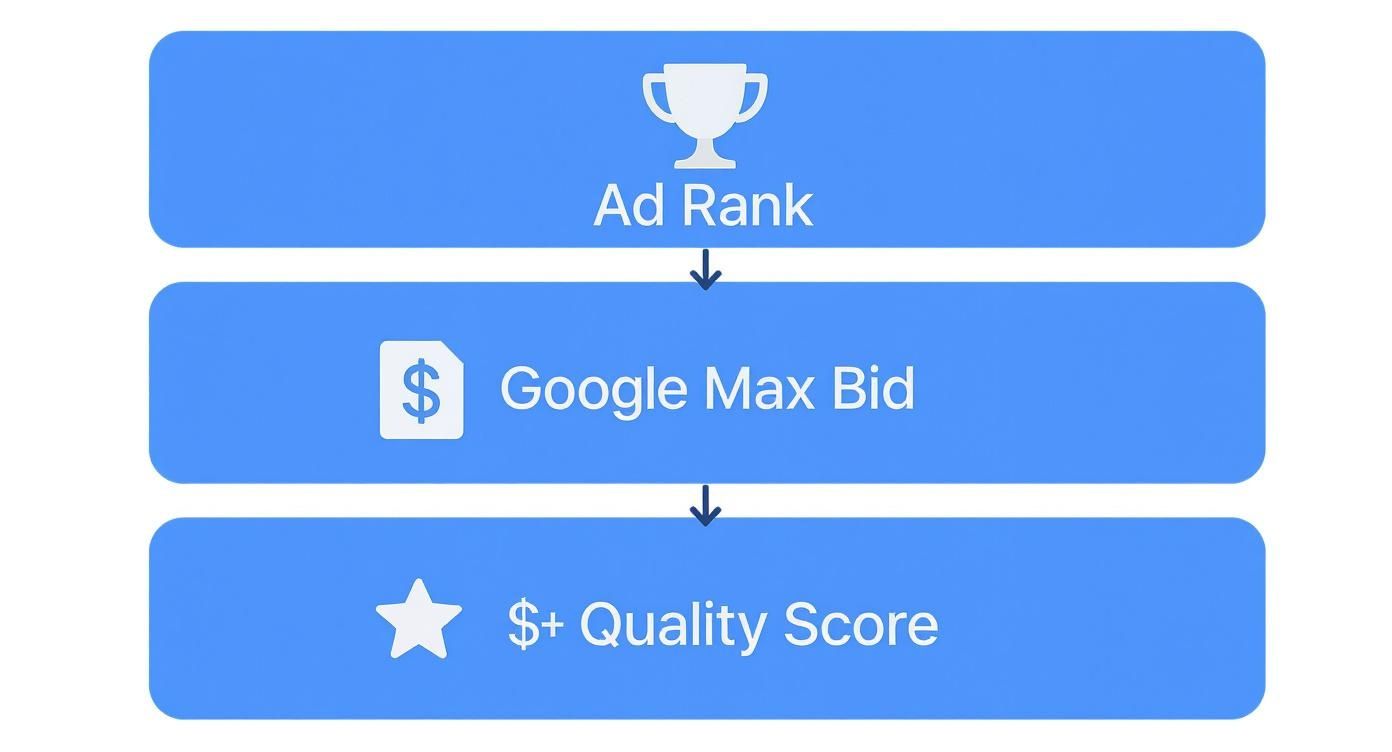
As you can see, a high Quality Score can actually land you a better ad position for less money. Google rewards relevance.
Pillar 4: High-Converting Landing Pages
The click isn't the finish line—it's the starting gun. Your landing page is the final, and arguably most critical, pillar. It has to deliver on the promise your ad just made. Nothing kills a conversion faster than a disconnect between the ad and the page it leads to.
A great landing page is focused, fast, and frictionless. It should have one clear goal, whether that’s getting a form fill, a purchase, or a download, making it dead simple for the visitor to take that next step.
Measuring Success with Key Paid Search Metrics
Launching a paid search campaign is just step one. The real work—and the real value—comes from measuring its performance to make sure you’re not just spending money, but actually making it. You need to track the right numbers to understand the story of your campaign’s health and profitability.
Think of it this way: launching a campaign without tracking metrics is like driving a car without a dashboard. The engine might be running, but you have no idea how fast you're going, how much fuel you have left, or if you're even headed in the right direction. You’re just driving blind.
Core Performance Metrics You Must Know
Before you get lost in the weeds, you need to get a handle on a few foundational metrics. These numbers give you a quick snapshot of how people are interacting with your ads and what those interactions are costing you.
- Click-Through Rate (CTR): This is the percentage of people who actually click your ad after seeing it. A high CTR is a great sign that your ad copy and keywords are hitting the mark.
- Cost Per Click (CPC): This is simply the average price you pay every time someone clicks your ad. The game is to keep this as low as possible without torpedoing your ad quality or ranking.
- Conversion Rate: This is the big one. It’s the percentage of clicks that lead to a meaningful action, like a sale or a lead form submission. This metric is the ultimate test of your ad and your landing page.
These stats are powerful on their own, but they tell a much richer story when you see how they connect to real business results. The average click-through rate for search ads on Google hovers around 3.17%, and those ads are responsible for about 27.6% of new visitor traffic. You can dig into more paid search performance statistics to see how you stack up.
Translating Clicks into Profit
While the core metrics are about ad performance, two others are all about profitability. These are the numbers your boss or your client really cares about because they tie your ad spend directly to the bottom line.
Return on Ad Spend (ROAS) is the North Star of paid search marketing. It answers the most important question: "For every dollar I put into ads, how many dollars am I getting back?"
Here’s how you get there:
- Cost Per Acquisition (CPA): This tells you exactly how much it costs to land one customer. You find it by dividing your total ad spend by your total number of conversions. Simple.
- Return on Ad Spend (ROAS): This is the ultimate measure of whether your campaigns are a money-maker or a money pit. Calculate it by dividing the total revenue from your ads by your total ad spend.
For instance, if you spend $500 on a campaign and it generates $2,000 in revenue, your ROAS is 4:1. This simple math proves your ads are a profitable investment, turning what feels like a technical chore into a powerful business case.
Understanding Costs and Competition in Your Industry
Ever wondered why a single click for a "personal injury lawyer" can run you hundreds of dollars, but a click for a "local coffee shop" might just cost a few bucks? The secret is in the intense competition and the massive potential value behind certain search terms, and it directly shapes what you’ll pay.
Getting a handle on what drives your cost-per-click (CPC) is the first step to setting a realistic budget. A keyword's price isn't pulled out of thin air; it’s a direct reflection of its market value. When a single customer could be worth tens of thousands of dollars, businesses are more than willing to bid high to get their attention. That's what creates a competitive auction where demand sets the price.
Key Factors That Influence Your Ad Costs
A few moving parts come together to determine the price of a click, creating a unique financial puzzle for every industry. If you want to manage your budget without pulling your hair out, you need to know what they are.
- Industry Competitiveness: High-stakes industries like legal, insurance, and finance have notoriously high CPCs. Why? Because the lifetime value of one customer is enormous. The more businesses bidding aggressively for the same keywords, the higher the costs go for everyone.
- Keyword Value and Intent: Think about the mindset behind a search. Someone Googling "emergency plumber near me" is in a much bigger hurry to buy than someone searching "how to fix a leaky faucet." Keywords that signal an immediate need are way more valuable, and therefore, more expensive.
- Seasonality: Costs aren't static; they can swing wildly throughout the year. For instance, keywords around "tax preparation services" get way more competitive—and pricey—between January and April.
The cost of paid search isn't set in stone. It's a living, breathing marketplace influenced by economic trends, user behavior, and what your competitors are doing. That's why you can't just "set it and forget it."
Even a user's physical location can change the price you pay for a click. Bidding on keywords in a dense, high-income city will almost always cost more than in a small, rural town. This complexity is exactly why effective paid search marketing is all about ongoing, hands-on optimization.
Lately, rates have been climbing across the board. The United States, for example, saw one of the highest average monthly CPCs on Google search advertising at $7.66, a major jump from previous years. You can read the full analysis on recent PPC trends at Search Engine Land. This trend just goes to show how critical smart, efficient campaign management has become for controlling costs and protecting your bottom line.
A Few Common Questions We Hear All the Time
Diving into paid search can feel a little intimidating at first. It's a new world with its own language and rules. To help you get your bearings, we've answered a few of the most common questions we get from business owners just starting out. Our goal is to give you the clarity you need to move forward with confidence.
How Quickly Will I See Results?
This is one of the biggest draws of paid search. Unlike SEO, which can take months of hard work to bear fruit, a paid search campaign can start sending traffic your way almost immediately.
Once your ads are built and approved, they can show up in search results within minutes. That means you can start pulling in data, testing your offer, and even generating leads on day one. But turning that initial traffic into consistent, profitable growth is a different game. That usually takes a few weeks of hands-on management, poring over the data, and making smart tweaks to get things dialed in.
Should I Manage This Myself or Hire Someone?
This is the big crossroads for a lot of businesses. Platforms like Google Ads are built to be user-friendly, but making them truly work for you requires a deep understanding of bidding, keywords, and strategy that takes time to develop.
Running your own campaigns is a fantastic way to learn the ropes, but be prepared for a serious time commitment if you want to do it right. Bringing in a pro or an agency gives you instant access to years of expertise. This almost always leads to a better return on your ad spend, much faster—especially if you're in a competitive market where every click counts and mistakes get expensive.
Is Paid Search Just Another Name for SEO?
Nope, but they are two sides of the same coin. Think of them as a tag team working together to get you seen on search engines.
- Paid Search (PPC): This is where you pay for prime ad spots at the very top of the search results for instant visibility. You're essentially buying your way to the front of the line.
- SEO (Search Engine Optimization): This is the organic process of fine-tuning your website to earn "free" traffic by ranking highly in the main search results over the long haul.
A truly dominant marketing strategy doesn’t pick one over the other. It uses both in concert to own the entire search results page.
At Frozen Crow Inc., we live and breathe this stuff. We build and manage high-performance paid search campaigns that drive real, measurable growth. If you're ready to see what a data-driven approach can do for your bottom line, check out our services and let's talk.


