


November 17, 2026
marketing agency vs in house: Which fits your business?
The real difference between hiring a marketing agency versus building an in-house team boils down to this: agencies give you specialized expertise and can scale up fast for all kinds of projects, while an in-house team offers deep brand integration and keeps knowledge within the company for the long haul.
It’s a classic business crossroads. Do you prioritize immediate access to a broad set of skills, or are you playing the long game with sustained, focused growth?
The Core Decision: Agency vs. In-House
Deciding whether to build your own marketing department or partner with an external agency is one of those big moves that will absolutely shape your company's growth, budget, and brand voice. There’s no magic formula here. The right path really depends on where your business is right now—your resources, your stage of growth, and your ultimate goals.
An agency brings a whole crew of specialists to the table. We’re talking SEO pros, content wizards, and data analysts who have seen it all across dozens of industries. This model is a lifesaver for businesses that need to get campaigns off the ground quickly or require niche skills that would be way too expensive to hire for full-time. Small businesses, in particular, get a huge boost from outsourced marketing for small business by tapping into top-tier talent without the overhead.
On the flip side, an in-house team lives and breathes your company culture and your product. That kind of insider knowledge leads to incredible brand consistency and lets you move fast on internal decisions. Over time, you're not just running campaigns; you're building a priceless internal asset—a team that grows with the company and holds onto critical market insights. If you want to dig deeper into this, check out a comprehensive guide on in-house vs. outsourcing.
To make this choice a little less daunting, I’ve put together a table that lays out the core trade-offs side-by-side.
Quick Comparison Marketing Agency vs In-House Team
Here's a high-level look at the critical differences. Think of it as your cheat sheet for weighing the pros and cons.
| Factor | Marketing Agency | In-House Team |
|---|---|---|
| Cost Structure | Predictable monthly retainer; often lower total cost for specialized skills. | Full-time salaries, benefits, training, and software costs. |
| Skill Access | Immediate access to a diverse team of specialists (SEO, PPC, creative). | Limited to the skills of hired employees; skill gaps can occur. |
| Speed & Onboarding | Rapid campaign launch; minimal onboarding time required. | Slower ramp-up due to recruitment, hiring, and training processes. |
| Brand Knowledge | External perspective; requires time to learn brand nuances. | Deep, intrinsic understanding of brand, culture, and products. |
| Scalability | Easily scale marketing efforts up or down based on need. | Scaling is rigid and often requires a lengthy hiring process. |
Ultimately, the table highlights a fundamental trade-off: an agency offers flexibility and a broad, ready-to-go skillset, while an in-house team provides deep integration and long-term strategic value. Neither is universally "better"—it's all about what your business needs to win.
Unpacking The True Cost of Each Model

It’s tempting to look at an agency's monthly retainer, glance at a potential new hire's salary, and assume you have the full picture. This is a classic mistake, and that kind of surface-level math almost always leads to a mismanaged budget.
The reality is that an in-house team comes with a ton of hidden expenses that go far beyond a simple paycheck. These costs pile up fast, creating a much bigger financial hole than most businesses plan for.
The Hidden Costs of an In-House Team
Hiring internally isn’t just about salaries. You’re signing up for a whole range of ongoing investments needed to keep that team effective and competitive.
Let's break down some of the real-world expenses:
- Recruitment and Onboarding: Finding top talent is a costly sport. Think recruiter fees, endless job postings, and the sheer number of hours your team sinks into interviews and screening.
- Benefits and Taxes: Don't forget about health insurance, retirement plans, and payroll taxes. These alone can easily tack on an extra 20-30% to each employee's base salary.
- Software and Tools: A modern marketing team needs a serious tech stack. We're talking about specialized tools for SEO, analytics, social media, and automation that can run into thousands of dollars every single month.
- Training and Development: The marketing world moves at lightning speed. To keep your team's skills from becoming obsolete, you’ll need to invest in ongoing training, workshops, and industry conferences.
A common pitfall is underestimating the fully loaded cost of a single employee. That marketing manager with a $90,000 salary? They’re probably costing the company closer to $120,000 a year once you factor in all the benefits, taxes, and overhead.
Calculating the Full Investment
To put this in perspective, building even a small, competent team is a major financial commitment. An analysis from MarkerHire found that a modest four-person in-house team—with a manager, content creator, analyst, and ad specialist—can cost anywhere from $450,000 to $550,000 per year. That number isn't just salaries; it includes all the associated overhead we just talked about.
An agency, on the other hand, bundles all of this. You get access to a full team of specialists—and their expensive, enterprise-level software subscriptions—for one predictable monthly fee. This model often delivers a much cleaner return on investment, particularly when you’re running focused campaigns. To really compare apples to apples, you have to know how to calculate marketing ROI for both approaches.
Ultimately, an agency offers cost predictability and immediate access to a deep well of expertise. This makes it a powerful choice for businesses that need specialized skills without the long-term financial burden of hiring. For companies with very consistent, core marketing needs, the long-term value of a dedicated in-house team can eventually outweigh that steep initial investment.
Evaluating Expertise and Skillset Access
When you’re weighing a marketing agency against an in-house team, one of the first things to consider is the talent you're getting. This decision really boils down to a classic trade-off: deep, focused brand knowledge versus broad, diverse strategic firepower. Each model has its place, depending on what you’re trying to accomplish.
An in-house team gets completely absorbed in your company's world. They live and breathe your brand voice, understand the quirks of your products, and develop an intuitive sense of your customer that’s tough for any outsider to replicate. This kind of deep institutional knowledge is pure gold for keeping your brand consistent.
But that intense focus can also create blind spots. A small internal team, no matter how good they are, will always have skill gaps. You might have a killer content writer but no seasoned data analyst, or crush it on social media but have no idea how to approach technical SEO.
Tapping into a Broader Skillset
This is where bringing in an agency completely changes the game. Instead of hiring one or two marketing generalists and hoping for the best, you get instant access to a full bench of specialists. These aren’t just people who know marketing; they’re experts who have seen what works (and what doesn't) across dozens of industries.
An agency is built to house diverse expertise. You can tap into:
- Creative Directors to inject fresh, innovative ideas into stale campaigns.
- SEO Analysts who live on the bleeding edge of Google's algorithm changes.
- PPC Specialists who can stretch your ad spend for maximum return.
- Data Scientists who can dig into your analytics and find growth opportunities you never knew existed.
If you’re trying to run complex, multi-channel campaigns, this kind of talent isn't just a nice-to-have; it's a necessity. To get a better feel for the specific roles an agency can fill, check out our guide on what a digital marketing agency does. For many businesses, getting this full suite of experts on day one is the main reason they outsource.
The Agency Advantage in a Specialized World
Modern marketing demands a dizzying array of skills, from AI-driven campaign management to advanced conversion analytics. Trying to build an in-house team that covers all those bases is a huge undertaking, both financially and logistically.
The real difference isn’t just about having more people; it's about having the right people for specific, high-impact tasks without the long-term overhead of a full-time salary. An agency gives you that expertise on demand, which lets you move a lot faster.
This isn’t just our opinion; the data backs it up. A HubSpot report found that 64% of companies feel that partnering with an agency gives them better access to specialized skills than they could get on their own. It just goes to show that more businesses see agencies as essential partners for navigating a marketing world that gets more complex by the day. You can find more insights about the benefits of agency expertise on F22 Labs.
Ultimately, the choice comes down to your immediate needs and long-term goals. If your priority is to cultivate deep, unshakable brand knowledge for steady, long-haul growth, an in-house team is a fantastic choice. But if you need to deploy a wide range of expert skills right now to jump on market opportunities, an agency offers a clear and powerful advantage.
Comparing Speed, Flexibility, and Scalability

In the whole agency vs. in-house debate, how quickly you can move is often the deciding factor. Your ability to jump on market changes, get campaigns out the door, and scale on demand can make or break your growth. This is where you can really see the structural differences between the two models.
Building an in-house team is a slow, deliberate process. The road from posting a job to having a fully productive employee can easily take months. You've got recruiting, interviews, negotiations, and then the whole onboarding period. While you end up with a dedicated team member, that timeline is a huge drag when you need to act now.
An agency, on the other hand, is built for speed. They're a ready-made team of specialists you can activate in a matter of weeks, not months. That speed to market is a massive leg up for anyone trying to capitalize on a trend or launch a product before the competition catches on.
Adapting to Business Needs
It's not just about the initial launch. The real test of agility is how well your marketing can adapt to whatever the business needs next. An in-house team is a fixed cost and a pretty rigid structure. Scaling up means another painful hiring cycle. Scaling down? That could mean layoffs.
This is where an agency’s flexibility really shines. Their entire model is designed to scale, letting you ramp your marketing efforts up or down without missing a beat.
Think about these common scenarios:
- Seasonal Pushes: A retailer can easily double their ad spend and content for the holiday season with an agency, then pull right back in January with zero HR drama.
- Product Launches: A tech company can bring on an agency for an intense, three-month launch campaign, getting specialized PR and media buying skills they don't need year-round.
- Budget Changes: If the market turns and you need to tighten the belt, reducing an agency retainer is a simple conversation. It's far less disruptive than downsizing an internal department.
An agency is like a volume dial for your marketing. An in-house team is more like an on/off switch. Being able to fine-tune your investment in real-time is a strategic advantage that protects your budget and helps you pounce on opportunities.
The flexibility of an agency just plain mitigates risk. Instead of being locked into fixed headcount and salaries, you can treat marketing as a variable expense that aligns directly with your revenue and current priorities. For any business in a fast-moving market, that adaptability isn't just a nice-to-have—it's essential for building a resilient growth strategy.
Sure, agencies bring a ton of firepower and specialized skills, but there are moments when investing in your own in-house team pays off way bigger in the long run. The in-house model really starts to shine once your marketing needs are consistent, deeply tied to your product, and demand an almost psychic understanding of your brand’s DNA.
Building a team internally becomes a massive asset for businesses that are past the initial mad dash for market share and are now digging in for sustainable growth. These people become the keepers of your brand's story and the engine that powers its next chapter.
You Can’t Outsource Brand Soul
The single biggest win for an internal team is their complete immersion in your brand. We're talking about people who live and breathe your company culture every single day. They’re in the product development meetings, they hear the customer feedback firsthand, and they are 100% plugged into your long-term goals.
This kind of deep-seated connection creates a level of brand consistency that an external partner will always struggle to match. Every blog post, every campaign, and every customer email is shaped by a core group that just gets it.
An in-house team doesn’t just check off marketing tasks; they build and defend the brand from the inside out. They rack up priceless institutional knowledge that turns into a real competitive advantage over time.
This is especially true in complex or niche industries—think B2B tech or specialized finance—where you absolutely need people who can speak the language fluently.
Playing the Long Game for Better ROI
Okay, the upfront cost of hiring an in-house team is definitely higher. But under the right circumstances, it can deliver a much better financial return over time. As your team finds its groove, they get more efficient, and the cost per project naturally drops compared to paying an agency retainer month after month, forever.
Just look at the case study on ProSoft GmbH, a B2B software company. After they swapped their agency for an in-house team, they saw a 43% jump in lead generation and cut their cost-per-lead by 27% in just one year. It’s a perfect example of how a dedicated team can fine-tune its approach with a level of precision that directly impacts the bottom line. You can dig into the full story of their transition from agency to in-house marketing.
Pulling this off means you have to be serious about a few things:
- Investing in People: You’re not just hiring for skills; you’re hiring for cultural fit.
- Building Processes: You need to create smooth, repeatable workflows for everything from content creation to campaign reporting.
- Getting the Right Tools: Your team needs the right marketing tech stack to do their best work.
When you nail these pieces, the whole marketing agency vs in house debate starts to look a lot different. Your internal team stops being a cost center and becomes a predictable, powerful growth engine for your business.
Making the Right Choice for Your Business
The agency vs. in-house debate isn't about finding a universally “better” option. It’s about figuring out the right fit for where your company is right now. The best path forward really depends on your current growth stage, how much you can invest, and what your long-term vision looks like.
A startup trying to grab market share, for example, will find an agency's speed and deep expertise invaluable for getting things done quickly. On the other hand, an established company that’s all about brand consistency and building a long-term asset will get a much better return from an in-house team.
A Framework for Your Decision
Look, there’s no one-size-fits-all answer here. Your choice should come from a serious, clear-eyed look at what you need most and where you see the business in the next 3 to 5 years.
If you feel stuck in the middle, consider the hybrid model. This approach gives you a powerful middle ground. You can keep a core team in-house for the day-to-day stuff while bringing in an agency for specialized projects, like a technical SEO audit or a huge product launch. It’s a smart way to fill crucial skill gaps without the long-term cost of a full-time hire.
The most effective marketing setups are rarely all-in or all-out. They're strategic blends designed to maximize strengths and cover weaknesses, shifting as the business grows and its needs change.
This decision tree gives you a quick visual on the key factors that usually point toward building an in-house team.
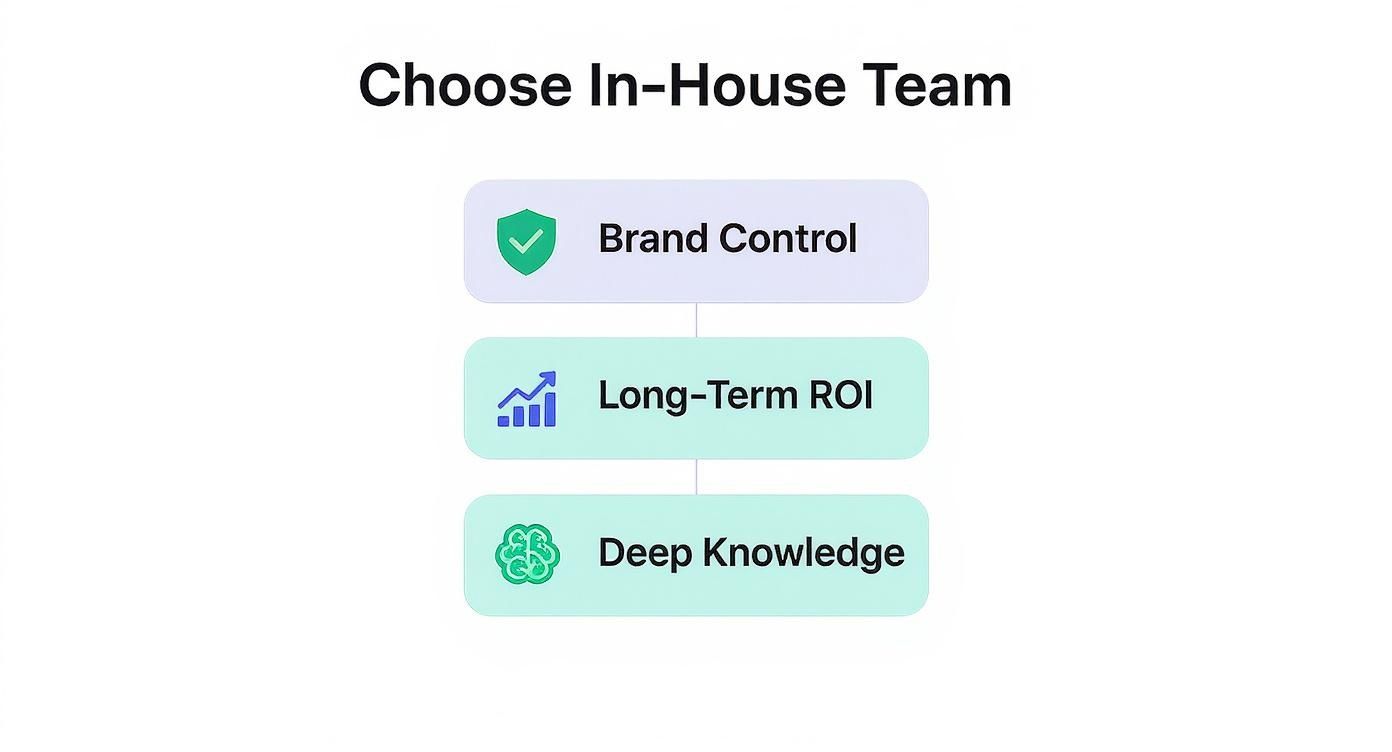
As you can see, things like total brand control and building deep institutional knowledge are strong signs that going in-house is the right move for sustainable growth.
To make the call with confidence, you need to ask yourself a few tough questions:
- Budget: Can we realistically handle the fully loaded costs of an in-house team? We're talking salary, benefits, software, and everything in between.
- Growth Stage: Is our main goal right now to move fast and test a bunch of channels, or are we focused on fine-tuning the channels we already have?
- Long-Term Goals: Are we trying to build a sustainable internal asset for the long haul, or do we just need to hit specific project goals as fast as possible?
Answering these questions honestly will light up the most logical path for you, making sure your marketing structure is set up to help your business grow, not hold it back.
Got Questions? We've Got Answers
Even after laying it all out, you're probably wrestling with a few specific questions. It's a big decision. Let's tackle some of the most common ones we hear from leaders trying to find the right path.
Which One Is Actually Cheaper: Agency or In-House?
At first glance, an agency often looks like the more budget-friendly option. A single in-house marketer can easily run you over $100,000 a year once you factor in salary, benefits, software, and training. An agency gives you a whole squad of specialists for a flat monthly fee, which can deliver a much quicker return on your investment.
But it's not always that simple. For businesses with consistent, high-volume marketing needs, building a skilled in-house team can become the more cost-effective choice in the long run. They build institutional knowledge and get more efficient over time, which is an asset that’s hard to put a price tag on.
What Exactly Is a Hybrid Marketing Model?
The hybrid model is the "best of both worlds" approach. It's where you build a core in-house team to handle things like brand strategy and day-to-day content, but you bring in an agency for the heavy lifting or highly specialized tasks. Think technical SEO audits, complex Google Ads management, or a massive creative campaign.
This setup gives you a ton of flexibility. You can plug specific skill gaps without having to hire another full-time employee.
The hybrid approach is a smart compromise. You get the deep brand understanding of an internal team paired with the specialized, on-demand firepower of an agency. It’s becoming the go-to solution for businesses that are serious about scaling.
Ultimately, this model lets you keep tight control over your core brand identity while tapping into expert skills exactly when you need them. It's a great way to optimize your budget and get better results.
Ready to stop guessing and make a confident choice? The team at Frozen Crow Inc. can give you a free, data-driven audit to see where you stand and map out the most effective way forward. Get your free marketing audit today!


