


August 20, 2026
A Practical Marketing Strategy for Small Businesses
Every smart marketing strategy starts with a simple, three-part process: audit what you're already doing, analyze what your competitors are up to, and establish clear, measurable goals. This isn't just busywork; it's about making sure every dollar you spend is based on data, not guesswork. This approach sets you up for real, sustainable growth.
Build Your Foundation With a No-Cost Marketing Audit

Before you can map out where you're going, you have to know where you stand. So many small business owners skip this part, jumping straight into campaigns without a clue about their existing strengths, weaknesses, or hidden opportunities. It's a recipe for wasting time and money on tactics that were never going to hit the mark.
A no-cost marketing audit is your first, most essential move. Think of it as a straightforward review of your current presence—even if you feel like you don’t really have one yet. This isn't about judging past efforts. It’s about grabbing a baseline so you can make smarter decisions from here on out. If you want a deeper dive, our guide on what is a marketing audit breaks down every component.
Assessing Your Digital Footprint
Let’s start with what you actually control. This initial self-check doesn't need to be some monumental task. Just run through a few direct questions to get a lay of the land.
Your internal audit should cover:
- Website Health: Is your site easy to use on a phone? Does it load in under three seconds? Can someone find your contact info without a scavenger hunt? A slow, clunky website will kill any other marketing you do.
- Social Media Presence: Which platforms are you actually on? Are the profiles filled out and professional? More importantly, is anyone paying attention (likes, comments, shares), or are you just shouting into the void?
- Customer Acquisition: How are people finding you right now? Is it word-of-mouth, a random Google search, or a specific social channel? This tells you what’s already working, even if by accident.
Sizing Up the Competition
Once you’ve got a handle on your own situation, it's time to peek over the fence. Understanding what your competitors are doing helps you spot gaps in the market and find what makes you different. You don't need fancy, expensive software for this.
A simple competitive peek involves:
- Googling Their Services: Search for the products or services you offer and see who pops up on the first page. Take note of what they’re doing right in their search listings.
- Analyzing Their Socials: Find their best-performing posts. What topics get people talking? What’s their tone?
- Reviewing Their Website: Sign up for their newsletter. Download their free guide. This gives you a firsthand look at their marketing funnel and how they talk to customers.
The point isn't to copy them. It's about understanding the sandbox you're playing in so you can carve out your own space.
A great marketing strategy doesn't just promote your business; it solves a specific problem for a specific audience better than anyone else. Your audit is the first step in identifying exactly what that is.
Setting Actionable Goals
Okay, with your audit done, you can finally set goals that are actually grounded in reality. Vague wishes like "get more customers" are useless. Instead, use the SMART framework to create objectives that are Specific, Measurable, Achievable, Relevant, and Time-bound.
For example, instead of "do better on social media," a SMART goal sounds like this: "Increase Instagram engagement by 15% in the next 90 days by posting three Reels per week and responding to all comments within 24 hours." See the difference?
This foundational work—the audit, the competitive analysis, and clear goal-setting—is the bedrock of any successful marketing plan. It ensures that every action you take is purposeful, measurable, and directly tied to growing your business. As you build this out, it's also the perfect time to explore proven strategies to attract customers that align with your new, data-backed plan.
Get to Know Your Real Customers
Trying to sell to "everyone" is a surefire way to connect with no one. A smart, budget-conscious marketing strategy doesn't just shout into a crowd; it speaks directly to a specific person who has a specific problem you can solve. To do that, you have to get past generic data and understand the real people you want to serve.
This means digging deeper than surface-level demographics like age and location. What really motivates them? What problems are keeping them up at night? Answering these questions is the difference between marketing that gets ignored and a message that makes someone feel genuinely understood.
From Data Points to Human Profiles
The goal here is to create customer profiles, or what we call buyer personas, that feel like actual people. These aren't just made-up characters; they’re composites of your ideal customers, built from a mix of real data, customer interviews, and some educated assumptions. This process turns abstract market segments into relatable individuals you can speak to.
Think about these two very different small businesses:
- A local coffee shop: Instead of targeting "coffee drinkers," they focus on "Freelance Fiona," a 32-year-old remote graphic designer. She needs a quiet "third place" to work with solid Wi-Fi and great coffee. Her pain point isn't just a lack of caffeine—it's the lack of a productive, inspiring spot outside her home office.
- A B2B IT consultant: Their target isn't just "companies," it's "Project Manager Pete." He's a 45-year-old manager at a mid-sized firm, totally overwhelmed by clunky software and terrified his projects will fall behind schedule. He values reliability, clear communication, and tools that make his team's job easier.
See how specific that is? Suddenly, every marketing decision gets clearer. The social media channels you pick, the words you use in an email—it all sharpens when you’re talking to Fiona or Pete, not some vague audience. For a more detailed walkthrough, you can learn more about how to create buyer personas and put it to work for your own business.
To get you started, here is a simple template to begin outlining who your ideal customer is. Don't overthink it at first; just fill in what you know and make educated guesses where you need to.
Simple Customer Persona Template
| Attribute | Description |
|---|---|
| Name | Give your persona a memorable name (e.g., Freelance Fiona) |
| Demographics | Age, gender, location, job title, income level, family status |
| Goals | What are their primary personal and professional goals? |
| Challenges | What's standing in their way? What are their biggest pain points? |
| Motivations | What drives their decisions? (e.g., saving time, gaining status) |
| Watering Holes | Where do they hang out online? (e.g., LinkedIn, specific blogs, Instagram) |
This simple exercise is a massive first step. You can always refine these details later as you gather more data and feedback from actual customers.
Mapping the Customer Journey
Once you know who your customer is, you need to understand their path to buying from you. This is the customer journey map, and it outlines every single touchpoint someone has with your business, from the first time they hear about you to the moment they become a loyal fan.
A typical journey breaks down into a few key stages:
- Awareness: The "aha!" moment. A person realizes they have a problem or need you can solve. How do they find you? Is it a Google search, a friend's recommendation, or a social media ad?
- Consideration: Now they're doing their homework. They might be reading your blog, comparing your prices to a competitor's, or checking out online reviews.
- Decision: It’s time to buy. What finally convinces them to pull the trigger? Is it a killer offer, a simple checkout process, or a glowing testimonial?
- Loyalty: The journey isn't over after the sale. This is about turning a one-time buyer into a repeat customer and a vocal advocate for your brand through great service and smart follow-up.
Understanding the customer journey allows you to meet your audience where they are. You can create the right content and offers for the right moment, guiding them smoothly from one stage to the next.
Let's go back to "Freelance Fiona." She might become aware of the coffee shop through a local Instagram geotag (Awareness). She then checks their Google reviews and menu online (Consideration). A "first coffee free" offer convinces her to finally visit (Decision). A friendly barista who remembers her name and a simple loyalty card program keep her coming back (Loyalty). Each step was a chance for the business to connect with her specific needs, proving that a focused approach is the core of any effective, budget-conscious marketing strategy.
Choose Marketing Channels That Actually Work
Now that you have a clear picture of your ideal customer, you can stop throwing money away on marketing that misses the mark. The next step is choosing the right channels to reach them. The goal isn't to be everywhere; it's to be exactly where your customers are, ready to listen.
A classic mistake is spreading a small budget across a dozen different platforms, hoping something sticks. A much smarter approach is to make a few strategic bets on the channels that offer the best possible return for your specific business. The right mix depends entirely on who you're trying to reach and what you're selling.
This is where all that work defining your customer pays off. Visualizing their profile helps you connect the dots between who they are and where they spend their time.
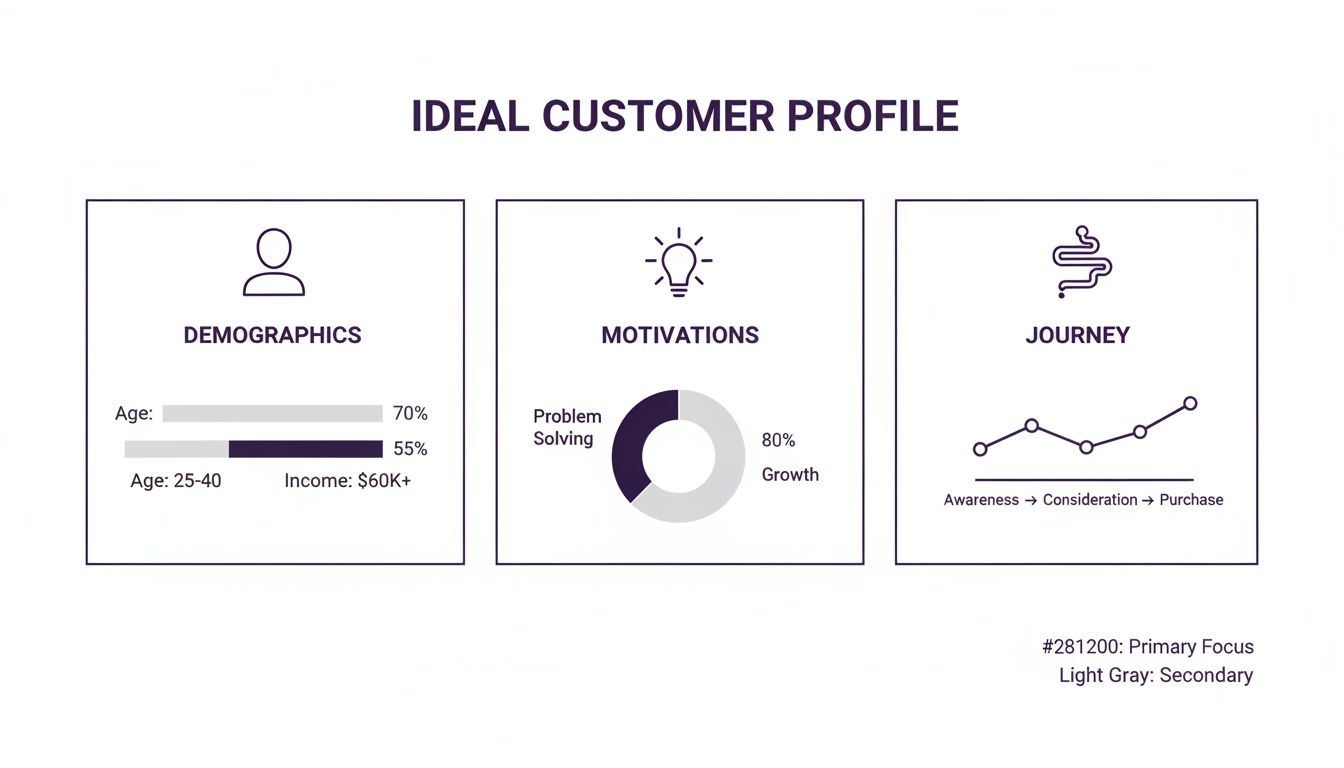
Mapping out their demographics, motivations, and journey directly points you toward the most effective places to focus your marketing efforts.
The Power Duo: Organic and Paid Channels
Your marketing efforts will generally fall into two buckets: organic and paid. A strong strategy doesn't pick one over the other—it uses both in harmony.
- Organic Marketing: Think of this as your long-term engine for growth. It includes things like search engine optimization (SEO), creating genuinely helpful blog posts or videos, and building a real community on social media. It takes more time and effort upfront, but you're building a sustainable asset that pays dividends for years.
- Paid Marketing: This is your accelerator pedal. Paid channels like social media ads on Facebook, Instagram, or LinkedIn, and pay-per-click (PPC) ads on Google can deliver immediate traffic and leads. They’re perfect for testing a new offer, promoting a time-sensitive campaign, or just getting in front of new audiences, fast.
The key is finding the right balance. Relying only on paid ads gets expensive and feels like you're on a treadmill. But an organic-only approach can be painfully slow to get off the ground.
Aligning Channels With Your Business Model
Let's make this real. The best channels for a local bakery are completely different from those for a B2B software consultant. Your customer persona is your north star here.
Scenario A: The Local Artisan Bakery
Your target is "Neighborhood Nancy," a local who loves supporting her community and values fresh, high-quality ingredients. She finds new spots through word-of-mouth and visual platforms.
- Top Channels:
- Local SEO: Getting your Google Business Profile in order is non-negotiable. When Nancy searches "bakeries near me," you absolutely have to show up with great reviews and mouth-watering photos.
- Instagram: This is your visual playground. Showcase daily specials, go behind the scenes with your bakers, and share customer photos. It's how you build a loyal local following.
- Email Marketing: A simple weekly newsletter announcing weekend specials or offering a small discount is a brilliant way to drive repeat business from your regulars.
Scenario B: The B2B Software Consultant
Your target is "Project Manager Pete," who is laser-focused on finding efficient, reliable solutions for his team. He spends his time on professional networks and reads industry content to stay sharp.
- Top Channels:
- LinkedIn: This is Pete's digital office. It's where you establish credibility by sharing insightful articles, case studies, and participating in relevant industry groups.
- Content Marketing (Blog): Writing in-depth blog posts that solve Pete’s biggest headaches (like "5 Ways to Streamline Project Reporting") positions you as a genuine expert and pulls in valuable organic search traffic.
- Targeted LinkedIn Ads: Instead of a spray-and-pray approach, you can run hyper-targeted ads to users with specific job titles like "Project Manager" at companies of a certain size. Every dollar is spent reaching the right person.
Your marketing channel isn't just a place to run ads; it's the environment where you build a relationship with your customer. Choose a place where they feel comfortable and ready to engage.
To help you weigh your options, here’s a quick comparison of some of the most common channels for small businesses.
Comparing Marketing Channels for Small Businesses
| Channel | Typical Cost | Effort Level | Potential ROI |
|---|---|---|---|
| Local SEO (GMB) | Free to Low | Medium | High |
| Content Marketing/SEO | Low to Medium | High | High (Long-term) |
| Email Marketing | Low | Low to Medium | Very High |
| Social Media (Organic) | Free to Low | Medium | Medium to High |
| Social Media Ads | Medium to High | Medium | Medium to High |
| Google PPC Ads | Medium to High | High | High (if optimized) |
| LinkedIn (Organic/Ads) | Low to High | Medium | High (for B2B) |
This table isn't exhaustive, but it gives you a solid framework for thinking about where your time and money might have the biggest impact.
Making Smart Bets With a Simple Framework
You can't do everything at once, and you shouldn't try. Prioritization is everything. This is especially true now; in 2023, a striking 78% of small businesses experimented with new marketing tactics. The most popular choices were social media ads and websites (both at 60%), followed by SEO at 50% and email marketing at 46%, according to recent small business marketing statistics.
To decide where you should start, evaluate potential channels against three simple criteria:
- Impact: How much potential does this channel have to reach your ideal customer and crush your SMART goals?
- Effort: How much time and skill will it take to do this well?
- Cost: What's the direct financial investment required to get started?
Begin with the channels that score high on impact but are lower on effort and cost. For most small businesses, this "sweet spot" often includes local SEO, a focused presence on one or two key social media platforms, and building an email list from day one.
Once you see some wins, you can reinvest your profits and expand into more demanding or expensive channels. This phased approach keeps your marketing ambitious but, more importantly, sustainable.
Create a Realistic Budget and Action Plan
A brilliant marketing strategy without a budget and a calendar is just a collection of good ideas. This is where we get incredibly practical, turning your strategic choices into a concrete, day-to-day action plan.
For many small business owners, this step feels the most intimidating. Don't let it be.

The key is to start lean and build momentum. You don't need a massive war chest to make an impact. A well-planned, modest budget focused on the right activities can easily outperform a larger, unfocused one.
Building Your First Marketing Budget
Forget complex spreadsheets and overwhelming formulas for a moment. At its core, a marketing budget is just a plan for how you'll spend your money to achieve your goals.
For a small business just starting out, a good rule of thumb is to allocate between 5% and 10% of your revenue to marketing. If you're pre-revenue or just launching, work with a fixed amount. A budget of $500 to $1,000 per month is a realistic and powerful starting point for many.
The goal here isn't to spend big; it's to prove what works on a small scale before you pour more fuel on the fire.
Let’s see how two different businesses might allocate a lean, $750/month starter budget:
Sample Budget 1: Local Service Provider (e.g., Plumber, Landscaper)
- Google Local Services Ads ($300): This is non-negotiable for immediate, local visibility. These are pay-per-lead ads that can generate calls right away.
- Social Media Ads ($150): Hyper-targeted Facebook or Instagram ads to build brand awareness within specific zip codes.
- Email Marketing Platform ($50): Tools like Mailchimp or Constant Contact are perfect for nurturing past clients and asking for reviews.
- Content & SEO Tools ($100): Subscriptions for basic keyword research or content optimization tools to build long-term authority.
- Miscellaneous ($150): This covers printing flyers, joining local business groups, or boosting a high-performing social post.
Sample Budget 2: E-commerce Brand (e.g., Handmade Jewelry)
- Social Media Ads ($400): The budget is heavily skewed toward Instagram and TikTok to drive direct traffic to product pages.
- Email & SMS Marketing ($100): Absolutely essential for recovering abandoned carts and promoting sales to your customer list.
- Influencer Seeding ($150): Send free products to micro-influencers in exchange for authentic posts. This is often more effective than paying for a single large placement.
- Content Creation Tools ($100): Subscriptions for apps like Canva or video editing software to create polished visuals.
See how the allocation directly reflects the customer and channels we identified earlier? The budget isn't just a list of expenses; it's a financial reflection of your strategy.
Your First 90 Days: A Phased Action Plan
Trying to launch everything at once is a recipe for burnout. Instead, structure your launch into a phased 30-60-90 day plan. This approach builds momentum, allows you to learn as you go, and makes the whole process feel much more manageable.
The goal of your first 90 days isn't perfection; it's progress. Focus on consistent execution and gathering data to inform your next moves.
Phase 1: The First 30 Days (Foundation & Quick Wins)
Your focus here is on getting the essential systems in place and generating your first bits of data.
- Set Up Tracking: Install Google Analytics on your website. Seriously, do this first. You need to be able to measure traffic from day one.
- Optimize Your Core Profile: Perfect your Google Business Profile or primary social media page. Ensure all information is accurate, photos are professional, and your value prop is crystal clear.
- Launch One Campaign: Start with a single, focused campaign. For the plumber, this is their Google Local Services Ads. For the jewelry brand, it’s a targeted Instagram ad for their best-selling product.
Phase 2: Days 31-60 (Analysis & Expansion)
Okay, you have some initial data. Now it's time to see what's working and double down.
- Review Early Results: Which ad creative got the most clicks? What social post drove the most engagement? Look at the numbers, not your gut feeling.
- Launch a Second Channel: Based on that review, introduce your next priority channel. The local business might start their email newsletter, while the e-commerce brand could experiment with TikTok video ads.
- Create Foundational Content: Write your first two blog posts based on keyword research or start a simple weekly content series on social media.
Phase 3: Days 61-90 (Optimization & Scaling)
By now, you should have a clearer picture of what resonates with your audience. This phase is all about refining your approach and preparing for growth.
- A/B Test Your Ads: Create a second version of your best-performing ad with a different headline or image to see if you can improve its performance.
- Document Your Processes: Create simple checklists for your recurring marketing tasks. This makes it easier to stay consistent and eventually delegate work.
- Plan for the Next Quarter: Using your 90-day data, outline your goals and budget for the next three months, reallocating funds to the channels that delivered the best results.
This structured, phased approach is the heart of a successful marketing strategy for small businesses. It transforms a daunting task into a series of achievable steps, ensuring every action is intentional, measurable, and moves you closer to your goals.
Measure What Matters and Adapt Your Strategy
A great marketing strategy is never set in stone. Think of it as a living plan that has to evolve right alongside your business. This brings us to the most critical part of the entire process: creating a tight feedback loop. You act, you measure the results, and you adapt based on what the data is telling you.
This is where we move past the feel-good "vanity metrics" like social media likes or follower counts. Those numbers are nice for the ego, but they don't pay the bills. Real growth comes from tracking the metrics that directly impact your bottom line.
Identifying Your Key Performance Indicators
To make smart decisions, you have to track the right data. Key Performance Indicators (KPIs) are the specific, measurable numbers that show you how effectively you're hitting your main business objectives. Instead of getting lost in a sea of analytics, you'll zero in on the handful that truly matter.
Your KPIs should tie directly back to the SMART goals you set earlier.
- If your goal is to increase website leads by 20%, your KPIs are things like Conversion Rate and Cost Per Lead.
- Aiming to boost online sales by 15%? You’ll be watching Customer Acquisition Cost (CAC) and Average Order Value (AOV) like a hawk.
- For a goal like improving customer retention, you’d monitor Customer Lifetime Value (CLV) and Churn Rate.
Sticking to these core metrics keeps you from getting distracted by noise and ensures every tweak you make is aimed at improving real business outcomes. You can build out your framework by exploring a detailed guide on how to measure digital marketing success.
Your marketing dashboard shouldn't be a data dump. It should be a clear, simple story about what's working, what isn't, and where your biggest opportunities are hiding.
Building Your Simple Marketing Dashboard
You don’t need a fancy, expensive software suite to track performance, especially when you're starting out. Free tools are more than powerful enough for most small businesses. The goal is to create a simple, at-a-glance dashboard that pulls your most important KPIs into one place.
A perfect place to start is with Google Analytics 4. It lets you build custom dashboards that show you exactly what you need to see, without any of the clutter.
Here are three essential reports to build into your dashboard:
- Traffic Acquisition Report: This shows you where your website visitors are coming from (e.g., Organic Search, Paid Social, Email). It’s the first place you’ll spot which of your marketing channels is pulling its weight.
- Engagement Report: This tells you what people do once they land on your site. Metrics like Engaged sessions and Average engagement time are great indicators of whether your content is actually connecting with your audience.
- Conversions Report: This is where you track the most important actions—form submissions, purchases, phone calls. This report is your direct line to measuring how well your website turns visitors into customers.
Establishing a Rhythm for Review and Optimization
Data is completely useless if you never look at it. The secret to an adaptive strategy is setting up a consistent rhythm for reviewing your numbers and making informed decisions. This isn’t a once-a-year activity; it’s an ongoing process.
Create a simple review schedule you can actually stick to:
- Weekly Check-in (15 minutes): A quick glance at your dashboard. See any sudden spikes or dips in traffic or leads? This is about spotting major fires before they have a chance to spread.
- Monthly Review (1 hour): Time for a deeper dive into your KPIs. How are you tracking against your quarterly goals? What did you learn from last month's campaigns that you can apply to the next?
This iterative approach is the engine of marketing improvement. For instance, a huge part of adapting your strategy is understanding the return on your investment. By consistently reviewing your data, you'll learn how to measure marketing ROI and can confidently shift your budget away from underperforming channels to the ones that are actually generating results.
This optimization loop is what ensures your marketing gets smarter and more efficient over time. This constant cycle of measuring, learning, and adapting is what separates the businesses that grow from the ones that stagnate.
Your Questions, Answered
Jumping into marketing always brings up a few big questions, especially when you're trying to make every dollar and minute count. Here are the straight answers to the things we hear most often from small business owners just like you.
"How Much Should I Actually Be Spending on Marketing?"
This is always the first question, and thankfully, it doesn't need to be a complicated one. A good rule of thumb for an established business is to set aside 5-10% of your total revenue for marketing. If you're a brand-new startup, it's smarter to just pick a fixed monthly number you're comfortable with. Seriously, even a few hundred dollars is a great place to start.
The goal isn't to dump a huge amount of cash in right away. It’s about using a small, controlled budget to figure out what actually works. Once a channel—like some hyper-targeted Facebook ads or a solid local SEO push—starts bringing in a positive return, that’s your green light. You can then confidently reinvest your profits to scale things up.
"Which Marketing Channels Should I Focus on First?"
Stop trying to be everywhere at once. It's a classic mistake that burns out small teams and budgets. The best way to get traction is to pick one or two channels where you know your ideal customers hang out, and get really good at them before you even think about expanding.
- Got a local, service-based business? Your first and only priority should be your Google Business Profile. It’s free, it’s powerful, and it's how local customers will find you. End of story.
- Selling e-commerce or highly visual products? Get on Instagram or TikTok. These are the best platforms for building a community and showing off what you sell.
- In the B2B or professional services space? Your foundation is LinkedIn and a genuinely helpful blog. This is how you build credibility and attract leads who are already looking for your expertise.
Here's the key takeaway: The "perfect" channel is simply where your specific audience already spends their time. Don't waste energy chasing trends; follow your customer.
"How Long Is This Going to Take Before I See Results?"
Patience is probably the most underrated marketing tool. The timeline for seeing a real return on your effort depends entirely on the channels you choose.
Paid advertising, like Google Ads or promoted social posts, can bring in traffic and leads almost immediately. We're talking within hours of a campaign going live. But that speed comes at a cost, and the traffic stops the second you turn off the spend.
On the other hand, organic strategies are a long game. Content marketing and SEO are about building an asset. It can easily take 3-6 months of consistent work before you start seeing real, meaningful organic traffic and rankings. The trade-off is huge, though. Those results are far more sustainable and actually grow over time. A smart marketing plan uses a mix of both—paid ads for the short-term wins and organic for long-term, stable growth.
At Frozen Crow Inc., we help businesses turn these questions into clear, actionable plans. If you're ready to build a strategy that delivers real, measurable growth, check out our services at https://frozencrow.com.


