


August 20, 2026
Mastering Email Campaigns: managing email campaigns for beginners
A solid email strategy is the difference between sending emails and actually getting results. It's the documented game plan that makes sure every campaign has a purpose, every message hits the right person, and every dollar you spend comes back to you. This is where you define your objectives, pinpoint your audience, and decide how you'll measure success before you even think about writing a subject line.
This foundational work turns your email list from a simple contact database into a powerful engine for growth.
Building Your Foundational Campaign Strategy
Jumping into your email platform without a plan is like setting sail without a map. Sure, you can send out a bunch of pretty emails, but you'll have no idea if they're actually taking your business where it needs to go. A real strategy ensures every ounce of effort is purposeful and contributes directly to your bottom line. It’s the difference between being busy and being effective.
This isn't about creating some massive, complicated document. It's about getting laser-focused on three core questions. The answers will guide every decision you make down the line, from your copy to your segmentation.
Defining Clear Campaign Objectives
First things first: what are you actually trying to achieve? Vague goals like "increase sales" aren't going to cut it. You need to get specific and measurable.
For example, an e-commerce startup isn't just trying to sell more. Their objective might be to "drive a 3% conversion rate on a new product line within 30 days." A B2B company isn't just looking for leads; they're aiming to "generate 50 qualified leads for a new webinar series by the end of the quarter."
When you have a crystal-clear target, everything else clicks into place:
- It focuses your content. You know exactly what message you need to send.
- It clarifies your design. The call-to-action (CTA) becomes obvious.
- It simplifies measurement. You know precisely what success looks like.
This simple flow shows how objectives, audience, and KPIs build on each other to form a solid strategy.
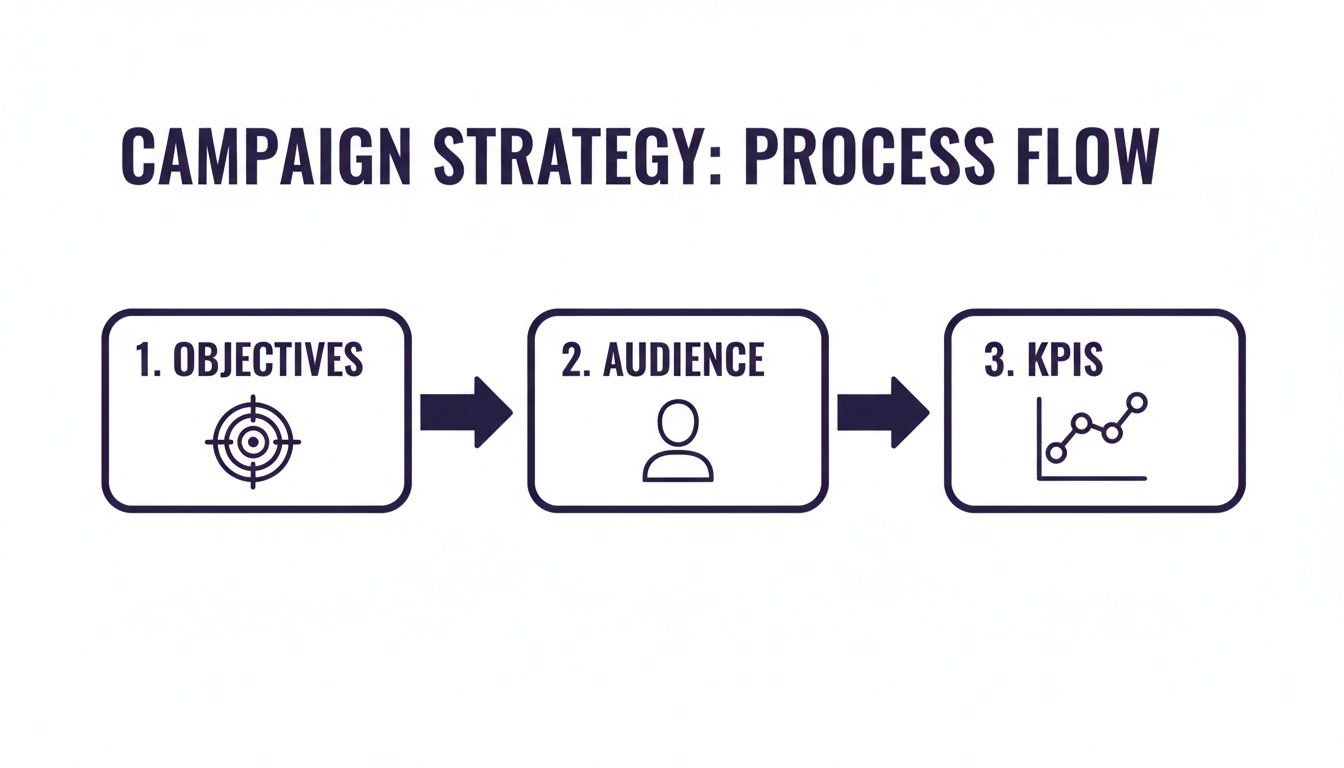
It all starts with the 'why' (your objective) before you move on to the 'who' (your audience) and the 'how' (your KPIs).
Identifying Your Target Audience
Okay, you know your goal. Now, who are you talking to? Blasting a generic message to your entire list is a surefire way to kill your engagement and rack up unsubscribes. You have to pinpoint the exact segment of your audience most likely to care about what you have to say.
(If you're just starting out, our guide on how to build an email list is the perfect place to get the groundwork right.)
Imagine you're an online clothing store dropping a new line of activewear. Instead of emailing every single subscriber, you’d zero in on people who've bought athletic gear before or clicked on your "5 Best Yoga Poses" blog post. That's relevance. That's what gets people to open, click, and buy.
Your email list isn't a monolith. It’s a collection of individuals with different histories and interests. The more precisely you can match the message to the person, the more your campaigns will feel like a one-on-one conversation.
Setting Meaningful KPIs
Finally, how will you know if you've won? Key Performance Indicators (KPIs) are the specific metrics you’ll track to see if your campaign is actually working. They're the hard data that proves your strategy is more than just a good idea.
Your KPIs should be a direct reflection of your campaign objective.
- Goal is brand awareness? Track Open Rate and Forward Rate.
- Trying to drive traffic? Your main KPI is Click-Through Rate (CTR).
- Focused on sales? The only thing that matters is Conversion Rate.
Let’s say a small business wants to bring back some dormant customers. A smart KPI would be to hit a 15% open rate and a 2% click-through rate on their "we miss you" email. Those numbers give them a clear benchmark for success and tell them what to tweak next time.
By locking in these three pillars—objectives, audience, and KPIs—you build a framework that gives every single email a clear purpose and a measurable path to success.
Mastering Audience Segmentation and Personalization
Let's be honest: sending a generic email blast to your entire list is the quickest way to the spam folder. Real campaign success comes from making each subscriber feel like you're talking directly to them. This means ditching the one-size-fits-all approach and getting serious about segmentation and personalization.
This shift from mass email to targeted conversation is exactly why the email marketing industry is booming. What was an $11.5 billion market in 2023 is expected to hit $46.1 billion by 2033. It's not just more emails; it's smarter emails. The proof is in the numbers, with average open rates climbing to 22.7% in 2024, largely thanks to marketers getting better at this stuff.

Actionable Segmentation Techniques
Segmentation is just a fancy word for breaking your audience into smaller, more focused groups. Instead of shouting into a packed stadium, you're pulling people aside for meaningful chats. To get this right, you first need to know who you’re talking to. A great starting point is to create buyer personas that truly represent your ideal customers.
Here are a few powerful ways to slice up your list:
- Purchase History: Group customers by what they bought, when they bought it, and how much they spent. Someone who bought hiking boots last month? They're a prime candidate for an email about your new waterproof jackets.
- Engagement Level: Split your list into your biggest fans (opened or clicked in the last 30 days) and those who've gone quiet (no action in 90+ days). Send exclusive perks to your loyal crew and a friendly re-engagement campaign to win back the sleepers.
- Browsing Behavior: If your email platform talks to your website, you can get really clever. Segment based on pages viewed or products they've lingered on. See someone spent five minutes on your "premium coffee grinders" page? That's your cue to send them an email showcasing your top-rated grinders.
The point of segmentation isn’t just to split up your list—it's to deliver relevance. A relevant email feels helpful, not pushy. That’s how you build real, long-term customer relationships.
Effective Audience Segmentation Strategies
Picking the right segmentation strategy depends entirely on your business model and goals. Here’s a quick breakdown of how different methods apply in the real world.
| Segmentation Type | Criteria | Example Use Case | Impact on Engagement |
|---|---|---|---|
| Demographic | Age, gender, location, income | A fashion retailer sending different style guides to men in New York vs. women in Miami. | Good starting point; improves relevance for location or age-specific offers. |
| Psychographic | Lifestyle, values, interests, personality | A travel company targeting "adventure seekers" with trekking packages vs. "luxury travelers" with resort deals. | High impact; speaks directly to a subscriber's motivations and desires. |
| Behavioral | Purchase history, website activity, email engagement | An e-commerce store sending a "we miss you" discount to customers who haven't purchased in 6 months. | Very high impact; based on actual user actions, making messages timely and specific. |
| Firmographic | Industry, company size, revenue (B2B) | A SaaS company sending case studies to prospects in the healthcare industry vs. the finance industry. | Essential for B2B; ensures content is relevant to the prospect's professional context. |
Ultimately, the most powerful campaigns often layer these strategies, creating hyper-specific segments that drive incredible results.
The Dynamic Content Playbook
Once you have your segments, you can supercharge your personalization with dynamic content. This lets you show different content blocks to different segments—all within a single email. It's personalization without the headache of building a dozen different campaigns.
Imagine an online bookstore sending one "New Arrivals" email. It could automatically show:
- Mystery novel recommendations to subscribers who have a history of buying thrillers.
- Cookbook suggestions to anyone who has purchased culinary books before.
- Children's book highlights to users who've been browsing the kids' section.
Everyone gets an email that feels uniquely curated for them, yet you only had to build one. This is a game-changer for boosting relevance and click-through rates.
If you want to go deeper, our guide on customer segmentation strategies unpacks these methods in more detail.
Automating Personalization at Scale
The real magic happens when you pair segmentation with automation. You can build workflows that automatically move subscribers between lists based on their actions, triggering perfectly timed, personalized emails along the way.
Think about an e-commerce welcome series:
- Email 1: A general welcome goes out to all new sign-ups.
- Email 2: A few days later, if they've browsed the "Men's Shoes" category, an email automatically follows up showcasing best-sellers from that section.
- Email 3: If they clicked a link but didn't buy, another automated email can nudge them with a small discount on their first footwear purchase.
This turns your email program from a simple broadcast tool into a smart, responsive marketing engine. You’re always sending the right message to the right person at the right time. That’s the heart of great email campaign management.
Designing Emails That Convert
Okay, so your killer segmentation got the email to the right person. But what happens after they open it? That’s where design and copy take over.
The best email campaigns don’t just send a message; they deliver an experience. Great design guides your reader’s eye, makes your content a breeze to read, and pushes them straight toward that call-to-action (CTA). Every single element, from the subject line all the way down to the footer, has a job to do.
Skimping on design is like having the perfect sales pitch but mumbling your way through it—the message just gets lost. When you get this right, your emails become a serious conversion machine.

Crafting Irresistible Subject Lines
Think of your subject line as the gatekeeper. Your email could be pure gold, but it's worthless if nobody ever opens it. The goal here is to spark curiosity and hint at value without giving the whole game away.
It's like a movie trailer—it needs to be compelling enough to make someone want to see the show. Personalization is your best friend here; even just adding a subscriber's name can give your open rates a nice little bump. And keep it short. Most people are on their phones, and long subject lines get cut off.
A few angles that work well:
- Urgency: "Your 20% off coupon expires tonight!"
- Curiosity: "Is this the biggest mistake you're making?"
- Benefit-driven: "Sleep better tonight with these 3 tips."
And don't sleep on the preheader text! That little snippet of text after the subject line is prime real estate. Use it to add some context and give them one more reason to click.
Principles of High-Converting Email Design
Once they’re in, the design has to do the heavy lifting. The mission is simple: make it readable and give them a clear path to action. A cluttered, confusing mess of an email gets deleted in a heartbeat. You’re aiming for a clean layout, a clear visual hierarchy, and, above all, a mobile-first approach.
This is where the money is. Seriously. Some campaigns see a mind-blowing 3,600% ROI—that's $36 back for every single dollar spent. It's why 59% of marketers say email is their number one source of ROI. With 4.5 billion global email users projected for 2025 and 60% of customers buying straight from promotional emails, good design isn't optional. It’s a core revenue driver. If you're curious, you can dig into more of these eye-opening email marketing statistics to see the full potential.
To make sure your design pulls its weight, stick to these fundamentals:
- Visual Hierarchy: Use headings, bold text, and images to draw the eye where you want it to go. Your main message and CTA should pop right off the page.
- White Space: Let your content breathe. Don't cram everything together. White space makes your email feel less overwhelming and way easier to scan.
- Brand Consistency: Stick to your brand’s colors, fonts, and logo. It looks professional and builds that all-important trust with your audience.
- Compelling Imagery: Use high-quality photos and graphics that actually add to your message. Ditch the generic stock photos whenever you can.
Pro Tip: Always, always design for mobile first. More than half of all emails are read on a phone. If it looks broken or is hard to read on a small screen, you’ve already lost a massive chunk of your audience before you even got started.
The Ultimate Pre-Send Checklist
Before you hit that big, scary "send" button, you need a final quality check. I can't stress this enough. One tiny mistake can tank your credibility and kill your results. Run through this list every single time—no exceptions.
- Check All Links: Seriously, click every single one. Make sure they go where they're supposed to. That includes images, text links, and social icons.
- Proofread Everything: Read it all out loud—subject line, preheader, body copy. You'll be amazed at the typos you catch when you hear them.
- Verify Personalization: Send a test to yourself. Does the
[First Name]token actually pull in a name, or does it show up as a broken tag? - Test Across Devices: Use a tool like Litmus or just send tests to an iPhone, an Android, and a desktop client. Make sure it looks good everywhere.
- Confirm Your CTA: Is your call-to-action obvious? Is it compelling? The button should have a contrasting color and use action-packed text like "Shop Now" or "Get Your Guide."
Automating Your Campaigns for Flawless Execution
This is where your strategy gets supercharged by technology. Firing off manual emails works for one-off announcements, but real growth comes from automation. Setting up automated workflows lets you nurture leads, keep subscribers engaged, and drive sales 24/7—even when you’re busy with a dozen other things.
It's how you scale personalized communication without hiring a massive team. Instead of just reacting, you're building smart systems that anticipate customer needs and send the perfect message at just the right moment.
Building Your First Automation Workflows
Getting started with automation doesn't have to be a huge headache. You can kick things off with a couple of high-impact workflows that deliver value right away. Think of these as your "set it and forget it" money-makers.
A welcome series is the perfect place to start. When someone new signs up, don't just send a single email and call it a day. Create a sequence of three to five emails that go out over a week or two. This "drip" campaign is your chance to introduce your brand, show off top products, offer a little discount, and start building a real relationship.
The other must-have is the abandoned cart series. For any e-commerce store, this is non-negotiable. When a customer adds an item to their cart but ghosts you at checkout, a friendly reminder an hour later can bring back a surprising amount of that lost revenue. For a deep dive into setting up these kinds of sequences, check out this practical guide to sending recurring emails.
Navigating the World of Email Deliverability
Look, a brilliant automated campaign is useless if it never reaches the inbox. This is where email deliverability becomes your most important technical hurdle. It’s simply a measure of how good you are at landing in your subscribers' inboxes instead of their spam folders.
Internet Service Providers (ISPs) like Gmail and Outlook are always watching. They’re looking for signals that you’re a legit sender who people actually want to hear from, not a spammer. Every single campaign you send either builds up your reputation or tears it down.
Your sender reputation is basically a credit score for your email program. A high score tells ISPs you're trustworthy, so they deliver your mail. A low score gets you a one-way ticket to spam—or worse, blocked entirely.
The stats don't lie. Automation is a game-changer, with 68.5% of marketers reporting better targeting and a wild 451% increase in qualified leads. But it’s not all easy—65% of pros still run into deliverability problems. The ones who nail the technical side, however, see an impressive 86% inbox placement rate.
Key Pillars of a Healthy Sender Reputation
Keeping your sender reputation high really just comes down to a few core practices. If you ignore these, you’re practically begging for your campaigns to fail.
- Consistent List Cleaning: Make a habit of removing inactive subscribers—anyone who hasn't opened your emails in a few months. Sending to an unengaged list tells ISPs your content isn't hitting the mark, which dings your reputation.
- Avoid Spam Traps: These are email addresses used by ISPs to catch spammers. They often look real but are inactive. Hitting one is a huge red flag. The only way around them is to keep your list clean, stick to opt-ins, and never, ever buy an email list.
- Minimize Spam Complaints: Keep your content relevant, and for goodness' sake, make your unsubscribe link easy to find. If people can't opt out easily, they’ll just mark you as spam out of frustration, which is way more damaging.
Authenticating Your Domain
Finally, there’s a critical technical step every single business needs to take: authentication. This just means adding a couple of records to your domain's settings to prove your emails are actually from you.
- SPF (Sender Policy Framework): This record is a list of all the mail servers that are allowed to send email for your domain. It’s what stops other people from faking your email address.
- DKIM (DomainKeys Identified Mail): This adds a digital signature to every email you send. The receiving server checks this signature to make sure the email wasn't messed with on its way to the inbox.
Getting SPF and DKIM set up is a one-time task that instantly signals to mailbox providers that you're a legitimate sender. Most email platforms have simple, step-by-step guides to walk you through it. If you're looking for more context on how these systems fit into a broader strategy, our guide on marketing automation for small business is a great resource.
Turning Campaign Data Into Actionable Insights
Hitting "send" on a campaign is just the starting line. The real magic happens in what you do after the email lands in the inbox. All that raw data from your email platform is just noise until you figure out how to translate it into smarter decisions.
This is the cycle that separates campaigns that thrive from those that just fade away: measure, test, refine, repeat. By really digging into your key performance indicators (KPIs), you can ditch the guesswork and start making data-backed improvements. Every send, whether it’s a home run or a total dud, becomes a lesson that sharpens your strategy for next time.
Defining Your Must-Track KPIs
Before you can fix anything, you have to know what to measure. Your email service provider probably throws a sea of metrics at you, but focusing on a handful of critical KPIs will give you the clearest picture of what’s actually going on. These are the numbers that tell you a real story.
Every small business should have these four metrics on lockdown:
- Open Rate: The percentage of people who actually opened your email. This is your first and best signal for whether your subject line is working and if people recognize your brand.
- Click-Through Rate (CTR): The percentage of recipients who clicked on at least one link. This is the ultimate test of your content—did your copy, design, and call-to-action actually compel someone to act?
- Conversion Rate: The percentage of people who completed the goal (like making a purchase or downloading a guide). This is the metric that ties your email marketing directly back to your business goals.
- Unsubscribe Rate: The percentage of recipients who opted out. A sudden jump here is a massive red flag. It’s telling you something is wrong with your content or your sending frequency.
Once you start tracking these consistently, you can establish a baseline. From there, you can start setting real goals and spotting trends before they become problems.
The Power of A/B Testing
A/B testing (or split testing) is your secret weapon for figuring out what your audience actually wants, not what you think they want. It’s simple: you create two versions of an email, change just one thing, and send it to different chunks of your list to see which one performs better. It replaces hunches with hard evidence.
You can test almost anything, but some elements give you a much bigger bang for your buck.
A/B testing isn't just about finding a winner; it's about understanding your audience on a deeper level. Every test, win or lose, gives you an insight into their preferences that you can apply to all future campaigns.
To get started, focus on high-impact elements like these:
- Subject Lines: Test a straightforward, benefit-driven line against one that’s more curious or mysterious.
- Calls-to-Action (CTAs): Pit "Shop Now" against "View the Collection." Or test a bright, bold button color against a more subtle one.
- Email Copy: Does your audience prefer short, punchy copy or a longer, more detailed story? Test it.
- Images and Visuals: See what drives more clicks—a clean product shot or an aspirational lifestyle photo?
The golden rule is to only test one variable at a time. If you change the subject line and the CTA button, you’ll never know which change actually made the difference.
Your Optimization Playbook for Common Scenarios
Data is useless if you don't do anything with it. Here’s a quick playbook for turning your analytics into actual improvements for your next send.
Scenario 1: Your Open Rates Suddenly Drop
When opens take a nosedive, the subject line is usually the prime suspect. But don't rule out deliverability issues, either.
- Action Plan:
- Test New Subject Lines: Try adding personalization, using a relevant emoji, or asking a question to pique interest.
- Check Sender Name: Is your "from" name instantly recognizable and trustworthy? A vague name can get you ignored.
- Review Sending Time: Did you send at an odd time? Test a few different send times to find when your audience is most engaged.
Scenario 2: Click-Through Rate is Low but Opens are High
This is a classic. You got them in the door with a great subject line, but the party inside was a letdown. The problem is with the email's content.
- Action Plan:
- Simplify Your CTA: Are you asking them to do too many things? Stick to one, crystal-clear call-to-action. Choice paralysis is real.
- Improve Visual Hierarchy: Use bold text, buttons, and clean spacing to guide the reader's eye right to the link you want them to click.
- Align Content with Subject Line: Make sure the email delivers on the promise you made in the subject line. A mismatch feels like a bait-and-switch and kills clicks.
For an even clearer picture, connect your email platform to a tool like Google Analytics. This lets you see what subscribers do after they click through to your site, giving you a full view of the customer journey and the true ROI of your email efforts.
Your Top Email Campaign Questions, Answered
Even with the perfect strategy on paper, running email campaigns in the real world throws curveballs. The questions that pop up along the way are what really separate the rookies from the pros. We've heard them all from businesses just like yours, so let's get straight to the answers.
Think of this as your field guide to troubleshooting common issues and making smarter, data-backed decisions as you grow.
How Often Should I Actually Be Sending Marketing Emails?
There’s no magic number here. The right email frequency really comes down to your audience, your industry, and how much real value you’re delivering with each send. A B2B software company might see great results from a bi-weekly newsletter, while an e-commerce brand could send multiple emails in a single day during a flash sale.
If you're just starting out, once a week is a solid baseline. It keeps your brand top-of-mind without burning out your list. But the most important thing is to watch your metrics like a hawk.
Pay attention to your unsubscribe rate. If you crank up the frequency and see a jump in unsubscribes, that's your audience telling you to ease up. It’s a direct signal to reassess the value you’re providing.
Which Email Metric Is the One That Truly Matters?
Open rates and click-through rates are great for a quick pulse check on your subject lines and content. But if you have to pick just one metric to rule them all, it’s your conversion rate. This is the number that ties your email efforts directly to your business goals.
A conversion is the main thing you want someone to do—make a purchase, book a demo, download a guide. It's the metric that proves your ROI. High engagement is nice, but if it isn’t leading to sales or sign-ups, it's just a vanity metric. Always optimize for results, not just clicks.
What Are the Biggest Mistakes People Make with Email Campaigns?
So many businesses get tripped up by the same handful of mistakes. Just avoiding these common pitfalls will put you way ahead of the game and protect your all-important sender reputation.
Here are the three big ones we see time and time again:
- Forgetting to clean your list: Sending emails to dead or inactive addresses is a great way to destroy your deliverability. You absolutely have to remove unengaged subscribers on a regular basis to keep your sender score healthy.
- Ignoring mobile optimization: More than half of all emails are opened on a phone. If your design is broken or hard to read on a small screen, you’ve already lost. Every single email has to be responsive—no excuses.
- Sending generic, one-size-fits-all content: Personalization isn't just a buzzword; it's a requirement. If an email doesn't feel like it was sent to me, for me, it’s going to be ignored or deleted.
Steering clear of these simple but incredibly costly errors is the foundation of any successful email program that actually builds customer loyalty and drives revenue.
At Frozen Crow Inc., we transform your email marketing from a simple task into a strategic growth engine. Our experts handle everything from strategy and implementation to continuous optimization, ensuring your campaigns drive real, measurable results. Discover how our integrated digital marketing services can elevate your brand today.


