


August 20, 2026
How to Build an Email List That Actually Drives Growth
At its core, building an email list is a straightforward value exchange: you offer something genuinely useful, and in return, someone gives you their email address. It could be a killer checklist, an exclusive discount, or a guide that solves a real problem.
Once they say yes, you've opened up a direct line of communication that you completely own.
Why an Email List Is Your Most Valuable Business Asset
Before we get into the nitty-gritty of how to build your list, we need to talk about why it's the most stable and powerful tool in your marketing arsenal. In a world where social media algorithms change on a whim, your email list is the one audience that truly belongs to you. It’s a direct, unfiltered connection to people who have literally raised their hands and said, "Yes, I want to hear from you."
Think about it. A viral social post might give you a massive spike in attention for a day or two, but that reach vanishes just as quickly. The platform's algorithm decides who sees your next post. You’re essentially just renting space on someone else's property.
An email list completely flips that script.
An email subscriber isn't just another follower. They're a qualified lead who has granted you permission to enter their most personal digital space—their inbox. That level of trust is the foundation for building real, long-term customer relationships and sustainable growth.
This direct line is your engine for turning casual browsers into loyal customers.
The Unmatched ROI of Email
When you put time and resources into building your list, you aren't just collecting contacts; you're building a reliable revenue channel. Email marketing consistently delivers an almost unbelievable 36:1 ROI—that's £36 back for every £1 you put in, blowing other channels out of the water.
This is especially true for small and medium-sized businesses. While organic reach on social platforms has plummeted to below 5%, your email list is your own private turf—a direct pipeline to your audience that no platform can ever throttle. You can find out more about why email should be your top priority.
This infographic really drives home the point.
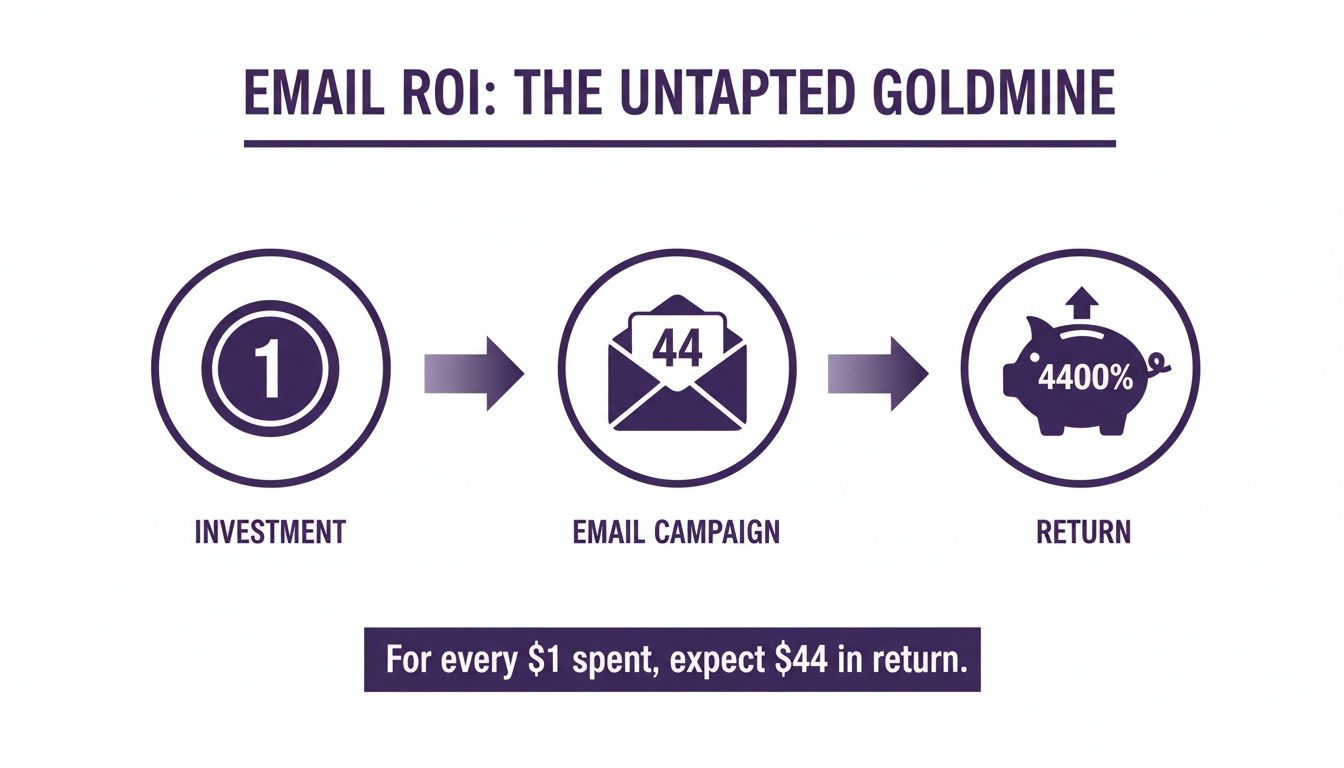
The numbers don't lie. A small, focused investment in email can generate a massive financial return for your business.
Beyond the Numbers: Owning Your Audience
But the real value goes way beyond just the financial returns. An email list gives you a stable foundation, insulating your business from the volatility of other platforms.
- Direct Communication: Forget fighting the algorithm. When you hit "send" on an email, you know it’s going to land right in their inbox.
- Deeper Personalization: You can slice and dice your list based on interests, purchase history, and behavior. This lets you send hyper-relevant messages that actually connect with people.
- Customer Journey Control: Email is the perfect tool for nurturing leads. You can guide subscribers from their first flicker of interest all the way to their first purchase and beyond, building a solid relationship every step of the way.
Ultimately, learning how to build an email list isn't just a marketing tactic—it's about creating a lasting business asset. You're building a community you can serve, engage with, and grow alongside for years, no matter what new app or algorithm comes along.
Setting the Strategic Foundation for Your List

A high-quality email list isn't built on slick pop-ups or clever tactics alone. The real work starts long before you ever create a sign-up form. Jumping straight into list-building without a plan is like trying to build a house without a blueprint—it’s going to be wobbly, and it's probably going to fall down.
This early foundational work is what makes sure every ounce of effort you put in later is targeted, effective, and built to last.
Define Your Ideal Subscriber
First things first: you have to move beyond a vague idea of your "target market" and get a crystal-clear picture of your ideal subscriber. This isn't just some fluffy marketing exercise; it’s the absolute core of your entire strategy.
You need to know exactly who you're talking to before you can say anything that actually lands. This means creating a detailed customer persona, which is really just a semi-fictional profile of your perfect subscriber. Go beyond the basic demographics and dig into their real-world headaches and ambitions.
What keeps them up at night? What problem are they desperately trying to solve that you can actually help with?
For a B2B consultant, this might be "Marketing Manager Molly," who's drowning under the pressure to prove ROI with a tiny budget. For an e-commerce store selling sustainable goods, it could be "Eco-Conscious Chris," who wants to make ethical purchases but doesn't know which brands to trust.
Your persona is your North Star. Every lead magnet you create, every subject line you write, and every email you send should feel like it was written specifically for that one person.
This level of clarity is what stops you from creating generic, beige content that appeals to no one. It’s the difference between shouting into a void and having a real conversation.
Choose Your Email Service Provider
Once you know who you're talking to, the next practical step is picking your Email Service Provider (ESP). This is the software that will house your list, send your campaigns, and run your automations. It's tempting to just grab the cheapest option, but trust me, this is a critical decision that will impact your growth for years.
When you're comparing platforms, look beyond the price tag and focus on these key features:
- Automation Capabilities: Can you create welcome sequences to automatically nurture new subscribers? This is non-negotiable for building relationships at scale.
- Segmentation and Tagging: Does the ESP let you group subscribers based on their interests, purchase history, or actions? Sending targeted emails to specific segments is how you get engagement rates to skyrocket.
- Scalability and Pricing: How does the pricing model work as your list grows? You don't want a provider that will punish your success with sudden, massive price hikes.
- Ease of Use: If the interface is clunky and confusing, you'll avoid using it. Pick a tool that feels intuitive and makes sending emails feel like less of a chore.
Understand the Rules of the Road
Finally, you have to build your list on a foundation of trust and legal compliance. Ignoring regulations like GDPR and the CAN-SPAM Act isn't just bad practice—it can land you with massive fines and permanently wreck your sender reputation.
Don't let the legal jargon scare you. The core principles are just common sense and respect for your subscribers.
Key Compliance Checklist:
- Get Explicit Consent: Never, ever add someone to your list without their clear permission. A pre-checked box on a form doesn’t cut it.
- Identify Yourself: Your emails must clearly state who they are from. That means including your business name and a physical address in every email footer.
- Provide an Easy Opt-Out: Every single email must have a clear, simple way for people to unsubscribe. And you have to honor those requests right away.
- Use Honest Subject Lines: Don't be deceptive. Your subject line needs to accurately reflect what's inside the email.
Following these rules from day one ensures you're building a list of people who actually want to hear from you. And at the end of the day, that’s the only kind of list worth having. To really solidify this groundwork, you might also want to explore these 10 Powerful Email List Building Strategies.
Creating Lead Magnets and Opt-Ins That People Actually Want
This is the moment of truth. Someone's email address is a valuable piece of personal information, and people guard it closely. They don't just give it away.
You earn a spot in their inbox by offering something even more valuable in return. We call this a lead magnet—a high-quality incentive that solves a real, immediate problem for your ideal customer.
The goal isn't just to snag an email; it's to start a relationship on the right foot. A killer lead magnet showcases your expertise and generosity, making a new subscriber feel like they just scored an incredible deal. It’s the handshake that says, “I get your challenges, and I can help.”
Move Beyond the Generic Checklist
Let's be honest, the days of slapping together a generic "10 Tips" PDF and expecting a flood of sign-ups are long gone. Your audience is way smarter than that.
To create a lead magnet that people genuinely want, it has to be hyper-specific, immediately actionable, and perfectly aligned with what your ideal subscriber is struggling with right now.
Here are a few real-world examples that cut through the noise:
- For an e-commerce store selling running shoes: Ditch the generic "Fitness Tips" PDF. Instead, offer an interactive "Find Your Perfect Running Shoe" quiz. It's specific, solves an immediate buyer problem, and gives you valuable data on your new subscriber.
- For a B2B consultant: Don't just offer a vague ebook. Create a "Project Proposal Template" in Google Docs that a potential client can copy and use today. It saves them time and instantly positions you as an indispensable expert.
- For a SaaS company: A free trial is good, but a "Workflow Cheat Sheet" that helps a new user get a specific win in their first 15 minutes is even better. It smashes the activation hurdle right away.
The best lead magnets deliver a quick win. They shouldn't be a 100-page ebook that feels like homework. They need to provide a tangible result or a moment of clarity in 10 minutes or less.
This immediate value exchange is what builds trust from the very first click, making subscribers excited to see what you send them next.
Choosing the Right Incentive for Your Business
Not all lead magnets are created equal, and what works for a SaaS company might fall flat for a local service business. The key is to match the format to your business model and the problem you're solving.
A quick table can help you brainstorm the right fit:
| Business Model | Top Lead Magnet Ideas | Key Goal |
|---|---|---|
| E-commerce | Quizzes, discount codes, buying guides, free shipping offers. | Drive an immediate purchase or product discovery. |
| SaaS | Free trials, templates, workflow cheat sheets, live demo. | Get users to experience the product's core value (activation). |
| Consulting/Services | Case studies, self-assessment tools, proposal templates, free consultations. | Demonstrate expertise and build trust for a high-ticket sale. |
| Content Creators | Ebooks, email courses, resource libraries, exclusive video content. | Showcase depth of knowledge and build a loyal audience. |
Think about the "next logical step" for your visitor. A lead magnet should feel like a natural progression, not a random offer.
Crafting High-Converting Opt-In Forms
Once you’ve got an irresistible offer, you need a seamless way to deliver it. This is where your opt-in form comes in. The design, copy, and placement of this form can make or break your conversion rates.
A great form makes saying "yes" an easy and obvious decision.
You'll generally use three types of opt-in forms on your site:
- Embedded Forms: These sit right inside your content, like at the end of a blog post or within a relevant paragraph. They feel less intrusive and are perfect for offering "content upgrades"—a bonus resource directly related to what someone is already reading.
- Pop-Ups: I know, they can be annoying. But the data doesn't lie: they work. The key is to make them smart. Use exit-intent pop-ups that only appear when someone is about to leave, or timed pop-ups that show after they've spent a minute on your page, signaling real interest.
- Dedicated Landing Pages: This is a standalone page with one single job: getting a visitor to sign up for your lead magnet. By removing all other distractions (like navigation menus), you focus all their attention on your offer and the call to action.
To get these forms working for you, you'll need to master some effective call to action strategies. This just means using clear, action-oriented language that tells the user exactly what to do and what they'll get.
Email Is Still King for Driving Action
Building these assets is a non-negotiable part of growing an email list because the payoff is huge. While social media is great for reach, email is the undisputed champion of conversion.
It's not even close. Email drives 40x more customer acquisitions than social media channels combined.
Traffic from email marketing converts into sales at a rate of 4.24%, completely dwarfing the 0.59% conversion rate from social media. You're talking to a warm audience that already raised their hand. And with nearly 50% of consumers saying they make purchases directly from marketing emails, it's clear your list is a direct line to revenue.
How to Promote Your Opt-Ins Across Every Channel
So you’ve created an amazing lead magnet. That's a huge win, but honestly, it’s only half the battle. If your ideal audience never sees it, all that hard work might as well not exist.
The next move is to get strategic. It's not about shouting from the rooftops; it’s about smart, integrated promotion across every channel where your potential subscribers are already hanging out. You need a playbook that drives consistent, targeted traffic straight to your sign-up forms and landing pages.
Let's break down the most effective tactics—both organic and paid—that work for businesses of any size.
Weave Opt-Ins into Your Existing Content
Your most popular content is a goldmine for growing your email list. People are already on these pages because they’re interested. Instead of just letting that warm traffic click away, give them a damn good reason to stay connected.
This is where the content upgrade shines. It's a bonus resource that’s hyper-relevant to the specific blog post someone is reading.
For instance, if you have a high-traffic post on "10 Social Media Tips for Small Businesses," your upgrade could be a downloadable "Social Media Content Calendar Template." You simply embed an opt-in form right there in the article, offering the template in exchange for their email. It works because it feels helpful, not interruptive.
Don't let your best content become a dead end. Dig into your analytics, find your top-performing blog posts, and create a tailored content upgrade for each one. This simple act of alignment can dramatically boost your conversion rates.
By meeting readers exactly where their interest is at its peak, you make subscribing feel like the easy and obvious next step.
Turn Social Media Profiles into Lead Generation Tools
Think of your social media profiles as valuable digital real estate, not just a place for updates. Every bio, description, and pinned post is a chance to point followers toward your email list.
Most platforms only give you one primary bio link—make it count. Don't just link to your homepage. Point it directly to a dedicated landing page for your best lead magnet. For a deep dive into what makes these pages convert, check out our complete guide on how to create a landing page that works.
Here’s a quick breakdown by platform:
- Instagram & TikTok: That "link in bio" is prime real estate. Use it for your main opt-in offer and mention it constantly in your Stories, Reels, and captions with a clear call to action like, "Get my free guide—link in bio!"
- LinkedIn & Facebook: Your personal and business profiles have sections for websites. Link them to your lead magnet's landing page. You can also pin a post to the top of your feed that highlights the offer and sells its benefits.
- YouTube: Drop a direct link to your sign-up page in the first few lines of every single video description. Make sure you also mention the free resource verbally in your videos, telling viewers exactly where to find it.
Use Smart Paid Advertising
Organic strategies are powerful, but a small, targeted ad budget can light a fire under your list-building efforts. You don't need to spend a fortune to see results. The key is to focus on sending high-intent traffic directly to your opt-in landing page.
Facebook Ads and Google Ads are the perfect places to start. On Facebook, you can run a "Lead Generation" campaign that uses an in-app form, making it frictionless for users to subscribe without ever leaving the platform. Or, you can run a "Traffic" campaign to send them to your own landing page.
With Google Ads, you can target people actively searching for solutions your lead magnet solves. If your offer is a "Beginner's Guide to SEO," you can run ads for keywords like "how to learn SEO" or "basic SEO tips." This ensures the people clicking your ad are already pre-qualified and genuinely interested. The focus here is on precision, not just volume, making even a small budget work incredibly hard for you.
Nurturing Subscribers for Long-Term Engagement
Getting that email address is a huge win, but it’s really just the starting line. The real work—and the real value—comes from building a genuine relationship that turns a casual subscriber into a loyal fan. This is where you shift from simply collecting emails to creating long-term engagement.
Your first impression is everything. In the world of email, that impression is your welcome sequence. This automated series of emails is your best shot at setting the tone, delivering on your promise, and making new subscribers feel like they made the right call.
A subscriber is never more engaged than in the 48 hours after they sign up. A well-crafted welcome sequence capitalizes on this peak interest, setting the foundation for a relationship that lasts. Neglecting it is like inviting a guest into your home and then ignoring them.
Think of it as the official onboarding for your brand. It’s your chance to share your story, manage expectations, and show them you actually get what they need.
Designing a Welcome Sequence That Works
Your welcome sequence needs to be more than a single email that just hands over the lead magnet. It should be a thoughtful, multi-step journey that pulls people into your world. While the number of emails can vary, a simple three-to-five-part series is a powerful place to start for any business.
A proven flow usually looks something like this:
- Email 1: The Instant Delivery. This needs to go out immediately. Its main job is to deliver what you promised, but it's also a warm, personal greeting. Keep it focused, friendly, and to the point.
- Email 2: The Story and Connection. A day or two later, open up and share the "why" behind your brand. This is where you build a human connection. Tell a short story, share your mission, or explain what gets you out of bed in the morning.
- Email 3: The Quick Win. Follow up with another piece of high-value content—a link to a popular blog post, a quick video tip, or a useful template. This reinforces your expertise and proves you’re here to give, not just take.
- Email 4: Set Expectations. Be upfront about what subscribers can expect from you. How often will you email them? What kind of stuff will you send? This simple act of transparency builds a surprising amount of trust.
This structured approach makes new subscribers feel seen, valued, and genuinely excited for what’s next. It’s a non-negotiable part of building an email list with real staying power.
Advanced Tactics for Engagement and Growth
Once your welcome sequence is humming along, you can start layering in more advanced strategies to deepen those relationships and keep the list growing. To keep people engaged for the long haul, you have to send the right message to the right person at the right time.
This is where segmentation comes in. Instead of blasting the same email to everyone, you group subscribers based on their interests, how they behave, or what they’ve bought. You could create segments for new customers, repeat buyers, or even people who clicked on a specific link in a past email.
The payoff is huge. Personalized emails driven by segmentation have been shown to generate 18 times more revenue than generic broadcast emails. It’s the difference between shouting into a crowd and having a one-on-one conversation.
Beyond personalization, you can also turn your existing subscribers into your best marketers.
- Create a Referral Program: Offer your current subscribers a cool incentive—a discount, exclusive content, or a gift card—for every new person they bring to your list. This puts word-of-mouth marketing on autopilot.
- Host a Collaborative Webinar: Team up with a business that serves a similar audience but isn't a direct competitor. Host a joint webinar and promote it to both of your email lists. It’s a fantastic way to get in front of a new, highly relevant group of people.
- Use Interactive Content: Keep things interesting with quizzes, polls, or surveys. Not only does this make your emails more fun, but it also gives you valuable data for future segmentation. A simple quiz can tell you exactly what topics your audience is hungry for.
These strategies work because they build on the trust you've already established. A huge part of keeping that trust is making sure your emails actually land in the inbox. For a deeper dive on this crucial piece of the puzzle, you can learn more about what email deliverability is and why it’s so critical for long-term success.
Common Email List Building Questions Answered
When you start building an email list, you're bound to hit some roadblocks. It's easy to get stuck second-guessing your strategy. Let's walk through some of the most common questions I hear and get you some clear, straightforward answers.
The goal here isn't to just give you textbook definitions, but to help you feel confident enough to start, manage, and scale your list without any of that nagging doubt.
How Often Should I Email My List?
There’s no single magic number here. The right frequency really depends on your audience, your industry, and what you’re offering. But if you’re looking for a solid starting point, aim for once a week. This keeps your brand top-of-mind without flooding someone's inbox.
What matters more than anything else is consistency. It’s far better to send one genuinely valuable email every Tuesday morning like clockwork than to send three emails one week and then go silent for the next two.
Keep a close eye on your engagement metrics. If your open and click-through rates are solid and your unsubscribe rate is low, you could try bumping up the frequency. If you send an extra email and see a spike in unsubscribes, that's your audience telling you to pull back.
Listen to your data—it will tell you exactly what your subscribers want.
What Is the Difference Between Single and Double Opt-In?
Getting this right is crucial, not just for the quality of your list but for compliance, too. The method you choose really sets the tone for your relationship with every new subscriber.
- Single Opt-In: Someone fills out your form and they're on the list. Instantly. It's fast, it's frictionless, and it generally helps your list grow a bit quicker.
- Double Opt-In: After they submit the form, they get an email with a confirmation link they have to click. This extra step verifies their email is real and confirms they really want to hear from you.
While single opt-in gets you more names faster, double opt-in almost always builds a higher-quality list. You end up with more engaged subscribers, you slash your bounce rates from typos and fake emails, and you build a much stronger sender reputation. For most businesses, that superior list quality is well worth the slightly slower growth.
Is It Ever Okay to Buy an Email List?
Let me make this simple: No.
It might seem like a tempting shortcut to get a ton of contacts overnight, but buying a list will do serious, long-term damage to your brand and your email marketing efforts.
First off, those people never gave you permission to contact them. That's a direct violation of anti-spam laws like GDPR and the CAN-SPAM Act, which can land you in hot water with some hefty fines.
Second, purchased lists are notoriously awful. They're often packed with old, inactive, or completely fake email addresses. The second you send a campaign to a list like that, your bounce rate will go through the roof. This tanks your sender reputation with providers like Gmail and Outlook, and pretty soon, even your legitimate emails will start landing in the spam folder. A huge part of avoiding the spam folder is writing emails people actually want to open, which starts with mastering your email subject line best practices.
Building your list organically is the only way to go. It ensures you're talking to people who actually want to hear from you, and that's the only audience that matters.
At Frozen Crow Inc., we help businesses move past the theory and build high-quality email lists that drive real engagement and growth. If you're ready to stop second-guessing and start seeing results, check out our digital marketing services at https://frozencrow.com.


