


August 20, 2026
In House vs Agency Marketing A Data-Backed Decision Guide
At its core, the in-house vs. agency marketing debate boils down to a classic trade-off: control versus expertise.
An in-house team gives you dedicated people who live and breathe your brand every single day, offering total oversight. On the flip side, a marketing agency hands you the keys to a whole team of specialized experts and battle-tested processes from day one. The right call hinges on what you value more—deep internal knowledge or broad, ready-to-go skills.
The Strategic Choice: In-House vs. Agency Marketing

Figuring out how to run your marketing isn't just an operational task; it's a major strategic decision that will shape your brand’s entire growth path. This is more than just deciding whether to hire employees or sign a contract. It’s a move that defines your company’s ability to pivot, access top-tier talent, and manage long-term costs. Honestly, the best path for you comes down to where your business is right now, what your budget looks like, and what you’re trying to achieve.
Bringing marketing in-house means your team is completely immersed in your company culture. They'll know your products, your people, and your internal quirks inside and out. This setup is perfect for businesses that need constant marketing attention and have a steady flow of predictable tasks.
But partnering with an agency immediately opens the door to a whole roster of specialists—think SEO analysts, PPC wizards, content strategists, and web developers—all without the overhead of salaries, benefits, and training. When you're weighing your options, getting familiar with the world of digital marketing outsourcing can really clarify which direction to take.
A great marketing agency brings both specialized skills and raw efficiency. They operate on proven frameworks that cut through the noise, letting them launch, test, and optimize campaigns without the usual guesswork. For a business, this often means seeing real results, faster.
This guide goes beyond a simple pros and cons list. We’re going to dig into the real differences in cost, control, expertise, and scalability to help you figure out which model truly fits your business goals.
In-House vs. Agency Marketing at a Glance
To make things simple, here’s a quick-reference table that breaks down the main characteristics of each model. It’s a great way to see the fundamental trade-offs side-by-side.
| Dimension | In-House Marketing Team | Marketing Agency |
|---|---|---|
| Cost Structure | Fixed salaries, benefits, training, software, and overhead. | Variable retainers or project-based fees; inclusive of tools. |
| Expertise | Deep brand knowledge but often generalist skills. | Broad industry experience and access to multiple specialists. |
| Speed & Onboarding | Slower startup due to hiring and training processes. | Rapid deployment; can launch campaigns within weeks. |
| Scalability | Limited by headcount; scaling requires new hires. | Flexible; can easily scale resources up or down as needed. |
| Control & Focus | 100% dedicated to your brand and its objectives. | Manages multiple clients; focus is shared but results-driven. |
As you can see, there’s no single "best" answer—only what's best for your specific situation.
A Realistic Financial Breakdown of Each Model

When you start comparing in-house vs. agency marketing, the conversation almost always boils down to salary vs. retainer. It seems simple, but that math is dangerously misleading. It completely ignores the mountain of hidden costs that come with building your own team.
A true financial breakdown tells a much different story. An in-house hire is never just their base salary. You're also on the hook for recruitment fees, benefits, payroll taxes, and office overhead. These “extras” can easily tack on another 25-40% to each employee's salary.
And that's just to get them in the door. The ongoing costs required to keep a modern marketing department running are what really add up.
Uncovering the Hidden Costs of an In-house Team
Building a marketing team from scratch means you're paying for the entire infrastructure—expenses that are usually bundled into a single agency fee.
Here’s a quick look at what you’re really funding:
- Essential Software and Tools: A professional marketing stack isn't cheap. Subscriptions for SEO platforms, analytics software, social media schedulers, and a CRM can run into thousands of dollars every single month.
- Ongoing Training and Development: Marketing moves fast. To keep your team's skills from becoming obsolete, you have to budget for courses, conferences, and certifications.
- Recruitment and Onboarding: Finding great talent is a job in itself. Factor in recruiter fees, job postings, and the dozens of internal hours spent on interviews, and the costs add up before they even start.
- Benefits and Overhead: This is the standard stuff—health insurance, retirement contributions, and paid time off. But you also have to think about laptops, software licenses, and even the physical desk space they occupy.
When you add it all up, that initial salary figure starts to look like just the tip of the iceberg.
The real financial comparison isn't about a single salary versus a retainer. It's about the total cost of ownership for a fully functional, skilled marketing operation. An agency’s fee often consolidates dozens of these individual expenses into one predictable monthly cost.
Dissecting Agency Pricing Models
Marketing agencies typically offer a few different ways to pay, giving you financial flexibility that a fixed-salary model just can't match. It's a big reason why so many businesses start looking into the benefits of outsourcing their digital marketing efforts.
The most common models you'll see are:
- Retainer: A fixed monthly fee for a clearly defined scope of work. This works perfectly for ongoing, long-term strategies.
- Project-Based: A one-time fee for a specific goal, like a website redesign or a new campaign launch.
- Performance-Based: The agency's fee is tied directly to hitting specific goals, like generating a certain number of leads or sales.
This flexibility lets you scale your marketing spend up or down as your needs change, without the headache of hiring or firing.
For small and medium-sized businesses, the numbers can be especially powerful. One analysis found that PR agencies can deliver 3-5x better ROI while cutting costs by up to 60% a year compared to an in-house team. The study broke it down: in-house PR costs ranged from $240,000-$420,000 annually, while agencies delivered better results for just $96,000-$180,000.
Ultimately, the choice comes down to having a clear-eyed view of all the costs. With an agency, you get access to a full team of specialists, their expensive tools, and their proven methods—all wrapped into one predictable fee. More often than not, that’s where you’ll find the stronger, clearer return on investment.
Comparing Expertise, Speed, and Scalability
Figuring out the money side of the in-house vs. agency debate is one thing, but the operational differences are where the real story unfolds. How fast can you get the right skills on deck? How quickly can you actually get stuff done? And how easily can you pivot when things change?
This is where you'll find the sharpest contrasts between the two models.

An in-house team’s biggest win is its deep brand immersion. Your people live and breathe your company culture, your products, and your customers every single day. That kind of insider knowledge is gold for creating marketing that feels authentic and hits all the right notes.
But that depth usually comes at the expense of breadth. Most in-house teams are built around marketing generalists who have to wear a lot of hats—one day they're a social media manager, the next they're wrestling with SEO. Building out a full roster of specialists is a slow, expensive recruiting grind that most small and mid-sized businesses just can't take on.
The Expertise Advantage
This is where an agency just plays a different game. When you bring on an agency, you're not just hiring one person; you’re tapping into an entire bench of specialists overnight.
You don't get a "marketing manager." You get a team that includes:
- SEO Analysts: The folks who live and breathe algorithm updates, technical site health, and keyword strategy.
- PPC Specialists: Pros dedicated to squeezing every drop of value out of your ad spend and maximizing ROAS.
- Data Scientists: The analysts who can dive deep into messy data to pull out real insights about your customers.
- Content Strategists: Planners who know exactly how to map out content that actually attracts, engages, and converts.
Trying to hire even one of these roles internally is a major commitment. An agency rolls all that collective brainpower into its service, giving you a serious competitive edge without the payroll headaches.
In today's market, specialized expertise isn't a luxury—it's a key advantage. A recent HubSpot report found that 64% of companies now choose agencies specifically for their specialist skills over in-house generalists. You can dig into this trend more over at this analysis on F22Labs.com.
Time to Impact and Execution Speed
In marketing, speed is everything. An in-house hire comes with a serious ramp-up period. Just the process of recruiting, hiring, and onboarding can easily burn three or four months before that person is even close to being fully productive.
An agency, on the other hand, is built to move fast. They come with proven processes, all the right tools, and an experienced team ready to go. They can often start pushing campaigns live within a few weeks of you signing on the dotted line. That speed can be the difference between catching a market trend and watching it pass you by.
The difference in time-to-impact is pretty stark:
- In-House: You're looking at a multi-month process of hiring and training before anything new really gets off the ground.
- Agency: They can launch almost immediately, plugging their proven workflows and specialists right into your business.
That kind of agility is invaluable, especially if you're in a fast-moving industry or trying to jump on seasonal opportunities.
Built-in Scalability
Maybe the most powerful operational perk of an agency is how easily it scales. Your business needs are never going to be static. One quarter you might need to go all-in on a product launch, and the next you might need to pull back and focus on development.
An in-house team, with its fixed salaries and headcount, really struggles with that kind of ebb and flow. Scaling up means another long hiring cycle. Scaling down can mean gut-wrenching layoffs.
The agency model is designed for this exact kind of flexibility. You can adjust your retainer or project scope every month to match your budget and priorities. This lets you treat marketing as a variable expense, not a fixed cost, giving you the power to adapt without being boxed in by your own org chart. That operational agility is a huge factor in the in-house vs. agency decision.
Thinking you have to choose between an in-house team and an agency is one of the biggest myths in marketing. It's a false choice that often pushes growing companies into a corner, forcing them to pick a side when the best answer is actually somewhere in the middle.
There's a third path that's quickly becoming the new standard: the hybrid model. This isn't about compromise; it's about being strategic. You get to keep your core brand strategy and day-to-day execution close to home while bringing in an agency for the heavy lifting and specialized skills. The result is a more flexible, powerful marketing engine that avoids the pitfalls of going all-in on one model.
How to Structure a Winning Hybrid Team
So what does this actually look like in practice? Typically, a company will have an in-house marketing manager or a small, core team. These folks are the keepers of the brand flame. They own the brand voice, manage the marketing calendar, and make sure everything aligns with the bigger company goals.
They act as part-strategist, part-project manager. This person or team becomes the agency's main point of contact, translating business objectives into clear, actionable briefs. This setup keeps the essential brand knowledge and decision-making power right where it belongs—inside your company.
The agency partner, meanwhile, is brought in to handle the highly technical, specialized, or resource-heavy tasks. This creates a clean, effective division of labor.
- Your In-House Team: Focuses on brand strategy, content ideas, customer conversations, and giving the final sign-off.
- Your Agency Partner: Handles the technical execution, manages specialized campaigns (like complex PPC or SEO), and dives deep into analytics.
The real magic of the hybrid model is playing to everyone's strengths. Let your in-house team do what they do best—live and breathe your brand and your customers. Outsource the stuff that requires years of niche expertise that’s frankly a nightmare to hire for full-time.
When Does a Hybrid Model Make the Most Sense?
This blended approach isn't just a temporary fix; it's a smart, sustainable structure for ambitious companies on the move. A classic example is a company with a brilliant in-house content lead who really gets the brand's story.
They can write amazing blog posts and customer stories, but they might not have a clue about the technical SEO needed to get them to rank. Or maybe they don't have the performance marketing chops to promote that content effectively. That's the perfect time to bring in an agency to handle technical SEO audits, link building, and paid distribution.
Other situations where a hybrid approach just clicks:
- Launching a New Product: Your team nails the core messaging and internal comms, while an agency runs a multi-channel ad blitz to create that initial buzz and drive sales.
- Entering a New Market: Your internal people can do the market research and adapt the brand positioning. An agency can then provide localized SEO and PPC campaigns fine-tuned for that region's search habits.
- Scaling Content: A single in-house marketer can set the content strategy and editorial calendar. An agency can then supply the writers, designers, and video producers to actually create all that content at scale.
This isn't just a theory; a major shift is already happening. A recent report shows that hybrid B2B marketing models have jumped from 36% to 46% in adoption, making them the top choice for modern businesses. In contrast, fully in-house teams dropped from 38% to 32%, and pure outsourcing fell from 26% to 22%.
It’s a clear signal that businesses are blending internal control with external firepower. You can dig into more of the data on why B2B marketers are making this move on Sagefrog.com. This trend proves the hybrid model is a practical solution for closing resource gaps and building a more resilient marketing function.
Making the Right Choice: A Situational Guide
There's no single right answer to the "in-house vs. agency" question. It’s a strategic call that hinges entirely on where your company is right now. The marketing model that works for a startup trying to find its footing is completely different from what a stable enterprise needs to defend its market share.
Getting this right means taking an honest look at your budget, your goals, what your team can actually do, and how fast you need to move. Let's break down the common scenarios to see which structure fits your current stage of growth.
For Startups and Early-Stage Companies
When you're just starting out, cash is king and speed is everything. You need to test ideas, find customers, and prove your concept—yesterday. In this world, hiring a full-time, specialized marketing team isn't just a luxury; it's a lead weight that slows you down.
This is exactly where a marketing agency shines. An agency gives you an entire team of specialists for less than the cost of a single senior hire. They can get a targeted PPC campaign live or start building an SEO foundation in weeks, not months. That's the kind of early traction that gets investors and customers to pay attention.
A few things to keep in mind at this stage:
- Need for Speed: An agency already has the people and processes in place. You can get campaigns up and running almost immediately.
- Budget Constraints: Agency retainers are a predictable operating expense. You sidestep the heavy upfront costs of salaries, benefits, and software subscriptions.
- Access to Specialists: You get instant access to experts in SEO, content, and paid ads without going through a painful, months-long hiring process.
For Growing Small and Mid-Sized Businesses
Once you've found your groove and have consistent revenue, your marketing needs get more complicated. You might have a marketing manager or a small team of generalists, but you’re hitting a wall. They’re great at the day-to-day, but they don't have the deep, niche expertise to scale a complex SEO strategy or manage a six-figure ad budget.
This is the perfect time to go hybrid. Keep a strategic leader in-house to own the brand voice and overall direction, then partner with an agency to handle the specialized work your team can't.
The hybrid approach really does offer the best of both worlds. You get the deep brand knowledge of an internal leader combined with the specialized, scalable power of an agency. It’s a flexible, high-octane marketing engine.
This model stops you from burning out your internal team while giving you access to A-list talent for the channels that matter most for growth. You aren't just plugging holes; you're building a smarter, more resilient marketing function.
This decision tree can help you visualize the key questions to ask as you figure out your next move.
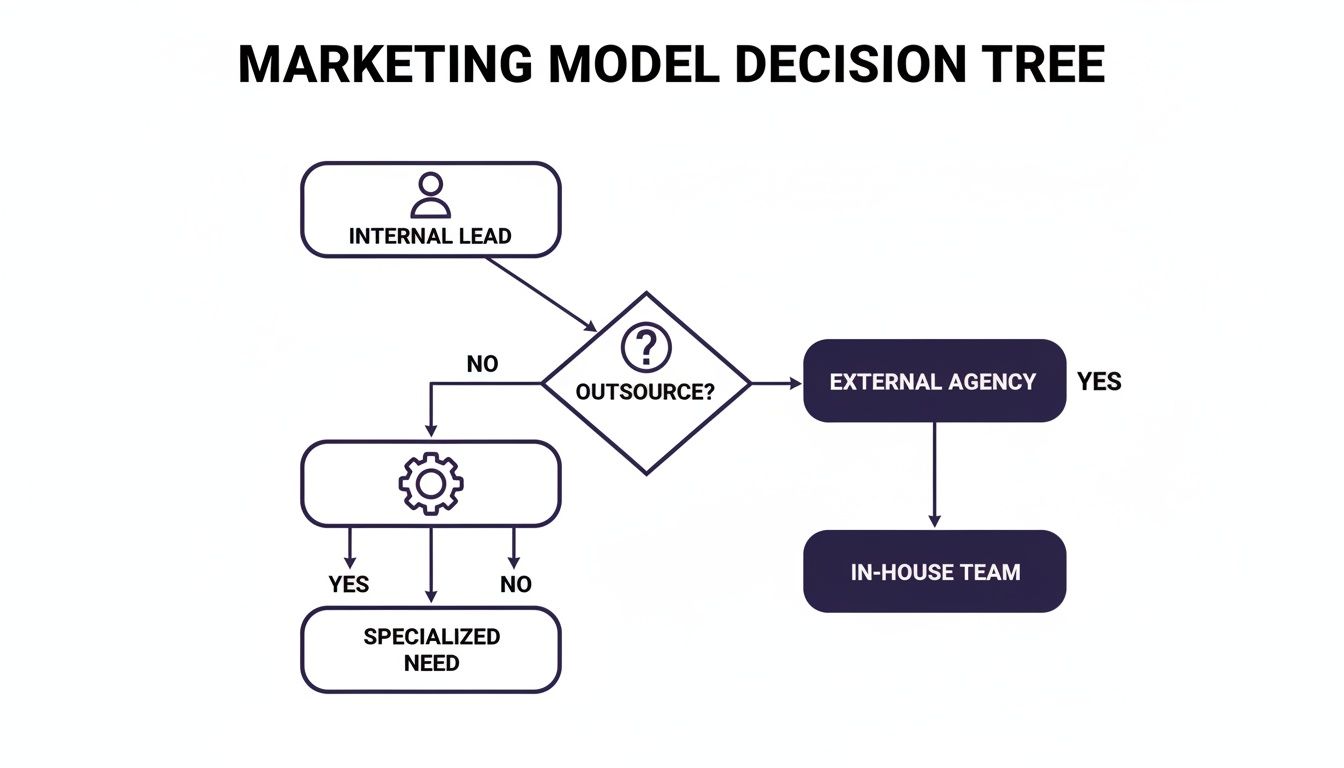
As the flowchart shows, the need for specialized skills is often the fork in the road that points growing businesses toward a hybrid or full agency model.
For Large Enterprises
For a big, established company, the math looks different. With a massive budget and complex, long-term goals, building a powerhouse in-house team often makes the most sense. At this scale, the cost of a full department of specialists—from data scientists to content strategists—is not just manageable, it's a strategic advantage.
An in-house team at this level offers unmatched brand consistency and institutional knowledge. They live and breathe the company culture and can work hand-in-glove with product, sales, and the C-suite, making sure every marketing push is perfectly woven into the company's bigger picture. The trick is having the resources not just to hire these experts, but to give them the best tools, training, and a real career path.
Even so, many large enterprises still run a hybrid model. They might keep core brand and content teams in-house but outsource highly specialized or one-off projects, like a massive website overhaul or a launch into a new international market.
To help clarify which path is right for you, we've put together a simple table matching common business situations with the model that typically works best.
Which Model Fits Your Business Stage?
| Business Scenario | Primary Need | Recommended Model | Key Rationale |
|---|---|---|---|
| Pre-Seed/Seed Startup | Market validation & speed to launch | Agency | Instant access to a full team of experts for less than one senior hire's salary. Gets campaigns live fast to generate crucial early data. |
| Series A/B Growth Stage | Scaling specific, high-impact channels | Hybrid | Internal leader sets strategy; agency executes on technical areas like SEO or paid media where deep expertise is required to scale effectively. |
| Established SMB | Expanding market share & optimizing ROI | Hybrid or In-House | If you have one or two core channels, build in-house. If you need a broad mix of skills, a hybrid model is more cost-effective and flexible. |
| Large Enterprise | Brand control & deep integration | In-House (often with Agency support) | Unparalleled brand alignment and institutional knowledge. Outsource project-based or highly specialized needs to an agency as needed. |
| Company Entering New Market | Local expertise & rapid deployment | Agency | A local or specialized agency brings immediate market knowledge, language skills, and established processes, avoiding a steep learning curve. |
This table is a starting point. Your specific circumstances will always be the deciding factor, but this framework can help guide your thinking.
A Checklist for Your Decision
To cut through the noise, ask yourself these direct questions. Your answers will point you to the right model for where you are right now.
- Budget Reality: Can we truly afford the fully-loaded cost of an in-house hire (salary + 40%), or does a predictable agency retainer make more sense for our cash flow?
- Speed to Market: Do we need to see results in the next 30-60 days, or can we wait the 4-6 months it takes to hire, onboard, and ramp up a new team member?
- Skill Gaps: Do we need a specialist with deep expertise in one specific area (like technical SEO), or do we just need a generalist to manage daily tasks?
- Scalability Needs: Do our marketing needs change dramatically from one quarter to the next? Do we need the freedom to scale our investment up or down without friction?
- Strategic Focus: Is our main goal to build a deep, internal knowledge base around our brand, or is it to hit specific performance goals as quickly and efficiently as possible?
Remember, this isn't a forever decision. The best marketing structure will change as your company grows. The goal is to pick the model that solves today's biggest challenges while giving you the room to adapt for whatever comes next.
How to Build a Successful Agency Partnership
Picking an agency is just the first step. The real work begins when you start building a relationship that actually drives results. A great partnership isn’t just about handing off tasks; it’s about bringing a new team into the fold that acts like a true extension of your own. This doesn't happen by accident—it takes a deliberate approach to vetting, onboarding, and collaborating from day one.
The entire foundation of a strong agency relationship rests on crystal-clear communication and perfectly aligned expectations. Before you even think about signing a contract, you need to dig into how they really operate. That means asking pointed questions that go way beyond their polished portfolio and case studies.
Defining Expectations and Communication
To sidestep the usual friction and misunderstandings down the road, you need to lock in a solid operational framework. Think of it as creating a shared playbook that both teams can reference.
Here are the key areas to nail down from the start:
- Communication Cadence: Agree on how often you'll connect and what format works best. Will it be quick weekly check-ins? Deeper monthly strategy sessions? A combination of both?
- Reporting Standards: Get specific about the metrics that actually matter to your business. A solid agency will deliver custom reports tying their work directly to your KPIs, not just a bunch of fluffy vanity metrics.
- Primary Contacts: Who's the go-to person on each side? Designating a single point of contact is the simplest way to streamline communication and keep everyone accountable.
- Approval Workflows: Map out exactly how content, campaigns, and creative assets will be reviewed and approved. This alone can prevent major bottlenecks and keep things moving.
Getting these ground rules sorted out early makes for a much smoother integration. For a deeper dive into vetting potential partners, our guide on how to choose the right digital marketing agency is a great resource.
The best agency partnerships are built on mutual trust and total transparency. Don't treat them like a vendor you're just paying for services. Treat them like a strategic partner. The more you share about your business challenges and long-term goals, the better equipped they'll be to deliver solutions that create real growth.
Setting the Stage for Collaborative Success
Once you've got the operational nuts and bolts figured out, the focus shifts to creating a truly collaborative environment. This is about more than just scheduling meetings. It’s about cultivating a shared sense of ownership over the outcomes. Give your agency the information, access, and trust they need to do their best work.
Many forward-thinking agencies use specialized tools like N8n Agency Software to keep their workflows and projects running smoothly. Understanding the tools and processes they rely on can help you align your own operations for a more seamless partnership. Ultimately, you're trying to build a single, unified team working toward the same goal, ensuring your in house vs agency marketing decision really pays off.
Common Questions About In House vs Agency Marketing
Even after weighing the pros and cons, a few nagging questions can make the final call feel heavy. It’s smart to be cautious. Getting this decision right sets the tone for your growth, so let's clear up the most common concerns we hear from business leaders.
Will I Lose Control Over Brand Messaging with an Agency?
This is a big one, and it’s a totally valid fear. You've poured everything into building your brand, and the thought of someone else fumbling the message is terrifying. But here’s the thing: a good agency partnership is built on collaboration, not a hostile takeover.
You always, always have the final say. A great agency works for you, acting as a specialized extension of your team. They’re there to execute your vision with a level of expertise you don't have in-house, not to replace it. The key is a solid onboarding process where you hand over your brand guidelines, customer profiles, and strategic goals. Any agency worth its salt will obsess over this alignment to make sure every campaign feels authentic to your brand.
How Much Should I Expect to Pay for a Marketing Agency?
There's no single price tag, and anyone who gives you one without asking a dozen questions first isn't being straight with you. Agency costs are all over the map, driven by the scope of work, the services you need, and the agency's experience level.
You'll generally run into a couple of common pricing models:
- Monthly Retainers: These can be anywhere from a few thousand dollars a month for a small business focused on one or two channels to tens of thousands for a full-blown enterprise strategy.
- Project-Based Fees: This is a one-time cost for a specific, defined project, like a website rebuild or a major product launch campaign.
A reputable agency will always give you a custom quote that ties directly to your goals and budget. You should only ever pay for what you actually need.
A common mistake is putting a single in-house salary head-to-head with an agency retainer. It's not an apples-to-apples comparison. An agency's fee bundles multiple expert salaries, top-tier software licenses, and overhead into one predictable cost, which often makes it the more efficient financial move.
How Difficult Is It to Switch Between Models?
Moving between an in-house team and an agency (or vice-versa) definitely requires a plan, but it’s completely doable. The process just looks a little different depending on which way you're going.
If you’re shifting from an in-house team to an agency, the game is all about knowledge transfer. You'll be focused on handing over digital assets, brand documents, and setting up new lines of communication.
Bringing marketing in-house from an agency? That’s a different beast. Now you’re in the business of recruiting, hiring, training, and migrating all those software accounts and campaign histories.
A hybrid model can also be a great way to ease the transition, letting you shift responsibilities over time instead of all at once. Whichever path you choose, a clear, documented plan is non-negotiable for a smooth handover and ensuring you can actually tell if the new setup is working. For more on that, you can learn how to measure marketing effectiveness in our detailed guide.
At Frozen Crow Inc., we build true partnerships by aligning our specialized expertise with your unique business goals. If you're ready to see measurable growth without the guesswork, explore our strategic digital marketing and IT services at https://frozencrow.com.


