


August 20, 2026
Marketing automation advantages: marketing automation advantages for growth
In today's competitive market, marketing teams are stretched thinner than ever. They are tasked with delivering personalized experiences at scale, nurturing leads across multiple channels, and proving ROI on every dollar spent. Manually juggling these demands is a recipe for burnout and missed opportunities. This is where marketing automation steps in, not as a mere tool, but as a strategic multiplier for your entire marketing engine.
The core marketing automation advantages, from saving precious hours on repetitive tasks to delivering hyper-relevant messages that convert, are the key to unlocking sustainable, scalable growth. For businesses aiming to elevate their brand and drive measurable results, like the clients we partner with at Frozen Crow Inc., understanding these benefits is the first step toward transforming your marketing operations. While many resources cover the basics, to further understand the overall advantages of smart automation, you can explore the key benefits of marketing automation for a foundational overview.
This comprehensive guide, however, goes deeper. We break down the 10 most impactful advantages your business can leverage immediately. You won't find generic advice here. Instead, you'll get actionable steps for implementation, insights on common pitfalls to avoid, and real-world examples to help you move from theory to execution. We will cover how automation directly boosts conversion rates, improves data management, enhances personalization, and enables scalable growth, providing a clear roadmap to make your marketing more efficient, effective, and data-driven. Let's get started.
1. Increased Conversion Rates Through Lead Nurturing
One of the most powerful marketing automation advantages is its ability to significantly increase conversion rates by systematically nurturing leads. Instead of treating all prospects the same, automation allows you to deliver targeted, personalized content at each stage of the customer journey. This process guides potential customers through the sales funnel much more effectively, building trust and demonstrating value along the way.

For small businesses and e-commerce stores, this means converting more of your existing website traffic without a proportional increase in ad spend. By automating responses to user behavior, you create a responsive and relevant experience that encourages action.
How to Implement Automated Nurturing
- E-commerce Abandoned Carts: An e-commerce site can automatically send a series of emails to a user who adds items to their cart but doesn't complete the purchase. The first email can be a simple reminder, followed by one offering a small discount, and a final one highlighting product reviews or creating a sense of urgency.
- SaaS Free Trials: A software company can create an automated onboarding sequence for new trial users. This workflow could send daily emails showcasing key features, linking to helpful tutorials, and offering a demo with a product specialist to drive paid conversions.
- B2B Content Delivery: A B2B service provider can nurture prospects by sending educational content based on their industry or job role. For example, a user who downloads a whitepaper on "SEO for Law Firms" is automatically added to a workflow that sends them case studies and articles relevant to the legal sector.
Actionable Tips for Higher Conversions
To maximize your nurturing efforts, segment your audience based on behavior, demographics, and purchase history. To significantly boost your conversion rates, implementing tools like efficient conversational lead generation chatbots can provide 24/7 engagement and nurturing. Always use clear calls-to-action (CTAs) and continuously test different email subject lines and send times. By focusing on a frictionless path to purchase, you'll see a direct impact on your bottom line. For more strategies on this topic, explore our complete guide to website conversion rate optimization.
2. Time and Resource Efficiency for Marketing Teams
Another key marketing automation advantage is its profound impact on team efficiency. Automation eliminates repetitive, time-consuming tasks like manual email sends, social media scheduling, and data entry. This liberation of resources allows your marketing team to shift its focus from mundane operations to high-value strategic initiatives, such as creative campaign development and performance analysis.
This efficiency is especially critical for small businesses and startups operating with lean teams. By automating workflows, these organizations can dramatically increase their marketing output and scale customer acquisition efforts without the immediate need to hire additional staff. It allows them to compete effectively by doing more with less, directly supporting scalable growth.
How to Implement Efficient Automation
- Social Media Management: A marketing manager can use an automation platform to schedule an entire month's worth of social media posts across LinkedIn, X (formerly Twitter), and Facebook in a single session. This ensures a consistent online presence without daily manual effort.
- E-commerce Recommendations: An online store can automate personalized product recommendation emails based on a customer's browsing history or past purchases. This not only saves time but also creates a highly relevant experience that drives repeat sales.
- Lead Qualification and Routing: A B2B company can set up a workflow that automatically scores leads based on their on-site behavior and demographic data. High-scoring leads can be instantly routed to the sales team, while lower-scoring leads are placed into a nurturing sequence.
Actionable Tips for Greater Efficiency
To maximize time savings, start by mapping your current marketing processes to identify the highest-volume, most repetitive tasks. Begin with one or two simple automation workflows, like a welcome email series, before building more complex sequences. Establish clear KPIs, such as "time saved per week" or "cost per lead," to measure the direct ROI of your automation efforts. Regularly audit your workflows to ensure they remain aligned with your business goals and train your team thoroughly on your chosen platform to maximize adoption and effectiveness.
3. Improved Customer Data Management and Analytics
A crucial marketing automation advantage is its ability to centralize and analyze vast amounts of customer data. Marketing automation platforms act as a hub, consolidating information from various touchpoints like your website, social media, email campaigns, and ad platforms into a unified profile. This creates a 360-degree view of each customer, transforming scattered data points into actionable intelligence.
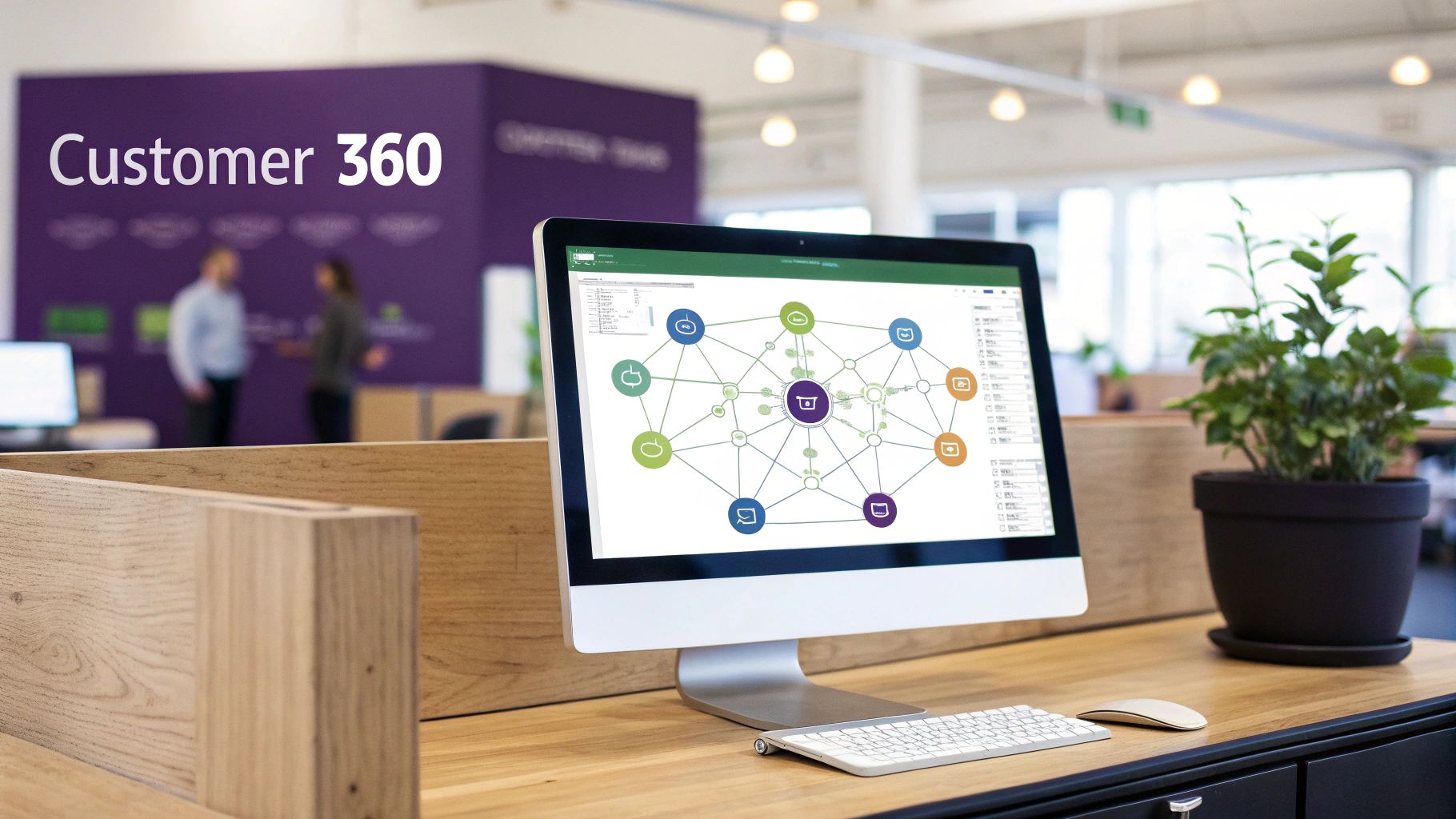
For businesses aiming for data-driven growth, this unified view is invaluable. It moves you beyond guesswork, allowing for precise segmentation, deep personalization, and real-time performance tracking that directly informs campaign optimization and strategy.
How to Implement Data-Driven Automation
- E-commerce Customer Journeys: An online store can track a customer's entire lifecycle, from their first ad click to their latest purchase. Automation can use this data to send personalized product recommendations, loyalty offers, or re-engagement campaigns based on their specific purchase history and browsing behavior.
- B2B Lead Scoring: A B2B firm can assign scores to leads based on their engagement. For instance, a prospect who downloads a case study and visits the pricing page automatically receives a higher score and is flagged for immediate follow-up by the sales team.
- Campaign ROI Analysis: Marketing teams can use the platform's analytics to identify which channels and campaigns generate the most valuable customers over time. This insight allows them to reallocate budgets to high-performing initiatives and cut spending on ineffective ones.
Actionable Tips for Better Data Management
To make the most of your data, establish strict quality standards and conduct regular data audits to keep information clean and accurate. Implement proper data governance policies from the start, ensuring all collection practices are compliant with regulations like GDPR. For a deeper understanding of organizing this data effectively, explore our guide on what a marketing database is and how to build one. Use progressive profiling in your forms to gradually build rich customer profiles without overwhelming new leads.
4. Cost Reduction and Improved ROI on Marketing Spend
A key reason businesses embrace automation is its direct impact on the bottom line. By automating repetitive tasks, improving targeting precision, and optimizing campaigns with real-time data, marketing automation significantly reduces customer acquisition costs (CAC). This process allows startups and SMBs to achieve enterprise-level marketing results at a fraction of the cost, ensuring every dollar spent is maximized for impact.
This advantage directly aligns with improving ad performance and conversions. Automation ensures your marketing budget is spent more efficiently on high-intent prospects, eliminating waste and boosting overall return on investment (ROI). It transforms marketing from a cost center into a predictable, revenue-generating engine.
How to Implement for Cost Efficiency
- E-commerce Ad Spend Optimization: An e-commerce brand can use automation to score leads based on website activity. This allows them to focus retargeting ad spend exclusively on high-value prospects, reducing wasted spend on uninterested visitors while maintaining sales volume.
- SaaS Lead Qualification: A SaaS startup can automate its lead nurturing process to filter out unqualified leads before they reach the sales team. This reduces the CAC by ensuring sales reps only spend time on prospects with a high probability of converting.
- B2B Agency Campaign Management: A B2B agency can use a single automation platform to manage multiple client campaigns, from email sequences to social media scheduling. This reduces the need for additional staff and consolidates subscription costs from multiple single-purpose tools.
Actionable Tips for Better ROI
To get the most out of your budget, start by calculating your current CAC and track its reduction monthly as you implement automation. Use lead scoring to avoid wasting marketing and sales resources on unqualified prospects. You should also regularly audit which campaigns and channels deliver the best ROI and reallocate your budget accordingly. Consolidating your marketing tools into a single automation platform can also reduce subscription costs and operational complexity.
5. Enhanced Personalization at Scale
One of the most transformative marketing automation advantages is the ability to deliver highly personalized experiences to thousands of individuals simultaneously. By leveraging dynamic content, behavioral triggers, and advanced segmentation, businesses can move beyond generic messaging and tailor content, offers, and product recommendations to each user's unique profile and journey without manual effort.

For e-commerce stores and digital brands, this level of personalization directly translates into higher engagement, improved customer satisfaction, and increased lifetime value. It makes each customer feel understood and valued, fostering a stronger connection with your brand.
How to Implement Personalization at Scale
- E-commerce Product Recommendations: An online store can automatically display product carousels based on a user's browsing history, past purchases, or items other similar customers have bought. This is a tactic famously used by giants like Amazon to drive cross-sells and upsells.
- Dynamic Email Campaigns: An email marketing platform can use dynamic content blocks that change based on the recipient's segment. A fashion retailer could send a single campaign that shows menswear to male subscribers and womenswear to female subscribers, all within the same email template.
- Tailored Landing Pages: A B2B company can create landing pages that show different headlines or calls-to-action based on the traffic source. A visitor from a LinkedIn ad campaign might see industry-specific language, while a visitor from a Google search sees messaging that matches their query.
Actionable Tips for Better Personalization
To make your personalization efforts effective, start by segmenting your audience thoughtfully based on both demographic and behavioral data. Use dynamic fields to include a customer's name in email subject lines and greetings. Always A/B test personalized campaigns against non-personalized versions to measure the direct impact on your key metrics. Most importantly, ensure your personalization enhances the user experience and provides genuine value rather than feeling invasive.
6. Consistent Brand Messaging Across Channels
Another key marketing automation advantage is its ability to enforce consistent brand messaging across all your marketing channels. Automation ensures that your branding, offers, and core value propositions remain uniform whether a customer interacts with you via email, social media, a landing page, or a digital ad. This consistency is crucial for building brand recognition and cultivating trust, especially for businesses establishing their presence.
This unified approach prevents the fragmentation that often occurs when different teams or individuals manage separate channels. Instead of disjointed communications, every customer touchpoint works together to reinforce your brand promise. For organizations aiming to elevate their brand, ensuring this consistency is a non-negotiable step toward building a strong, memorable identity.
How to Implement Consistent Messaging
- Coordinated Product Launches: When launching a new product, use automation to schedule and deploy a sequence of announcements across email, social media, and paid ads. The messaging, visuals, and calls-to-action should be synchronized to create a powerful, unified campaign that builds excitement and drives initial sales.
- Multi-Channel Nurturing Campaigns: A prospect who downloads an ebook could receive a follow-up email, see a related testimonial ad on LinkedIn, and get an SMS notification about an upcoming webinar. Automation ensures the messaging in each touchpoint is contextually relevant and aligned with the overall campaign goal.
- Centralized Approval Workflows: Implement workflows within your automation platform that require all marketing assets, from emails to social posts, to be reviewed and approved by a brand manager before going live. This simple step guarantees that every piece of content adheres to brand guidelines.
Actionable Tips for Brand Consistency
To maximize brand consistency, start by creating a centralized message and asset library that all campaigns can pull from. Develop clear, documented brand guidelines covering voice, tone, and visual identity before you even begin implementing automation. Regularly audit your active campaigns to identify and correct any messaging drift. By establishing a single source of truth for your brand, you ensure every automated interaction strengthens customer trust and recognition.
7. Faster Response Times and Improved Customer Service
Another critical marketing automation advantage is the ability to deliver instant responses and dramatically improve customer service. In a world where speed is expected, automation ensures that inquiries, form submissions, and support requests receive immediate acknowledgment. This rapid communication builds confidence, prevents leads from going cold, and enhances overall customer satisfaction.
For service-oriented businesses, this means you can provide timely, helpful interactions even outside of standard business hours. Automation acts as your 24/7 front-line team, assuring customers their message has been received and will be handled, which reinforces a brand image of responsiveness and care.
How to Implement Automated Customer Responses
- Immediate Inquiry Confirmations: When a potential client fills out a "Contact Us" form on your website, an automated email is instantly sent to confirm receipt. This message can set expectations by providing an estimated response time and linking to a helpful FAQ page or blog post.
- Intelligent Lead Routing: A prospect in Europe who requests a demo can be automatically routed to the EMEA sales representative's calendar. The system can check for availability and send a personalized booking link, eliminating manual coordination and delays across time zones.
- Automated Support Ticketing: A customer submitting a support ticket through a portal immediately receives an automated reply with their ticket number and a link to track its status. This simple step confirms the request is in the queue and reduces follow-up inquiries.
Actionable Tips for Better Service
To make your automated responses feel more human, craft personalized messages that go beyond a generic "we received your request." Implement intelligent routing based on customer attributes and team availability to connect people with the right expert quickly. For more complex issues, ensure you have a clear escalation path that seamlessly transitions an automated conversation to a human agent. By consistently tracking and analyzing response time metrics, you can identify and eliminate bottlenecks in your customer service process.
8. Better Lead Qualification and Sales Enablement
A crucial advantage of marketing automation is its ability to bridge the gap between marketing and sales, leading to better lead qualification and more effective sales enablement. Automation systems identify and score leads based on their behavior, demographics, and engagement levels. This ensures that the sales team spends their valuable time on high-quality, sales-ready prospects who have demonstrated genuine buying intent.
This alignment dramatically improves efficiency and helps close more deals. By automating the process of identifying the hottest leads, you free sales representatives from the time-consuming task of chasing cold or unqualified prospects. For startups and SMBs, this capability is a game-changer, directly improving deal velocity and conversion rates by focusing sales efforts where they count the most.
How to Implement Automated Lead Qualification
- Behavioral Alerts for Sales: Set up real-time alerts for your sales team when a prospect takes a high-intent action. For instance, a salesperson could receive an instant notification when a lead from their territory downloads a pricing sheet, visits the "contact us" page, or requests a product demo.
- Automated Handoff Workflows: Create a workflow that automatically assigns a qualified lead to a sales rep and simultaneously stops marketing nurture emails. This prevents confusing, overlapping communication and provides a seamless transition from marketing to sales.
- Dynamic Sales Collateral Delivery: Use automation to send relevant sales collateral based on a prospect's profile or recent activity. If a lead in the manufacturing sector downloads a case study, the system can automatically send them a follow-up email with a data sheet on a relevant product feature.
Actionable Tips for Better Sales Enablement
To maximize this marketing automation advantage, start by collaboratively defining lead qualification criteria with your sales team. Begin with a conservative lead scoring model and refine it based on which leads actually convert into customers. Regularly review your scoring rules and ensure there is a clear, documented process for the marketing-to-sales lead handoff. Most importantly, provide the sales team with the full context of a lead's engagement history so they can have more informed and effective conversations.
9. Data-Driven Decision Making and Campaign Optimization
A core marketing automation advantage lies in its ability to provide the comprehensive analytics needed for truly data-driven decision-making. Instead of relying on guesswork or anecdotal evidence, automation platforms offer real-time dashboards and performance reports. This analytical foundation allows marketing leaders to understand what is working, identify optimization opportunities, and continuously improve campaign performance.
For marketing managers and startup founders, this means having the power to allocate budget and resources effectively. By tracking every touchpoint, you can attribute revenue to specific campaigns and channels, proving ROI and justifying marketing spend with concrete data.
How to Implement Data-Driven Optimization
- A/B Testing Subject Lines: An email marketing team can use automation to test two different subject lines on a small segment of their audience. The system automatically identifies the winner based on open rates and sends the more effective version to the remaining subscribers.
- Channel Performance Analysis: A B2B company can track leads from various sources like organic search, paid ads, and social media. The automation platform's analytics will reveal which channels deliver not just the most leads, but the highest-value customers, guiding future budget allocation.
- Segment-Based Insights: An e-commerce brand might discover through its analytics that customers in a specific geographic region convert at three times the average rate. This insight enables them to create targeted campaigns and offers specifically for that high-performing segment.
Actionable Tips for Better Insights
To get the most from your analytics, establish clear KPIs and success metrics before launching any campaign. Use dashboards to track performance daily, not just in monthly reports, allowing for rapid adjustments. Most importantly, create feedback loops where insights from your data directly inform and drive the next iteration of your strategy. For a deeper dive into this approach, explore our complete guide to data-driven marketing strategies.
10. Scalable Growth Without Proportional Cost Increases
A crucial advantage of marketing automation is its ability to facilitate scalable growth without the traditional, proportional increase in costs. This means your business can manage more leads, customers, and campaigns across multiple channels without needing to hire a significantly larger team. Once your automated workflows are built, they can handle an exponential increase in volume with minimal additional investment.
For startups and small businesses, this is a game-changer. It allows you to expand your reach and customer base rapidly while keeping your operational overhead lean. You can maintain or even improve your unit economics, acquiring more customers at a lower cost per acquisition over time, a core principle of sustainable growth.
How to Implement for Scalability
- E-commerce Expansion: A growing e-commerce store can use automation to manage campaigns for 100,000+ customers with a small marketing team. Workflows for order confirmations, shipping updates, abandoned carts, and post-purchase follow-ups run seamlessly regardless of order volume.
- SaaS User Onboarding: A software company can automate the entire onboarding process for thousands of new trial users each month. This includes welcome emails, feature tutorials, and usage-based nudges, all handled by the system without manual intervention from the customer success team.
- Agency Client Management: A digital marketing agency can scale its services to manage dozens of client campaigns simultaneously. Automation can handle client reporting, lead notifications, and internal task assignments, allowing a lean team to deliver consistent results across a growing portfolio.
Actionable Tips for Scalable Automation
To ensure your automation strategy supports growth, choose a platform that can scale with you, like those offered by HubSpot or ActiveCampaign, to avoid a costly migration later. Document all your processes from the beginning to make training and handoffs easier. As your volume increases, regularly monitor platform usage and costs, and be prepared to optimize your workflows; a system that works for 1,000 contacts may need adjustments for 100,000. For more on building a foundation for growth, check out our insights on brand development for startups.
Marketing Automation: 10-Point Advantages Comparison
| Item | Implementation Complexity (🔄) | Resource Requirements (⚡) | Expected Outcomes (📊) | Ideal Use Cases (💡) | Key Advantages (⭐) |
|---|---|---|---|---|---|
| Increased Conversion Rates Through Lead Nurturing | Moderate 🔄 — triggers, sequences & integrations | Moderate ⚡ — automation platform + clean data | Higher conversion rates; improved CLV 📊 | E‑commerce abandoned carts; SaaS trial onboarding | Personalized nurturing at scale; more conversions ⭐ |
| Time and Resource Efficiency for Marketing Teams | Low–Moderate 🔄 — workflow setup & training | Low ⚡ — automation tools and staff adoption | Reduced manual work; increased output 📊 | SMBs/startups with lean teams; routine scheduling | Frees staff for strategy; consistent execution ⭐ |
| Improved Customer Data Management and Analytics | High 🔄 — data consolidation & governance | High ⚡ — CRM, integrations, analytics stack | 360° customer view; real‑time insights 📊 | Data‑driven orgs; complex B2B journeys | Eliminates silos; enables predictive insights ⭐ |
| Cost Reduction and Improved ROI on Marketing Spend | Moderate 🔄 — attribution, scoring & optimization | Moderate ⚡ — A/B tools, ad automation, analytics | Lower CAC; improved budget allocation 📊 | Startups/e‑commerce optimizing ad spend | More efficient spend; higher marketing ROI ⭐ |
| Enhanced Personalization at Scale | High 🔄 — dynamic content and segmentation | High ⚡ — recommendation engines & data pipelines | Higher engagement (+20–50%); better retention 📊 | E‑commerce & digital brands needing personalization | Scales tailored experiences; higher conversion rates ⭐ |
| Consistent Brand Messaging Across Channels | Moderate 🔄 — centralized messaging & approvals | Low–Moderate ⚡ — templates, approval workflows | Stronger brand recognition; fewer errors 📊 | Multi‑channel campaigns; product launches | Brand consistency; reduced off‑brand messages ⭐ |
| Faster Response Times and Improved Customer Service | Low–Moderate 🔄 — autoresponders and routing logic | Moderate ⚡ — chatbots, ticketing, routing rules | Faster responses; higher customer satisfaction 📊 | Service businesses; after‑hours lead capture | Immediate engagement; prevents cold leads ⭐ |
| Better Lead Qualification and Sales Enablement | Moderate 🔄 — scoring models & handoff workflows | Moderate ⚡ — CRM, lead‑scoring tools, sales alignment | Higher lead quality; faster sales cycles 📊 | B2B sales teams; agencies aligning M+S | Sales‑ready leads; improved close rates ⭐ |
| Data‑Driven Decision Making and Campaign Optimization | Moderate–High 🔄 — dashboards, attribution & testing | Moderate ⚡ — analytics platforms & skilled users | Actionable insights; continuous performance gains 📊 | Performance marketing; growth teams | Rapid testing & optimization; better forecasting ⭐ |
| Scalable Growth Without Proportional Cost Increases | Moderate 🔄 — systematize workflows for scale | Moderate–High ⚡ — scalable platform tiers & monitoring | Higher volume with stable unit economics 📊 | High‑growth startups; agencies managing many clients | Scale efficiently; maintain or lower CAC ⭐ |
From Automation to Acceleration: Your Next Strategic Move
We've explored the landscape of marketing automation, dissecting ten powerful advantages that can fundamentally reshape how your business connects with its audience. From the precision of enhanced personalization at scale and the efficiency of streamlined workflows to the strategic clarity offered by robust analytics, the case for adoption is compelling. The journey from manual effort to automated excellence is not just about saving time; it's about reallocating that time to what truly matters: strategy, creativity, and building genuine customer relationships.
The core theme woven through each advantage, from improved lead nurturing to scalable growth, is the transition from reactive marketing to proactive, intelligent engagement. You are no longer just broadcasting a message; you are orchestrating a series of personalized, timely, and relevant conversations. This shift is what separates businesses that simply survive from those that thrive in a competitive digital ecosystem.
Synthesizing the Advantages into a Cohesive Strategy
Individually, each benefit we've discussed offers a significant boost. However, the true power of marketing automation is realized when these advantages are integrated into a holistic strategy.
- Efficiency and Personalization: By automating repetitive tasks (Advantage #2), your team gains the bandwidth to craft the highly personalized campaigns (Advantage #5) that drive engagement.
- Data and Decisions: Clean data management (Advantage #3) directly fuels the data-driven decision-making (Advantage #9) needed to optimize campaigns and prove ROI (Advantage #4).
- Nurturing and Conversion: Sophisticated lead nurturing workflows (Advantage #1) are only possible with effective lead qualification (Advantage #8), ensuring the sales team engages with the most promising prospects at the perfect moment.
This interconnectedness highlights a critical takeaway: implementing a marketing automation platform is not the finish line. It is the starting pistol for a new race, one focused on continuous improvement, strategic alignment, and leveraging technology to amplify human ingenuity. The most significant of all marketing automation advantages is its ability to serve as a central nervous system for your entire marketing and sales operation, creating a seamless flow of information and action.
Your Actionable Blueprint for Moving Forward
Understanding the benefits is the first step. Translating that understanding into tangible results requires a clear plan. Here is your blueprint to harness the power we've detailed:
- Define Your Primary Objective: Don't try to solve everything at once. Are you focused on lead generation, customer retention, or sales enablement? Pick one primary goal to build your initial automation strategy around.
- Conduct a Process Audit: Identify the most time-consuming, repetitive manual tasks your marketing and sales teams currently perform. These are your prime candidates for initial automation workflows.
- Start with a Foundational Workflow: Begin with a simple yet high-impact automation, such as a "welcome" email series for new subscribers or a basic lead nurturing sequence for new downloads. This allows you to learn the platform and demonstrate early wins.
- Commit to Data Hygiene: Your automation is only as good as the data that fuels it. Establish clear processes for data entry, segmentation, and regular cleanup from day one.
- Measure, Analyze, Optimize, Repeat: Set clear KPIs for each automation. Regularly review performance, identify bottlenecks, A/B test your messaging and timing, and continuously refine your approach for better results.
Ultimately, marketing automation is more than just software; it's a strategic philosophy. It’s about building a scalable, efficient, and intelligent marketing engine that works for you 24/7. This frees your team to focus on high-level strategy, creative innovation, and the human-to-human connections that technology can facilitate but never fully replace. The path forward is clear: move from simply doing marketing to engineering a system that delivers predictable, scalable, and profitable growth.
Are you ready to turn these theoretical advantages into a practical reality for your business? The team at Frozen Crow Inc. specializes in bridging the gap between powerful technology and strategic implementation, ensuring your marketing automation platform becomes a core driver of growth. Schedule a free, no-obligation marketing audit with our experts today to discover your unique opportunities for automation and acceleration.


