


August 20, 2026
A Practical Digital Marketing Strategy for Small Businesses
As a small business owner, you're wearing a dozen hats at once. Time is short, budgets are tight, and you're fighting to get noticed. In this constant hustle, a focused digital marketing strategy for small businesses isn't just another task to add to the list—it's the single most powerful tool you have to turn those scarce resources into real, measurable growth.
Why a Smart Marketing Strategy Is Your Greatest Advantage

Too many small businesses fall into the "random acts of marketing" trap. You boost a social media post here, send out a newsletter there, and cross your fingers, hoping something sticks. I get it. The effort is there, but without a clear plan connecting your actions to your goals, it's a fast track to wasted money and burnout.
A real strategy changes everything. It turns those scattered tactics into a single, cohesive system that works for you. Think of it like this: throwing seeds in the wind versus planting a garden. A strategy is the blueprint for that garden. It tells you exactly what soil to prepare, which plants will actually thrive, and how much water they'll need to grow.
From Reactive to Proactive Growth
Without a documented plan, marketing becomes a constant reaction. You're chasing the latest trend or copying a competitor's move, all without knowing if it’s the right fit for your audience or your goals. This reactive approach is exhausting, inefficient, and nearly impossible to measure.
A well-defined strategy lets you get proactive. It puts you back in control, empowering you to make deliberate choices about where to invest your time and money for the biggest possible return. This planned approach delivers some huge wins:
- Clarity and Focus: Your entire team gets on the same page, all pulling in the same direction toward specific, shared goals.
- Resource Optimization: You stop wasting money and start putting your limited budget and time into the channels most likely to reach your ideal customers.
- Smarter Decision-Making: With clear Key Performance Indicators (KPIs), you can actually see what’s working. You start making data-driven adjustments instead of just guessing.
Building a Competitive Edge
Your strategy is what gives you a unique edge. It’s how a local bakery can outmaneuver a giant chain or how a small e-commerce shop can build a fiercely loyal community. Even when the economy feels uncertain, small businesses know this is true. A recent LocaliQ report showed that 49% of small businesses plan to increase their marketing budgets, a clear sign that they believe in strategic growth.
It all starts with understanding the fundamentals of effective advertising. That means getting your strategy clear before a single dollar is spent, a concept broken down in this practical guide on how to advertise a small business.
Building Your Foundation for Sustainable Growth

Before you spend a single dollar on ads or write one social media post, you have to pour the concrete. It’s tempting to jump straight into the exciting stuff, but a winning digital marketing strategy for small businesses isn’t built on guesswork—it’s built on a solid foundation. Rushing this stage is the most common mistake we see.
This groundwork makes sure every future marketing decision is strategic and effective. Think of it as your compass. It guides every ad campaign, every piece of content, and every dollar you spend. Let's build out the three core pillars, one by one.
Define Your Ideal Customer
You can't talk to everyone. If you try, your message will just become background noise. The first step is getting crystal clear on who, exactly, you’re talking to. This goes way beyond basic demographics like age or location. You need to build out a detailed Ideal Customer Profile (ICP), often called a buyer persona.
Think of your ICP as the main character in your business’s story. What are their biggest frustrations? What goals are they trying to hit where your product or service can help? Answering these questions brings incredible clarity. It turns your marketing from generic shouting into a helpful, one-on-one conversation.
To really dig in, we’ve got a full guide that explains in detail how to create buyer personas for your business.
Set Clear SMART Goals
Once you know who you're talking to, you need to decide what you want them to do. Vague goals like "get more customers" feel good to say, but they're useless in practice because you can't measure them. Instead, you need to set SMART goals—a simple framework that brings much-needed structure and accountability to your objectives.
A goal without a plan is just a wish. The SMART framework turns your marketing wishes into an actionable roadmap, ensuring every activity has a clear purpose and a measurable outcome.
This popular framework forces you to get specific across five criteria:
- Specific: What, exactly, do you want to accomplish? "Increase online leads from our website" is much better than "grow the business."
- Measurable: How will you track progress and know when you’ve succeeded? "Increase leads by 20%" is something you can actually measure.
- Achievable: Is the goal realistic with your team and budget? A 20% lift is challenging but possible; 200% in a month probably isn't.
- Relevant: Does this goal directly support your bigger business objectives? More qualified leads directly fuel sales.
- Time-bound: When will this get done? Setting a deadline like "by the end of Q3" creates focus and urgency.
Now, your goal becomes: "Increase qualified online leads from our website by 20% by the end of Q3." See the difference? That's a target you can actually aim for.
Craft Your Unique Value Proposition
Finally, you have to answer the most important question in business: "Why should someone choose you over anyone else?" Your answer is your Unique Value Proposition (UVP). It's a short, powerful statement that communicates the specific benefit you offer that no one else does.
A strong UVP isn't just a catchy slogan. It’s the heart of your messaging and the thing that makes you memorable. It should immediately tell your ideal customer what problem you solve and why you’re the best choice. For instance, a local coffee shop's UVP could be: "The freshest locally-roasted coffee, served in under two minutes—guaranteed."
That simple statement highlights quality, speed, and a risk-free promise, instantly setting it apart from the cafe next door. To really turn your strategy into a growth engine, check out these 10 potent small business growth strategies.
Choosing the Right Tools for the Job
The world of digital marketing can feel like a massive, overwhelming toolbox. There are powerful instruments for every job imaginable, but trying to use all of them at once is the fastest way to burn out and drain your budget. A smart digital marketing strategy for small businesses isn't about doing everything; it's about choosing the right tool for the right job, right when you need it.
That means being selective. Instead of spreading yourself thin across ten different platforms, your real goal is to master just one or two channels where your ideal customers are already spending their time. Let's break down the core channels to make that choice a little clearer.
SEO: The Customer Magnet
Search Engine Optimization (SEO) is your magnet. It’s the art and science of making your website more attractive to search engines like Google, so you show up the moment a potential customer is looking for what you offer. They're already raising their hand; SEO just makes sure they see you.
Think about it. When someone types "best local plumber" or "handmade leather wallets" into that search bar, they have a real problem to solve or a purchase they want to make. Getting your business onto that first page of results is like having a shop on the busiest street in town. It pulls in high-quality traffic from people who are ready to act, making it an incredibly powerful long-term investment.
Social Media: The Community Hub
If SEO is your magnet, then social media is your community hub. This is where you stop broadcasting messages and start building actual relationships. It’s less about the hard sell and more about creating loyalty, showing off your brand's personality, and having authentic conversations.
Every platform has its own vibe. For a B2B consultant, LinkedIn is a professional networking event. For a local boutique, Instagram is a visual lookbook. The key is to show up where your customers are and provide real value—whether that’s helpful tips, behind-the-scenes content, or just a post that makes them smile. That consistent interaction builds a following that genuinely trusts you.
And the reality is, small businesses are already all-in on this. A recent survey from the Small Business & Entrepreneurship Council found that 91% of small businesses now use multiple channels to market their products. They lean heavily on platforms like Facebook (59% usage), Instagram (43%), and YouTube (40%), right alongside their own websites (53%). You can find more detailed insights into small business marketing trends in their full report.
Content Marketing: The Expert Library
Content marketing is your expert library. This is where you prove you know your stuff by creating and sharing valuable, relevant, and consistent content—things like blog posts, how-to guides, and videos that solve your audience's problems. It’s the fuel for your SEO and gives you something meaningful to share on social media.
By consistently answering your customers' biggest questions, you build incredible trust and establish your business as the go-to authority. So when they're finally ready to make a purchase, who will they choose? The company that only pushed sales ads, or the one that helped them out for free long before they were ready to buy?
Content marketing is the only marketing left that builds assets over time. A great piece of content published today can continue attracting customers and building trust for years to come, delivering an incredible return on your initial investment.
Email Marketing: The Personal Conversation
Finally, email marketing is your direct line—a personal conversation. Unlike social media, where mysterious algorithms decide who sees your posts, email gives you a direct connection to your most engaged audience. These are people who have explicitly given you permission to contact them, making it the perfect channel for nurturing leads and encouraging repeat business.
This is where you share exclusive offers, send company updates, and deliver personalized content that deepens that customer relationship. As you grow, managing these conversations can be streamlined. To see how you can put some of these efforts on autopilot, check out our guide on marketing automation for small business.
Which Digital Marketing Channel Is Right for Your Small Business?
So, where should you start? This table is designed to help you match your business goals to the channels that will give you the most bang for your buck.
| Channel | Best For | Primary Goal | Key Metric | Effort Level |
|---|---|---|---|---|
| SEO | Businesses whose customers actively search for their services online (e.g., plumbers, lawyers, local restaurants). | Driving high-intent organic traffic to your website. | Organic Traffic, Keyword Rankings, Website Leads | High (Ongoing) |
| Social Media | Brands with strong visual appeal or a desire to build a community (e.g., e-commerce, cafes, artists). | Building brand awareness and fostering customer loyalty. | Engagement Rate, Follower Growth, Reach | Medium (Consistent) |
| Content Marketing | B2B services, complex products, or businesses that rely on expertise and trust (e.g., consultants, software). | Establishing authority and generating qualified leads. | Time on Page, Newsletter Signups, Downloads | High (Upfront) |
| Email Marketing | Businesses with repeat customers or longer sales cycles (e.g., e-commerce, service-based businesses). | Nurturing leads and driving customer retention. | Open Rate, Click-Through Rate, Conversion Rate | Low (Ongoing) |
The best advice is to pick one channel and commit to mastering it. Don't try to be a master of all trades from day one. Choose the tool that feels most natural for your business and your customers, learn it inside and out, and only expand once you have a solid, repeatable process in place.
Budgeting Smart and Measuring What Matters
Let's get into the two topics that make most small business owners a little nervous: money and data. You can have the best marketing ideas in the world, but without a solid plan for your budget and your metrics, they’ll fizzle out fast. A real digital marketing strategy for small businesses means being just as deliberate with your dollars and data as you are with your ad copy.
Stop thinking of your marketing budget as an expense. It’s a calculated investment in growth. You wouldn't build a house without a budget and a blueprint, right? Same logic. A smart budget makes sure your hard-earned cash goes to the channels actually bringing in customers, not just the ones making the most noise.
How to Create a Practical Marketing Budget
For most small businesses, the easiest on-ramp is the percentage-of-revenue model. A good rule of thumb is to set aside 7-12% of your total annual revenue for all things marketing. If you’re a startup trying to make a splash or launching a new product, you might want to push that closer to 15% to really grab some attention.
But while that gives you a starting number, a much sharper approach is to build your budget around your specific goals. It’s called goal-based budgeting, and it forces you to work backward from what you actually want to achieve.
- Define Your Goal: Make it a SMART goal. For example, "Get 50 new paying customers in the next three months."
- Estimate Your Cost Per Acquisition (CPA): Do a little homework. What’s the average cost to land one customer using Google Ads or social media in your industry? Let’s pretend it’s $100.
- Do the Math: Multiply your customer goal by your CPA. In this case, 50 customers x $100 each = a $5,000 budget for that campaign.
Suddenly, you’ve connected every dollar you spend to a real business outcome. The conversation shifts from a vague, "How much can we afford to spend?" to a powerful, "What do we need to invest to hit our target?"
Measuring What Truly Matters for Growth
Once your campaigns are out in the wild, the real work begins. How do you know if they're actually working? It’s so easy to get caught up in vanity metrics—things like likes, shares, and follower counts. They feel good, but they don't pay the bills.
The goal isn't just to be seen; it's to get results. Focusing on actionable Key Performance Indicators (KPIs) ensures you're measuring progress toward your actual business objectives, not just online popularity.
To make smart decisions, you need to track the numbers that tell the true story of your marketing performance.
- Customer Acquisition Cost (CAC): How much does it cost you, in total, to win a single new customer? A low CAC means you're running an efficient machine.
- Conversion Rate: What percentage of people who visit your site actually do the thing you want them to do (buy something, fill out a form, etc.)? A high conversion rate means your message is landing perfectly.
- Return on Ad Spend (ROAS): This one's simple: for every dollar you put into ads, how many dollars in revenue did you get back? A 4:1 ROAS means you made $4 for every $1 you spent.
- Customer Lifetime Value (CLV): This is the total amount of money a typical customer is likely to spend with you over their entire relationship with your business. Knowing this number is critical—it tells you exactly how much you can afford to spend to get a new customer in the first place.
Your First Steps with Analytics
You don't need a fancy, expensive software suite to get started. Free tools like Google Analytics are incredibly powerful for seeing how people find your website, what they do when they get there, and where they drop off.
By setting up a few simple goals in Analytics, you can see which channels are driving real results. For a deeper look at getting this all set up, check out our complete guide on measuring digital marketing performance.
When you pair a thoughtful budget with a laser focus on the right KPIs, you turn marketing from a guessing game into a predictable engine for growth. This is how you confidently double down on what works, cut what doesn’t, and make every single dollar count.
Bringing Your Marketing Strategy to Life
A detailed plan is a great start, but a strategy document sitting in a folder doesn't attract a single customer. This is where the real work begins—turning those ideas into action and, ultimately, into tangible results.
It's easy to get overwhelmed trying to do everything at once. So, we're going to break it down into three manageable phases. Think of it as building your marketing engine one piece at a time. This approach helps you build momentum, avoid paralysis, and lets your strategy evolve as you learn what actually connects with your audience.
Phase 1: Launch (Months 1-3)
Your first 90 days are all about getting your digital footprint established. The goal here isn't perfection; it's progress. We’re focused on getting the fundamentals right and starting to gather the data that will guide every decision you make down the road.
For most local businesses, the absolute first step is to claim and fully optimize your Google Business Profile. With 46% of all Google searches being for local information, this is non-negotiable. It’s your digital storefront on the world's biggest search engine, and you need to own it.
From there, your launch phase should hit these key actions:
- Pick One Core Channel: Based on your earlier research, choose the single best channel to reach your ideal customer—whether that's SEO, Instagram, or email—and go all-in. Don't spread yourself too thin.
- Create Foundational Content: Develop a small batch of high-quality content to get started. This could be five cornerstone blog posts for SEO, a month's worth of social media updates, or an introductory email sequence for new subscribers.
- Get Your Analytics Right: Make sure your tracking tools, like Google Analytics, are properly set up to measure the KPIs you defined. You can't improve what you can't measure.
This timeline shows how your focus shifts over time, from initial budget deployment to refining costs and improving conversions as you learn more.
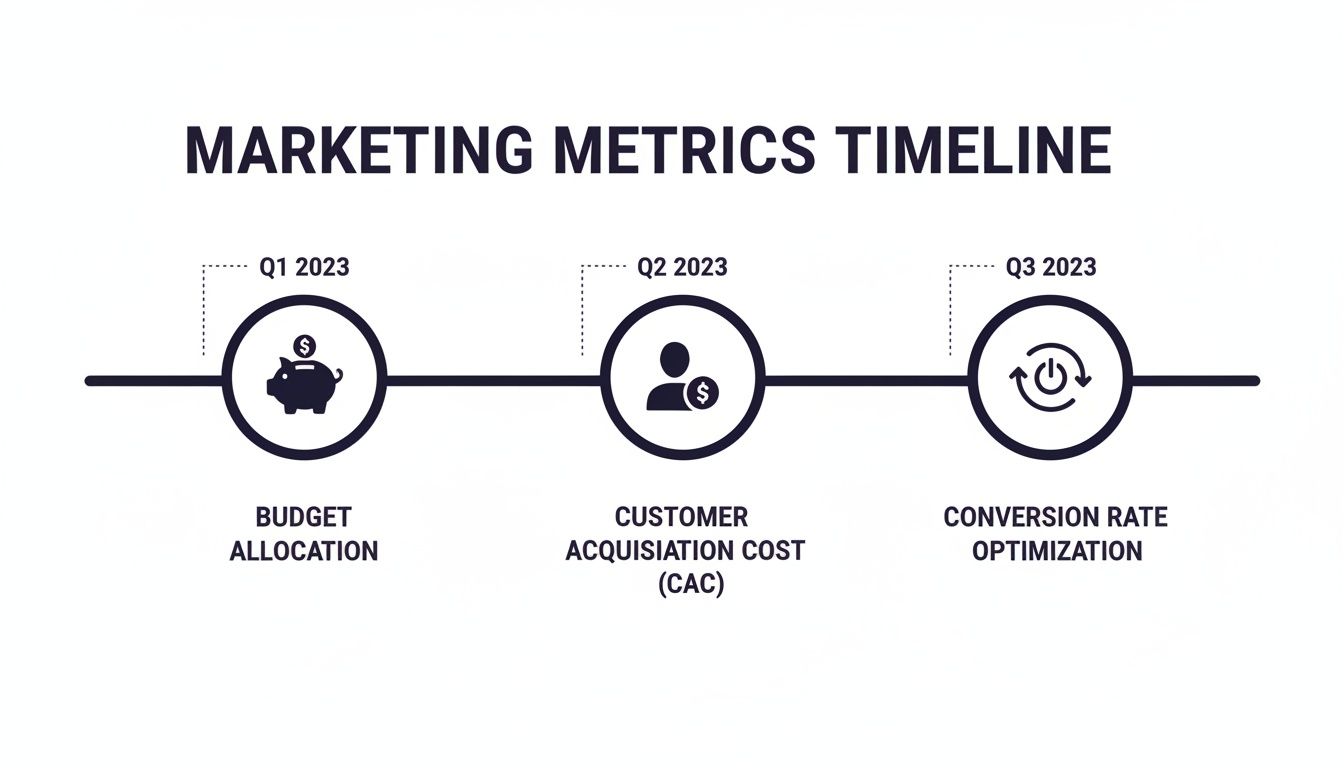
As you can see, the early days are about spending to learn. That data is what allows you to tighten up your customer acquisition cost (CAC) and boost your conversion rates later on.
Phase 2: Optimize (Months 4-6)
Now you’ve got three months of data. You're no longer guessing. You have real-world insights into what’s working and what’s falling flat. The optimization phase is all about using that data to make smarter decisions, sharpen your messaging, and improve your return on investment. We're moving from broad strokes to fine-tuning.
This is the perfect time to run simple A/B tests. Try testing two different headlines on a landing page or two different images in a social ad to see which pulls better. You’d be surprised how small tweaks can lead to big wins in your conversion rates.
A marketing strategy that doesn't adapt is a strategy that's destined to fail. This is the phase where your plan becomes a living, breathing system that gets smarter with every click and conversion.
Phase 3: Scale (Month 7 and Beyond)
Once you’ve found a profitable, repeatable formula, it’s time to hit the accelerator. The scaling phase is about strategically reinvesting your profits back into the channels that are delivering the goods. It’s about doing more of what works while cautiously exploring new avenues for growth.
Automation becomes your best friend here. As you grow, you can’t manually handle every single task. Using tools for email automation or social media scheduling frees you up to think about the big picture instead of getting buried in the day-to-day grind. Speed is everything—since 78% of customers buy from the first business to respond, having automated follow-ups gives you a massive edge. You can discover more insights about small business marketing stats on 800.com.
Key activities for scaling up include:
- Increase Your Budget: Confidently pour more fuel on the fire by increasing the budget for your top-performing campaigns.
- Expand to a Second Channel: With your first channel humming along, now you can introduce a second, complementary one to the mix.
- Refine and Automate: Build out workflows to nurture leads and manage customer communications automatically. This ensures no opportunity ever slips through the cracks.
Answering Your Top Marketing Questions
So you've laid the strategic groundwork. The plan looks good on paper, but now it's time to actually do it. Moving from a well-documented strategy to real-world execution can feel like a big leap, and it’s totally normal to have questions.
This is where the rubber meets the road. We're going to tackle the most common challenges and questions we hear from small business owners every day. Think of this as your quick-reference guide for navigating those first crucial steps with confidence.
How Much Should a Small Business Spend on Digital Marketing?
There's no single magic number, but a solid rule of thumb is to set aside 7-12% of your total revenue for marketing. If you’re a new business or you're in a serious growth phase, pushing that closer to 15% can give you the fuel needed to really make a dent and capture market share.
A smarter way to approach this, though, is to work backward from your goals.
First, figure out how many new customers you actually need to hit your revenue targets. Then, do a little research on the estimated cost to acquire a customer on a promising channel, like social media ads or a search campaign. This lets you build a budget that’s tied directly to results, not just a random percentage.
A great way to start is with a small, controlled test budget on one or two channels. Measure your return on investment carefully, and then confidently scale what works. This data-driven method takes the guesswork out of it and makes every dollar count.
Don't forget to prioritize the "free" stuff first. Things like claiming and optimizing your Google Business Profile can deliver huge value with sweat equity instead of cash, stretching your budget even further.
Which Digital Marketing Channel Is Best to Start With?
This is one of the most important questions you'll ask, and the answer comes down to one simple thing: where do your ideal customers hang out online? Trying to be everywhere at once is a classic rookie mistake and a fast track to burnout. The key is to pick one channel, get really good at it, and only then start thinking about expanding.
Here’s a simple framework to help you choose:
- For Local Services (Plumber, Cafe, Salon): Start with Local SEO. Your absolute first move should be to claim and meticulously fill out your Google Business Profile. This is how you show up when someone nearby is actively searching for exactly what you offer.
- For Visually Appealing Products (Jewelry, Fashion, Home Decor): Your home base should be Instagram or Pinterest. These platforms are built for visuals, making them perfect for showcasing products, building a distinct brand aesthetic, and creating a community.
- For B2B Companies (Consultants, Software, Agencies): Go all-in on LinkedIn and content marketing. Sharing insightful articles, case studies, and industry analysis on LinkedIn positions you as an authority and attracts the kind of professional clients you're looking for.
Resist the urge to do a little bit of everything. Your focused, dedicated effort on a single, well-chosen platform will deliver far better results than scattered attempts across five.
Can I Do Digital Marketing Myself or Should I Hire Someone?
You can absolutely get started on your own. In fact, you should. Many foundational marketing tasks are perfectly manageable for a business owner. Things like updating your social media, writing your first few blog posts, and managing your Google Business Profile are great places to start.
But your time is your most valuable asset. The moment you find that marketing is consistently eating up more than 5-10 hours a week and pulling you away from running the business, it's time to get help.
Think about hiring a freelancer or a small agency when you need to level up in more technical areas like advanced SEO, pay-per-click (PPC) ad management with a tool like Google Ads, or interpreting complex analytics. This isn't giving up; it's a strategic investment to grow faster.
How Long Does It Take to See Results From Digital Marketing?
This one is tough because the timeline depends entirely on the channels you choose. It's crucial to set the right expectations from the start so you don't get discouraged and quit too early.
- Paid Advertising (Google Ads, Facebook Ads): These channels can bring in traffic, leads, and even sales almost immediately. The catch? They require a constant budget and ongoing optimization to stay profitable. The results stop when the spending stops.
- Organic Marketing (SEO, Content Marketing): This is the long game. You're building a sustainable asset for your business. It can easily take 4-6 months to see significant traction in search rankings and a real jump in organic traffic. But these results compound over time.
The most effective digital marketing strategy for small businesses uses a mix of both. Use paid ads for quick wins and to gather valuable customer data fast. At the same time, consistently invest in your SEO and content for long-term, sustainable growth that doesn't vanish when you turn off an ad campaign. This balanced approach gives you both immediate momentum and long-term stability.
Ready to turn your strategy into measurable success? At Frozen Crow Inc., we specialize in building and executing data-driven marketing plans that deliver real results for small businesses. Get a free marketing audit to see exactly where your opportunities lie.


