


August 20, 2026
A Practical Guide to B2B PPC Advertising That Drives Real Growth
B2B PPC isn't just a different flavor of paid advertising; it's a completely different ballgame. You're not aiming for quick, impulse buys. You're targeting specific professionals at specific companies to generate high-value leads, which means solving complex business problems over the long haul.
Success here demands a deep, almost obsessive, understanding of your target audience and a campaign structure built with surgical precision.
Building Your B2B PPC Foundation
Jumping into B2B PPC without a solid plan is the fastest way to burn through your budget. Before you write a single line of ad copy or set a bid, you have to lay the groundwork. This isn't just a preliminary step—it's the single most critical factor determining whether your ad spend becomes a growth engine or an expensive lesson.
The whole process boils down to three core pillars: defining your audience, picking the right keywords, and structuring your ad account for success.
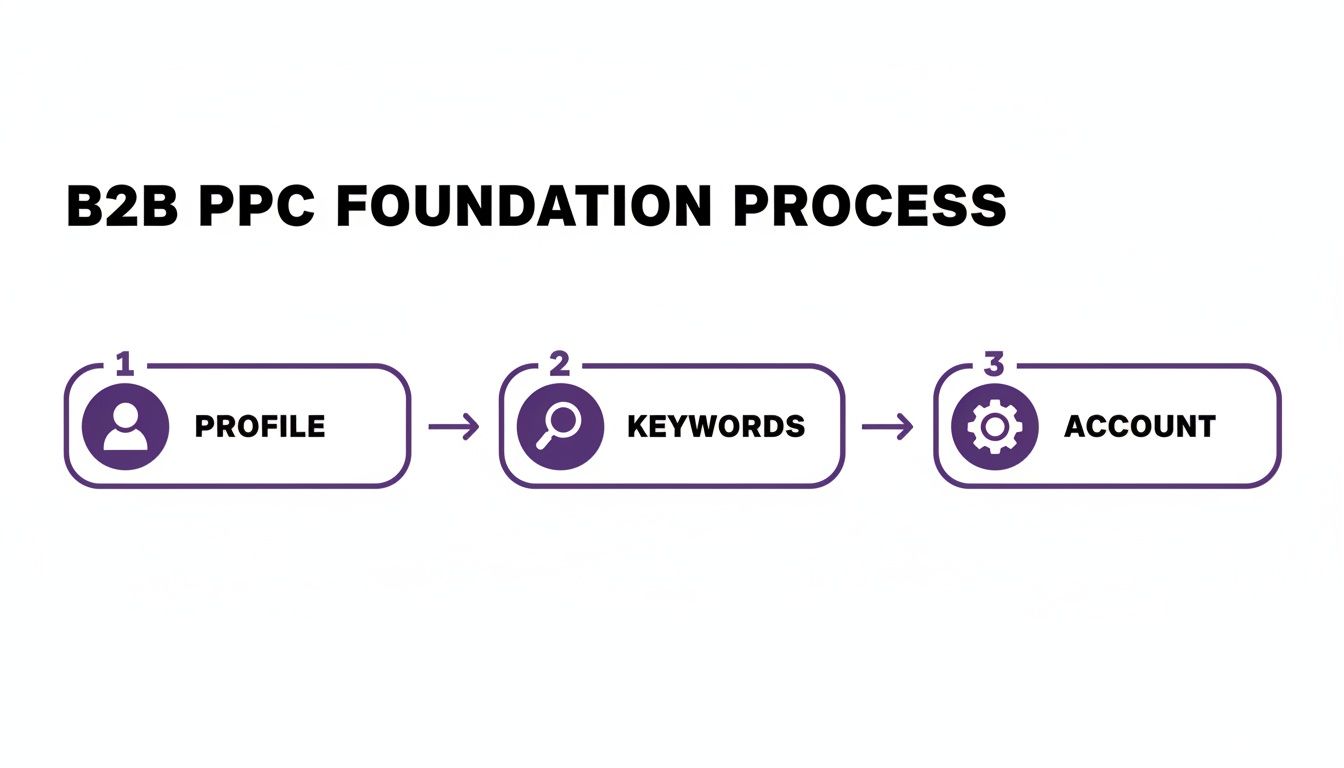
Each of these steps builds on the last. Get one wrong, and the entire structure gets wobbly. Get them right, and you've built a machine that prevents wasted spend and keeps your campaigns relevant from day one.
Define Your Ideal Customer Profile
In B2B, you're not selling to a vague demographic. You're selling to a specific person, in a specific role, at a very specific type of company. This is your Ideal Customer Profile (ICP), and it needs to be ruthlessly detailed. Generic personas simply won't cut it.
Your ICP has to go way beyond basic firmographics like company size or industry. You need to dig into the human element driving the business decisions.
- Job Titles and Seniority: Who is the actual decision-maker? Who are the influencers, gatekeepers, and end-users involved in the buying committee?
- Pain Points: What daily headaches or strategic nightmares does your product solve for them? Get specific.
- Buying Triggers: What event lights a fire under them to start searching? Think a new compliance regulation, a failed audit, or losing a major client because of an operational gap.
- Watering Holes: Where do they hang out online to get information? Are they in certain LinkedIn groups, reading niche industry publications, or following specific thought leaders?
Nailing these profiles is everything. It dictates your targeting, your messaging, and your entire strategy. If you need a hand with this, check out our guide on how to create buyer personas: https://frozencrow.com/how-to-create-buyer-personas/
Conduct Laser-Focused Keyword Research
Once you have a crystal-clear ICP, your keyword research gets a lot easier—and a lot more effective. You can finally step into your customer's shoes and ask, "What would they actually type into Google when this problem is keeping them up at night?"
With the global search advertising market projected to hit US$351.55 billion, the competition is fierce. You simply can't afford to waste money on broad, irrelevant terms.
Good keyword research means mapping terms to the different stages of the buying journey. For a great deep-dive on this, check out this practical guide to keyword research for small business.
Here's how I think about it:
- Top-of-Funnel (Awareness): These are broad, problem-aware searches. Think "what is project management software" or "cybersecurity best practices." You're capturing early-stage interest here, not closing deals.
- Middle-of-Funnel (Consideration): Now they're comparing options. Keywords look like "Salesforce vs HubSpot" or solution-focused searches like "best accounting software for small business."
- Bottom-of-Funnel (Decision): This is where the magic happens. These are high-intent, branded, or action-oriented terms like "monday.com pricing" or "hire a managed IT services provider."
Use tools like Google's Keyword Planner to validate your ideas with real search volume. Don't just guess; find the terms that have actual demand behind them.
Structure Your Account for Scalability and Clarity
Finally, how you organize your Google Ads or LinkedIn Ads account is a massive, often-overlooked deal. A messy, chaotic structure makes optimization a nightmare and reporting practically useless. Your goal should be a clean, logical hierarchy that mirrors your business goals.
A well-structured account is your command center. It lets you control budgets, tailor messaging to specific audiences, and track performance with precision. Think of it as the filing system for your entire PPC operation—if it's a mess, you'll never find what you need when you need it.
The best way to do this is to segment your campaigns logically. Some of the most effective B2B structures I've used are segmented by:
- Service or Product Line: Create separate campaigns for each distinct thing you sell. Simple, but effective.
- Buyer Persona: If you're selling to a CFO and an IT Manager, they need completely different messaging. Give them their own campaigns.
- Funnel Stage: Dedicate separate campaigns to your top, middle, and bottom-of-funnel keywords. This gives you granular control over budget allocation and lets you measure performance at each stage of the journey.
Putting in this foundational work upfront ensures every dollar you spend is a calculated investment, not a shot in the dark.
Advanced B2B Targeting and Ad Creative
Throwing your budget at generic targeting in B2B PPC is like trying to catch a specific fish with a giant, hole-filled net. You'll spend a ton of money and come up empty. Unlike consumer marketing, where a wide net can work, B2B success is all about precision—reaching a specific person, at a specific company, with a very specific problem.
This means we have to move past basic keyword strategies and get into persona-driven targeting. We’re talking about layering firmographics, intent signals, and professional data to build an audience that actually matters. The goal isn't to show your ads to everyone; it's to show them only to the right ones.
Nail Your Targeting With LinkedIn Ads
When you need to get granular, LinkedIn is in a league of its own. It's no surprise that over 80% of B2B businesses use LinkedIn Ads; the platform's professional data is an absolute goldmine for finding decision-makers. The level of detail here is something other platforms just can't match. For more on this, check out these PPC statistics and trends.
Here are a few of the most powerful targeting levers you should be pulling:
- Job Title & Seniority: This is your bread and butter. You can go straight for the "VP of Marketing" or "Director of IT" and, just as importantly, exclude interns and assistants who don't hold the purse strings.
- Company Targeting (ABM): Have a list of dream accounts? Just upload it. You can serve ads exclusively to employees at those target companies, which is the heart and soul of any good account-based marketing (ABM) strategy.
- Industry & Company Size: Layer on filters to perfectly match your ICP. Think: "Software companies with 50-200 employees in North America."
- Group Membership: This is a clever one. Target members of niche professional groups like "SaaS Founders" or "Cybersecurity Professionals" to find people actively engaged in your industry.
B2B PPC Platform Targeting Capabilities
Each platform offers a different set of tools for reaching your audience. While LinkedIn is the clear winner for professional data, Google and Microsoft offer powerful intent-based targeting that's crucial for capturing demand. Here's a quick breakdown:
| Targeting Option | Google Ads | LinkedIn Ads | Microsoft Ads |
|---|---|---|---|
| Keywords | Excellent (Broadest Reach) | Yes (Limited Scope) | Excellent (Strong B2B User Base) |
| Company Targeting | Limited (Via Custom Audiences) | Excellent (Native ABM Lists) | Excellent (LinkedIn Profile Targeting) |
| Job Title/Function | Limited (Via Custom Audiences) | Excellent (Native Data) | Excellent (LinkedIn Profile Targeting) |
| Industry | Limited (In-Market/Affinity) | Excellent (Native Data) | Excellent (LinkedIn Profile Targeting) |
| Company Size | No | Excellent (Native Data) | Excellent (LinkedIn Profile Targeting) |
| Retargeting | Excellent | Good | Excellent |
The key takeaway? Don't put all your eggs in one basket. The strongest B2B strategies use these platforms in tandem to guide prospects through the funnel.
Combining Platforms for the Win
The best B2B PPC campaigns don’t live on a single platform. You need to play to each channel's strengths to create a seamless customer journey. Think of it this way: LinkedIn is where you build awareness and educate, while Google is where you capture active, bottom-of-funnel demand.
For example, you could run a campaign on LinkedIn promoting a new whitepaper to VPs of Finance at mid-sized tech companies. A week later, when one of those VPs searches Google for "enterprise accounting software," your search ad is right there at the top. They already recognize your brand, making them far more likely to click.
The real power move is connecting these dots. Use retargeting to show Google Search Ads specifically to users who engaged with your LinkedIn content. This multi-touch approach builds the familiarity and trust needed to close a complex B2B deal.
Writing Ad Creative That Actually Solves a Problem
In B2B, your ad creative has one job: build credibility and show you understand your customer's pain. People aren't looking for a flashy discount; they're looking for a partner who can solve a real business challenge—something that will improve efficiency, cut costs, or reduce risk.
With the average click-through rate for B2B search ads sitting at a modest 2.41%, you can't afford to be vague. Your messaging has to be sharp, value-driven, and immediately relevant.
Here’s how to get your ad creative right:
- Lead with the Pain Point: Use a Problem-Agitate-Solve framework in your headlines. "Tired of Manual HR Reporting?" will grab a CHRO's attention far more effectively than "Best HR Software."
- Talk Outcomes, Not Features: Nobody cares about your "cloud-native architecture." They care about what it does for them. Instead of "AI-Powered Analytics," try "Get Accurate Revenue Forecasts in Minutes."
- Weave in Social Proof: Phrases like "Trusted by 5,000+ B2B Teams" or "Rated #1 for Customer Support" build instant trust right in the ad copy itself.
- Match the Offer to the Funnel Stage: A top-of-funnel ad should offer low-commitment value, like a free guide or webinar. A bottom-of-funnel ad needs a clear, action-oriented CTA like "Request a Demo" or "Get a Custom Quote." Don't ask for a demo from someone who just heard of you.
Designing Landing Pages That Actually Convert Leads
You can have the most brilliant, perfectly targeted ad campaign in the world, but if your landing page drops the ball, all that effort and money goes right down the drain. The post-click experience is where B2B PPC campaigns are won or lost.
A killer landing page isn’t about flashy design. It’s about clarity, trust, and making it dead simple for a busy professional to say "yes."
Think of it this way: your ad makes a promise, and the landing page has to deliver on it—instantly. This is all about message match. If your ad talks about a "cybersecurity risk assessment," your landing page headline better say "Cybersecurity Risk Assessment," not some vague fluff like "IT Security Solutions." Any mismatch creates a moment of confusion, and that’s all it takes for them to hit the back button.
The Core Elements of a B2B Landing Page
Every B2B landing page that works is built on the same foundational pieces. They all come together to guide a visitor toward one single goal. It’s basically an online sales pitch that anticipates and answers a prospect's questions before they even have to ask.
Here's what you absolutely need:
- A Razor-Sharp Value Prop: In one powerful headline, tell them what you do, who you do it for, and the biggest benefit they'll get. No jargon. No confusion.
- Trust-Building Social Proof: B2B buyers hate risk. You need to build credibility fast. Slap on logos of well-known clients, pull-quotes from happy customers, link to case studies, or show off industry awards.
- A Frictionless Form: Keep your forms short. I mean really short. Only ask for the absolute bare minimum you need to qualify a lead. Pro tip: multi-step forms often work wonders by breaking down the ask into smaller, less intimidating chunks.
- A Clear, Singular Call-to-Action (CTA): Don't be shy. Tell the user exactly what to do next. Use action-packed language like "Request My Demo" or "Download the Guide," and make that button pop off the page.
For a deeper dive into these principles, you might be interested in our guide covering the best practices for landing page design.
The "To Gate or Not to Gate" Debate
Ah, the classic B2B dilemma. Do you put that awesome piece of content behind a form? Gating content obviously gets you leads, but it also puts a barrier between your prospect and your insights.
There’s no single right answer here. It all comes down to your campaign goal and how valuable the asset is.
A simple framework: If the whole point is to generate MQLs with a high-value asset (like a deep industry report or a proprietary tool), gate it. If you’re just trying to get maximum reach and brand awareness with top-of-funnel content (like a blog post or infographic), leave it open.
A monster "2024 State of SaaS Marketing" report? That's a perfect candidate for gating. A quick checklist on "5 Ways to Improve Email Open Rates"? Better to leave that one ungated to attract a much wider audience.
A/B Testing Your Way to Higher Conversions
Even tiny changes can have a massive impact on your page’s performance. The average conversion rate for B2B search ads hovers around a measly 3.04%, which means you can't afford not to be optimizing. Stop guessing what works and start A/B testing to make data-driven decisions.
Start by testing the big stuff, one element at a time:
- Headline: Pit a benefit-driven headline against one that agitates a pain point.
- CTA Button: Test a different color (orange vs. green) or different copy ("Get Started" vs. "Request a Quote").
- Page Layout: Try a version with the form on the right versus one with it on the left.
- Social Proof: See what works better—a slick video testimonial or a simple row of client logos.
Even a small lift in your conversion rate can slash your cost per acquisition and send your campaign ROI through the roof. The secret is to test methodically, let the data tell you what to do next, and never stop iterating.
Strategic Bidding and Budget Management
Managing your budget and bids in B2B PPC is a completely different ballgame than B2C. You aren’t just chasing a quick online sale; you're playing the long game, building a relationship that might take months to pay off. The whole process is more complex—longer sales cycles, more people to convince, and much higher customer lifetime values. This means every dollar you spend needs to be deliberate.
This isn't about snagging the cheapest clicks possible. It's about winning the right clicks at a cost that actually makes sense for your business. Nail this, and you’ll have a reliable engine for generating high-value leads. Get it wrong, and you'll burn through your budget with almost nothing to show for it.
Choosing Your Bidding Strategy
Your bidding strategy on platforms like Google Ads is the lever that controls how your budget gets spent. The choice really boils down to how much control you want versus how much you want to lean on automation. It all depends on your campaign's maturity, how much conversion data you have, and what you’re trying to achieve.
- Manual CPC (Cost-Per-Click): This puts you in the driver's seat. You set the maximum bid for every keyword or ad group yourself. It’s perfect for brand-new campaigns where you have zero conversion data and need to keep a close eye on costs while you figure out what works.
- Target CPA (Cost-Per-Action): Once you start seeing a consistent flow of conversions—think at least 15-30 a month—you can hand the reins over to this automated strategy. You tell Google your target cost per lead, and its algorithm goes to work finding people likely to convert at that price.
- Maximize Conversions: This one does exactly what it says: it tries to get you the most conversions possible within your daily budget. It’s a powerful tool but can be aggressive with your spend, so you need to be sure you’ve set a daily budget you’re comfortable maxing out.
I usually start new campaigns with Manual CPC to gather initial data and get a feel for the landscape. Once the conversions start rolling in, I'll switch over to Target CPA and let the algorithm do the heavy lifting.
The Rise of Mobile in B2B PPC
The old idea that B2B decision-makers are chained to their desktops is completely outdated. They’re researching on their phones just like everyone else. In fact, mobile spend is on track to gobble up 66% of total digital ad budgets, and it already drives 52% of all paid clicks.
What does this mean for you? A mobile-first experience isn't a "nice-to-have" anymore. It's a necessity.
Optimizing for mobile goes beyond just having a responsive landing page. You have to think about the user’s context. They’re likely on the go, looking for a quick answer or an easy way to get in touch. Your ads and landing pages have to be built for that reality.
To stay competitive, you need to focus on a few key things:
- Short, Punchy Ad Copy: Small screens mean less room for fluff. Get straight to the point.
- Click-to-Call Extensions: Make it dead simple for a prospect to call you right from the ad.
- Fast, Responsive Landing Pages: If your page takes more than a couple of seconds to load on a phone, you’ve already lost. That lead is gone.
Allocating Your Budget Effectively
A smart budget strategy isn't about spreading your money evenly across all your campaigns. It’s about doubling down on what works and funding your most profitable efforts.
A simple, practical way to think about this is to segment your budget by intent. For instance, you could pour 70% of your budget into high-intent, bottom-of-funnel search campaigns that capture people ready to make a decision. The other 30% could then be split between mid-funnel remarketing campaigns and top-of-funnel awareness efforts on platforms like LinkedIn.
Knowing what a lead is actually worth to your business is the cornerstone of any effective bidding strategy. If you don't know this number, you're just guessing. A Lead Value Calculator can help you figure out exactly how much you can afford to pay for each lead.
This is critical in the B2B world, where the average CPA can easily top $116. Once you know your lead value, you can bid with confidence, knowing that your campaigns are directly tied to revenue and set up for a strong return on ad spend (ROAS).
Measuring B2B PPC Success Beyond the Click
In the world of B2B advertising, a click is just a handshake, and a form fill is only the start of a much longer conversation. If you're still judging your campaigns on vanity metrics like clicks and impressions, you're setting yourself up to misread performance and burn through your budget.
Real success isn't found at the top of the funnel. It's measured much deeper, where marketing efforts actually connect to revenue. It’s all about shifting your focus from front-end metrics to the KPIs that genuinely matter to the business's bottom line.
Moving Beyond Simple Conversion Tracking
Let’s be honest: a "conversion" in B2B is rarely a single event. The path from a prospect's first ad click to a signed contract can take months and involve dozens of touchpoints. Your measurement strategy has to account for that complexity.
The first step is getting crystal clear on what a quality lead actually is. Not all demo requests are created equal. You need to be able to track how these leads progress through your sales pipeline, from initial interest to a closed-won deal.
This is where you need to get obsessed with metrics like:
- Cost per Marketing Qualified Lead (MQL): How much are you paying to get a lead your marketing team actually deems worthy of a sales conversation?
- Cost per Sales Qualified Lead (SQL): What does it cost to generate a lead that the sales team has accepted and is actively working?
- Pipeline Contribution: This is a big one. What percentage of the active sales pipeline came directly from your PPC campaigns? This is how you prove your value to leadership.
- Return on Ad Spend (ROAS): The ultimate gut check. Are you profitable? This is the revenue you generated divided by your total ad spend.
Tracking these KPIs properly means you absolutely must have a tight integration between your ad platforms (like Google Ads and LinkedIn) and your CRM (like Salesforce or HubSpot). For a deeper dive, you can learn more about setting up proper Google Ads conversion tracking in our detailed guide.
Why Attribution Models Are Everything
Attribution is simply the process of giving credit to the marketing touchpoints that influence a sale. With long B2B sales cycles, a customer might see a LinkedIn ad, click a Google search ad a month later, and then finally convert from an email campaign. Who gets the credit?
In B2B, single-touch attribution can be dangerously misleading. A last-click model might make your branded search campaigns look like heroes, while completely ignoring the top-of-funnel LinkedIn ad that introduced the prospect to your brand three months earlier.
Here’s a quick breakdown of the common models:
- First-Touch Attribution: Gives 100% of the credit to the very first interaction. It’s great for understanding which channels are best at generating initial awareness and filling the top of your funnel.
- Last-Touch Attribution: Assigns all the credit to the final touchpoint before the conversion. It’s simple, but it often overvalues bottom-of-funnel activities and ignores everything that got the prospect there in the first place.
- Multi-Touch Attribution: These models are far more nuanced and distribute credit across multiple interactions. Models like Linear, Time-Decay, and U-Shaped each offer a different way to weigh the importance of each step in the buyer’s journey.
Choosing the right attribution model really comes down to your business goals. If you're focused on demand generation, a first-touch model might be perfect. If you’re all about closing deals that are already in the pipeline, you might lean toward a model that gives more weight to later interactions.
The table below breaks down some of the most critical KPIs to watch at each funnel stage.
Essential KPIs for B2B PPC Campaigns
| Funnel Stage | Primary KPI | Why It Matters |
|---|---|---|
| Top of Funnel (Awareness) | Impressions, Clicks, Click-Through Rate (CTR) | Measures initial reach and engagement. Are you getting in front of the right audience and is your message resonating enough for a click? |
| Middle of Funnel (Consideration) | Conversions (e.g., eBook downloads, webinar sign-ups), Cost Per Lead (CPL) | Tracks how effectively you're turning visitors into known leads. This is the first step in nurturing a long-term relationship. |
| Bottom of Funnel (Decision) | Marketing Qualified Leads (MQLs), Sales Qualified Leads (SQLs), Cost Per MQL/SQL | Connects marketing efforts to sales-ready leads. This is where you measure lead quality, not just quantity. |
| Post-Conversion (Revenue) | Pipeline Contribution, Customer Acquisition Cost (CAC), Return on Ad Spend (ROAS) | The ultimate measure of success. This ties your ad spend directly to new business and proves the financial impact of your campaigns. |
Ultimately, your goal is to build a complete, end-to-end picture of the customer journey. This means tracking a lead from the moment they click your ad, through your website, into your CRM, and all the way to a closed deal.
While the average Cost Per Action (CPA) for B2B search ads hovers around $116, knowing which of those actions actually turn into revenue is the key. It's what allows you to stop guessing and start optimizing your spend with confidence, scaling the campaigns that drive real, measurable growth.
Answering a Few Common B2B PPC Questions
Even with a perfect plan, B2B advertising has its quirks. Let's tackle some of the most common questions we hear from marketers trying to navigate these tricky waters.
What Is a Good Cost Per Lead for B2B PPC?
This is the million-dollar question, isn't it? But the honest answer is: there's no single magic number. A "good" Cost Per Lead (CPL) is completely relative to your business.
For a company selling a simple software subscription, a $200 CPL might sound like a five-alarm fire. But for another business selling enterprise solutions where the customer lifetime value (CLV) is $100,000, that same $200 CPL is an absolute steal. The metric is meaningless without context.
The only way to answer this is to work backward from your revenue. Figure out your target CPL by looking at your CLV, your sales team's close rate, and the return you need to see. This changes the question from "what's a good CPL?" to "what CPL can my business actually afford while staying profitable?"
How Is B2B PPC Different From B2C PPC?
The platforms might be the same, but the game is totally different. The core distinctions really boil down to who you're talking to, why they're listening, and how long it takes them to make a decision.
- Audience Size: B2B is about precision. You might be targeting a tiny, specific group of a few thousand key professionals, while B2C campaigns often blast their message to millions.
- Sales Cycle: B2B deals are marathons, not sprints. They're long, complicated, and usually involve a whole committee of decision-makers. B2C purchases? They're often quick, emotional, and made by one person.
- Messaging: In B2B, your ad copy needs to speak the language of business—think ROI, efficiency, and solving complex operational headaches. B2C is all about appealing to emotion, desire, and getting that instant gratification.
Put simply, B2C is a volume game. B2B is a quality game.
Which Platform Is Better: Google Ads or LinkedIn Ads?
This isn't an "either/or" situation. It's a "when and why" one. Both platforms are pillars of a strong B2B strategy, but they serve two very different—and very complementary—purposes.
Google Ads is for capturing intent. It’s the undisputed king of reaching people who are actively looking for a solution right now. When a VP of Operations types "best logistics management software" into that search bar, you have to be there. It’s your go-to for grabbing those bottom-of-the-funnel, hand-raised leads.
LinkedIn Ads is for creating demand. Its real power is in its ridiculously specific targeting. You can put your message directly in front of the exact job titles at the exact companies you want to work with, long before they even realize they need you. This makes it perfect for top-of-funnel campaigns, sharing valuable content, and building an audience of ideal future customers.
A winning strategy uses both. You use LinkedIn to get on their radar and show them you know your stuff, and you use Google Ads to be the obvious answer when they’re finally ready to buy.
At Frozen Crow Inc., we turn these complex strategies into measurable growth for your business. If you're ready to build a PPC engine that drives quality leads and proves its ROI, we're here to help. Schedule your free marketing audit today and let's start building your success story.


