


November 18, 2026
IT Solutions for Business Growth and Success
IT solutions are simply the tools and services—things like cloud storage, cybersecurity, and data analytics—that help a business run smoothly, stay safe, and grow. These aren't just nice-to-haves anymore; they're the very engine powering how modern companies operate, compete, and collaborate.
Why Modern IT Solutions Are Your Business Engine
Let's cut through the buzzwords. At its heart, a strategic IT setup acts like the central nervous system for your entire company. It’s what connects sales, operations, marketing, and customer service, allowing every part of your business to move and adapt together.
Without this connected system, you get information silos. Marketing doesn't know what sales is doing, and operations can't see what's coming down the pipeline. A solid IT framework makes sure information flows where it’s needed, when it’s needed. For instance, when your sales team logs a customer interaction in a cloud CRM, marketing can immediately use that insight to sharpen their messaging. It creates a smarter, more responsive business.
From Cost Center to Growth Driver
For decades, business leaders saw IT as a line item on the budget—a necessary cost just to keep the lights on and the computers running. That whole mindset is outdated. Today, the right technology is a powerful tool for generating revenue and boosting efficiency. Instead of just reacting to problems, modern IT solutions proactively create new opportunities.
This change in perspective is key to building a resilient company. This idea of using technology as a business engine is the core of digital transformation, a crucial strategy for any business that wants to stick around. By automating tedious tasks, for example, technology frees up your people to focus on what really matters: strategy, innovation, and building customer relationships.
A well-chosen IT solution doesn't just fix one problem; it elevates your entire company's potential. It transforms raw data into smart decisions, protects your most valuable assets, and gives you the agility to navigate a fast-moving market.
The Foundation for Modern Operations
To succeed today, every business needs a solid technological foundation. This isn't about chasing the latest shiny object; it's about putting core building blocks in place that support your long-term vision. A strong IT framework usually rests on three pillars:
- Cloud Services: Giving you secure and scalable access to your data and software from anywhere, on any device.
- Cybersecurity: Shielding your digital assets and customer information from an endless stream of threats.
- Data Analytics: Helping you spot trends, predict outcomes, and make better decisions by understanding the information you already have.
These aren't separate, isolated tools. They’re all part of a single, interconnected strategy. Your cybersecurity protects the data you store in the cloud, and your analytics tools make sense of that data to guide your next move. This guide will walk you through each of these components, showing you how they fit together to build a resilient, efficient business that's ready for whatever comes next.
Exploring the Core IT Solutions Your Company Needs
Diving into IT solutions can feel like you're trying to learn a completely new language. Let’s cut through the jargon. Instead of thinking about abstract tech, let's look at these services as powerful tools designed to solve specific, real-world business problems. Each has a distinct role, and together, they build a more resilient and agile company.
Unlocking Flexibility with the Cloud
Think of cloud services as your company's infinitely expandable, state-of-the-art digital warehouse. Instead of sinking a small fortune into building, cooling, and securing your own server room, you're essentially renting space in a top-tier, professionally managed facility. This smart move flips a huge capital expense into a predictable, manageable operational cost.
This model gives you incredible agility. Imagine a small e-commerce shop gearing up for a holiday sale. With the cloud, it can instantly scale up website capacity to handle the rush and then scale right back down when things quiet down, only paying for what it actually used. No more crashed websites during peak traffic or wasted money on servers sitting idle.
Fortifying Your Digital Borders
Next up are cybersecurity solutions. These are your company's digital bodyguards, surveillance systems, and reinforced vaults all rolled into one. In today's world, where digital threats are a constant, a single lock on the door just doesn't cut it anymore. Robust cybersecurity is all about protecting your most valuable assets, from financial records to customer data.
It works by creating layers of defense. A firewall, for instance, acts like a perimeter fence, stopping malicious traffic before it even gets close to your network. At the same time, endpoint protection on employee laptops and phones acts like a security guard at every door, constantly watching for suspicious activity. If one layer is breached, others are ready to stop an attack in its tracks.
The image below shows how these different IT solutions work together to deliver real business benefits.
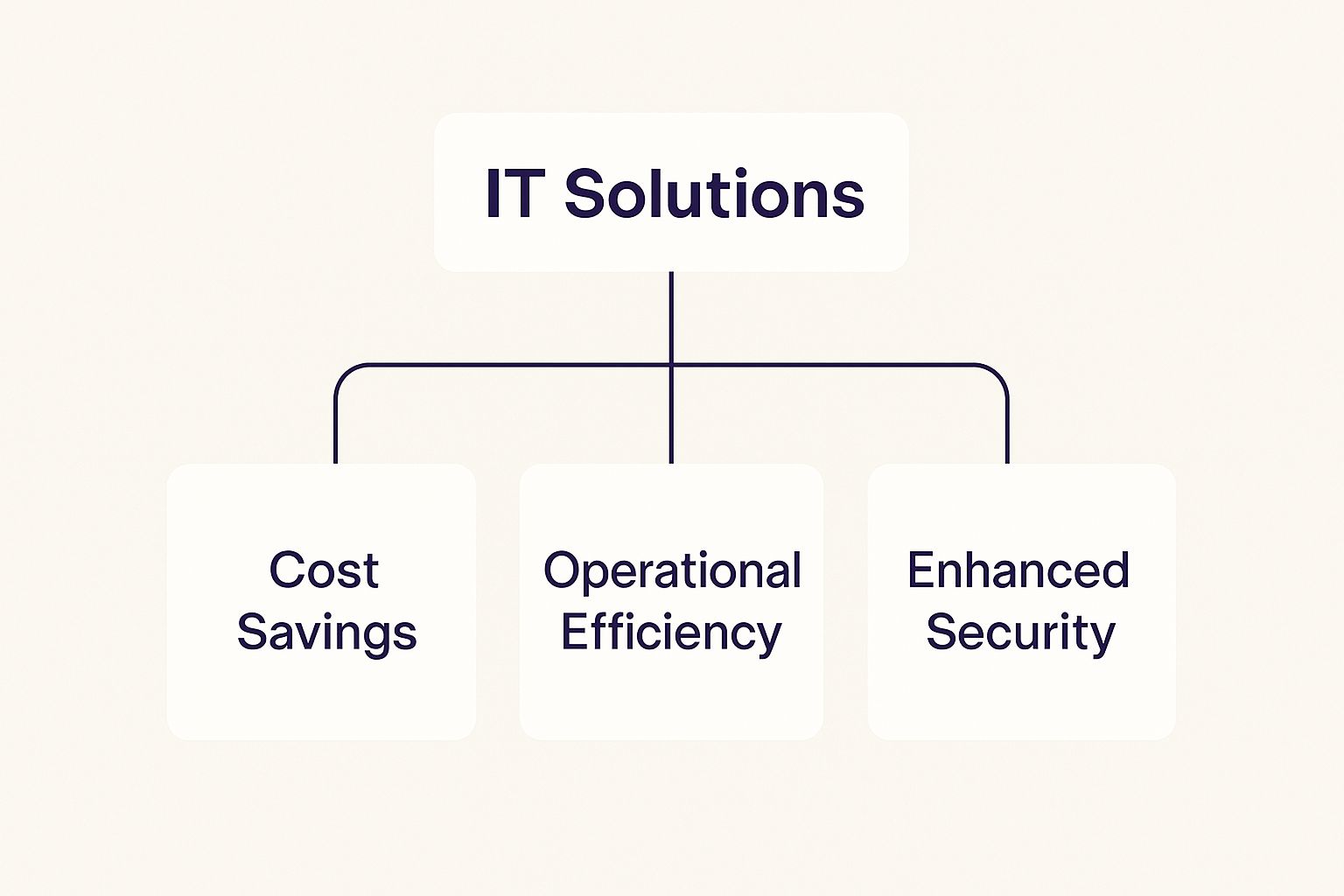
As you can see, a well-thought-out IT strategy directly leads to better efficiency, lower costs, and much stronger security across the board.
Turning Raw Data Into Actionable Insights
So many businesses are sitting on a goldmine of information and don't even know it. This is where data analytics comes in. Picture it as having a dedicated team of market researchers who can sift through mountains of data points—from sales figures to website clicks—to find meaningful patterns and trends. It’s about turning all those raw numbers into a clear, compelling story.
For a retail business, this could mean discovering which products people frequently buy together, paving the way for smarter promotions. A service company could analyze support tickets to find recurring problems, allowing them to fix the root cause instead of just patching the symptoms. Analytics takes the guesswork out of making big decisions.
By transforming raw numbers into a strategic roadmap, data analytics gives you the power to anticipate customer needs, optimize operations, and confidently identify new growth opportunities before your competitors do.
This laser focus on data-driven growth is a huge reason the global IT services market is booming. Projections show it’s on track to hit $2.32 trillion by 2032. At the same time, with cyber threats getting smarter, around 77% of organizations have rightly decided to increase their cybersecurity budgets to protect their operations and their customers.
Creating Tools for Your Unique Challenges
Finally, there are times when an off-the-shelf program just won't cut it. Custom software development is like hiring a master craftsman to build a tool for a very specific, critical job. Sure, a standard wrench works for most bolts, but sometimes you need something designed for a unique purpose. That’s what custom software does—it solves the problems that generic applications can't touch.
A logistics company, for example, might need a custom app to run a complex delivery route algorithm that standard software can’t handle. Or a healthcare provider might need a patient management system that integrates with older, specialized equipment. To get a better sense of how custom technology can reshape a business, it's worth looking into intelligent automation solutions.
To help you see how these pieces fit together, here’s a quick summary of the main IT solution categories and what they do for a business.
Key IT Solution Categories and Their Business Impact
| IT Solution Category | Primary Function | Common Business Problems Solved |
|---|---|---|
| Cloud Services | Provides on-demand access to computing resources like servers, storage, and databases over the internet. | High upfront hardware costs, lack of scalability, difficult remote access, and complex disaster recovery. |
| Cybersecurity | Protects networks, devices, and data from unauthorized access, cyberattacks, and damage. | Data breaches, malware infections, ransomware attacks, compliance violations, and reputational damage. |
| Data Analytics | Collects, processes, and analyzes large datasets to uncover insights, trends, and patterns. | Poor decision-making, missed market opportunities, inefficient operations, and a lack of customer understanding. |
| Custom Software | Designs, creates, and deploys software applications tailored to specific user or organizational needs. | Inefficient workflows, lack of integration between systems, and unique business processes not covered by off-the-shelf software. |
These four pillars—cloud, security, analytics, and custom software—form the foundation of a modern IT strategy. Each one addresses a fundamental business need. When they’re integrated thoughtfully, they empower a company to run more efficiently, securely, and intelligently. The real secret is identifying your biggest challenges and matching them with the right tool for the job.
The Financial Case for Strategic IT Investment
Every business owner eventually hits a wall and asks the big question: "Is all this tech really worth the money?" It's easy to look at IT solutions for business and see just another line item on the expense report. But that’s a limited view.
The smarter way to think about it is to flip the question. Don't ask what it costs; ask what it earns. The right technology isn't a cost center—it's a powerful engine for generating revenue, cutting operational waste, and building a more resilient company. The real impact isn't the upfront price tag, but the long-term gains.
From Capital Drain to Operational Gain
One of the biggest financial game-changers in modern IT is the move away from huge, unpredictable capital expenditures (CapEx). Not long ago, growth meant buying racks of expensive servers, new hardware, and boxes of software licenses. This approach tied up massive amounts of cash in equipment that was guaranteed to become outdated.
Cloud services turn that entire model upside down.
Instead of buying a server, you're essentially renting the exact amount of computing power you need, right when you need it. This simple shift turns a daunting capital expense into a predictable, manageable operating expense (OpEx).
The effect on your cash flow is enormous. It frees up money you can put back into the business—hiring key people, launching a new marketing campaign, or developing a new product. You’re no longer forced to guess what your needs will be in five years; you just pay for what you use today and scale up or down instantly.
Slashing Costs with Smart Automation
Beyond the CapEx vs. OpEx shift, a smart IT strategy directly trims your day-to-day operational costs. Just think about all the repetitive, manual chores that eat up your team's time. We're talking about tasks like data entry, sending out invoices, or pulling the same reports week after week. These aren't just boring; they're breeding grounds for human error, which can be surprisingly expensive to fix.
Automation tools can handle these jobs flawlessly, 24/7. This brings two major financial wins:
- Reduced Labor Costs: You can get much more done without having to hire more people for administrative work.
- Increased Productivity: Your team is free to focus on the high-value, creative work that actually moves the needle, like talking to customers or dreaming up new ideas.
This isn't just a minor tweak. It's a fundamental upgrade to your business engine, making every pound spent on payroll work harder for you. To really dig into this, check out this fantastic guide to investment in technology for growth to see these principles in action.
Cybersecurity as a Financial Shield
It's tempting to see cybersecurity as a grudge purchase—another necessary cost of doing business. That’s a dangerous and short-sighted view. A solid security plan is one of the smartest financial moves you can make. Think of it less like an expense and more like an essential insurance policy against total disaster.
The fallout from a single data breach can be catastrophic, going far beyond the immediate clean-up. You could be facing regulatory fines, legal bills, and the cost of compensating customers. Worse yet is the long-term damage to your reputation. A proactive investment in good security is a tiny fraction of the cost of recovering from a breach.
There’s a reason global IT spending is projected to hit a staggering $5.74 trillion in 2025, with over $1.7 trillion of that going to IT services alone. Security and AI are huge drivers of that growth. Investing in the right it solutions for business isn't just about playing catch-up; it's about laying a stronger, more profitable, and more secure foundation for whatever comes next.
How to Choose the Right IT Solutions Partner
Picking the right technology is only half the battle. The real make-or-break decision is finding an IT partner who acts less like a vendor and more like a strategic part of your team. This relationship is critical—a great partner doesn't just install software; they take the time to understand your business goals and then build a technology plan to get you there.
Get this choice wrong, and you could be stuck with recurring tech problems, surprise costs, and a system that holds you back instead of propelling you forward. The goal is to find a team that fits so well with yours that they feel like an in-house department, offering expertise and support that’s always just a call away. This isn't a decision to rush.
Evaluate Their Industry Experience
The first thing you should look for is experience in your specific industry. It’s a non-negotiable. A provider who works with law firms all day knows the ins and outs of legal compliance and security. The same goes for a partner specializing in e-commerce—they’ll already have deep knowledge of inventory systems, payment gateways, and protecting customer data.
General IT knowledge is fine, but industry-specific expertise is where the real value is. These providers have seen the common roadblocks, they get the regulatory pressures, and they can recommend it solutions for business that are already proven to work for companies just like yours. They speak your language from day one.
When you're talking to potential partners, ask for case studies or references from businesses in your niche. A proven track record is the best evidence you can get.
Assess Their Scalability and Flexibility
Your business isn't going to stand still, so your IT partner shouldn't either. The provider that’s a perfect fit for a 10-person startup might not have the chops to support a 100-person company. You have to choose a partner whose services can grow right along with you.
This means looking for service models that can scale. Can they easily add new users when you hire? Expand your cloud storage on short notice? Roll out more advanced security when you need it? A rigid, one-size-fits-all contract is a recipe for frustration. You want flexible agreements that let you dial services up or down as your needs change.
A true technology partner invests in your future success, not just your current needs. They should be able to present a clear vision of how their support will evolve as you hit new growth milestones, ensuring your technology never limits your ambition.
This kind of forward-thinking approach is what separates a simple service provider from a genuine strategic partner who is committed to your long-term journey.
Scrutinize Their Support and Service Agreements
A partnership can turn sour fast if the support is terrible. Before you sign anything, you need to understand their support structure and get familiar with their Service Level Agreement (SLA). The SLA is the official document that spells out their commitments on things like uptime and how fast they'll respond when you have a problem.
Don't let them get away with vague promises like "great support." You need to dig deeper with specific, practical questions to understand what really happens when things go wrong.
Here’s a checklist of questions you should ask every potential IT provider:
- What are your guaranteed response times? Get specific numbers for different levels of urgency. A full system outage should get a much faster response than a minor software bug.
- How do you handle client onboarding? A well-organized onboarding process means a smooth transition with minimal disruption to your business.
- What are your standard security protocols? Ask about their own internal security and what measures they'll put in place for you.
- Who will be my primary point of contact? Having a dedicated account manager or a small, consistent team makes a world of difference for accountability.
- What’s included in the monthly fee, and what costs extra? You need total transparency here. Hidden fees for project work or after-hours support can kill a budget.
Choosing the right IT partner is a foundational decision that will affect your entire business for years. By focusing on industry expertise, scalability, and transparent support, you can find a partner who won’t just fix today's headaches but will help you build a more efficient, secure, and successful company.
A Practical Roadmap for Successful IT Implementation
You've picked the right technology and found a great partner. That’s a huge win, but the real work is just beginning. Even the most powerful it solutions for business can fall flat if the rollout is a mess. A successful launch isn't about flipping a switch and hoping for the best; it's a deliberate process designed to minimize headaches and get your team on board from day one.
To keep things from getting overwhelming, let's break it down into three manageable phases: thoughtful planning, careful deployment, and continuous optimization. This approach turns a potentially stressful transition into a smooth upgrade that actually delivers on its promises.
Phase 1: The Planning Stage
Before anyone installs a single piece of software, you need a rock-solid plan. Honestly, this is the most important part of the whole process. Think of it like drawing up the blueprints before you start pouring the foundation for a new house. The decisions you make here will shape the entire project.
The first step is getting all the key players in the same room. This isn't just about the leadership team who signed the check; it includes the department managers and the people who will be using these new tools every single day. Getting their input early helps you spot potential roadblocks and builds a sense of ownership, which is crucial for a smooth transition later on.
With everyone aligned, it's time to set clear, measurable goals. "Improve efficiency" is way too vague to be useful. You need concrete targets to aim for.
- Reduce manual data entry time by 25% within the first quarter.
- Decrease system downtime by 15% over the next six months.
- Improve customer response times by 20% by the end of the year.
These specific metrics give you a clear yardstick to measure the project's real-world impact and ROI.
Phase 2: The Deployment Stage
With a solid plan in hand, you're ready to get your hands dirty. The deployment phase is where the new solution gets plugged into your existing business operations. This involves some technical heavy lifting, but just as importantly, it requires getting your team ready for the change.
Data migration is usually the first big hurdle. You have to move all your information from the old system to the new one, and it needs to be done meticulously to ensure nothing gets lost or scrambled. Right after that comes system integration, which is all about making sure the new solution can talk to your other essential tools, like your accounting software or CRM.
The most overlooked aspect of deployment is almost always the human one. You can install the most brilliant technology in the world, but if your team doesn't know how to use it, the investment is a total loss. Good training isn't optional—it's essential.
And don't think of training as a one-and-done meeting. It should be an ongoing effort with resources your team can always access, like workshops, quick video tutorials, and easy-to-read guides. This is how you turn hesitation into confidence and get people excited about the new tools.
Phase 3: The Optimization Stage
Going live doesn't mean you're finished. In many ways, this is where the real value starts to build. The optimization phase is a continuous loop of monitoring how things are going, listening to feedback, and tweaking the system so it grows along with your business.
Right after launch, keep a close eye on system performance. Are you hitting those goals you set back in the planning phase? Use analytics to track your key metrics. This data will show you what's working beautifully and where you might need to make some adjustments, taking all the guesswork out of the equation.
It's just as important to get feedback directly from your employees. They're in the trenches every day and will have the best insights into what’s a genuine help and what’s just a frustration. Regular check-ins or simple surveys can help you catch small issues before they blow up into major problems.
This final phase transforms your IT project from a one-time event into a living, breathing part of your business strategy. By constantly refining your tools based on real performance and user feedback, you guarantee your it solutions for business will keep delivering maximum value for years to come.
Staying ahead of the curve isn't just a good idea anymore—it's essential for survival. The tech world is always moving, and the shifts we see coming will fundamentally change how businesses run. Getting ready now means you won't just keep up; you'll stay competitive and relevant for the long haul. This isn't about jumping on every shiny new trend, but about being smart and choosing the right it solutions for business that will actually pay off down the road.
We're already seeing technologies like Artificial Intelligence (AI) and the Internet of Things (IoT) move from buzzwords to real-world tools. AI, for instance, isn't just for basic data entry anymore. It's now capable of automating complex workflows, which frees up your sharpest people to focus on strategy and growth. In the same way, IoT sensors can give a manufacturing company a live look at its machinery, making it possible to predict when a part will fail before it breaks down and shuts down the line.
What's Coming Next?
Over the next ten years, the big move will be toward proactive and predictive systems. Think less about reacting to problems and more about getting ahead of them. This is especially true in cybersecurity. The old model of cleaning up after an attack is being replaced by tools that can anticipate threats. Predictive security uses AI to watch for unusual network activity and flag potential issues before they ever become a full-blown breach.
Adopting new tech isn't about ripping out everything you have and starting over. It's about making smart, incremental changes that build a stronger, more efficient, and forward-looking business over time.
This constant evolution is fueling some serious growth. The global IT services market is on track to nearly double, jumping from $1.61 trillion in 2025 to a projected $2.98 trillion by 2034. That surge shows a worldwide demand for smarter, more connected technology, with North America leading the pack. If you want to dig into the numbers and see what's behind this massive expansion, you can learn about the IT services market forecast from Precedence Research. It’s a clear signal that building a future-focused IT strategy today is one of the best investments you can make.
Frequently Asked Questions About IT Solutions
Diving into IT solutions often brings up more questions than answers. It's completely normal. To help clear things up, I've put together some straightforward answers to the questions I hear most often from business owners just like you.

How Much Should a Small Business Budget for IT Solutions?
While there's no magic number, a common guideline you'll hear is to set aside 3% to 6% of your annual revenue for IT. But honestly, that's just a starting point. A much smarter approach is to budget based on what your business actually needs to accomplish.
Think about it this way: what are your biggest operational headaches right now? Are there security risks keeping you up at night? A good IT partner can help you pinpoint these high-priority areas and suggest a practical, phased plan. You can tackle the most critical needs first—like reliable data backups or a professional email system—and see an immediate return without draining your budget.
What Is the Very First Step to Finding IT Solutions?
Before you pick up the phone or send a single email to a vendor, your first step should always be to look inward. Sit down with your team and get a crystal-clear picture of the challenges you're facing every day. This internal needs assessment is absolutely crucial.
Jot down the specific problems you need to solve. For instance:
- Are slow, clunky systems wasting your team's time?
- Do you worry about security gaps that could expose sensitive customer information?
- Are your current tools making it difficult for remote or hybrid teams to work together effectively?
With a solid list of problems in hand, you can then define what success would look like. This clarity is your greatest asset; it allows you to ask vendors the right questions and filter out solutions that don't address your real-world needs.
The best IT strategies don't begin with a shopping list of technology. They start with a deep understanding of your business goals. When you know where you're going, every IT decision becomes a stepping stone to get you there.
How Can I Measure the ROI of My IT Investment?
Measuring the return on an IT investment is about looking beyond just the invoice. You need to consider both the hard numbers and the "softer" improvements that impact your daily operations. Combining these two perspectives gives you the full story of what your IT solutions for business are truly worth.
On the quantitative side, you can track concrete metrics. Look for direct financial wins like reduced spending on hardware repairs, less system downtime, and measurable increases in how much work your team gets done.
But don't stop there. The qualitative benefits are just as important. Think about things like a boost in team morale because they're no longer fighting with frustrating tech, or happier customers who get faster, more reliable service. To really see the impact, take a snapshot of these metrics before you make a change. That "before and after" picture is the clearest proof of your investment's value.
Ready to stop guessing and start growing? Frozen Crow Inc. provides strategic IT services and digital marketing that deliver measurable results. We turn your technology challenges into growth opportunities. Get your free audit today and build a smarter IT roadmap.


