


October 13, 2026
A Guide to Outsource Lead Generation
To keep a business growing, you have to keep the sales pipeline full. That’s a given. But doing it consistently can absolutely drain your internal team, pulling them away from what they do best.
That’s why making the call to outsource lead generation isn't just about cutting costs anymore—it’s a strategic play. It gives you access to specialized skills and tech, freeing up your sales reps to focus on one thing: closing deals.
Why Top Companies Outsource Lead Generation
Forget the old view of outsourcing as just a way to save a few bucks. Today, it’s a full-blown growth strategy.
Think about what it takes to run a lead generation team in-house. It’s a massive undertaking. You’ve got salaries, constant training, and a sophisticated tech stack that needs to be managed and paid for. It all adds up, and fast.
This pressure often forces sales reps to spend way too much time prospecting instead of actually talking to qualified buyers. I’ve seen it happen time and time again—it’s a huge pain point for so many companies.
Overcoming Internal Limitations
An in-house team, no matter how good, runs into some pretty common walls:
- Sky-High Overhead: The combined cost of salaries, benefits, software licenses, and training for an internal team is seriously expensive.
- Lack of Specialization: Your team might be killer closers, but are they experts in multi-channel prospecting? What about data enrichment or writing cold outreach copy that actually gets a response? Probably not.
- Scaling is a Nightmare: Trying to ramp your lead gen efforts up or down to match the market is clunky and inefficient with a fixed team.
When you outsource, you're not just hiring a service; you're plugging directly into a team of specialists who live and breathe this stuff. They already have the proven playbooks, the right tech, and the talent to start delivering from day one. That's a massive head start.
A Strategic Shift Towards Efficiency
Choosing to bring in a partner for lead generation lets you scale your growth without the headache of building an entire department from scratch. The numbers back this up. With 50% of marketers calling lead generation a top priority, the demand for efficient, expert solutions is only growing. You can see more on these trends in this lead generation outsourcing report.
This approach also lets you get smarter with your strategy. While your partner handles all the top-of-funnel work—finding and warming up leads—your internal team can focus on what they were hired for: building relationships and closing sales.
For example, the effectiveness of email marketing skyrockets when it's managed by experts as part of a coordinated outreach plan. This division of labor is precisely why smart companies now see outsourcing not as an expense, but as a core investment in their long-term success.
Defining Your Goals and Ideal Customer Profile

Before you even think about talking to a potential partner, you need a rock-solid blueprint. Kicking off the process to outsource lead generation without this foundation is like setting sail with no map and no destination. Sure, you'll be moving, but you won't end up anywhere you actually want to be.
The first move is to get past vague, unhelpful wishes. "We need more leads" isn't a strategy. It's a complaint. To give any partner a fighting chance at success, you have to define exactly what a win looks like in sharp, measurable terms.
This means getting granular. Forget the generic requests. A strong goal gives your campaign-specific targets that will guide every single decision.
Setting SMART and Actionable Goals
Think of your goals as the North Star for your entire campaign. A great framework I always come back to is SMART (Specific, Measurable, Achievable, Relevant, Time-bound). It’s what turns a fuzzy idea into a clear directive your outsourced team can actually run with.
Let’s look at a real-world example. A weak goal sounds like this: "Increase leads from the tech sector." It’s basically useless.
A powerful, SMART goal is completely different: "Generate 25 sales-qualified leads (SQLs) per month from mid-market SaaS companies in North America with 100-500 employees within the next quarter." Now that gives your partner a clear finish line to race toward.
Your goals dictate the entire strategy. A goal focused on booking demos requires a different approach than one centered on driving webinar sign-ups. Be explicit about the outcomes you expect.
This level of detail isn't just nice to have; it's non-negotiable. It gets both teams on the same page, kills ambiguity from the start, and gives you a clear benchmark for tracking performance and ROI. Anything less is just guesswork.
Building Your Ideal Customer Profile
Once you know what you want to achieve, you have to define who you're going after. Your Ideal Customer Profile (ICP) is the single most important document you will ever hand your lead generation partner. It’s the source of truth that ensures they aren’t just finding leads, but the right leads.
A weak ICP just scratches the surface with basic firmographics like company size or industry. A truly effective ICP goes way deeper, painting a vivid picture of the companies that are a perfect fit for what you sell.
A great ICP should include specifics like:
- Key Pain Points: What real-world business challenges are they wrestling with that your product or service directly solves?
- Buying Triggers: What events kickstart their search for a solution like yours? Think things like a new funding round, hiring a C-level executive, or a major competitor stumble.
- Decision-Makers: Who are the key people involved in the buying committee? Is it the CTO, the VP of Marketing, or the Head of Operations? Get specific with titles.
- Tech Stack: What other software and tools are they already using? This is gold, as it can signal easy integrations or compatibility issues.
When you create this level of detail, you empower your partner to craft outreach that is hyper-relevant. They can speak directly to a prospect’s known problems, which dramatically increases the odds of getting a positive response.
Finding and Vetting the Right Lead Generation Partner
This is it. Choosing your outsourcing partner is the single most important decision you'll make in this entire process.
Get it right, and you'll have an extension of your own team flooding your pipeline with real opportunities. Get it wrong, and you're looking at a drained budget, months of frustration, and a whole lot of nothing to show for it.
You have to look past the slick sales decks and dig into how they actually work. This isn't about hiring someone to just send emails or make calls. You need a partner who gets your niche, speaks your industry's language, and truly understands what makes your Ideal Customer Profile tick.
What to Actually Look For
When you start talking to potential partners, your evaluation needs to zero in on four key areas: their track record in your industry, the tech they use, how they qualify leads, and their communication style. Knowing their comfort level with modern tools, like AI lead generation software, can tell you a lot about their efficiency and ability to scale.
Don't let them off the hook with generic answers. Ask direct questions that force them to show you, not just tell you.
- "Walk me through your exact lead handoff process." This tells you everything about how smoothly they'll integrate with your sales team.
- "Can you share an anonymized client performance report?" Look for more than just lead volume. You want to see metrics that matter, like lead-to-opportunity conversion rates.
- "How do you make sure your outreach sounds like us?" This shows you if they care about protecting your brand's voice and reputation.
A great partner will welcome these questions. They'll be proud to show you their process and prove their results. If you get vague answers or they seem evasive, that's a massive red flag.
Understanding the Money Side
The way you pay your partner is a huge piece of the puzzle. Most agencies use a few common models, and the right one for you comes down to your budget, how much risk you're willing to take, and the level of quality you demand.
Get this right, and the efficiencies can be massive. We've seen companies that outsource lead generation slash their costs by up to 70% compared to running it all in-house. That’s the power of shedding overhead for things like training and technology.
This chart gives you a visual for the key performance indicators to weigh when you're comparing potential partners.
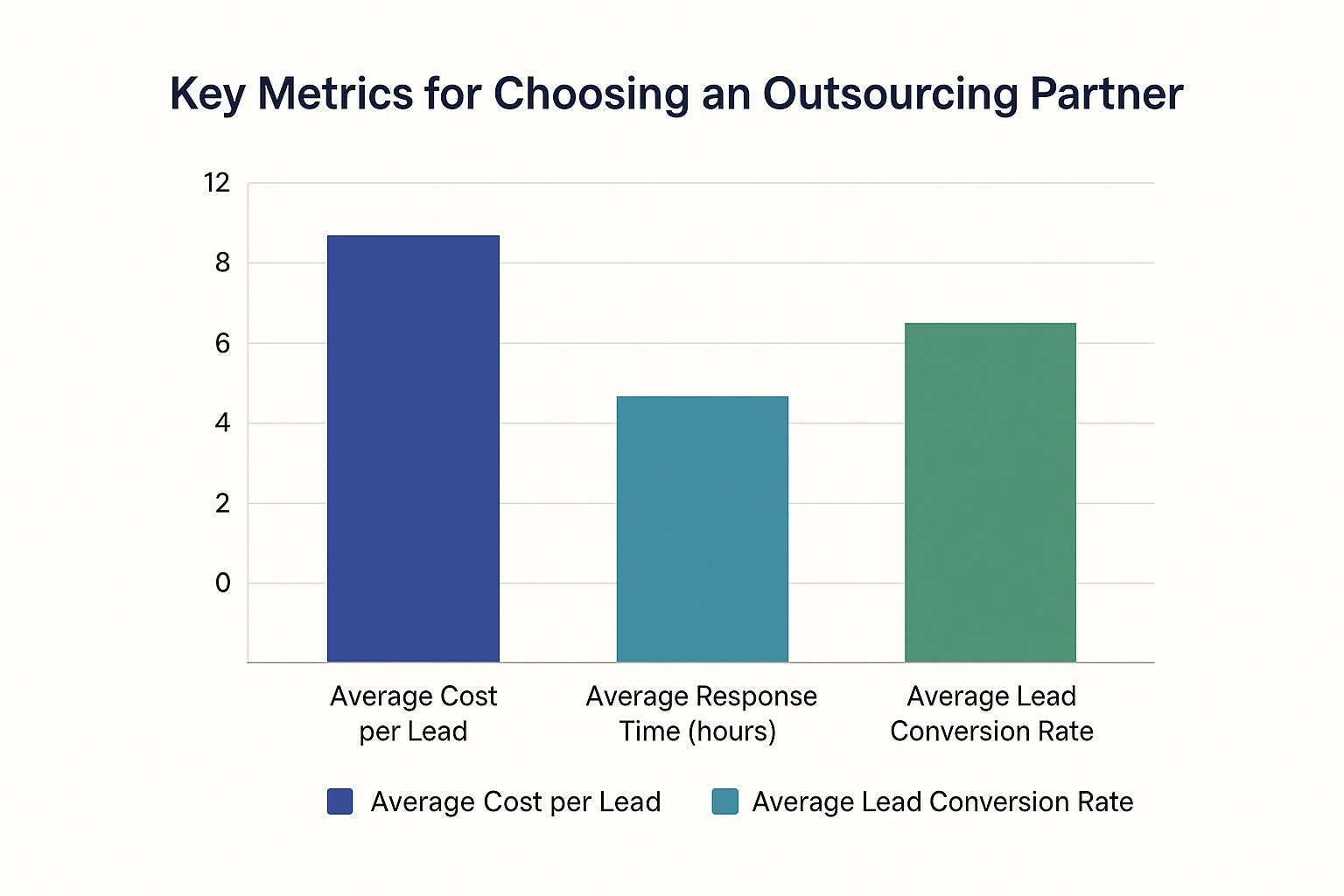
The data really drives home the trade-offs between cost, speed, and quality. It forces you to align a partner's strengths with what you really need to achieve.
Comparing Lead Generation Outsourcing Models
To help you decide, here’s a breakdown of the most common pricing and service models you'll run into. Think about which one best aligns with your goals and budget.
| Model Type | Best For | Potential Pros | Potential Cons |
|---|---|---|---|
| Pay-Per-Lead | Businesses needing predictable costs and a specific volume of leads. | You only pay for agreed-upon results. Clear, upfront cost structure. | Can incentivize quantity over quality. Leads may be less qualified. |
| Monthly Retainer | Companies seeking a dedicated partner for a comprehensive, long-term strategy. | Agency is deeply invested in your success. More strategic and holistic approach. | Higher upfront cost. Results are not always guaranteed month-to-month. |
| Hybrid Model | Organizations that want a balance of partnership and performance-based incentives. | Combines the stability of a retainer with bonuses for hitting targets. | Can be more complex to structure and track. Requires clear success metrics. |
Choosing the right model is about more than just the price tag—it’s about aligning incentives. A pay-per-lead deal might feel safer, but a retainer is what builds a true, collaborative partnership.
Often, the strategic depth needed for effective lead generation advertising really only comes from that kind of retainer-based relationship. Weigh your options carefully to find the perfect fit for your long-term growth.
Get Your Campaign Off to a Strong Start

Alright, you've chosen your partner. Now the real work begins. The success of your entire decision to outsource lead generation really comes down to how well you kick things off together. This initial onboarding isn't just a formality; it sets the tone for the entire relationship and helps you sidestep those costly misunderstandings that can derail a campaign later.
A powerful start is all about being prepared. Before you even have your first official call, you should have a toolkit of essential assets ready to go. This isn't just about being organized—it’s about empowering your new partner to get to work immediately and start delivering results faster.
Think of it like handing over the keys to a high-performance car. You wouldn't just toss them over and walk away; you'd show them the controls and explain how it handles.
Your Pre-Launch Checklist
To make this transition as smooth as possible, get these critical documents and access points ready for your new partner:
- Your ICP and Goal Docs: Hand over the detailed Ideal Customer Profile and SMART goals you've already mapped out. This is their roadmap.
- Brand and Messaging Playbook: Give them a clear guide on your company’s voice, your key talking points, and—just as important—what they should never say.
- CRM and Tool Access: Grant them the permissions they need to log activities and push leads directly into your system. This is a must-have for clean data and accurate reporting.
Showing up with these items ready on day one proves you're a serious, committed partner and instantly builds trust.
The whole point of a kickoff meeting is to bridge the gap between strategy and execution. It’s where you and your partner turn your ICP document into real-world outreach copy and nail down exactly what a 'qualified lead' means to your sales team.
Defining a Qualified Lead—Together
This is probably the most important conversation you'll have with your new agency. What you consider a "lead" might be completely different from their definition. You absolutely have to get on the same page from the jump. A solid start to your campaign often involves optimizing things like effective lead capture forms to make sure you're gathering the right info from the get-go.
Work together to establish a clear, shared definition of a qualified lead. Is it just anyone who fits your ICP and downloaded a whitepaper? Or is it someone who has specifically asked for a demo call?
You need to be painfully specific here. For example, a Sales Qualified Lead (SQL) could be defined as: "A key decision-maker at a company with over 100 employees who has confirmed both budget and authority during an initial discovery call."
This crystal-clear definition becomes the yardstick for measuring all campaign performance. It's the bedrock that makes the whole process of outsourcing your lead generation actually work.
How to Manage and Optimize Your Outsourced Campaigns
So, you’ve hired an outside team. Now what?
If you want to truly succeed when you outsource lead generation, you have to ditch the "set it and forget it" mindset. This isn't just another vendor transaction. It's an active partnership, and your role shifts from doing the work to steering the ship and making sure it's headed in the right direction.
The bedrock of any strong agency partnership is a consistent, data-driven rhythm of communication. Don't be the person who waits for a monthly report to find out something went wrong two weeks ago. You need a tighter feedback loop.
We insist on weekly check-ins with our partners. It's non-negotiable. These quick meetings catch small issues before they snowball into major roadblocks and keep everyone aligned on the mission.
Moving Beyond Simple Lead Volume
These weekly sessions aren't just for looking at the total number of leads. That’s a vanity metric. The real magic happens when you dig into the numbers that actually signal progress and, more importantly, a return on your investment.
To manage your outsourced team effectively, you have to track the metrics that connect directly to sales and revenue. While every business has its own unique KPIs, a solid performance dashboard should always prioritize quality over sheer quantity.
Your weekly conversations should revolve around questions like these:
- Lead-to-Opportunity Conversion Rate: What percentage of the leads they send over are actually accepted by sales and turned into real pipeline opportunities? This is the ultimate test of lead quality.
- Cost Per SQL (Sales Qualified Lead): Forget cost per lead. How much are you really spending for each lead that meets your team’s strict qualification criteria?
- Pipeline Velocity: Are these new leads zipping through your sales stages, or are they collecting dust and getting stuck somewhere? Slow velocity can point to a mismatch in expectations or targeting.
Tracking these numbers gives you a much clearer picture of what's happening. For instance, a low lead-to-opportunity rate isn't just a bad number—it's a diagnostic tool. It might tell you the agency's targeting is a bit off or that their initial qualification script needs a tweak. This is the kind of insight that drives real improvement.
Giving Feedback That Actually Works
The way you deliver feedback is just as crucial as the data itself. Your goal is to solve problems together, not put your agency on the defensive.
Instead of saying, "Your lead quality was bad last week," frame it as a collaborative challenge.
Try this instead: "I noticed our sales team flagged 15% of last week's leads as unqualified because of budget constraints. Could we brainstorm some ways to screen for budget better on that first call?" See the difference? One is an accusation; the other is an invitation to improve together.
The point of ongoing management isn't to micromanage your partner. It's to empower them with the data and insights they need to knock it out of the park for you. A great partnership is a two-way street built on trust and shared goals.
When you nail this collaborative approach, the operational benefits are huge. Your sales team gets to stop prospecting and focus entirely on what they do best—building relationships and closing deals. This strategic split has been proven to boost sales productivity and deliver a steady, reliable stream of highly qualified, sales-ready leads. You can learn more about how this optimizes your sales team's effectiveness on VolkartMay.com.
Ultimately, managing your outsourced campaigns is an active, ongoing process. By setting up clear communication, focusing on the right metrics, and giving constructive, data-backed feedback, you can turn a simple vendor relationship into a powerful growth engine for your entire business.
Common Questions About Outsourcing Lead Generation

Even with the perfect game plan, a few practical questions always pop up right before you pull the trigger on outsourcing lead generation. It’s smart to hit pause and get clear on the real-world stuff—like cost, brand consistency, and how long it actually takes to see results.
Let’s tackle the most common questions we hear from businesses just like yours. My goal is to give you straight answers so you can move forward with confidence.
How Much Does It Cost to Outsource Lead Generation?
This is the big one, and the honest answer is: it varies. A lot. The price tag depends entirely on the pricing model, how complex your industry is, and the sheer scope of work you need.
You'll generally run into a few common structures:
- Pay-per-lead: This can range from $50 to over $500 per qualified lead, especially if your qualification criteria are super specific.
- Monthly Retainer: This is a popular route, typically falling between $3,000 and $10,000+ per month for a dedicated team and consistent outreach.
- Hybrid Model: Some agencies mix it up with a base retainer plus performance bonuses for hitting certain milestones.
The real takeaway here is to look at cost through the lens of potential ROI and customer lifetime value, not just the sticker price. A cheap service delivering junk leads will cost you far more in the long run than a premium partner who consistently fills your pipeline.
Will I Lose Control Over My Brand Messaging?
This is a completely valid fear. Your brand’s voice is one of your most valuable assets, and the last thing you want is for a partner to mangle it.
Here’s the thing: a true professional partner works to amplify your brand, not overwrite it. You don't lose control; you delegate the execution. A solid agency will insist on a deep dive during onboarding. They'll want your brand guidelines, style guides, and—most importantly—your approval on all messaging, from email templates to call scripts, before anything goes live.
Think of them as a specialized extension of your marketing team. They bring the lead gen machine, but you provide the brand's soul. It's a collaboration, and constant communication is what keeps your messaging perfectly on-point.
How Quickly Can I Expect to See Results?
Everyone wants immediate wins, but a sustainable lead generation engine takes time to build and calibrate. Be very skeptical of any provider promising an overnight flood of perfect leads. It just doesn't work that way.
Realistically, the first 30 days are all about setup, strategy, and getting the initial campaigns out the door. You should expect to see a consistent flow of qualified leads trickling in within the first 60 to 90 days. This is the critical period where the agency uses real-world data and feedback from your sales team to sharpen targeting and refine messaging.
Patience during this initial phase pays off with steady, scalable growth later. A great partnership focuses on building a healthy, long-term pipeline, not just chasing a temporary spike in numbers. It's also worth thinking about what happens after a lead comes in; strong customer retention marketing strategies are key to getting the most value out of every new contact.
What Is the Difference Between Appointment Setting and Lead Generation?
These two get used interchangeably all the time, but they’re definitely not the same thing. Nailing down the difference is crucial for setting the right expectations with your partner.
- Lead Generation is the broad, top-of-funnel process. It’s about research, building lists, multi-channel outreach, and nurturing contacts until they become a sales-ready opportunity.
- Appointment Setting is a much more specific action. Its one and only goal is to take a qualified lead and book a meeting directly on your sales team’s calendar.
Essentially, an appointment is often the final step of a successful lead generation process, but it isn't the whole game. One builds the pipeline; the other fills the calendar.
Ready to build a predictable, high-growth sales pipeline without the internal overhead? Frozen Crow Inc. specializes in creating and executing data-driven lead generation strategies that deliver measurable results. Let us handle the heavy lifting of finding and qualifying leads so your team can focus on what they do best—closing deals. Get your free marketing audit today!


