


August 20, 2026
How to Create a Digital Marketing Strategy: A Practical Guide
Before you even think about launching a new campaign or chasing the latest social media trend, you have to do the groundwork. A winning digital marketing strategy isn't built on guesswork—it’s built on a brutally honest assessment of where you are right now.
Jumping straight into tactics without this foundation is like trying to build a house on sand. It just won't hold up.
Laying Your Strategic Foundation
First things first: you need a clear, data-backed picture of your current digital footprint. This means getting real about what's working, what's broken, and what you’ve been completely ignoring.
This process starts with a full-on digital marketing audit. I'm not talking about a quick glance at your follower count. This is a deep dive into every corner of your online presence.
Running a Digital Marketing Audit
Think of an audit as your single source of truth. It gives you a baseline for every single decision you'll make from this point forward. Without it, setting realistic goals is impossible, and measuring progress is just a shot in the dark.
Here are the core areas you need to dig into:
- Website Performance: Pop open Google Analytics and look at your traffic sources, bounce rate, and average time on page. Is your site fast? Is it mobile-friendly? A clunky website will kill even the most brilliant marketing campaign.
- Search Engine Optimization (SEO): How easy is it for people to find you on Google? Find out which keywords you already rank for and, more importantly, which ones your competitors are owning. You'll also want to hunt for any technical SEO gremlins holding you back.
- Social Media Engagement: Forget vanity metrics like follower counts. What you really need to know is your engagement rate—the likes, comments, and shares per post. Which platforms are actually sending traffic to your website? If you're just starting out, creating an effective social media strategy for small businesses is a non-negotiable first step.
- Paid Advertising (PPC): Look back at your ad spend. What was your cost per acquisition (CPA)? Which campaigns delivered the best return on investment (ROI)?
This simple flowchart shows how these pieces fit together. You start with an audit, use that data for analysis, and then establish a benchmark.
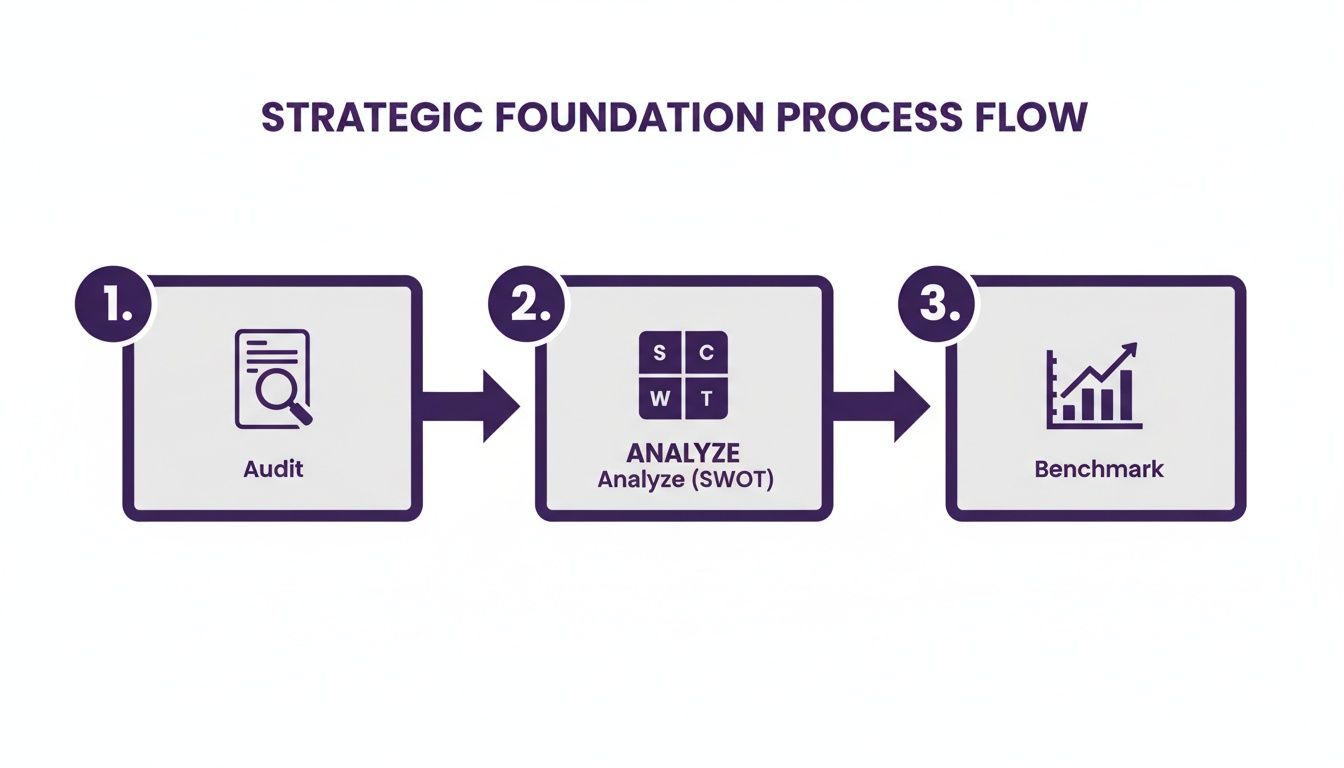
The process is straightforward: A thorough audit gives you the intel for a proper analysis, which in turn lets you set meaningful benchmarks for your goals.
Analyzing Your Position in the Market
Once you've got your internal data sorted, it’s time to look outside your own four walls. The classic SWOT analysis—Strengths, Weaknesses, Opportunities, and Threats—is perfect for this. It's a simple framework that forces you to put your audit findings into the context of the wider market.
A SWOT analysis isn't some dusty business school exercise. It’s a practical tool that turns raw data from your audit into a clear strategic direction. It shows you exactly where to attack and where you need to play defense.
Here's a practical way to break it down:
- Strengths (Internal): What are you genuinely good at? Maybe you have a super-engaged email list or a killer brand reputation in a small niche.
- Weaknesses (Internal): Where are the holes in your game? This could be anything from a non-existent SEO presence to a landing page that just doesn't convert.
- Opportunities (External): What's happening out in the world you can jump on? Perhaps a competitor is dropping the ball on a key social platform, or a new search trend is starting to pop.
- Threats (External): What could trip you up? This might be a new competitor entering the scene, a negative industry trend, or a sudden algorithm change from Google or Facebook.
This analysis connects the dots between your performance and the market reality. It transforms a boring list of metrics into a compelling story that points you toward the most logical path for growth.
Alright, you've crunched the numbers from your audit and now you know where you stand. The next step is to stop analyzing and start building. A marketing plan without a specific audience and clear goals is just a shot in the dark—it feels busy, but it rarely hits the mark.
This is where you get crystal clear on who you're talking to and what you're trying to achieve. Nailing this down is the difference between marketing that resonates and marketing that gets ignored, saving you a ton of time and money in the process.

Crafting Detailed Buyer Personas
First things first: you need to know your audience better than just surface-level demographics. A critical first step in any real strategy is understanding how to identify your target audience. That's where buyer personas come into play.
A buyer persona is essentially a character sketch of your ideal customer, built from real-world research and data on your existing client base. Think of it as putting a face and a name to the person you're trying to attract.
To build a persona that actually helps, you need to go deeper than just age and location. Dig into their:
- Motivations: What really drives their decisions? What are they trying to accomplish in their work or life?
- Pain Points: What's keeping them up at night? What daily frustrations could your product or service completely erase?
- Online Behaviors: Where do they hang out online? Are they scrolling through LinkedIn, watching YouTube tutorials, or listening to niche podcasts during their commute?
For instance, a persona for a B2B software company might be "Marketing Manager Mike." He's drowning in spreadsheets and desperately needs a simple, all-in-one reporting tool to make his life easier. Knowing this means you can craft messages that speak directly to his pain, not just list your product's features.
If you want to go deeper, check out our guide on how to create buyer personas that will actually sharpen your strategy.
Translating Objectives into SMART Goals
Once you know who you're talking to, it's time to set some real goals. Vague ambitions like "get more sales" or "grow our following" are useless. They feel good to say, but they don't give your team a clear roadmap.
This is exactly why the SMART framework is so valuable. It's a simple gut-check that forces you to turn those fuzzy objectives into tangible targets.
Your goals must be:
- Specific: Nail down exactly what you want to accomplish.
- Measurable: How will you track progress? Define the metric.
- Achievable: Be ambitious, but realistic based on your resources.
- Relevant: Does this goal actually support your bigger business objectives?
- Time-bound: Give it a deadline.
A vague goal is "improve website traffic." A SMART goal is: "Increase organic website traffic from U.S. visitors by 15% in Q3 by publishing four new, search-optimized blog posts each month."
See the difference? One is a wish. The other is a plan.
Here are a few examples of how you can apply the SMART framework to turn broad objectives into marketing goals you can actually work toward.
SMART Goal Framework Examples
| Vague Objective | SMART Goal | Business Type Example |
|---|---|---|
| Get more leads | Increase marketing qualified leads (MQLs) from our website by 20% in the next 6 months by creating a new downloadable ebook and promoting it via LinkedIn Ads. | B2B SaaS Company |
| Grow our brand | Increase our Instagram follower count by 25% and engagement rate to 3% by the end of Q4 by posting 5 Reels per week and partnering with 3 micro-influencers. | E-commerce Fashion Brand |
| Increase sales | Drive $50,000 in revenue from our email marketing campaigns over the next quarter by launching a 3-part promotional series to our existing subscriber list. | Online Course Creator |
This level of detail gives your team complete clarity and creates a concrete benchmark for success.
Focus on Intent, Not Just Keywords
As you're setting these goals, remember that how people find things online is changing. It's no longer just about stuffing keywords into a blog post. The real game-changer is shifting your focus from keywords to intent.
Discovery now happens everywhere—through AI-powered search, social media feeds, and video recommendations. With digital projected to command 74.4% of total ad spend by 2025, you can't afford to ignore any part of the customer journey.
Understanding the why behind a search allows you to create content and run campaigns that meet people's underlying needs. This intent-driven approach leads to way better engagement and, ultimately, higher conversion rates across your entire digital strategy.
Choosing Your Channels and Crafting Your Message

Alright, you’ve got your buyer personas dialed in and a set of SMART goals guiding the way. Now for the big question: where do you actually connect with these people, and what are you going to say?
It’s tempting to jump on every popular platform, but that’s a classic mistake. It just spreads your resources thin and guarantees you won't make a real impact anywhere.
The real key is to be surgical. Figure out where your ideal customers actually spend their time and are most likely to listen. For a B2B tech company, that's probably LinkedIn. For a boutique clothing brand, you're almost certainly going to find your tribe on Instagram or Pinterest.
This isn’t about picking just one channel. It’s about building a system where each platform works together, guiding people from just discovering you to becoming a loyal customer.
Mapping Channels to Your Business Goals
Think of your marketing channels like tools in a toolbox. You wouldn’t use a hammer to tighten a screw. The same logic applies here—the channels you pick have to align perfectly with your goals and the audience you're trying to reach.
Let's say your main goal is to generate high-quality leads for a consulting service. Your channel mix might look something like this:
- SEO & Content Marketing: This is for catching people who are actively Googling for solutions you provide. Think deep-dive blog posts and downloadable guides that show you know your stuff.
- LinkedIn Ads: Perfect for getting hyper-specific, targeting people by job title and industry with valuable content like a webinar or a whitepaper.
- Email Marketing: Once you have those leads, this is how you nurture them. Send them case studies and helpful insights to move them closer to booking a call.
But if you’re an e-commerce brand trying to move more product, you’d focus on a completely different set of channels centered around visual appeal and social proof.
Your marketing channels are not a popularity contest. Success comes from choosing platforms based on where your specific audience is most engaged, not just where the most users are. A smaller, niche platform with a highly relevant audience will always outperform a massive platform where your ideal customer isn't listening.
Building an Integrated Content Ecosystem
Content is the fuel for every single one of your channels. The best strategies don’t just create content for one platform at a time. They build an ecosystem where one great piece of content can be repurposed and shared across multiple channels, squeezing every last drop of value out of it.
This is where a content plan is non-negotiable. It’s your roadmap. It tells you what to create, when to publish it, and how it all ties back to your main goals. A solid plan keeps your messaging consistent and your efforts coordinated.
If you want to get serious about organizing your content, our guide on how to create a content calendar breaks down the entire process step-by-step.
With an integrated approach, a single, in-depth blog post can become:
- A dozen social media posts for LinkedIn and Twitter, each highlighting a key takeaway.
- A visually appealing infographic for Pinterest.
- A quick script for a YouTube Short or Instagram Reel.
- The main feature in your next email newsletter.
This approach saves an incredible amount of time and makes sure your core message is heard everywhere, in every format.
Selecting Your Core Channels
While every business has its own unique mix, most winning strategies are built on a foundation of owned, earned, and paid media.
- Owned Media: This is your turf. Your website, blog, and email list are channels you control completely. They are the bedrock of your strategy.
- Earned Media: This is the organic buzz you get from things like social shares, press mentions, and SEO. It builds trust in a way that advertising just can't. In fact, 91% of marketers say SEO has been a major driver for hitting their business goals.
- Paid Media: This is your accelerator. Think PPC ads, social media ads, and sponsored content. It’s how you get your message in front of a precise audience, fast.
Ever wonder why email is still a huge deal? It’s because 64% of people prefer it for data collection, making it a goldmine for personalization. Then you have social proof, where 50% of consumers found products on social media in 2023, and 59% ended up buying through those channels. With content marketing budgets jumping 41% in early 2024, it's clear you need to weave these channels together.
By picking the right channels and fueling them with a smart, cohesive content plan, you stop doing random acts of marketing. Instead, you build a powerful, integrated system that drives real, predictable growth.
Allocating Your Budget and Resources Wisely

Let’s get real. Even the most brilliant strategy is just a document without the fuel to make it happen. This is where we talk about the money and the people—the resources that turn your plan into reality.
Thinking about your budget isn't about limiting what you can do. It's about empowering your strategy. It’s about putting your money where it will work the hardest. For a small business or a startup, every single dollar has a job to do, so the focus has to be on efficiency and a clear, measurable return.
Choosing the Right Budgeting Model
There's no one-size-fits-all formula for setting a marketing budget, but a few tried-and-true models can give you a solid place to start. The trick is picking one that fits your company's current reality.
Here are a few popular ways to approach it:
- Percentage of Revenue: This is the most straightforward method. You simply dedicate a set percentage of your total revenue to marketing. For established businesses, that's often in the 7-12% range. Growth-hungry startups? They might push that to 20% or even higher.
- Objective and Task-Based: I’m a big fan of this one because it’s the most strategic. You work backward from your SMART goals. Figure out the exact tasks needed to hit those goals (like running a specific Google Ads campaign or producing four new blog posts), and then you add up the costs. This directly links every dollar you spend to an outcome you want.
- Competitor-Based: This involves a bit of educated guesswork. You try to figure out what your competitors are spending and aim to match or beat them. It’s a useful benchmark, but it’s risky. You're making a big assumption that their strategy is actually working and that their goals are the same as yours.
For most small businesses I work with, a hybrid approach works best. Use the percentage-of-revenue model to set a realistic spending ceiling, then use the objective-based model to make sure those funds are aimed squarely at activities that will move the needle.
Distributing Funds Across Your Strategy
Once you’ve got your total budget, the next puzzle is how to slice it up. A good, balanced budget usually covers three main areas: the channels themselves, the content you'll create, and the tech you need to run it all.
A common mistake is spreading the budget too thin across every possible channel. You’re far better off dominating one or two platforms where you know your audience lives than having a weak, underfunded presence on five.
Here’s a simple way to think about allocating your funds:
| Category | Description | Example Allocation (for a $5,000/month budget) |
|---|---|---|
| Channels & Ad Spend | This is your fuel for paid promotion—think Google Ads, social media advertising, and maybe some influencer collaborations. | $2,500 |
| Content Creation | These are the funds for creating the assets themselves, like blog posts, videos, and graphics. This might cover hiring freelance writers or designers. | $1,500 |
| Marketing Tech | This bucket covers the cost of your essential software: email platforms, SEO tools, social media schedulers, and analytics dashboards. | $1,000 |
This structure makes sure you're not just throwing money at ads. You're also investing in the high-quality content that makes those ads effective and the tools you need to track what’s actually working.
Smart spending is more critical than ever. With global digital ad spend expected to rocket past $800 billion by 2026, you have to focus on high-ROI activities to keep up. Recent data shows that websites, blogs, and SEO make up 16% of the highest ROI channels. Plus, having a presence on 3+ channels can increase engagement by a whopping 250%—all of which highlights the need for smart, multi-channel budget planning. If you want to dig deeper, you can find more of these digital marketing industry statistics on Entrepreneur's HQ.
Structuring Your Team and Resources
Finally, who is going to do all this work? Are you a one-person show, or do you have a small team? Be brutally honest about what you and your team can realistically handle.
If your team is fantastic at writing content but clueless about the technical side of SEO, it’s much smarter to outsource the technical SEO to a freelancer or a small agency. Don't try to learn it on the fly while you’re trying to grow. This lets your team play to their strengths while an expert fills a critical gap.
This mix of in-house talent and outsourced expertise often gets the best results without the hefty price tag of a big, full-time marketing department.
Measuring Success And Optimizing For Growth
Your marketing strategy isn't something you carve in stone and forget about. It's a living, breathing plan that has to adapt. Markets shift, customer behavior changes, and new tools pop up overnight. Real success isn't about just launching your campaigns; it's about constantly measuring what's working, cutting what isn't, and pouring fuel on the fire of your biggest wins.
If you aren't tracking and optimizing, you're flying blind. You might feel busy, but you'll have no clue if any of that effort is actually moving the needle. This is where we tie everything back to those SMART goals you defined earlier.
Selecting The Right KPIs For Your Goals
First things first: focus on the metrics that actually matter. It's incredibly easy to get hypnotized by vanity metrics—like a flood of social media likes or impressions—that feel good but do nothing for your bottom line.
Instead, you need to lock in on Key Performance Indicators (KPIs) that connect directly to your business goals. Think of a KPI as your compass; it’s a hard number that shows you how effectively you’re hitting your targets and tells you if you're pointed in the right direction.
Let's make this simple. Here’s how you can map your goals directly to the right metrics.
Mapping KPIs to Marketing Goals
This table offers a straightforward way to see which KPIs you should be watching, depending on what you're trying to achieve with a specific channel. It cuts through the noise and focuses on what drives real results.
| Marketing Goal | Primary Channel | Key Performance Indicator (KPI) |
|---|---|---|
| Increase Brand Awareness | Social Media / Content Marketing | Reach, Share of Voice, Branded Search Volume |
| Generate More Leads | SEO / PPC Ads | Conversion Rate, Cost Per Lead (CPL), Click-Through Rate (CTR) |
| Drive E-commerce Sales | Email Marketing / Social Ads | Return on Ad Spend (ROAS), Average Order Value (AOV), Cart Abandonment Rate |
| Improve Customer Loyalty | Email / Community Forum | Customer Lifetime Value (CLV), Repeat Purchase Rate, Net Promoter Score (NPS) |
Choosing KPIs that are actually aligned with your objectives ensures you’re not just tracking data for the sake of it—you’re measuring real progress. If you want to get even more granular, our guide on how to measure digital marketing success goes much deeper into selecting and tracking the right numbers.
Establishing Your Reporting Rhythm
Once you know what to track, you have to decide how and when you'll look at it. You don't need a crazy-expensive, enterprise-level analytics suite to get started. Free tools like Google Analytics 4 (GA4) and the built-in dashboards on your social media platforms are packed with valuable data.
The trick is to get into a consistent rhythm. It could be a quick weekly check-in or a more formal monthly review. A simple dashboard that pulls your most critical KPIs into one place can give you a snapshot of performance without you having to log in to five different platforms.
Your reporting should always answer three questions:
- What happened? (e.g., "Organic traffic was up 15% this month.")
- Why did it happen? (e.g., "Those two new blog posts started ranking for key terms.")
- What are we doing next? (e.g., "We're building out more content around that successful topic.")
This simple framework is what turns raw data into smart, actionable decisions.
Embracing The Optimization Loop
Here's where the real magic happens. Tracking your numbers is only half the battle. Growth comes from what you do with that information. This is where the continuous optimization loop comes in. It’s a simple but powerful cycle that keeps your strategy sharp.
The goal of optimization isn’t perfection; it’s progress. Small, consistent improvements over time lead to significant long-term growth. Don't wait for the perfect data—start with what you have and iterate.
This loop has three repeating steps: Measure, Analyze, Act.
-
Measure: You collect the data from your KPIs. For example, you see your last email newsletter had an 18% open rate, falling short of your 25% target.
-
Analyze: You dig in and ask "why?" You form a hypothesis. Maybe the subject line was flat, or maybe you sent it at 2 PM on a Friday when everyone was already checked out.
-
Act: You test that hypothesis. For the next newsletter, you run a simple A/B test. Half your list gets a subject line phrased as a question; the other half gets a direct statement.
And then the loop starts over. You measure the results to see which version won. This repeatable process is how you make data-driven decisions everywhere—from tweaking your ad copy and landing page layouts to testing new calls-to-action. By adopting this mindset of constant improvement, your marketing strategy becomes a dynamic engine for growth, always getting smarter and more effective.
Common Questions About Digital Strategy
Building a digital marketing plan is one thing; keeping it on track is another. Even the most seasoned pros run into questions along the way. Let's dig into a few of the most common ones that pop up, so you can move forward with confidence.
How Often Should I Update My Digital Marketing Strategy?
This is a big one. The short answer? Way more often than once a year. Your strategy shouldn't be a "set it and forget it" document gathering dust on a server somewhere. It needs to be a living, breathing guide for your team.
I've found a two-tiered rhythm works best for keeping things agile without creating chaos.
-
The Quarterly Deep Dive: Every three months, block out time to do a serious review. Are your SMART goals still the right ones? Has a new competitor shown up on your radar? This is where you make the big-picture adjustments based on hard data and shifts in the market.
-
The Monthly Check-in: Think of this as a quick tactical huddle. Pull up your KPI dashboard. Is that new social channel flatlining? Maybe it's time to shift a bit of ad spend or A/B test a different email subject line.
This approach keeps you from overreacting to every little dip, but it also ensures you don't let a failing campaign bleed money for six months before pulling the plug.
What Are The Must-Have Tools On A Tight Budget?
You really don't need a massive software budget to make an impact, especially when you're starting out. The key is to cover your bases with powerful, free tools first.
Here’s a barebones toolkit I recommend to every startup:
-
Analytics: Google Analytics 4 (GA4) is non-negotiable and 100% free. It's the source of truth for who's visiting your site and what they do when they get there.
-
SEO: Start with Google Search Console. It tells you exactly how Google sees your site. For keyword research, a tool like Ubersuggest offers a decent number of free daily searches to get you started.
-
Social Media: A scheduler is a huge time-saver. Buffer or Later both have free plans that let you manage a few profiles and queue up posts in advance.
-
Email Marketing: Mailchimp is the classic starting point for a reason. Its free plan has everything you need to build a list and send out professional-looking campaigns.
Get these set up first. Once you're growing and have specific problems to solve, you can start investing in paid tools that have a clear ROI.
How Much Should I Spend On Digital Marketing?
There's no single magic number here. A common rule of thumb for small businesses is to earmark 7-12% of your total revenue for marketing. If you're a startup in a heavy growth phase, that could easily jump to 20% or more.
But honestly, percentages are just a starting point. A much smarter way to build your budget is using the objective-and-task method.
Instead of just picking a number, you work backward from your goals. Figure out what you need to achieve (e.g., "get 50 qualified leads this quarter"). Then, list the tasks required to get there (e.g., "run a targeted LinkedIn ad campaign"). Finally, you price out those specific activities.
This approach forces every dollar to have a job. It connects your spending directly to a business outcome, which is how you build a marketing plan that actually makes money instead of just costing money.
Ready to stop guessing and start growing? The team at Frozen Crow Inc. specializes in creating data-driven digital marketing strategies that deliver real results. We offer a free marketing audit to uncover your biggest opportunities and provide a clear path forward. Let us help you build a plan that boosts clicks, conversions, and customer acquisition. Visit us at https://frozencrow.com to get started.


