


August 20, 2026
What is Demand Generation Marketing? Key Strategies Explained
Let’s talk about a term you hear all the time: demand generation. It's more than just a marketing buzzword; it's a fundamental shift in how you attract customers. Forget chasing individual leads. The real goal is to build an entire ecosystem around your brand that naturally pulls your ideal customers in because you're consistently providing value.
So, What Is Demand Generation Marketing, Really?

At its heart, demand generation is about playing the long game. Think of it this way: old-school lead generation is like casting a huge net and hoping you catch a few fish. Demand generation is about making your entire lake so clean, healthy, and appealing that the best fish just want to be there. It's the art and science of becoming an indispensable authority in your field.
How do you do that? By consistently putting out high-value, educational, and problem-solving content without immediately asking for a sale. The philosophy is refreshingly simple: educate and empower your audience first. When you do that, you build genuine trust and position your brand as the first place people turn for answers.
To get a clearer picture, let's break down the foundational pillars of this approach.
Core Principles of Demand Generation
| Principle | Description |
|---|---|
| Value-First Mindset | Offer genuine help and expertise with no strings attached. Your goal is to educate and solve problems, not just sell a product. |
| Audience Centricity | Every piece of content, every campaign, is built around your audience's real-world challenges, questions, and goals. |
| Full-Funnel Focus | Nurture relationships from the very first spark of awareness all the way through to loyalty and advocacy, not just the final sale. |
| Brand as a Resource | Aim to become the go-to source of information in your niche. When people have questions, they should think of you first. |
This table captures the essence of the strategy: it's a holistic, long-term commitment to your audience's success.
The Philosophy That Drives It
The core idea is to meet your audience where they are, addressing their pain points and curiosities long before they even think about making a purchase. It's a nurturing process that guides prospects along their entire journey, from that first "What is…?" Google search to becoming a loyal, vocal advocate for your brand.
Demand generation isn't a single campaign; it's the sum of all marketing efforts that create demand for your product or service. It’s about building a brand that people actively seek out because they believe in the value you provide.
The real objective is to make your audience aware of a problem they might not have even put a name to yet, and then carefully position your solution as the most logical, effective answer. This is a world away from just grabbing the contact info of people who are already actively shopping. A great starting point is understanding the various strategies to increase brand awareness and grow your business.
How It Builds a Sustainable Growth Engine
By focusing on the entire marketing funnel—not just the bottom—demand generation creates a reliable, predictable pipeline. When you generate authentic interest at the top, you ensure a steady stream of engaged, informed prospects who are genuinely ready to move toward a decision.
This all-in approach delivers some powerful benefits:
- Builds Brand Authority: When you consistently share your expertise, you stop being just another vendor and become a trusted voice in your industry.
- Improves Lead Quality: Prospects who have followed your content for a while are better educated and far more aligned with your solution. Our guide on how to build brand awareness dives deeper into this.
- Shortens the Sales Cycle: An educated lead doesn't need as much convincing. They already get it. They understand the value you offer because you've been demonstrating it all along.
Over the last decade, this practice has grown up. It's moved beyond a simple focus on lead volume and has become a sophisticated, data-driven process that supports every single stage of the buyer's journey. Today, it’s all about attracting quality prospects who show real intent.
Demand Generation vs. Lead Generation Explained
It’s one of the most common mix-ups in marketing, and for good reason. At first glance, demand generation and lead generation look like they’re chasing the exact same thing: more conversions. But peel back a layer, and you’ll find two very different, yet equally vital, parts of a modern growth strategy.
Figuring out the difference isn't just semantics—it's the key to building a marketing machine that doesn't just wait for interest but actually creates it from scratch.
Think of it like this: Demand generation is all about making it rain. It’s the entire process of seeding the clouds and creating the right atmospheric conditions so that your market is primed for growth. You’re building an ecosystem where interest in what you offer can naturally start to pour down.
Lead generation, on the other hand, is putting out the buckets to catch the rain. It’s the specific, focused action of collecting the contact info from people who are ready to take the next step.
The Core Philosophical Difference
The real split comes down to their primary mission. Demand generation is a top-of-funnel, brand-centric play. Its job is to make your ideal audience realize they even have a problem and position your company as the obvious, trusted expert to solve it. It’s about educating, informing, and building genuine authority long before a sales pitch ever comes into the conversation.
Lead generation kicks in further down the funnel. It's designed to convert the awareness and trust you’ve built into tangible contacts for your sales team. This is where you put up a gate—offering a valuable ebook, a free trial, or a demo in exchange for an email address. If you want to get deeper into the mechanics of this, exploring different strategies for lead generation for SaaS offers some great, practical context.
The best marketing strategies don't treat this as an either/or choice. They understand that strong lead generation is a direct result of successful demand generation. You can’t put out buckets if there are no clouds in the sky.
Demand Generation vs Lead Generation: A Strategic Comparison
To really nail down the differences, let's put these two disciplines side-by-side.
| Attribute | Demand Generation | Lead Generation |
|---|---|---|
| Primary Goal | To create awareness, educate the market, and build brand authority. | To capture contact information from interested prospects. |
| Audience Focus | Broad, targeting a wide segment of your ideal customer profile (ICP). | Narrow, targeting specific individuals who have shown buying intent. |
| Core Tactics | Ungated blog posts, podcasts, social media content, SEO, community building. | Gated ebooks, whitepapers, free trials, demo requests, contact forms. |
| Key Metrics | Website traffic, social engagement, share of voice, content downloads. | Conversion rates, Cost Per Lead (CPL), MQLs, SQLs. |
| Timeframe | A long-term strategy focused on building a sustainable, predictable pipeline. | Short-term tactics focused on immediate database growth. |
At the end of the day, these two functions are partners, not rivals. Demand generation fills the lake with fish by making your brand a known, respected name. Lead generation is the fishing rod you use to catch the ones ready to bite.
When you invest in both, you're not just running campaigns—you're building a powerful, self-sustaining system that drives predictable and scalable growth.
Core Strategies for Your Demand Generation Engine
Alright, you get the big picture of demand generation. Now, let's get our hands dirty and talk about how to actually build the thing. A solid demand gen program isn't about one magic tactic; it's a well-oiled engine with a bunch of interconnected strategies all humming along together.
Think of it like building a high-performance car. You need the engine, the transmission, and the wheels all working in sync to get you down the road. Each strategy we're about to cover is a critical component that attracts, engages, and nurtures your ideal customers, creating the momentum you need for a healthy sales pipeline.
Let's pop the hood and look at the essential gears.
Create High-Value Educational Content
Content is the fuel for this entire machine. But let’s be clear: we’re not talking about thinly-veiled sales pitches or fluffy blog posts. The goal here is to create resources that genuinely solve problems, answer tough questions, and make your audience smarter—long before they ever see a "buy now" button. This is how you build trust and become the go-to authority in your space.
Some of the most effective types of content include:
- In-depth Blog Posts: Move past the surface-level stuff. We're talking comprehensive, step-by-step guides that your audience can put to work immediately.
- Insightful Whitepapers and Ebooks: These are your deep dives. Use them to unpack complex topics, show off your expertise, and deliver a ton of value in one package.
- Helpful Checklists and Templates: Simple, practical tools that make someone's job easier are marketing gold. They're shareable, useful, and create an instant positive vibe around your brand.
The secret is to obsess over your audience's pain points, not your product's features. When you’re the one consistently providing the answers, you’re the first one they’ll call when it's time to make a purchase.
Master Search Engine Optimization
Creating brilliant content is pointless if no one can find it. That's where Search Engine Optimization (SEO) comes in. SEO is the bridge connecting people who are actively searching for solutions to the incredible content you just created.
But good SEO for demand gen isn't just about stuffing keywords onto a page. It's about getting inside your customer's head and understanding their intent. What questions are they typing into Google at 2 AM? What problems are they desperately trying to solve? When your content lines up perfectly with those queries, you attract a highly motivated audience at the exact moment of need.
A well-executed SEO strategy doesn't just drive traffic; it drives the right traffic. It brings prospects to your digital doorstep who are already looking for the kind of value you provide, making them more receptive to your message.
This organic approach builds a long-term, sustainable asset. Unlike a paid ad that vanishes the second you stop paying, a top-ranking blog post can keep generating interest and awareness for years.
Implement Account-Based Marketing
For most B2B companies, some customers are just more valuable than others. That’s a fact. Account-Based Marketing (ABM) is a laser-focused strategy where you stop casting a wide net and start throwing spears at the exact high-value accounts you want to land.
ABM completely flips the traditional marketing funnel. You start by identifying your dream clients, and then you build hyper-personalized campaigns just for them. This might mean creating custom content that speaks to their specific industry challenges or running targeted digital ads aimed directly at the key decision-makers within that single company.
This kind of personalized attention gets results. When you need to manage these targeted efforts, certain platforms can help streamline everything, showing you how to find success with HubSpot for business growth. The precision of ABM leads to a much better return on your marketing spend. In fact, research shows that ABM drives a higher ROI for about 76% of marketers, proving just how powerful this targeted approach can be.
Engage Audiences with Webinars and Events
Sometimes, you need to connect with people in real-time. Webinars and virtual events are fantastic for demonstrating your expertise, building a community, and putting a human face to your brand. They’re your chance to answer questions live and build rapport in a way that static content just can't match.
A great webinar is all about genuine educational value. Forget the hour-long sales pitch. Instead, focus on hosting expert panel discussions, live workshops, or deep-dive tutorials. You're there to teach, not to sell.
Here are a few formats that work really well:
- Educational Workshops: Teach your audience a new skill or walk them through solving a nagging problem, step by step.
- Expert Panel Discussions: Bring a few industry pros together to debate trends. You get diverse perspectives and draw a bigger, more engaged crowd.
- Product Demos (Done Right): Instead of a boring feature tour, frame your demo around solving one specific, high-stakes problem for a niche audience.
Amplify Your Reach with Paid Social Advertising
Organic strategies are your foundation, but paid social ads are the accelerator. Platforms like LinkedIn are incredibly powerful for getting your best content in front of a precisely targeted audience.
The key here is to shift your mindset from lead gen to content distribution. You're not using ads to beg for an email address. Instead, you're paying to promote your ungated blog posts, your webinar recordings, and your thought-leadership articles. You are simply offering value, no strings attached. This builds brand familiarity and warms up your audience, so when you do have a gated offer, they already know and trust you.
By weaving these core strategies together, you create a powerful, always-on demand generation engine. You're building authority with your content, attracting qualified traffic with SEO, zeroing in on key accounts with ABM, engaging them with live events, and pouring fuel on the fire with smart paid advertising. This is the blueprint for creating predictable, sustainable growth.
How to Build a Demand Generation Funnel
Building an effective demand generation funnel isn't about forcing people down a rigid, one-way street. It’s more like designing a guided journey that helps your ideal customers discover, understand, and ultimately choose your solution on their own terms. Think of it as a framework that aligns your marketing with the natural way a buyer thinks.
This journey usually breaks down into three key stages. Each stage has its own goal, requires different kinds of content, and speaks to someone with a totally different level of awareness. By mapping this out, you can create a seamless experience that builds real trust and momentum every step of the way.
Top of the Funnel (ToFu): Awareness and Discovery
The top of the funnel is all about attraction and education. At this point, your audience isn't even looking for your product. They're just looking for answers. They have a problem, a question, or a curiosity, and they're just starting to poke around for information. Your job is to meet them right there with high-value content, no strings attached.
The mission here is simple: be helpful. You want to be the trusted resource they stumble upon when they type a question into Google. This is absolutely not the time for a sales pitch. It's about building brand awareness and proving your expertise by generously sharing what you know.
Effective ToFu content often looks like this:
- Educational Blog Posts: Think comprehensive guides that answer the most common questions in your industry.
- Informative Videos: Short, engaging videos that break down complex topics into something anyone can understand.
- Social Media Content: Shareable tips, infographics, and quick insights that deliver immediate value.
- Podcasts: In-depth conversations with other experts that build your authority in the space.
The key to the ToFu stage is to offer value freely. You're building an audience, not a list of leads. The entire focus is on generating traffic and making a great first impression that leaves people wanting to hear more from you.
Middle of the Funnel (MoFu): Nurturing and Consideration
Once you've grabbed someone's attention, the next step is to nurture that initial spark of interest. In the middle of the funnel, your audience knows they have a problem and they're actively weighing their options. They understand the challenge; now they’re trying to figure out the best way to tackle it.
Your goal shifts from broad education to more specific guidance. This is where you can start to subtly introduce your company's unique point of view. You need to prove that you not only get their problem but have a credible way of solving it. Gated content—like a detailed guide that requires an email to download—often comes into play here.
Content for the MoFu stage goes a lot deeper:
- Case Studies: Real-world stories showing exactly how you've helped similar customers get results.
- Webinars: Live or on-demand sessions that do a deep dive into specific strategies or solutions.
- Whitepapers and Ebooks: Detailed reports that offer expert analysis and data-backed insights.
- Email Nurture Sequences: A series of automated emails that deliver helpful resources over time, keeping you top of mind.
This infographic shows how marketers can track the flow of prospects through the funnel, measuring lead volume, engagement, and conversion rates.
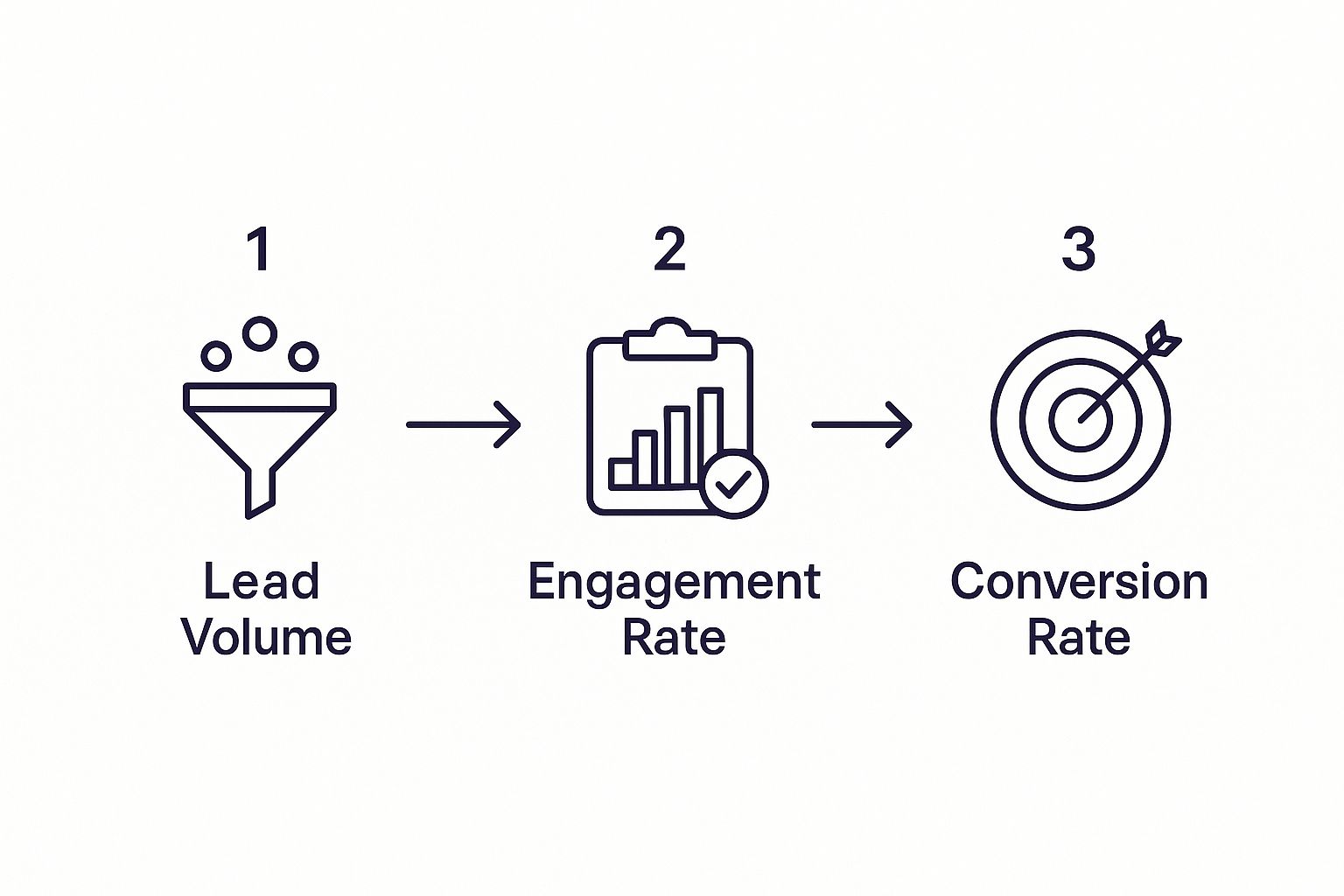
This visualization highlights the critical need to not only attract interest but to actively analyze how that interest translates into meaningful engagement and, ultimately, business results.
Bottom of the Funnel (BoFu): Decision and Conversion
The bottom of the funnel is where the magic happens—where all that demand you've built gets converted into a real sales opportunity. Prospects at this stage are solution-aware. They've done their homework, they know their options, and they're ready to pull the trigger. Your only goal is to make it incredibly easy for them to choose you.
The content and offers here are all about your product. You have to clearly show your value and demonstrate exactly how your solution will solve their specific problem better than anyone else. The communication becomes much more direct, personal, and focused on helping them make a purchase.
BoFu activities are all designed to drive action:
- Product Demos: Personalized walkthroughs that highlight the features most relevant to a prospect's specific needs.
- Free Trials or Consultations: Risk-free ways for people to experience your solution firsthand.
- Pricing and Comparison Pages: Clear, transparent information that helps prospects justify their decision to their team.
- Testimonials and Reviews: Social proof from real customers that builds confidence and backs up your claims.
Recent industry data really drives home the importance of this structure, especially the MoFu stage. A benchmark survey revealed that 57% of marketers see case studies as their most crucial content format for demand gen, confirming just how powerful they are for building trust. Yet, the same survey found that only 29% of marketers have fully integrated their brand and demand efforts. That's a huge opportunity for companies to create a more connected journey. You can read more about these findings in the full 2025 demand generation report.
By thoughtfully guiding people through each stage, you transform broad, passive awareness into high-quality, sales-ready opportunities.
Measuring Your Demand Generation Success
A powerful demand generation strategy feels great, but "feeling" isn't a business metric. To prove your efforts are actually working and keep the budget flowing, you need to measure what truly matters.
The first step is to stop obsessing over vanity metrics like clicks and social media likes. Sure, those numbers might look good on a report, but they don't tell you if you're actually growing the business. The real goal is to draw a straight line from your marketing activities to revenue.
This means shifting your focus away from simply counting leads—a classic lead generation metric—and toward understanding the real-world business impact you're creating.
Moving Beyond Lead Volume
Relying on lead volume alone can be a trap. A campaign that pulls in 1,000 leads might seem like a smashing success, but what if only ten of them are qualified? Worse, what if none of them ever become customers? That's the core difference in measurement philosophy between demand gen and lead gen.
True demand generation success is measured by how it influences the entire sales pipeline and adds to the bottom line. It’s about quality, not just quantity.
The best demand generation programs don't just fill the top of the funnel; they improve the health of the entire revenue engine. Success isn't measured in MQLs. It's measured in pipeline growth, sales cycle velocity, and customer lifetime value.
To get this deeper view, you have to track a specific set of metrics that tell the complete story.
Key Metrics That Truly Matter
Tracking the right key performance indicators (KPIs) is everything. These are the numbers that show you how efficiently you’re spending, the quality of the demand you're creating, and the long-term value you're delivering.
Here are the essentials to get a handle on:
- Customer Acquisition Cost (CAC): This is your total sales and marketing spend divided by the number of new customers you brought in. A lower CAC means your demand engine is running efficiently.
- Lifetime Value (LTV): This metric shows the total revenue you can expect from a single customer over their entire relationship with you. When your LTV is way higher than your CAC (a 3:1 ratio is a common benchmark), you've got a healthy, sustainable business model.
- Sales Cycle Length: This is the average time it takes for someone to go from a lead to a paying customer. Solid demand generation warms people up with great content, which should naturally lead to a shorter, smoother sales process.
- Pipeline Velocity: This is a killer metric. It calculates how quickly deals are moving through your sales pipeline and how much they're worth. It’s a direct indicator of the health and momentum of your revenue stream.
Focusing on these KPIs changes the conversation from "How many leads did we get?" to "How much qualified pipeline did marketing influence?" That's the language that gets executives and sales leaders to sit up and listen.
Connecting Actions to Outcomes
Once you're tracking these metrics, the next step is to connect them back to specific marketing activities. This is where marketing attribution comes into play. Attribution models help you figure out which channels, campaigns, and content pieces are actually doing the heavy lifting for your revenue goals.
For instance, you might discover your podcast drives customers with the highest LTV, while your blog posts bring in leads with the shortest sales cycles. You can learn more about connecting these dots by exploring different approaches to what is marketing attribution in our detailed guide. This insight is gold—it tells you where to double down and what to cut.
Ultimately, measuring demand generation is about proving that marketing isn't just a cost center—it's a primary driver of predictable revenue. Master these metrics, and you can confidently demonstrate your ROI, make data-backed decisions, and point your team's efforts directly at what matters most.
Got Questions About Demand Generation? We've Got Answers.

Diving into demand generation always sparks a few questions. It’s a big shift from traditional marketing, so it's only natural to wonder about the nuts and bolts of making it work.
We get it. Below, we're tackling the most common questions we hear from marketers who are just getting started. Think of it as your practical guide to navigating the early stages with confidence.
How Long Until I Actually See Results?
This is always the first question, and it gets right to the heart of what makes demand gen different. It's a long game, not a quick win. You're building a sustainable growth engine, and that takes time, patience, and a whole lot of consistency.
You'll likely spot some early signs of life—like more website traffic or better engagement on social—within the first few months. But to see a real, tangible impact on your sales pipeline and revenue, you should plan for at least 6-12 months of dedicated work. You're building brand authority and trust, and that just doesn't happen overnight.
The real magic of demand generation is how it compounds. The work you do today lays a foundation that makes all your future marketing more powerful. It creates a flywheel of awareness that just keeps spinning faster over time.
Is This Really a Strategy for Small Businesses?
Absolutely. In fact, it might be one of the best equalizers for smaller companies that can't just out-spend their competition on ads. The core principles work for any size business.
A small business can make a huge impact by being strategic instead of just loud. Rather than trying to be everywhere at once, you can:
- Own a Niche: Become the go-to expert for a very specific type of customer.
- Go Deep, Not Wide: Create one incredible, in-depth guide instead of ten forgettable blog posts.
- Build a Real Community: Focus on engaging with people on the one or two platforms where your audience actually spends their time.
It's all about consistency, not volume. A focused, high-value approach will almost always beat a scattered, high-budget one.
What's the Sales Team's Role in All This?
This is crucial: your sales and marketing teams have to be completely in sync. They can't operate on separate islands. If they do, demand generation will fall flat.
Marketing's job is to create awareness and educate the market, warming up potential customers long before they're ready to buy. But the sales team holds the keys to making sure that effort isn't wasted. They’re on the front lines, and their feedback is pure gold.
They can tell you:
- Lead Quality: Are the people marketing is attracting actually the right fit?
- Customer Pain Points: What are the real-world problems they hear about on calls every single day?
- Common Objections: What roadblocks come up in sales conversations that marketing could address earlier?
This feedback loop is what allows marketing to sharpen its messaging and targeting. It ensures the demand you're building is for people who can actually become customers. A seamless handoff isn't just nice to have; it's non-negotiable.
At Frozen Crow Inc., we transform these principles into practice, building custom demand generation strategies that drive measurable growth. Our experts can help you navigate these questions and more, creating an engine that delivers predictable results. Discover how our strategic approach can elevate your brand by visiting https://frozencrow.com.


