


November 17, 2026
What Is Cost Per Acquisition (CPA)? An Essential Guide
When you're running digital marketing campaigns, you need to know what you're actually paying for. That’s where Cost Per Acquisition (CPA) comes in. It's the total cost you spend to get a potential customer to take one specific action—like signing up for a newsletter, downloading an e-book, or filling out a lead form.
It’s a direct measure of the price of a conversion, which isn't always the same as making a sale.
Defining Cost Per Acquisition in Plain English

Think of it like a carnival game. You spend money on prizes, renting the booth, and paying staff, all to get people to successfully toss a ring onto a bottle. Your CPA would be your total costs divided by the number of people who actually won a prize. It’s a laser-focused metric for one single outcome.
In marketing, CPA cuts through the noise to answer one simple question: "How much did we pay for that specific action?" The "action" is whatever you decide is valuable, often long before someone pulls out their credit card.
CPA vs. CAC: The Critical Difference
People often mix up Cost Per Acquisition (CPA) and Customer Acquisition Cost (CAC), but they tell two very different stories. Think of them as relatives, not twins.
CPA is all about the cost of a specific action or conversion, which is often a top-of-funnel activity. In contrast, CAC measures the total cost to land a new, paying customer.
A user might download your free guide (an "acquisition" measured by CPA), but they don't become a "customer" until they actually buy your product (which is measured by CAC). Getting this right is fundamental to understanding your campaign performance.
This means a single customer's journey could have multiple CPA events. For example:
- Action 1: A user clicks a Google Ad and signs up for your email list. That has a CPA.
- Action 2: A few weeks later, they download a free trial of your software. That’s another acquisition with its own CPA.
- Final Outcome: They finally subscribe to a paid plan. This is what contributes to your overall CAC.
In short, CPA gives you granular, real-time feedback on how efficient your individual campaigns are. CAC gives you the bigger picture of how much it costs your entire business to make a sale.
To make this crystal clear, here’s a quick breakdown of how they stack up.
CPA vs. CAC At a Glance
This table simplifies the core differences between these two essential metrics, helping you see where each fits into your marketing analytics.
| Metric | What It Measures | Typical Formula | Best Used For |
|---|---|---|---|
| CPA | The cost to generate a single action or conversion (e.g., lead, signup, download). | Total Campaign Cost / Total Conversions | Measuring the efficiency of specific marketing campaigns and top-of-funnel activities. |
| CAC | The total cost to acquire a new paying customer. | Total Sales & Marketing Costs / New Customers Acquired | Evaluating the long-term profitability and scalability of the business model. |
By tracking both, you get the complete story. CPA tells you how well you're generating interest, while CAC shows how effectively you're turning that interest into cold, hard revenue.
Why CPA Is a Critical Metric for Business Growth

Knowing what Cost Per Acquisition means is step one. But truly understanding why it matters is what separates the marketers who get by from the ones who drive real growth.
Tracking your CPA is like giving your marketing budget a regular financial health check. It cuts through the noise of vanity metrics like clicks and impressions and gets straight to the point: how financially efficient are your campaigns?
This single number tells you exactly which channels are turning your ad spend into actual customers. A low, stable CPA is the sign of a healthy, scalable marketing engine ready to grow. On the other hand, a high or climbing CPA can silently bleed your budget, signaling that a campaign is no longer profitable or sustainable.
The pressure to be efficient has never been higher. Since 2017, the average cost to acquire a customer for both B2B and B2C companies has shot up by roughly 60%. This puts immense pressure on marketing teams to justify every dollar and prove a clear ROI. You can discover more insights about how acquisition costs are changing over time.
This is exactly why having a firm grip on your CPA isn't just a good idea—it's non-negotiable.
Driving Smarter Budget Decisions
Think of your marketing budget as fuel for your business. Without CPA data, you're just pouring that fuel randomly across different engines, hoping one of them roars to life. With CPA, you know precisely which engine gives you the most mileage.
Let's say an e-commerce store is running campaigns on both Instagram and Google Shopping.
- Instagram Ads: They spend $2,000 and get 50 sales. That’s a CPA of $40.
- Google Shopping Ads: They spend another $2,000 and get 80 sales. Here, the CPA is just $25.
Armed with this simple data, the marketing manager instantly knows Google Shopping is the more efficient channel. This empowers them to make a smart, data-backed decision: shift more budget from Instagram over to Google Shopping to get more sales without spending a dime extra.
CPA transforms your marketing from a guessing game into a calculated strategy. It provides the clarity needed to double down on what works and cut what doesn’t, ensuring every dollar is invested for maximum impact.
By consistently keeping an eye on your CPA and working to lower it, you build a more resilient and profitable business. It's the key to shifting your marketing efforts from a cost center into a reliable growth driver, paving the way for sustainable expansion.
How to Actually Calculate Your Cost Per Acquisition
Getting your Cost Per Acquisition right is the bedrock of smart marketing. The formula itself looks simple, but its real power comes from understanding what you're plugging into it.
At its most basic, the calculation is:
CPA = Total Campaign Cost ÷ Total Conversions
Looks easy, right? But the devil is always in the details. A fuzzy definition of "cost" or "conversion" will give you a fuzzy CPA. And a fuzzy CPA leads to bad decisions—like pouring money into a losing channel or pulling the plug on a winner way too soon.
Nailing Down Your Total Campaign Cost
To get a true picture of your CPA, you have to account for every single dollar that went into making a campaign happen. A classic rookie mistake is to only count the ad spend. That gives you an artificially low CPA that feels good but is completely misleading.
A real accounting of your costs needs to include:
- Direct Ad Spend: This is the obvious one—the money you pay directly to platforms like Google Ads, Meta, or LinkedIn to run your ads.
- Agency or Freelancer Fees: If you’re working with an agency, a consultant, or even a freelance copywriter, their fees are a direct cost of that campaign. Don't forget them.
- Content and Creative Production: Think about the costs for graphic design, video shoots, or any other assets you had to create specifically for the campaign. It all adds up.
- Marketing Tools and Software: You need to factor in a portion of your subscription costs for the tools that made the campaign possible—analytics software, landing page builders, you name it.
When you add all these pieces together, you stop looking at a surface-level metric and start seeing a true business metric that reflects your actual investment.
Defining What a "Conversion" Really Is
Just as important as your costs is defining what a "conversion" means for this specific campaign. The action has to line up with your goal. A conversion isn't always a sale; it's any valuable action a user takes that moves them closer to becoming a customer.
For example, a SaaS company’s "conversion" might be someone signing up for a demo. For an e-commerce brand, it's probably that first purchase from a new customer. The key is to be consistent. Pick one clear, measurable action for each campaign and stick with it.
Let's look at how this plays out for two different businesses.
Example 1: The SaaS Company
- Goal: Generate demo requests.
- Total Campaign Cost: $5,000 (this includes their ad spend and agency management fees).
- Total Conversions: 50 demo requests.
- Calculation: $5,000 / 50 = $100 CPA.
Example 2: The Online Retailer
- Goal: Drive first-time sales.
- Total Campaign Cost: $10,000 (this covers ad spend plus the costs for the product photography and video ads).
- Total Conversions: 250 first-time purchases.
- Calculation: $10,000 / 250 = $40 CPA.
By being this precise with both your costs and your conversion goals, you end up with a CPA number you can actually trust to guide your strategy.
Navigating CPA Benchmarks Across Different Industries
Once you’ve nailed down your Cost Per Acquisition, the very next question is always the same: "So… is my CPA any good?"
The answer isn't a simple yes or no. A "good" CPA is completely relative, changing wildly from one industry to the next based on a whole host of economic factors.
Comparing your CPA to some universal average is like comparing the fuel efficiency of a moped to a freight train—they operate on completely different scales for entirely different reasons. A B2B software company might be thrilled with a $133 CPA for a new enterprise client, but an e-commerce store selling t-shirts would see that same number as an absolute disaster.
Why Industry Context Is Everything
So, what causes these massive gaps in what’s considered a "good" CPA? It really boils down to a few key factors that dictate how much a business can—and should—be willing to pay for a new customer.
Getting a handle on these variables is critical for setting realistic goals and figuring out if your campaigns are actually working. Without this context, you’re basically flying blind, with no way to know if you're spending your marketing budget wisely or just burning through cash.
The main things shaping these benchmarks are:
- Product Price and Profit Margins: A company selling a $3,000 software subscription has a lot more room to spend on acquisition than a brand selling $30 t-shirts. The potential profit from a single sale sets the ceiling for your CPA.
- Customer Lifetime Value (LTV): If your customers tend to stick around and make repeat purchases (think subscription boxes or SaaS), you can justify a higher upfront CPA. The real payoff comes over the long haul.
- Market Competition: In cutthroat industries like legal services or insurance, everyone is bidding on the same keywords. This drives ad prices up and, consequently, your acquisition costs.
- Sales Cycle Length: For businesses with long, complex sales funnels (like enterprise software), you're investing a lot more time and effort into nurturing each lead. This naturally leads to a higher CPA by the time a deal finally closes.
A "good" CPA isn't a static number. It's a moving target that you have to measure against your specific industry, business model, and the lifetime value of the customer you're after. Judging your CPA in a vacuum is one of the fastest ways to misread your data.
Benchmarks in Action: A Look at the Numbers
The infographic below breaks down the simple math behind CPA, showing how your total ad spend and the number of conversions you get come together.
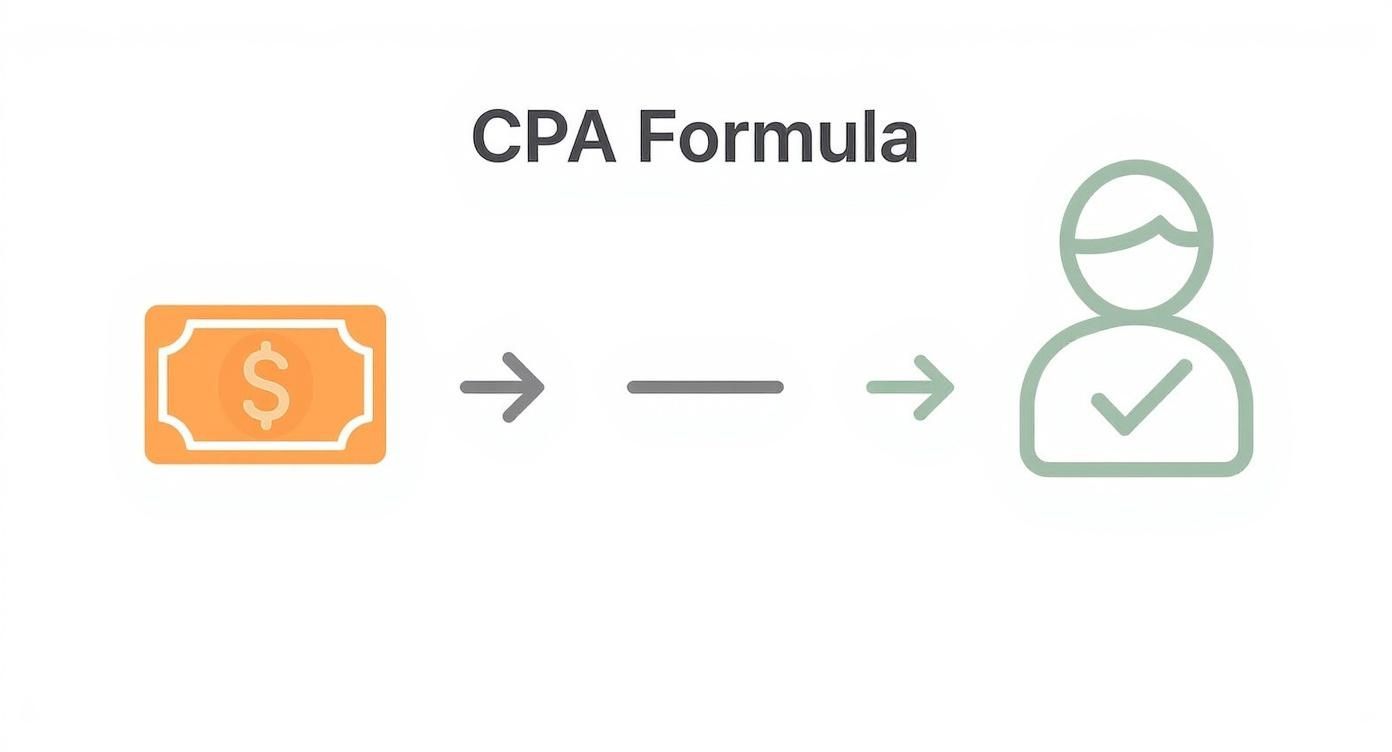
It’s a straightforward formula that directly connects your investment to the results you’re getting.
The data really shows just how wide the CPA gap is between different sectors. Taking a look at pay-per-click (PPC) ads gives us a clear picture. The average CPA for search campaigns across all industries was recently around $59.18. But that number is pretty much useless on its own.
Average Cost Per Acquisition by Industry (Search Ads)
To give you a clearer idea, here’s a look at how average CPAs on the Google Search Network vary across different industries.
| Industry | Average CPA (Search) |
|---|---|
| Technology | $133.52 |
| Legal | $135.17 |
| Finance & Insurance | $105.75 |
| Business Services | $93.94 |
| Real Estate | $86.07 |
| Health | $78.09 |
| Ecommerce | $45.27 |
As you can see, the technology sector faces a much steeper average CPA of $133.52, while e-commerce enjoys a much lower average. You can read the full research about these acquisition costs to dive deeper.
This is exactly why knowing your industry’s benchmarks is so important. It gives you the right lens to evaluate your own performance, set achievable goals, and make smarter calls on where to put your marketing dollars for the best results.
Proven Strategies to Lower Your Cost Per Acquisition
Knowing your Cost Per Acquisition is one thing. Actively driving it down is how you turn data into dollars. A high CPA isn't a red flag; it's a huge opportunity to tighten up your strategy and make every single marketing dollar pull its weight.
When you lower your CPA, you're essentially boosting the efficiency of your campaigns. You’re making sure every dollar you put in generates the maximum possible return on the other side. With competition getting stiffer every day, this isn't just a nice-to-have skill—it's essential. The cost to get a new customer is climbing like crazy. In fact, between 2013 and 2021, acquisition costs shot up by a staggering 222% across the board.
In this climate, you can't afford not to optimize. Let’s walk through some proven, no-fluff strategies you can use right now to get that number moving in the right direction.
Enhance Ad Relevance with Quality Score
If you're running Google Ads, your Quality Score is one of the biggest levers you can pull to lower your CPA. A high score is Google's way of telling you that your ads are a good match for what people are searching for. The reward? Lower ad costs and better ad positions. Simple as that.
Think of it as a report card for your ad's overall health. To get a better grade, you need to focus on a few key areas:
- Tightly-Knit Keyword Groups: Don't just dump a hundred keywords into one ad group. Keep your themes super specific and relevant.
- Mirroring Ad Copy: Your ad copy has to directly reflect the keywords it's tied to. If someone types in "waterproof hiking boots for men," your headline should say something very, very close to that.
- A Seamless Landing Page Experience: The page someone lands on after the click has to deliver on the ad's promise. The journey from search to conversion needs to feel like one smooth, connected experience.
Nailing your Quality Score directly cuts down your cost-per-click, which naturally brings down your cost per acquisition. It's one of the most direct ways to improve campaign efficiency.
Optimize Your Landing Page Experience
Your ad’s job is to get the click. Your landing page’s job is to close the deal. You can have the best ad in the world, but if your landing page is slow, confusing, or just plain clunky, your CPA will go through the roof. Get this: even a one-second delay in page load time can slash your conversions by 7%.
Your landing page is the final handshake in the acquisition process. If it's weak, the entire deal falls apart. Optimizing this single page is often the fastest way to see a dramatic drop in your CPA.
Here’s a quick-and-dirty checklist for a landing page that actually converts:
- A Clear, Punchy Headline: Does it match the ad and scream value?
- Frictionless Forms: Are you asking for their life story or just the essentials? Shorter forms almost always win.
- One Obvious Call-to-Action (CTA): What’s the one thing you want them to do? Make it impossible to miss.
- Mobile-First Design: Does it look and work great on a phone? Because that's where most of your traffic is coming from.
- Trust Signals: Sprinkle in some testimonials, reviews, or security badges. Give them a reason to trust you.
Methodically checking these boxes will lift your conversion rate, which directly lowers your CPA without you having to spend another dime on ads.
Refine Creatives with A/B Testing
Stop guessing what ad copy or image will work best. A/B testing, or split testing, is how you let your audience tell you what they want. It takes the guesswork completely out of the equation.
The idea is simple. You create two versions of an ad—let's call them A and B—with just one small difference between them. Maybe it's a different headline, a new image, or a tweaked call-to-action. Then, you run them at the same time and let the data show you which one gets you a lower CPA.
To dive deeper into making your ad spend work harder, check out these tactics to reduce customer acquisition cost.
Got Questions About CPA? We’ve Got Answers.
Alright, let's dig into some of the most common questions that pop up once marketers start wrapping their heads around cost per acquisition. Think of this as the practical, real-world follow-up that turns theory into action.
Getting these details right is what separates a good campaign from a great one, ensuring you’re making decisions that actually grow your bottom line.
What’s a Good LTV to CPA Ratio?
This is the big one. How does what you spend to get a customer stack up against what they're worth to you over time? That’s the core of the Customer Lifetime Value (LTV) to CPA relationship. A low CPA is nice, but it's just a number until you compare it to the value of the customer it brought in.
The industry standard for a healthy, sustainable business is an LTV to CPA ratio of at least 3:1.
What does that mean in plain English? For every dollar you put into acquiring a customer, you should be getting at least three dollars back over the course of their relationship with you. This ratio tells you that your marketing engine isn't just running—it's profitable and ready to scale.
If your ratio is down at 1:1, you're essentially just trading dollars. Any lower, and you're losing money. On the flip side, a sky-high ratio like 5:1 might feel like a huge win, but it could actually mean you're being too conservative with your marketing spend and leaving serious growth on the table. For a deeper dive, check out this excellent breakdown of the LTV to CAC ratio and its calculation.
How Do I Track CPA for Different Marketing Channels?
To get a true picture of your performance, you absolutely have to track CPA on a channel-by-channel basis. Lumping everything together is a recipe for wasted ad spend. The key here is proper attribution—knowing exactly which channel gets credit for which conversion. This is where tools like UTM codes are your best friend.
By adding these simple tags to your campaign URLs, you’re giving your analytics platform (like Google Analytics) a roadmap to trace every visitor back to their origin.
- Isolate Your Costs: First, get a clear total spend for each channel you’re using—Google Ads, Facebook Ads, email campaigns, you name it.
- Segment Your Conversions: Next, hop into your analytics and see how many conversions each of those specific channels drove.
- Do the Math: Now just divide the cost of each channel by the number of conversions it brought in. Voila—you have a CPA for each one.
This is where the magic happens. This granular data shows you, clear as day, which platforms are your workhorses and which are just bleeding your budget dry. From there, reallocating your spend for maximum impact becomes a much simpler conversation.
What Are the Most Common Mistakes When Analyzing CPA?
Knowing what not to do is just as important as knowing what to do. A few simple, common slip-ups can completely throw off your CPA analysis and lead you to make the wrong calls.
One of the biggest blunders is not including all the costs. It’s easy to just look at ad spend, but what about agency fees, the cost of your marketing software, or the money spent on creating the ads? Forgetting those will give you a dangerously optimistic CPA. Another classic mistake is failing to segment the data. A single, blended CPA for all your campaigns hides the gold. The real insights come from comparing the CPA of different channels, campaigns, and even customer segments.
But maybe the most critical pitfall of all is obsessing over CPA in a vacuum. A high CPA can set off alarm bells, but if that high cost is bringing in a customer with an even higher lifetime value, it might be one of the best investments you can make. It's all about context.
At Frozen Crow Inc., we live and breathe this stuff. Our strategic digital marketing and IT services are built to cut through the noise and give you a clear, accurate picture of your campaign performance. We make sure every dollar you spend is working toward measurable growth. Request your free marketing audit today!


