


October 12, 2026
What Is Conversion Rate in Marketing and How to Improve It
Let's get straight to the point: your conversion rate is the percentage of people who do what you want them to do.
It’s one of the most honest metrics in all of marketing. It tells you, in plain numbers, whether your message is actually connecting with people or just making noise.
Understanding Conversion Rate in Simple Terms
Forget the textbook definitions. Imagine you get 100 people to visit your landing page. If five of them fill out your contact form, your conversion rate for that goal is 5%. It's that simple.
This single number cuts through all the vanity metrics like traffic and impressions. It answers the one question that truly matters: "Is my marketing getting results?"
But here’s the key—a "conversion" isn't always about making a sale. It’s any meaningful action that moves a visitor one step closer to becoming a customer. The action you track depends entirely on what you're trying to achieve.
What Counts as a Conversion?
Before you can measure anything, you have to decide what a "win" looks like for your business. For an e-commerce site, the ultimate conversion is obviously a purchase. But for a B2B software company, it might be getting someone to book a demo.
Every business relies on a series of these small wins to build momentum and drive growth. Here are a few examples of key conversion actions that move the needle.
Examples of Key Conversion Actions
A "conversion" is more than just a sale. It's any valuable action that signals a user is moving from a passive browser to an active prospect. Below are some common examples that drive real business growth across different models.
| Conversion Type | Business Goal | Example Action |
|---|---|---|
| Purchase | Drive direct revenue | A customer completes the checkout process on an e-commerce store. |
| Form Submission | Generate qualified leads | A visitor requests a custom quote for a home renovation project. |
| Content Download | Build an email list & educate prospects | A user provides their email to download a free eBook or whitepaper. |
| Free Trial Signup | Product adoption & user acquisition | A potential customer signs up for a 14-day trial of a SaaS tool. |
| Newsletter Subscription | Nurture long-term leads | A blog reader subscribes to receive weekly marketing tips. |
Ultimately, a conversion is about turning casual interest into a tangible step forward.
A conversion is the moment a casual browser becomes an engaged prospect. It's the digital handshake that signals interest and opens the door for a deeper business relationship.
Tracking your conversion rate gives you a direct line of sight into the effectiveness of your website's design, your ad copy, and your overall user experience. It’s the ultimate report card for your marketing efforts.
How to Calculate Your Conversion Rate
Ready to get your hands dirty and turn the concept into a concrete number? The good news is that calculating your conversion rate is surprisingly simple. You don't need a PhD in statistics or a fancy software suite—just a bit of basic math.
The entire process hangs on one straightforward formula. This little equation is the key to understanding what's actually working in your marketing and what’s just spinning its wheels.
The Conversion Rate Formula
(Total Number of Conversions / Total Number of Visitors) * 100 = Conversion Rate (%)
That’s it. This formula gives you a clean percentage, showing you exactly how well your page or campaign is convincing people to take action.
Now, let's see how this plays out in the real world.
Practical Calculation Examples
A formula is only as good as its application. To make this crystal clear, let's walk through three common scenarios you’ll definitely encounter.
1. E-commerce Product Page
Picture an online shoe store that gets 5,000 visitors to a new product page for running shoes. Over the month, 150 of those visitors make a purchase.
- Calculation: (150 sales / 5,000 visitors) * 100 = 3% Conversion Rate
2. B2B Demo Request Landing Page
A SaaS company is running ads, driving 800 people to a landing page where they can book a free demo. Of those visitors, 60 actually fill out the form.
- Calculation: (60 demo requests / 800 visitors) * 100 = 7.5% Conversion Rate
3. Local Service Contact Form
A local plumbing business gets 300 clicks from a local ad campaign to its "Request a Quote" page. Out of that traffic, 18 people submit the form.
- Calculation: (18 form submissions / 300 visitors) * 100 = 6% Conversion Rate
Each of these numbers tells a story. The shoe store now has a performance benchmark for its product pages. The SaaS company can see how this specific landing page stacks up against its others.
This single metric is so powerful because it has a direct impact on your bottom line. For instance, a higher conversion rate almost always leads to a lower cost per acquisition, which means every dollar you spend on marketing goes further. Now that’s efficiency.
Why Conversion Rate Is a Critical Business Metric
Knowing how to calculate your conversion rate is one thing. Understanding why it’s a vital sign for your business's health is where the real power lies.
A strong conversion rate is basically the engine of efficient growth. It’s proof you’re not just getting eyeballs on your site, but actually persuading people to take meaningful action. Think of it as a direct reflection of your entire marketing funnel—from the ad copy that caught their eye to the landing page design and, of course, your product’s core value.
It shifts the focus from just buying more traffic to getting the absolute most out of the traffic you already have. That’s the definition of working smarter.
The Tale of Two Companies
Let's make this real. Imagine two online stores, "Alpha Apparel" and "Bravo Basics." Both sell similar t-shirts and spend the exact same amount on ads to bring in 10,000 visitors a month. On the surface, their efforts look identical.
But the results tell a completely different story:
- Alpha Apparel: Has a conversion rate of 1%. They make 100 sales from their 10,000 visitors.
- Bravo Basics: Has a conversion rate of 4%. They make 400 sales from the same number of visitors.
Bravo Basics is generating four times the revenue from the exact same ad spend and traffic. This is what I mean when I say conversion rate is a multiplier. While Alpha Apparel is stuck trying to figure out how to quadruple its ad budget just to catch up, Bravo Basics can reinvest its profits back into the business and pull even further ahead.
A higher conversion rate is the fastest way to increase your Return on Investment (ROI) without spending a single extra dollar on advertising. It makes every visitor more valuable.
The financial impact here is huge. In digital marketing, the average sales funnel conversion rate across all industries is a pretty sobering 2.35%. That means for every 100 potential customers, fewer than three actually buy something.
The top-performing companies? They hit rates of 5.31% or more because they never stop optimizing. They relentlessly tweak every single step of the customer journey.
A high conversion rate doesn't just pump up revenue; it fundamentally improves your business's financial health. It's directly tied to other critical metrics, like reducing customer acquisition costs, which is essential for any kind of sustainable growth. By converting more of the visitors you already have, you lower the cost to get each new customer. This directly fattens your profit margins and makes your entire operation more resilient.
Benchmarking Your Conversion Rate Performance
So you’ve got your conversion rate calculated. Great. But now comes the real question: is that number any good?
Honestly, the answer is always, "it depends." A “good” conversion rate isn’t a universal figure. It’s completely contextual, changing wildly depending on your industry, what you’re selling, and where your traffic is coming from.
Without benchmarks, your conversion rate is just a number floating in a void. Is that 3% you’re seeing a reason to pop the champagne, or a red flag that something’s broken? Comparing your performance against industry and channel averages gives you the context you need to set realistic goals and spot your biggest opportunities.
This is where a solid grasp of your conversion rate becomes a strategic weapon, letting you measure success with real accuracy.
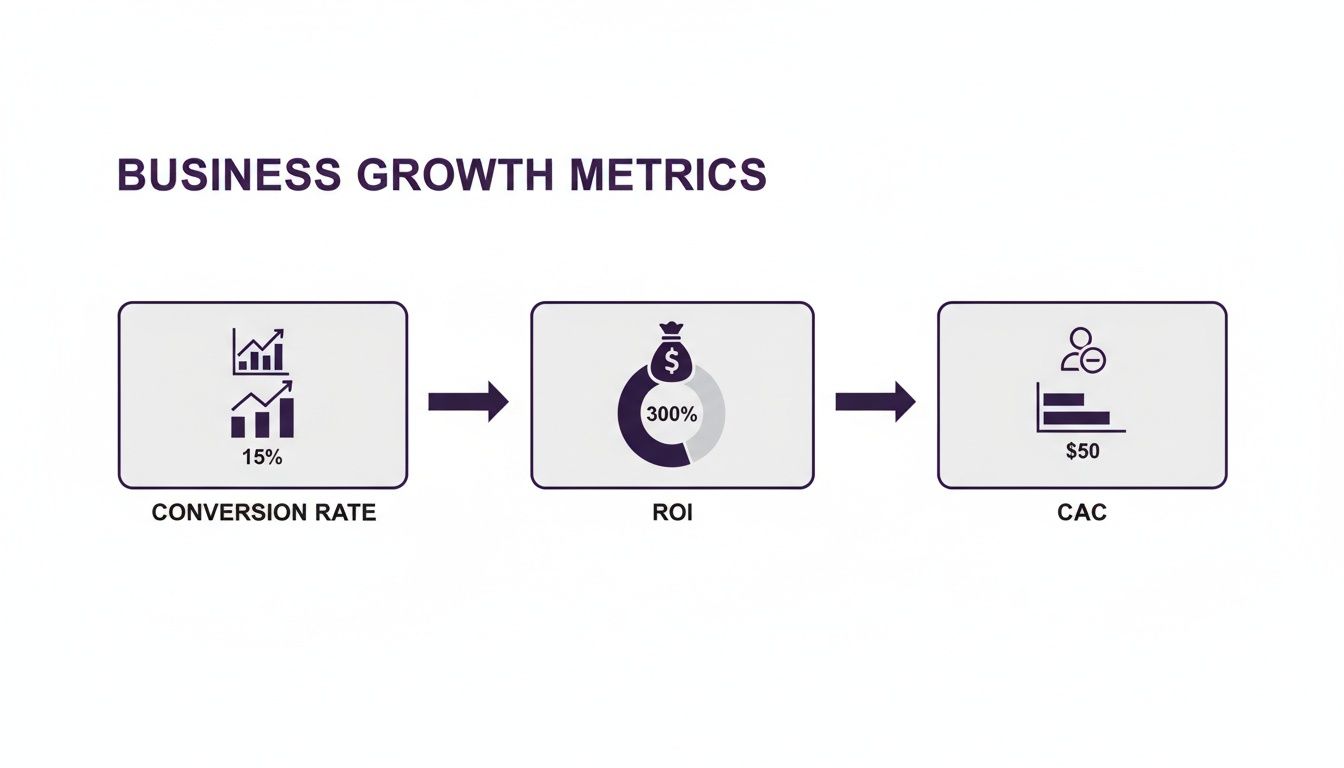
As you can see, improving your conversion rate isn't just a vanity metric. It has a direct, powerful impact on your ROI and helps drive down the cost of acquiring each new customer.
Industry And Channel Averages
Every industry has its own rhythm. The journey a customer takes to buy a new face cream is completely different from a business owner vetting new accounting software. Naturally, this means their conversion rates are going to look very different.
For instance, e-commerce sites in the food & beverage space pull in an impressive 3.1% average conversion rate, easily beating the global benchmark of just over 2%. Beauty and skincare aren't far behind at 3%, proving that sharp targeting in a niche market pays off.
These numbers also show why the device matters. Even though mobile traffic makes up over 70% of visitors, it converts at a lower 2.9% compared to desktop’s much stronger 4.8%. You can dig into more industry benchmarks over at Statista.
The marketing channel you use is just as important. Think about the user's mindset. Someone actively searching on Google for a solution is in a completely different headspace than someone casually scrolling through their social feed. This "intent" level is a game-changer.
To give you a clearer picture, here’s how different channels tend to stack up.
Average Conversion Rates by Marketing Channel
A comparison of typical conversion rate performance across popular digital marketing channels to help businesses benchmark their efforts.
| Marketing Channel | Average Conversion Rate | Best For |
|---|---|---|
| Organic Search | 2.5% – 4.5% | High-intent users actively seeking solutions. |
| Paid Search (PPC) | 3% – 5% | Highly targeted campaigns with immediate visibility. |
| Email Marketing | 4% – 6% | Nurturing leads and marketing to a warm audience. |
| Social Media (Paid) | 1% – 2.5% | Top-of-funnel goals like brand awareness and lead gen. |
| Referral | 5% – 10% | High-trust traffic from word-of-mouth recommendations. |
| Affiliate Marketing | 3% – 7% | Performance-based sales driven by trusted partners. |
These averages are a solid starting point. They help you gauge where you stand in the grand scheme of things and set smarter, more attainable goals for your own campaigns.
Benchmarking isn't about chasing someone else's numbers. It's about understanding the field you're playing on so you can create a winning strategy tailored to your specific goals and audience.
Use these averages to get a read on your own performance. If your rates are lagging, you’ve just found a clear opportunity to optimize. And if you’re already beating the average? You know your strategy is working, and it’s time to figure out how to scale it.
Proven Strategies to Improve Your Conversion Rate
Knowing your conversion rate is one thing. Actually improving it is where the real work begins. This is the world of Conversion Rate Optimization (CRO)—a continuous process of testing, tweaking, and refining your website to turn more visitors into customers.
This isn't about guesswork or big, risky changes. It’s about making small, data-backed adjustments that can lead to surprisingly big wins. Think about it: even a small lift from a 2% to a 3% conversion rate is a 50% increase in your leads or sales, all from the same amount of traffic.
A/B Test Your Headlines and Calls-to-Action
Your headline is your first impression, and your call-to-action (CTA) is your closing argument. If the headline doesn't grab attention, they won't stick around. If the CTA is weak or confusing, they won't take the next step.
This is where A/B testing (or split testing) comes in. It’s simple: you show two different versions of an element to two different groups of visitors to see which one performs better. For example, you could test "Get Your Free Quote" against "See Pricing Instantly." Instead of guessing, you let your audience’s actions tell you exactly what they want to see.
Simplify Your Forms and Checkout Process
Every single field you ask someone to fill out is a potential roadblock. It’s another chance for them to get frustrated, lose patience, and leave. One famous study even found that cutting form fields from four to three could boost conversions by a staggering 50%.
Take a hard, honest look at your forms. Do you really need their phone number right now? Is every field absolutely essential to get that initial conversion? A clean, streamlined checkout or lead form makes it effortless for people to say "yes," which dramatically cuts down on abandonment.
The best user experience is often invisible. Your goal should be to remove every unnecessary click, question, and distraction that stands between a visitor's interest and their decision to convert.
Build Trust with Authentic Social Proof
Here’s a simple truth: people trust other people far more than they trust brands. That’s why social proof is so powerful. When you display things like customer reviews, testimonials, case studies, and trust badges (like security seals), you’re giving hesitant visitors a reason to believe in you.
It validates their choice, showing them that others just like them have already had a great experience. For ecommerce brands, this is non-negotiable. If you're in that space, check out a data-driven playbook for ecommerce conversion rate improvement for more specific tactics.
Optimize Your Website Speed
We live in an age of instant gratification, and a slow website is a conversion killer. It’s not an exaggeration—research shows that if your site takes more than three seconds to load, you could be losing nearly half of your visitors before they even see what you have to offer.
Get serious about speed. Compress your images, use a content delivery network (CDN), and clean up your code. A faster site doesn't just create a better user experience; it also gives you a nice boost in your SEO rankings. For a deeper dive into these tactics and more, take a look at our complete guide on conversion optimization best practices.
Tracking Your Conversions Accurately
Here's a hard truth: you can't fix what you don't measure. Trying to guess which marketing efforts are actually moving the needle is a recipe for a wasted budget and a whole lot of frustration. To get real results, you need accurate conversion tracking—it's the only way to turn vague assumptions into solid data you can act on.
The whole process starts by getting crystal clear on your conversion goals inside your analytics and ad platforms. Tools like Google Analytics 4 (GA4) or the ad pixels from Meta and Google are your best friends here. Think of these little snippets of code as digital accountants, meticulously logging every single time a user takes the action you want them to on your website.
Setting them up right is non-negotiable. It ensures every decision you make is backed by numbers, not just a gut feeling. If you need a hand with the technical side, our guide on setting up Google Ads conversion tracking walks you through it step-by-step.
Defining Your Primary Conversion Goals
First things first: you have to identify what a "win" actually looks like for your business. For an e-commerce store, a sale is the obvious endgame, but for other business models, different actions are just as valuable.
- Lead Generation: A user fills out your contact form or requests a quote.
- Engagement: Someone subscribes to your newsletter or downloads a helpful whitepaper.
- Product Consideration: A visitor adds an item to their cart or signs up for a free trial.
It’s also crucial to avoid the classic pitfalls, like double-counting conversions. You need to make sure a user who hits refresh on a "thank you" page isn't counted as a brand new lead. Clean data is everything.
Don't sleep on micro-conversions. Actions like watching a product video or spending a certain amount of time on a key page are huge indicators of interest. They help paint a much richer picture of the customer journey.
Platform-specific tracking is where you'll find the gold. You’ll quickly see that not all channels perform the same. For instance, industry benchmarks often show Google Ads leading with a 4.29% average conversion rate because it captures people with high-intent right when they're searching. Meanwhile, Facebook Ads can hit an impressive 9.21% by getting hyper-specific with audience targeting.
When you track properly, you empower yourself to put your money where it will work the hardest.
A Few Common Questions We Get About Conversion Rates
Once you start digging into conversion rates, a few questions always seem to pop up. It’s natural. Getting a handle on these details is what separates a good analysis from a flawed one, so let's clear up a few common points of confusion.
What’s the Difference Between Conversion Rate and Click-Through Rate (CTR)?
This one trips up a lot of people, but the difference is pretty simple when you think about it like a physical storefront.
Your Click-Through Rate (CTR) is like measuring how many people saw your sign out front and decided to walk through the door. It tells you if your ad or your link was interesting enough to grab their attention. It’s all about generating that initial interest.
Your Conversion Rate, on the other hand, measures how many of those people who came inside actually bought something. This tells you how good your store—your landing page or website—is at persuading them to take that final step.
So, CTR measures interest, while conversion rate measures action. If you have a high CTR but a low conversion rate, it’s a huge red flag that what you promised in your ad isn't matching up with what people find when they land on your page.
How Long Does It Realistically Take to See an Improvement?
That's the million-dollar question, isn't it? The honest answer is: it depends.
If you're running a simple A/B test on a page that gets a lot of traffic—maybe just changing a headline or a button color—you could see a statistically significant winner in just a couple of weeks.
But for bigger changes, like a full landing page redesign or overhauling your entire checkout process, you'll need to give it more time. We're often talking a month or more to collect enough clean data to make a real decision. It all comes down to how much traffic you have and how big of a change you’re testing.
Patience and consistent testing are essential. Rushing to conclusions based on a few days of data is one of the biggest mistakes in conversion optimization.
Can a Conversion Rate Be Too High?
It sounds crazy, but yes, an unusually high conversion rate can absolutely be a warning sign. If you see a lead form converting at 50%, your first instinct shouldn't be to celebrate—it should be to investigate.
Often, it points to a problem. Maybe your tracking is broken and it's firing on every page load. Or, it could mean your offer is attracting a ton of low-quality, unqualified leads who will never actually turn into paying customers. Always dig into abnormally high rates to make sure the data is clean and the conversions are actually valuable to your business.
Are you ready to stop guessing and start improving your conversion rate with data-driven strategies? The experts at Frozen Crow Inc. offer a free marketing audit to identify your biggest opportunities for growth. Get your free audit today and start turning more visitors into customers!


