


August 20, 2026
A Practical Guide to Website Conversion Rate Optimization
Let’s talk about a familiar feeling: your website traffic looks great on paper, but your sales and leads are flatlining. It’s a common frustration. You’ve poured time and money into SEO, social media, and ad campaigns to get people in the door, but all that effort goes to waste if they walk right back out without taking action.
This is exactly where website conversion rate optimization (CRO) becomes your most valuable player.
Why CRO Is a Non-Negotiable Strategy
Instead of constantly chasing more traffic, CRO is all about getting more value from the traffic you already have. It’s a systematic way of understanding what makes your visitors tick—what grabs their attention, what causes them to hesitate, and ultimately, what convinces them to convert.
If you need a refresher, this deep dive into the definition of conversion rate in marketing is a great place to start.
Small Lifts Produce Big Wins
The real magic of CRO is how tiny improvements can have an outsized impact on your bottom line.
Picture an e-commerce store with 20,000 monthly visitors and an average order value of $50. At a 1% conversion rate, they’re making $10,000 a month (20,000 visitors x 1% = 200 sales x $50). Solid, but not amazing.
Now, let's say they use CRO to bump that conversion rate up by just half a percent, to 1.5%. That tiny lift pushes them to 300 sales and $15,000 in revenue. That’s a 50% increase in revenue from the exact same amount of traffic. Now we’re talking.
Moving Beyond Guesswork
At its core, CRO is about trading your assumptions for cold, hard data. It’s not about following the latest design trends or randomly changing button colors and hoping for the best.
It's a structured process that involves:
- Digging into user behavior with tools like analytics, heatmaps, and session recordings to see what people are actually doing.
- Building educated hypotheses about what changes might improve the experience and drive more conversions.
- Running A/B or multivariate tests to prove (or disprove) those hypotheses with real user data.
This data-first approach takes the guesswork out of the equation. You’re no longer just making changes; you’re making strategic improvements backed by evidence.
Average Conversion Rates by Traffic Source and Page Type
A quick look at industry benchmarks to help you gauge your own performance.
| Source / Page Type | Average Conversion Rate |
|---|---|
| All Websites (Overall) | 2.9% |
| B2B Websites (Overall) | 2.2% |
| E-commerce (Overall) | 2.0% |
| Paid Search (PPC) | 4.4% |
| Organic Search (SEO) | 4.7% |
| Lead Generation Pages | 11.9% |
These numbers tell a clear story. While the overall average conversion rate hovers around a modest 2.9%, highly optimized pages—like those built specifically for lead generation—can perform dramatically better, sometimes hitting nearly 12%. It just goes to show how much potential is waiting to be unlocked with a focused CRO strategy.
Building Your CRO Foundation with Audits and Goals
Jumping straight into A/B testing buttons and headlines without a plan is like trying to navigate a new city without a map. It's a classic mistake. Before you can improve your conversion rates, you have to get a clear picture of where you are right now.
This means doing a thorough audit of your current performance, mixing hard data with a real understanding of how people actually use your site.
Think of it as the diagnostic phase for your website conversion rate optimization. It's all about asking the right questions: Where are we losing potential customers? Which pages just aren't pulling their weight? And the big one: why are people bailing before they convert?
This initial groundwork sets the stage for every hypothesis and test you'll run later. It turns vague wishes into a focused, data-driven strategy.
Digging into Your Quantitative Data
Your first stop should always be your analytics platform, which for most of us is Google Analytics. This is where you uncover the "what" of user behavior. You’re not just looking at surface-level traffic; you’re on the hunt for conversion roadblocks hidden in the numbers.
Start by mapping out your most critical user paths. If you’re running an e-commerce store, this is usually the journey from a product page all the way to the final thank-you page. For a B2B business, it might be the path to a demo request form.
Once you know the key journeys, focus your attention here:
- High-Traffic, Low-Conversion Pages: Look for pages that get plenty of eyeballs but fail to convince visitors to take the next step. A popular blog post with no clear call-to-action is a perfect example of a wasted opportunity.
- High Exit Rate Pages: Pinpoint the exact pages where a huge chunk of your visitors decide they've had enough and leave. Is it a confusing shipping page? A form with way too many fields? These are your friction points.
- Funnel Drop-Off Points: Get into your conversion funnels and see precisely where users abandon the process. A massive drop-off between adding an item to the cart and starting the checkout process is a glaring red flag that something's wrong.
A common mistake I see is treating all traffic equally. You have to segment your data by source (organic, paid, social) and device (desktop, mobile, tablet). You might discover that your mobile checkout experience is responsible for 75% of abandoned carts—a critical insight you’d totally miss otherwise.
Uncovering the "Why" with Qualitative Analysis
Numbers tell you what’s happening, but they almost never tell you why. To get the full story, you need to see your website through your users' eyes. This is where qualitative tools come in, giving you the human context behind the data.
A truly effective what is a marketing audit always blends both quantitative and qualitative insights.
These tools are invaluable for building empathy and understanding what's actually frustrating your visitors.
Heatmaps and Scroll Maps
Heatmaps are awesome. They visually show you where people are clicking, where their mouse is hovering, and how far down a page they bother to scroll. You might discover users are clicking on an un-clickable image, or that they never even scroll far enough to see your main call-to-action.
Session Recordings
These are anonymous video playbacks of real user sessions on your site. Honestly, watching just a handful of these can be an eye-opening, almost painful, experience. You can see exactly where a user hesitates, gets lost in your navigation, or struggles to fill out a form before finally giving up and leaving.
Setting SMART Goals for Your CRO Program
Once you have your data and insights, you can stop saying things like "increase sales" and start setting specific, actionable goals. The best way to do this is with the SMART framework—Specific, Measurable, Achievable, Relevant, and Time-bound.
This process eliminates the guesswork and gives your CRO efforts a clear finish line.
| Vague Goal | SMART Goal |
|---|---|
| Improve the checkout | Reduce cart abandonment rate by 15% in Q3. |
| Get more leads | Increase demo request form submissions from the homepage by 20% over the next 60 days. |
| Make product pages better | Boost 'Add to Cart' clicks on our top five product pages by 10% this month. |
Setting goals this way is crucial. It ensures every single test you run is tied to a meaningful business objective, which helps you prioritize your efforts and measure the real impact of your optimization strategy on your bottom line.
Crafting Hypotheses and Running Effective Tests
Okay, you've waded through the analytics and watched enough session recordings to see where people are getting stuck. This is where the real fun begins. Now it’s time to turn those observations into educated guesses—hypotheses—that you can actually put to the test.
A strong hypothesis isn't just a shot in the dark. It’s a clear, structured statement that connects a specific change to an expected outcome, all backed by the data you just uncovered. This is how you stop guessing and start building a real, data-driven testing strategy.
Building Your Testable Hypothesis
Every solid test I've ever run started with a simple, clear hypothesis. A fantastic framework to use is: "By changing [X], we expect [Y] to happen because [Z]." This little formula forces you to be specific about what you're changing, why you're changing it, and what you think will happen.
Let's walk through a real-world scenario. Your heatmaps show that on mobile, almost no one is scrolling far enough to see your glowing customer reviews. You have a hunch this is killing trust right before they need to click "add to cart."
- Vague Idea: "We should probably move the reviews up."
- Strong Hypothesis: "By moving the customer star rating and a key review snippet right below the product title, we expect to lift add-to-cart clicks by 10% because it will immediately build social proof and crush purchase anxiety for mobile shoppers."
See the difference? The second version is specific, measurable, and directly addresses a behavior you actually observed. That's the bedrock of any effective CRO program.
This short process flow nails how your audit findings should directly feed into your goals, which then shapes your entire testing plan.
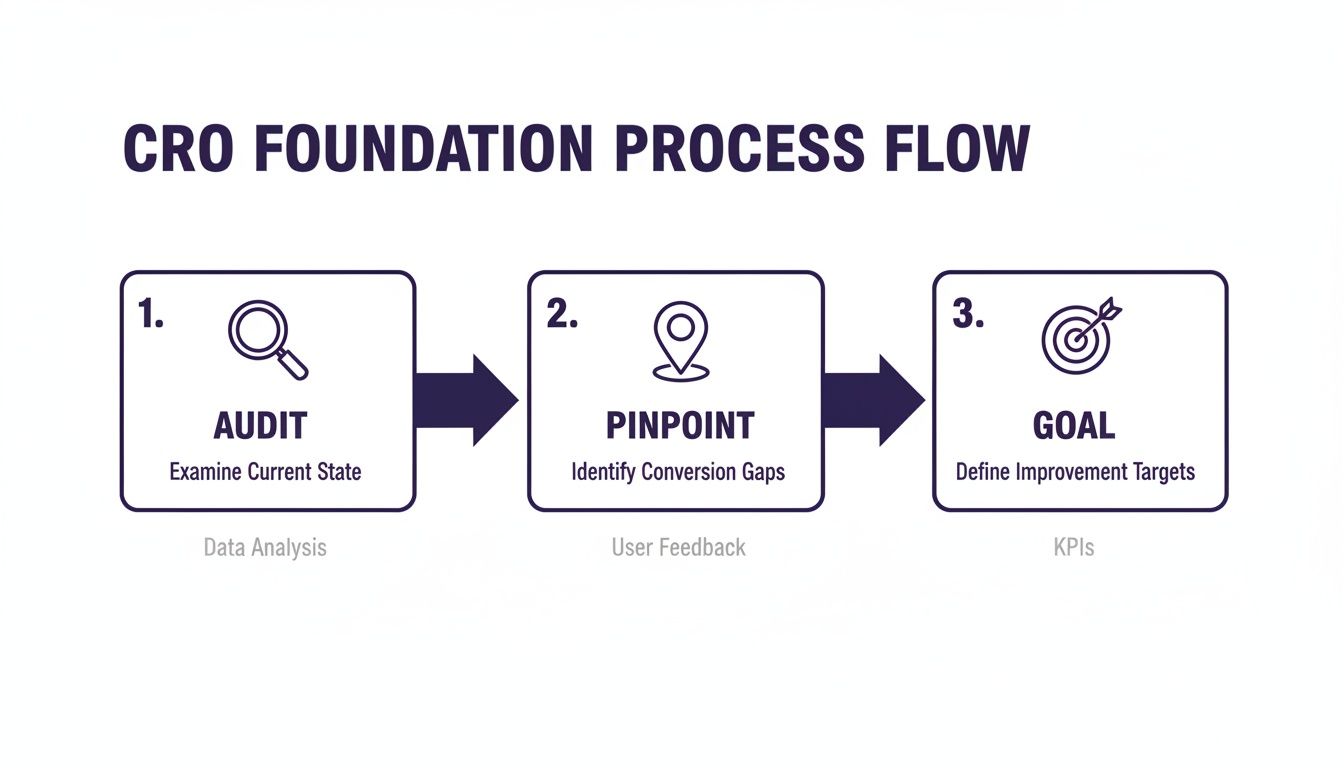
This simple progression from audit to goal-setting ensures every test you run is purposeful and aimed at solving a genuine user problem.
Choosing the Right Testing Method
With a solid hypothesis in hand, you need to pick the right tool for the job. There are a few ways to run tests, and each one is suited for different situations.
A/B Testing
This is your bread and butter. You simply compare two versions of a page—Version A (the control) and Version B (the variation)—to see which one performs better. It’s perfect for testing single, high-impact changes. Our internal guide breaks down in detail what A/B testing in marketing really means and how to get it right.
- When to Use It: Testing a new headline, a different call-to-action button color, or a re-written product description. It’s the go-to for clear-cut, focused comparisons.
Multivariate Testing (MVT)
MVT is a bit more complex. Instead of one change, you’re testing multiple changes on a page at the same time to see which combination wins. Think two different headlines, two images, and two CTAs, all running at once.
- When to Use It: You have a high-traffic page and you want to understand the individual impact of several elements. A word of warning: MVT needs a lot more traffic than a simple A/B test to deliver a reliable result.
Split URL Testing
This method is for the big swings. You're not just tweaking a button; you're testing two completely different versions of a page, each living on its own URL. You split traffic between the original and the total redesign.
- When to Use It: You're overhauling a checkout flow or launching a complete page redesign. It’s for radical changes, not minor tweaks.
What Makes a Test Result Trustworthy?
Running a test is easy. Getting a reliable result is the hard part. The key concept here is statistical significance, which is usually set at a 95% confidence level. All this means is that you can be 95% sure your results aren't just a random fluke.
Don’t call a test early! It’s so tempting to stop a test the second one version pulls ahead, but this is a classic way to get a false positive. Let your testing tool run until it has enough data to declare a statistically significant winner.
A huge piece of building great hypotheses is getting deep user insights, often through usability testing of a website to improve UX. Watching real people stumble through your site will give you the "why" you need for your next big test idea.
The potential here is massive. The average landing page converts at a measly 2.35%, but the top players are in another stratosphere. The top 10% of sites see conversion rates of 11.45% or higher. Just getting your pages to a 5.31% conversion rate puts you ahead of 75% of your competitors. It just goes to show that even small, data-backed improvements can give you a serious edge.
High-Impact Levers for Boosting Your Conversions
While A/B testing is a fantastic long-term strategy, some improvements are so fundamental they almost always deliver a win. These are the high-impact levers you can pull right now to see tangible gains.
I'm talking about the three pillars that support every successful website conversion rate optimization effort: user experience, persuasive copy, and site speed.
Think of these as the foundation of your house. You can spend all day rearranging the furniture (running A/B tests), but if the foundation is cracked, the whole thing will crumble. Nailing these core elements creates a baseline of excellence that makes all your future optimization efforts way more effective.
Streamline Your User Experience
User experience (UX) is all about making your website easy and enjoyable to use. When it’s good, visitors barely notice it. When it’s bad, it’s a conversion killer. Your entire goal here is to remove friction at every single touchpoint.
Start with your navigation. Can people find what they’re looking for in three clicks or less? If your menu is a cluttered mess of dropdowns, you’re just creating cognitive load. Simplify it. Pare it down to the absolute essentials, using clear, intuitive labels that your audience actually understands.
Next, let's talk forms. Nobody loves filling out forms, so make yours as painless as possible. Only ask for the information you absolutely need right now. If you're looking for specific ideas, these actionable conversion rate optimization tips for forms offer a great checklist.
My personal rule of thumb is to treat every form field as a tiny obstacle. For each one, I ask, "Do we really need this to complete the transaction?" You'd be amazed how often the answer is no. Just cutting two or three unnecessary fields can dramatically boost completion rates.
Finally, you have to be obsessive about mobile. With well over half of all web traffic coming from mobile devices, a clunky, hard-to-use mobile site is a non-starter. This means big, tappable buttons, simple layouts, and a checkout process that doesn't require a magnifying glass and a surgeon's steady hand.
Write Copy That Sells
Your website's copy isn't just there to describe what you sell; it's your 24/7 salesperson. It has to connect with your audience, build trust, and gently guide them toward taking action. It's a massive part of any solid conversion strategy.
Your value proposition is the single most important piece of copy on your site. It needs to be front and center, instantly communicating what you do, who it's for, and why you're the best choice. If a visitor can't figure that out in five seconds, they're gone.
Beyond the big headlines, you need to sweat the small stuff—your microcopy. I'm talking about the little bits of text on your buttons, form labels, and even error messages. Good microcopy calms anxiety and clarifies what happens next.
For example, simply changing a button from "Submit" to "Get Your Free Quote" accomplishes two key things:
- It's specific: The user knows exactly what they're getting when they click.
- It highlights value: It reinforces the benefit ("Free Quote") instead of the chore ("Submit").
This might seem like a tiny detail, but these little reassurances add up. They make the user feel more confident and in control throughout their entire journey.
Prioritize Blazing-Fast Site Speed
In the world of CRO, speed is king. It's not just some technical metric; it's a direct reflection of how much you respect your user's time. A slow site feels broken and untrustworthy, sending potential customers straight to your faster competitors.
The financial impact here is staggering. Shaving just one second off your website's load time can boost conversions by a whopping 7%. Getting your pages under two seconds? That can push conversions up by 15%. One analysis from Portent found that B2B sites loading in one second see 3x higher conversion rates than those that take five seconds. The numbers don't lie.
So, where do you start?
Begin with a free tool like Google PageSpeed Insights. It will give you a clear, actionable report card on your site's performance and point out exactly what's slowing it down.
More often than not, the biggest culprits are large, unoptimized images. Compressing your images is one of the easiest and most effective things you can do for an immediate impact on your load times.
Other common fixes include:
- Minimizing code: This just means removing unnecessary characters from your HTML, CSS, and JavaScript files.
- Using browser caching: This lets you store parts of your site on a visitor's device, so it loads much faster when they come back.
- Upgrading your hosting: Sometimes, the simplest solution is moving to a faster, more reliable server.
Treating speed as a top priority isn't just a job for your developers—it's a core component of any successful website conversion rate optimization program.
Advanced Strategies to Maximize Your ROI
Okay, you’ve sorted out the low-hanging fruit—your site is faster and the user experience is solid. Now what? It's time to graduate from the one-size-fits-all approach. This is where the real magic happens in website conversion rate optimization, creating tailored experiences that make each visitor feel like you get them.
Think about it: a first-time visitor clicking from a social media ad is worlds apart from a loyal customer who's bought from you five times. Advanced CRO is all about recognizing these differences and acting on them. By fine-tuning your content, offers, and messaging for different segments, you meet people exactly where they are.
Embrace the Power of Personalization
Personalization isn't some far-off marketing dream anymore; it’s a practical, powerful way to lift conversions right now. It boils down to using what you know about a visitor—their location, how they found you, what they've looked at before—to make their experience more relevant.
You don't need to overhaul your entire site. Small, smart tweaks can have a huge impact.
- New visitor? Hit them with a popup for 10% off their first order. It's a classic for a reason.
- Returning customer? Ditch that first-time offer. Instead, show them new arrivals based on what they've bought in the past.
- Someone visiting from a cold climate? A smart e-commerce site would automatically push winter coats and boots to the top of the homepage.
The goal is to make the path to purchase feel less like a generic sales funnel and more like a helpful, intuitive journey designed just for them.
View Accessibility as a Conversion Opportunity
So many people see web accessibility as a chore—a technical box to check off a compliance list. That mindset is a massive missed opportunity. Truthfully, making your site accessible is one of the smartest conversion plays you can make.
When you design for people with disabilities, you’re not just being inclusive; you're creating a better, smoother experience for every single visitor.
You're also opening your digital doors to a huge market. Around 16% of the global population has a significant disability. Ignoring them is like leaving money on the table.
Treating accessibility as an afterthought is a huge mistake. Simple things like adding descriptive alt-text to images, using high-contrast text, and ensuring keyboard navigation don't just help users with disabilities—they boost your SEO and make your site easier for everyone to use.
Good accessibility is good UX. Clear navigation, readable fonts, and simple forms are universal wins that make it easier for every person on your site to become a customer.
Calculating the ROI of Your CRO Efforts
At the end of the day, CRO has to pay for itself. You need to prove that all this testing and tweaking is actually making the business money. Thankfully, calculating the return on investment (ROI) for your program doesn't require a finance degree.
It all comes down to tracking two things: the cost of your CRO program and the value you get back from the improvements.
Program Costs are pretty straightforward:
- The monthly fees for your testing and analytics software.
- Salaries for your team or the cost of hiring an agency.
- The time everyone spends on research, building tests, and digging through the data.
Value Generated is where it gets exciting. This is the new revenue you can directly attribute to your winning tests. For an e-commerce store, let's say a test bumps the conversion rate from 2% to 2.5% on a page that gets 50,000 visitors a month. If your average order is $100, that little 0.5% lift just added $25,000 in revenue. Per month.
When you consistently measure the revenue lift against your costs, CRO stops looking like a "marketing expense" and starts being recognized for what it is: a powerful revenue engine for the business.
Your CRO Questions, Answered
Even with the best playbook, getting into the weeds of website conversion rate optimization always brings up new questions. When you're staring at the data, it's easy to get stuck. I've pulled together answers to some of the most common hurdles I see business owners run into.
Think of this as your quick-reference guide for those "what now?" moments.
How Much Traffic Do I Need for A/B Testing?
This is the big one, and the honest answer is: it’s not about a magic number. The real goal is to hit statistical significance within a reasonable time—I usually aim for two to four weeks. If a test drags on for months, you risk market shifts and other outside factors muddying your results.
As a general rule of thumb, shoot for at least 1,000 unique visitors and 100 conversions for each variation you're testing.
Don't have that kind of traffic? No problem. It just means you need to adjust your strategy. Forget testing tiny tweaks like button colors and instead, swing for the fences with high-impact changes backed by your qualitative data. A full landing page redesign, for example, is far more likely to give you a clear winner on lower traffic than a minor headline change.
What Are the Most Important CRO Metrics to Track?
Your main conversion rate—be it a purchase, a lead form, or a demo request—is the headline act. But it can't tell the whole story on its own. Focusing on just one metric is a classic mistake. I've seen tests that boosted sign-ups but absolutely tanked the quality of those new leads.
To get the full picture, you need a basket of supporting KPIs.
- Bounce Rate: Are your changes immediately turning people off?
- Average Session Duration: Are people more or less engaged with the new version?
- Pages per Session: Is the change encouraging users to explore more of your site?
- Cart Abandonment Rate: For e-commerce sites, this is an absolute must-watch.
- Micro-conversions: Don't ignore the small wins, like newsletter sign-ups or PDF downloads. They're strong signals of user intent.
These secondary metrics give you the context you need. They help you understand the entire user journey and flag friction points that your main conversion goal might completely miss.
A "win" that boosts one metric while hurting others isn't a win at all—it's a net loss for the business. Always look at the broader impact before you roll out a change across your whole site.
Should We Hire an Agency or Do CRO In-House?
This really boils down to three things: your team's expertise, your resources (time and money), and how fast you need to see a return.
Building an in-house CRO program is a powerful way to develop deep, institutional knowledge. But it’s not easy. It requires someone—or a whole team—with a very specific blend of skills in analytics, UX, copywriting, and even a bit of development. If you've already got that talent on the payroll, it can be a great, cost-effective option.
On the other hand, bringing in a specialized agency gives you instant access to a team of seasoned pros, high-end testing software, and battle-tested processes. For most small and medium-sized businesses, it’s often the faster path to meaningful results and can actually be more affordable than hiring a full-time, senior-level CRO specialist.
At Frozen Crow Inc., we turn data into dollars. Our CRO services are designed to find the hidden opportunities on your site and convert more of your hard-earned traffic into customers. Stop guessing and start growing with a free marketing audit today.


