


August 20, 2026
Strategic it consulting services: Align Tech with Growth and Value
What exactly are strategic IT consulting services? In short, it’s high-level guidance that connects your company’s technology directly to its business goals. Think of it like hiring an architect before you start building. You need someone to create the blueprint that ensures every digital tool, process, and system is designed to support long-term growth and give you an edge.
What Are Strategic IT Consulting Services, Really?
Imagine trying to build a skyscraper without a plan. You could bring in the best plumbers, electricians, and construction crews on the planet, but you’d still end up with a chaotic, inefficient, and frankly, dangerous building. This is exactly what happens when businesses handle technology reactively—just fixing problems as they pop up without a clear vision for the future.
Strategic IT consulting provides that critical blueprint. It shifts the entire conversation away from day-to-day IT chores like fixing a broken printer or resetting a password. Instead, it focuses on designing a technology roadmap that gets you where you want to go. A strategic consultant doesn't just ask, "Is your server running?" They ask, "Will your current tech stack even support your five-year growth plan?"
Moving Beyond the Break-Fix Mentality
The real difference comes down to purpose. Traditional IT support is reactive; it’s all about putting out fires and solving today’s technical glitches. Strategic IT consulting is proactive. It’s about preventing those fires from ever starting and, more importantly, finding new ways to use technology to create opportunities.
This approach means taking a deep dive into your business—your market, your operations, and your biggest goals. We’re not just looking at servers and software; we're looking at the entire picture.
It's no surprise that this kind of high-level planning is taking off. The global strategy consulting market, a core piece of strategic IT consulting services, was valued at $39.15 billion in 2024 and is expected to hit $96.25 billion by 2032. That explosion shows just how much companies are relying on expert guidance to navigate fast-paced technology and fierce competition. You can read more about the growth of the strategy consulting market.
Strategic IT Consulting vs Traditional IT Support
To really get it, it helps to see a side-by-side comparison. The table below breaks down the fundamental differences between these two vital, but very different, services.
| Aspect | Strategic IT Consulting | Traditional IT Support |
|---|---|---|
| Primary Goal | Align technology with long-term business objectives to drive growth and create a competitive edge. | Resolve immediate technical problems and maintain daily operational stability. |
| Focus | Proactive, future-oriented planning, and optimization. | Reactive, present-focused troubleshooting, and maintenance. |
| Scope | Business-wide, encompassing processes, market positioning, cybersecurity, and data analytics. | Specific to hardware, software, and network functionality. |
| Outcomes | Increased profitability, improved efficiency, enhanced market position, and innovation. | Minimized downtime, functional systems, and user problem resolution. |
At the end of the day, a standard IT provider keeps the lights on. A strategic partner helps you design a more efficient power grid for the entire city.
A strategic IT partner works on your business, not just in it. Their role is to transform technology from a necessary expense into a powerful asset that generates revenue and builds sustainable value for the future. This shift in perspective is what defines the service.
The Core Services That Drive Transformation
Strategic IT consulting isn't a one-size-fits-all product you pull off a shelf. It’s a whole toolkit of high-impact services, all designed to get your technology and your business ambitions pulling in the same direction. Think of it less like basic IT support and more like having a technical co-founder focused on growth.
At the end of the day, it's about building a clear path forward. We look at where you are now, where you want to be in five years, and then design the tech strategy to bridge that gap. This is way more than just recommending new software; it's a deep, hands-on partnership.

Developing Your Technology Roadmap
One of the first things we tackle is building a multi-year technology roadmap. This isn't just a shopping list for new servers. It's a strategic plan that lines up every tech initiative, investment, and timeline directly with your business goals.
It’s built to answer the big questions: "What systems do we need to handle a 25% sales increase?" or "How can we use the cloud to lower our operating costs over the next three years?" This roadmap brings clarity, making sure every dollar you spend on tech is a smart investment, not just a reaction to something breaking. For smaller businesses, our guide on IT services for small businesses dives deeper into making this work on a smaller scale.
Spearheading Digital Transformation
"Digital transformation" gets thrown around a lot, but it really just means rethinking how you work and serve customers with modern technology. An IT consultant is the person who actually makes these big projects happen.
In the real world, this could mean a few things:
- Process Automation: We find those manual, soul-crushing tasks and build automated workflows that boost efficiency and cut down on mistakes.
- Cloud Migration: We’ll map out a plan to move your servers and apps to the cloud, giving you more flexibility and often saving you a lot of money.
- Customer Experience Platforms: We can implement modern CRM systems that give your customers a smooth, personalized experience every time they interact with you.
These are complicated projects. A good consultant brings the experience to get them done on time and on budget, ensuring they actually deliver the results you're after.
Building Data Analytics and Business Intelligence
Your business is sitting on a goldmine of data, but it’s worthless if you can’t make sense of it. A huge part of strategic IT consulting services is helping you turn that raw information into smart decisions.
A consultant helps you move from just collecting data to actually using it. They build the dashboards and reports that show you what your customers are doing, where your operations are getting stuck, and where new opportunities are hiding.
This is more than just installing software; it's about building a data-driven culture. We help define the key metrics (KPIs) that matter, set up reporting that makes sense, and train your team to use data to win. This can even include advanced tools like AI-powered knowledge management to pull insights from information scattered across your whole company.
Ensuring Cybersecurity and Compliance
The more technology you rely on, the more risk you take on. A strategic consultant is your first line of defense, protecting your business from digital threats and tricky regulatory rules.
This goes way beyond just installing antivirus software. It's a complete game plan:
- Risk Assessment: We start with a deep dive into your systems and processes to find the weak spots.
- Framework Design: We build a full cybersecurity plan with policies and technical controls to plug those gaps.
- Compliance Audits: We make sure you’re following the rules for your industry, whether it’s HIPAA, GDPR, or PCI DSS.
- Disaster Recovery Planning: If the worst happens, we’ll have a plan ready so you can get back up and running fast.
By managing risk proactively, a consultant protects your reputation, your customers' trust, and your bottom line. It turns a massive headache into just another well-managed part of your business.
Turning Technology Strategy Into Real Business Value
So, you’ve got a new server, a cloud migration plan, or a fancy software platform. The big question is, how does any of that actually improve your bottom line? This is where IT stops being an expense and starts becoming a strategic investment. Strategic IT consulting exists to draw a straight line from a technical project to the real-world business results your CEO and CFO actually care about.
It’s about ditching the jargon and focusing on tangible return on investment (ROI). A great strategy doesn't just give you a faster network; it delivers a more profitable business. This focus on results is why demand is booming. North America is leading the charge in the global strategic consulting market, especially in sectors like e-commerce and healthcare where tech is crucial for operations and customer experience. Just look at the U.S. alone—the IT consulting industry, which is tied at the hip to these strategic services, grew into a massive $759.6 billion market in 2025. You can get a closer look at the growth of the strategic consulting market on stellarmr.com.
From Cost Center to Profit Center
Here’s the real magic: a well-crafted IT strategy can flip technology from a necessary cost into a powerful profit engine. This isn’t abstract theory; it happens in clear, measurable ways. By digging into your current operations, a consultant can pinpoint exactly where technology will make the biggest impact.
This means looking at how you work, how you sell, and how you serve your customers. We find the friction points—the bottlenecks slowing you down—and use technology to smooth them out. The result is a more efficient, effective, and competitive organization. This is a fundamental piece of any successful digital transformation for small business looking to punch above its weight.
What This Looks Like in the Real World
Let's get practical. Here’s how a strategic IT partnership directly translates into business value:
-
Scenario 1: Slashing Operational Costs: An e-commerce company is bleeding money on expensive, on-premise servers that can't even handle holiday traffic. A consultant maps out a cloud migration. The result? A 30% reduction in infrastructure costs, zero downtime during peak season, and the ability to scale automatically, preventing lost sales.
-
Scenario 2: Boosting Sales Conversions: A B2B sales team is stuck using a messy mix of spreadsheets and outdated systems to track customer data. A consultant rolls out a modern CRM and a business intelligence (BI) dashboard. Suddenly, the team has a 360-degree view of every customer, leading to a 15% increase in cross-selling and a shorter sales cycle.
-
Scenario 3: Mitigating Million-Dollar Risks: A healthcare provider is losing sleep over potential data breaches and HIPAA compliance. A strategic consultant performs a full risk assessment and builds a proactive cybersecurity framework. This single move prevents a data breach that could have easily cost millions in fines, lawsuits, and a shattered reputation.
A successful IT project isn’t measured by how many servers were upgraded. It’s measured by how much operational efficiency was gained or how much revenue grew as a direct result.
Your Engine for a Competitive Edge
Ultimately, strategic IT consulting is about building a competitive advantage that lasts. When your technology is perfectly aligned with your core business goals, you create an operational machine that your competitors simply can't copy.
This alignment means you’re not just chasing the latest tech trends. You’re using technology to actively outmaneuver the competition. Whether it’s through smarter data insights, a more efficient supply chain, or a better customer experience, technology is no longer just a utility. It becomes your secret weapon.
How to Choose the Right IT Consulting Partner
Picking a firm for strategic IT consulting services isn’t like hiring a plumber. It's more like bringing on a long-term business partner. The right firm won't just follow orders; they'll push back on your assumptions, get genuinely excited about your vision, and take real ownership of the outcome.
Get it wrong, and you're looking at wasted money and projects that go nowhere. But get it right? You've just found a powerful engine for growth. This calls for a thoughtful approach that goes way beyond comparing price tags. You’re evaluating their expertise, their process, and critically, how well they click with your company’s culture and goals. They should feel like a natural part of your leadership team.
The real goal here is to find a consultant who is just as invested in your business results as you are. Their success should be tied directly to your KPIs, not just checking off a list of technical tasks. That's the bedrock of a real strategic partnership.
Look for Deep Industry Expertise
A consultant who already gets your industry has a massive head start. They know the language, they know your competitors, and they understand the regulatory headaches you deal with every day. This kind of specialized knowledge means they can offer solutions that actually work in the real world, not just generic advice from a textbook.
Think about it: a consultant with a deep background in e-commerce will already understand the complexities of supply chain integration and customer data platforms. One who lives and breathes healthcare will be a pro at HIPAA compliance and patient data security.
When you’re vetting potential partners, make them prove it:
- Case Studies: Ask for detailed stories of work they've done for companies like yours. Zero in on the specific problems they solved and the business results they delivered.
- Client References: Get on the phone with their past or current clients. Ask them about communication, problem-solving skills, and the tangible impact the consultant had on their business.
Doing this homework ensures you're not paying for their on-the-job training.
Evaluate Their Strategic Process
A true strategic partner has a clear, transparent game plan for getting from discovery to execution. They should be able to walk you through exactly how they'll learn your business, build a strategy, and manage the rollout. If their process sounds fuzzy or disorganized, that's a huge red flag.
A solid methodology usually looks something like this:
- Thorough Discovery: They should start by asking a ton of questions. They need to get a deep understanding of your operations, your pain points, and where you want to go.
- Collaborative Strategy: The best consultants build the roadmap with you, making sure it aligns perfectly with your vision and budget.
- Clear Implementation Plan: You should get a detailed project plan with clear milestones, timelines, and who's responsible for what.
- Ongoing Measurement: They establish KPIs right from the start and have a system for tracking progress to show you a real return on your investment.
This kind of structured approach eliminates surprises and keeps everyone on the same page from day one.
Before you sign on the dotted line, it's critical to have a structured way to compare your options. A simple evaluation checklist can help you move past gut feelings and make a data-informed decision. It forces you to look at each potential partner through the same lens, ensuring a fair and balanced comparison.
Evaluation Checklist for IT Consulting Partners
| Evaluation Criteria | Provider A Score (1-5) | Provider B Score (1-5) | Notes |
|---|---|---|---|
| Industry-Specific Experience | Do they have proven case studies in our sector? | ||
| Technical Expertise | Do they have deep knowledge of the specific tech we need? | ||
| Strategic Process & Methodology | Is their process for discovery and implementation clear? | ||
| Communication & Transparency | How proactive and clear are they in their communication? | ||
| Client References & Reputation | What do their past clients say about their results? | ||
| Cultural Fit & Team Chemistry | Do their values and work style align with ours? | ||
| Focus on Business Outcomes | Do they talk more about business results or technical tasks? | ||
| Pricing Model & Value | Is their pricing clear and aligned with the value they provide? |
Using a table like this helps you organize your thoughts and spot the partner that truly aligns with your most important criteria, not just the one with the slickest sales pitch.
Ask the Right Questions
Your evaluation is only as good as the questions you ask. Go beyond the technical specs and dig into how they think and operate. The right questions will reveal a firm's true character and capabilities.
Here are a few sharp questions to get you started:
- "How do you measure a project's success beyond just finishing on time and on budget?"
- "Describe your process for making sure our own teams actually adopt and use the new technology."
- "Walk me through a time a project got derailed. How did you handle it, and what happened?"
- "How do you keep up with new tech trends, and how do you decide which ones are actually worth a client's time and money?"
Their answers will tell you a lot about their experience, their commitment to your success, and their ability to navigate the messy reality of complex projects.
Prioritize Cultural Fit
Finally, never underestimate the power of a good cultural fit. You’re going to be working very closely with this team, often on high-stakes, stressful projects. If your communication styles, values, or work ethic clash, the partnership is doomed from the start.
Do they communicate proactively? Are they flexible when things change? Do they seem genuinely passionate about what they do? Choose a partner whose team you trust, respect, and won't mind seeing in your boardroom every week.
Your Strategic IT Implementation Roadmap
So, what does this actually look like in practice? Bringing on an IT consulting partner isn't like flipping a switch and hoping for the best. It's a structured journey we take together with a clear destination in mind. Think of it like building a custom home: you don't just get the keys on moving day. You’re part of the process, from the first sketch to the final coat of paint.
A solid roadmap takes the guesswork out of the equation, breaking a massive undertaking into clear, manageable stages. Each step has its own goals, activities, and deliverables, making sure we’re always on the same page and moving forward with purpose. This is what separates a true partnership from a simple vendor transaction.
Phase 1: The Discovery and Assessment
First things first, we have to go deep. This phase is the foundation for everything that follows. Our team acts like detectives, getting to know every corner of your business—not just your servers and software, but your operations, your culture, and where you stand in the market.
This isn't just a simple questionnaire. It's a full-on investigation to get the complete picture: your strengths, your weaknesses, hidden opportunities, and any potential roadblocks ahead.
Here’s what we typically do:
- Stakeholder Interviews: We sit down with key people from every department. We want to hear from the C-suite all the way to the front lines to understand their daily workflows, biggest headaches, and what success looks like to them.
- Technical Audits: We conduct a top-to-bottom review of your entire tech stack—infrastructure, apps, security, and data practices.
- Process Mapping: We chart out your core business processes to pinpoint bottlenecks, inefficiencies, and the exact spots where technology can make the biggest impact.
The result is a detailed diagnostic report. This document doesn't just list problems; it gives you a crystal-clear snapshot of where you are today and sets the baseline for all the work to come.
Phase 2: The Strategy and Blueprint Design
With a solid understanding of your business, it's time to draw up the blueprint. This is where we translate all those findings from the discovery phase into a concrete, actionable technology roadmap. It's a highly collaborative process where your business goals are the North Star for every single decision.
We're not chasing the latest tech fads here. This is about designing a practical, tailored plan that uses technology as a tool to solve your specific challenges and hit your specific targets.
A great IT strategy is really just a business plan expressed through technology. It should clearly explain why we’re doing something and what specific business outcome it will drive, whether that’s boosting revenue or making customers happier.
This phase gives you several crucial documents:
- The Strategic Roadmap: A multi-year plan that lays out specific projects, timelines, budgets, and the business goals tied to each one.
- Solution Architecture: Detailed designs for any new systems or infrastructure, ensuring they’re built to be scalable, secure, and right for the job.
- Change Management Plan: A vital but often overlooked plan to get your team on board. This covers training, communication, and support to make the transition smooth for everyone.
Phase 3: The Implementation and Execution
Now we bring the plan to life. The implementation phase is all about turning strategy into reality. That could mean moving systems to the cloud, rolling out new software, or building out a stronger cybersecurity defense. Good project management is everything here, making sure we stay on schedule, on budget, and deliver what we promised.
Communication is constant throughout this stage. We provide regular updates, manage all the vendors, and work side-by-side with your internal teams to ensure a smooth transition. This hands-on approach keeps disruptions to a minimum while the transformation is happening. It's a methodical process where every step is carefully managed to reduce risk and hit the milestones we laid out in the blueprint.
Phase 4: Optimization and Continuous Improvement
The "go-live" date isn't the finish line—it’s just the start of a new chapter. Technology never sits still, and a real strategic partner sticks around to make sure the solutions we built continue to deliver value long after day one. This final phase is all about monitoring, measuring, and refining.
We track the key performance indicators (KPIs) we established back in the strategy phase to measure the real-world impact on your business. By analyzing performance data and listening to user feedback, we can make ongoing tweaks and find new opportunities for improvement. This creates a cycle of optimization, ensuring your technology doesn't just meet your needs today but evolves right alongside your business.
Measuring the Success of Your IT Strategy
There’s an old saying: if you can’t measure it, you can’t manage it. A partnership with a strategic IT consulting firm isn’t truly a success until you can prove its return on investment. This means looking past the simple tech stats like server uptime and focusing on the numbers that actually move the needle for your business.
The real goal is to draw a straight line from every tech initiative directly back to a tangible business outcome. When you can show your stakeholders exactly how that new system boosted profitability or market share, the value of your IT spend becomes crystal clear. That’s how you prove this was a strategic move, not just another expense.
Key Metrics That Define Success
Tracking success means you have to be looking at the right data. While technical metrics have their place, the real story is told through business-focused KPIs that show clear operational improvements and financial gains.
Here are the kinds of metrics that really matter:
- Customer Lifetime Value (CLV): Did that new CRM system actually lead to better customer retention and more repeat business? A jump in CLV is a huge win.
- Process Efficiency Gains: Measure the time or money you’re saving on specific tasks. For example, automating the invoicing process could slash processing time by 75%.
- Employee Productivity: How is new tech helping your team get more done? You could track this by looking at sales-per-employee or the number of projects completed each quarter.
- Cost of Customer Acquisition (CAC): A slick, well-integrated marketing and sales platform can seriously lower the cost of finding and converting new leads, which hits the bottom line directly.
The most powerful KPIs tell a clear story of cause and effect. They answer the question: "Because we implemented X technology, we achieved Y business result." This clarity transforms IT from a cost center into a documented value driver.
This is why having a clear roadmap is so important. You start with discovery, build the strategy, and then move to implementation.
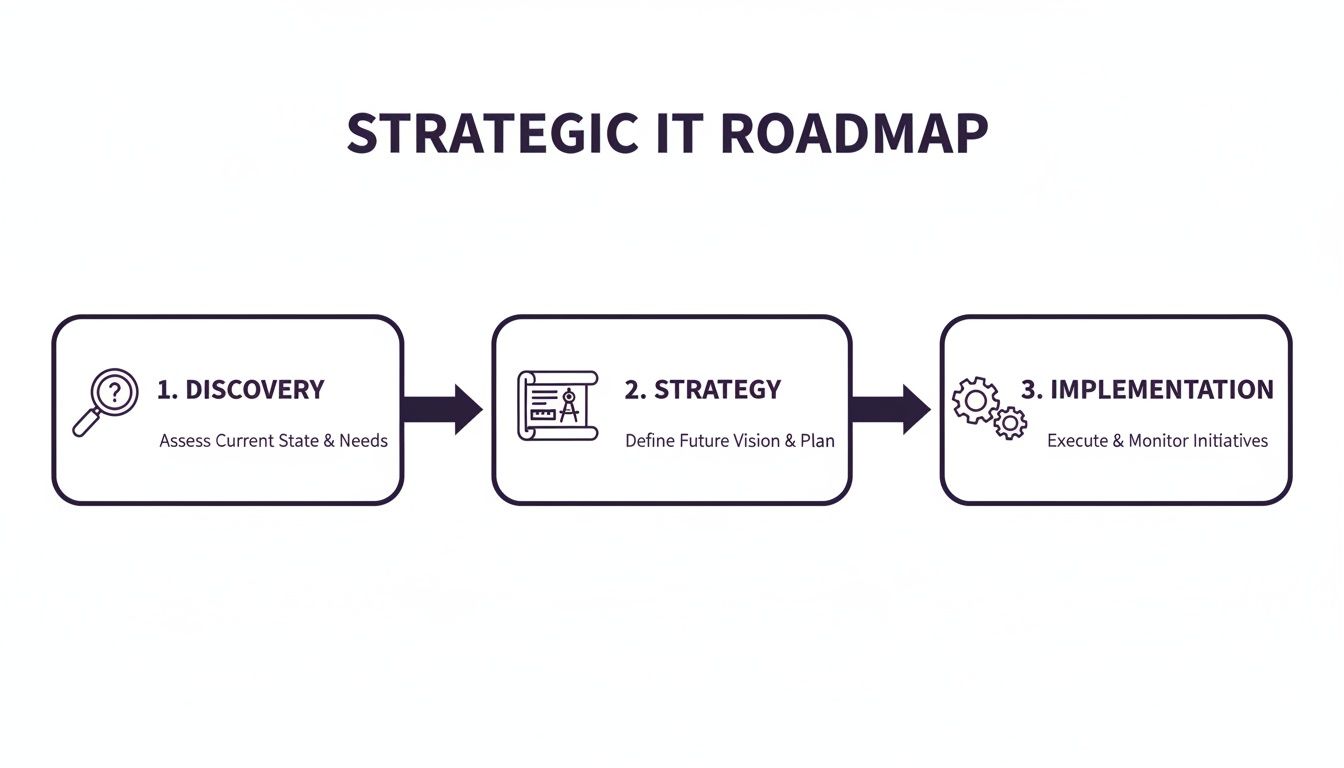
This kind of structured approach ensures that measurement and KPIs are baked into the plan from day one, not just tacked on at the end.
To get a handle on tracking your IT initiatives, it helps to understand the key performance indicators for software development that measure outcomes right at the source. By integrating the right metrics from the start, you create a feedback loop that drives constant improvement and shows a clear ROI. If you want to dive deeper, check out our business intelligence tools comparison to see how the right software can make tracking these vital metrics a whole lot easier.
Got Questions? Let's Talk Through Them.
Even with the best plan laid out, a few practical questions always pop up before bringing in a strategic IT partner. That's completely normal. Business leaders need to know what they’re getting into—what it costs, what the first couple of months look like, and how it will all feel on a day-to-day basis. Getting these things out in the open builds the confidence you need to make the right move.
So, what does this actually cost? That's usually the first thing on everyone's mind. Unlike a fixed-price project, strategic consulting isn't a one-and-done purchase. It's typically handled on a retainer or project basis, which reflects the high-level, ongoing nature of the work. Think of it less like buying a piece of software and more like adding a seasoned tech executive to your leadership team, but without the full-time salary. The investment is tied directly to hitting your business goals, not just checking off tasks.
Another big one: what happens in the first 30 to 60 days? This is all about discovery. Your consultants are going to dive deep, interviewing your team, auditing your tech stack, and mapping out every process. It's an intense learning sprint designed to give them the full picture so they can build a strategy that actually works for your business.
Making the Partnership Work
How do you make sure your internal team and external consultants actually click? A successful engagement comes down to open communication and setting clear ground rules from day one.
- Pick a Point Person: Designate one person inside your company to be the main contact. This streamlines communication and keeps decisions moving.
- Frame it as a Partnership: Make it clear the consultants are here to help, not to judge or critique. They're an extension of your team.
- Set a Rhythm: Schedule regular check-ins to go over progress, tackle roadblocks, and just make sure everyone is on the same page.
The best engagements feel like a true partnership. When your team sees the consultants as allies working toward the same goal, you get a collaborative energy that lets a powerful strategy take root and grow.
Ready to get your technology and business goals on the same page? Frozen Crow Inc. delivers the expert strategic IT consulting you need to drive real growth and carve out a competitive edge. Get your free audit and custom strategy today.


