


November 17, 2026
Small Business IT Consulting Services for Growth & Success
Let’s be honest. For most small business owners, technology is an afterthought—something you only notice when the Wi-Fi dies or a critical file goes missing. This "break-fix" approach feels normal, but it’s a quiet killer of productivity, security, and growth.
When you’re stuck in reactive mode, a minor server issue can quickly spiral into a major financial headache. In fact, downtime can cost a small business as much as $427 per minute. That's not a typo.
This is exactly why small business IT consulting services are so critical. They shift your entire mindset.
What Exactly Are IT Consulting Services?
Forget the idea of an IT consultant as just a computer repair person. Think of them more like a strategic partner—a personal trainer for your company’s entire tech infrastructure. Their job isn’t just to respond to problems; it's to get your technology in shape, identify weaknesses, and build a proactive plan for strength and resilience.
Moving Beyond Simple Fixes
A good consultant doesn't just fix a broken printer. They dig deeper to understand why things are breaking in the first place. They look at your whole technology ecosystem to make sure every piece works together to push your business forward.
This strategic approach covers a few key areas:
- Aligning Technology with Business Goals: They work to ensure every dollar you spend on tech directly supports what you’re trying to achieve, whether that’s boosting sales or making your team more efficient.
- Proactive Problem Prevention: Instead of waiting for a crash, they implement monitoring and maintenance to catch small issues before they can disrupt your operations.
- Building a Scalable Infrastructure: They design your systems to grow with you. This foresight prevents you from having to do a hugely expensive overhaul the moment your business starts to take off.
By focusing on long-term strategy instead of short-term fixes, IT consulting transforms technology from a reactive expense into a proactive tool for competitive advantage. It’s about building a foundation for sustainable success.
Ultimately, these services give you access to high-level expertise you couldn't afford to hire full-time. You get the guidance of a seasoned IT leader who ensures your technology isn't just working—it's working for you.
Core Services That Drive Business Success
The world of small business IT consulting services can feel like an alphabet soup of technical terms. But behind the jargon are concrete solutions built to solve real business problems. Instead of getting lost in the tech, let's look at the core services that translate directly into better security, efficiency, and growth.
This visual breaks down the three primary benefits that all good IT services deliver.
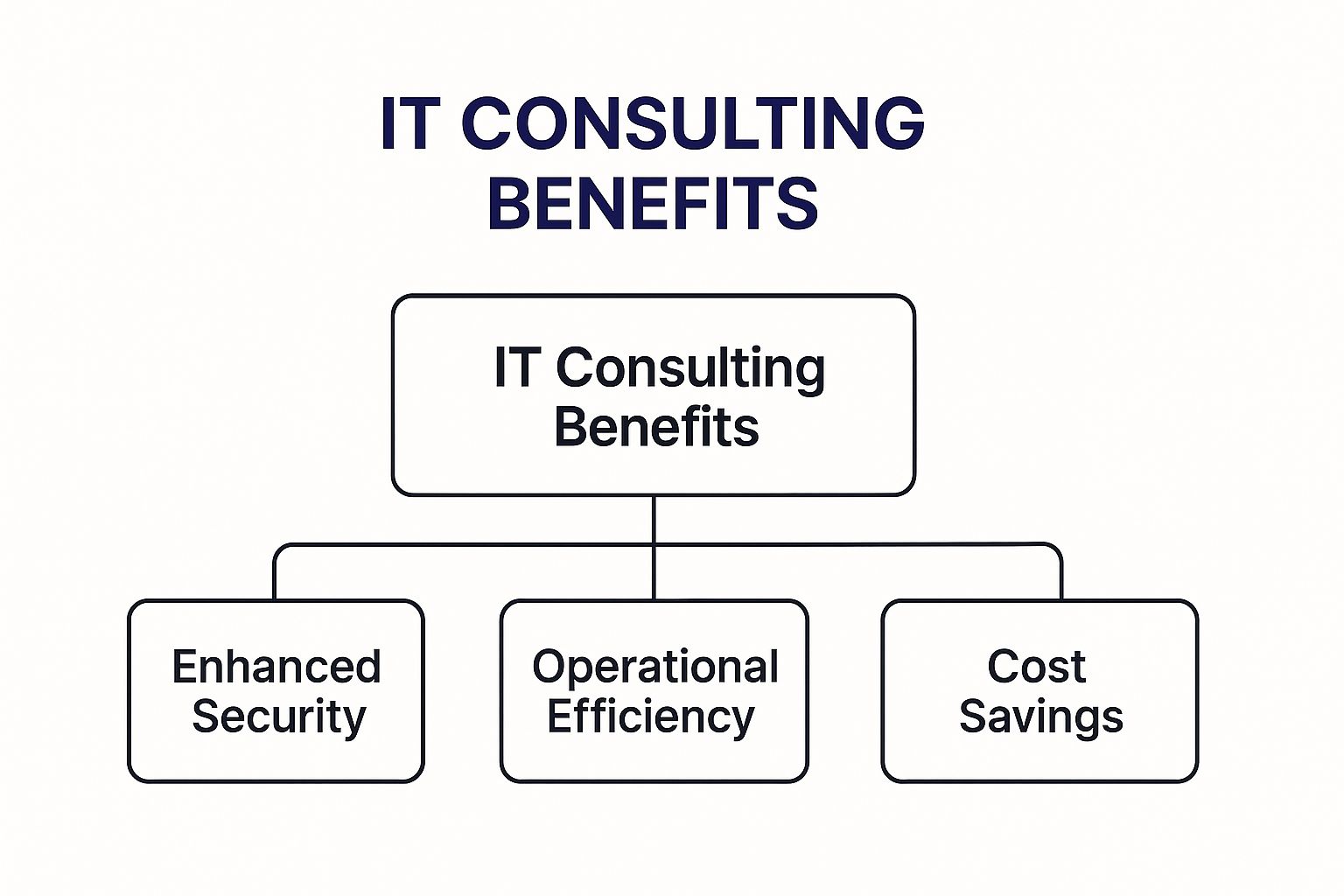
As you can see, every effective IT strategy boils down to strengthening security, boosting how your business runs, and saving you real money.
Strategic IT Planning
Think of this as the architectural blueprint for your business's technology. You wouldn't build a house without a plan, right? You'd end up with mismatched rooms, wasted space, and a ton of expensive fixes. The same goes for your IT.
A consultant doesn't just fix what's broken today. They dig into where your business is headed in the next three to five years and design a technology roadmap to get you there. This proactive approach ensures every dollar you spend on tech is a deliberate, impactful investment—not just a reaction to the latest fire.
This strategic alignment is the difference between technology being a constant budget drain and a powerful engine for your business's future.
Good planning prevents you from buying an underpowered server you'll outgrow in a year or sinking money into software your team can't actually use.
Cybersecurity Defense
For a small business, a single data breach isn't just a headache; it can be a company-ending event. Cybersecurity defense is all about building a digital fortress to protect your most valuable assets: your data and your customers’ trust.
This goes way beyond just installing antivirus software. A consultant builds a multi-layered defense strategy that includes:
- Network Security: Putting up firewalls and access controls to keep unauthorized people out of your digital workspace.
- Employee Training: Teaching your team how to spot and avoid phishing scams, which are the sneaky entry point for 90% of cyberattacks.
- Data Encryption: Scrambling your sensitive information so it’s completely unreadable to anyone who might steal it.
These measures work together to create a tough defense system that actively protects you from constantly evolving threats, giving you some much-needed peace of mind. To see how these protections fit into a complete strategy, explore our guide to IT solutions for business.
Cloud Migration and Management
The cloud gives small businesses incredible power, offering access to enterprise-level tools without the massive upfront cost of buying and maintaining physical hardware. A consultant is your guide, helping you pick the right cloud platforms and moving your data and apps over securely.
Whether it's switching to Microsoft 365 for seamless team collaboration or moving your servers to a scalable platform like Amazon Web Services (AWS), an expert makes sure the transition is smooth. This single move can slash your hardware maintenance costs and give your team the freedom to work from anywhere.
Network Management and Support
Your network is the central nervous system of your business. When it's slow or unreliable, everything grinds to a halt. Network management is the proactive work of monitoring, maintaining, and optimizing your network to keep it running at peak performance with minimal downtime.
This is the behind-the-scenes work that keeps your Wi-Fi fast, your servers humming, and your team accessing the files they need without a hitch. It’s what keeps your daily operations running smoothly.
To give you a clearer picture, here’s a breakdown of how these services directly benefit a small business.
Key IT Consulting Services and Their Business Impact
| Consulting Service | What It Solves | Primary Business Benefit |
|---|---|---|
| Strategic IT Planning | Reactive spending, mismatched technology, and lack of a long-term vision. | Ensures technology investments align with growth goals, preventing waste. |
| Cybersecurity Defense | Vulnerability to data breaches, ransomware, and phishing attacks. | Protects sensitive data, maintains customer trust, and prevents financial loss. |
| Cloud Migration | High hardware costs, limited remote access, and difficulty scaling. | Reduces capital expenses, increases flexibility, and improves collaboration. |
| Network Management | Slow performance, frequent downtime, and connectivity issues. | Maximizes productivity by ensuring reliable and efficient operations. |
As you can see, each service is designed not just to manage technology, but to solve a specific business challenge and drive a positive outcome.
The demand for this kind of expert guidance is exploding. The global software consulting market, valued at USD 350 billion in 2024, is expected to skyrocket to over USD 1.1 trillion by 2034. This massive growth, detailed by Precedence Research, shows just how essential expert IT strategy has become for any business trying to stay competitive.
Why Investing in IT Consulting Is Non-Negotiable

It’s easy to look at small business IT consulting services and see just another line item on the budget. That’s a common mistake, and frankly, a costly one. It's time to reframe that thinking. An IT consultant isn't an expense; they're a strategic investment designed to deliver a clear, measurable return that hits your bottom line.
Think about it like this: you wouldn't think twice about buying a new machine that makes your production line 50% faster. The right technology partner does the same thing, just in the digital world. Their work translates directly into better efficiency, tougher security, and real, long-term cost savings.
Boosting Efficiency and Productivity
Inefficient tech is a silent killer of profits. Every day, slow networks, clunky software, and manual, repetitive tasks drain your company’s resources. It all adds up to wasted hours and frustrated employees who can’t do their best work. An IT consultant steps in as an efficiency expert, hunting down and eliminating these bottlenecks.
We saw this with a local e-commerce shop that was battling frequent website crashes during peak sales. They were losing thousands in revenue and, just as importantly, customer trust. After a consultant came in and optimized their network and server setup, they slashed that costly downtime by over 90%. That wasn't just a tech fix; it was a direct boost to their sales and stability.
Investing in IT consulting is about turning your technology from a source of frustration into a catalyst for productivity. It frees your team to focus on high-value work instead of fighting with their tools.
Strengthening Security and Reducing Risk
For a small business, the financial fallout from a cyberattack can be absolutely catastrophic. Proactive security isn't some luxury—it's a survival necessity. A good consultant builds robust defenses that shield your data, your reputation, and your finances from harm, saving you from potentially devastating recovery costs down the road.
Take a local service provider we know. They were about to drop a ton of money on new on-site servers. An IT consultant stepped in and showed them how a flexible cloud solution would not only be more secure but would also save them thousands in upfront hardware costs and ongoing maintenance. This one strategic pivot protected their data and instantly improved their cash flow.
A huge part of this is getting expert guidance on bigger initiatives, like putting together solid digital transformation strategies.
Unlocking Strategic Growth Opportunities
A great IT consultant does more than just fix what's broken; they help you find new ways to grow. They introduce you to tools and processes that can give you a serious competitive edge.
This could mean automating repetitive tasks, a key benefit you see with tools like marketing automation for small business, or setting up data analytics that uncover priceless insights about your customers.
These are the kinds of strategic moves where the real value is hiding. By investing in expert guidance, you’re not just keeping the lights on—you're building a smarter, tougher, and more profitable business for the long haul.
Choosing the Right IT Consulting Partner
Picking the right partner for your small business it consulting services is less like a transaction and more like hiring a key team member. Get it right, and you can seriously accelerate your growth. Get it wrong, and you’re looking at wasted money and endless headaches.
This isn’t just about finding someone who knows tech. It's about finding a partner who actually gets what you’re trying to build.
You have to cut through the sales pitches to find a firm that genuinely understands your company’s goals, your team’s culture, and the specific challenges of your industry. A consultant who’s a rockstar for retail clients might completely miss the mark on the compliance needs of a healthcare startup.
Vetting Experience and Expertise
Start by looking for a proven track record. Don't just take their word for it—ask for concrete examples of how they've helped businesses just like yours. A consultant with deep experience in your niche already knows your common pain points and won't be learning on your dime.
Next, pay close attention to how they communicate. Technology can get complicated, fast. You need a partner who can break things down in plain English, without hiding behind a wall of confusing jargon.
Their ability to connect technical details to real-world business impact is what truly matters. This is how you stay in control and make informed decisions, instead of just blindly following recommendations. A great way to test this is to ask direct questions early on. Their answers should be clear, concise, and focused on solving your problems—not just listing their technical skills.
The best IT consultants act as translators, bridging the gap between complex technology and tangible business outcomes. Their primary goal should be your understanding and empowerment.
Critical Questions for Potential Partners
When you start interviewing firms, a list of targeted questions is your best friend. It helps you compare your options objectively and makes sure you don't miss anything important.
Here are a few must-ask questions to get you started:
- Industry Experience: "Can you show me a case study or connect me with a reference from a client in our industry?"
- Support and Response: "What does your support process actually look like? If we have a critical issue, what’s your guaranteed response time?"
- Team Structure: "Who will be our day-to-day contact, and what’s their background?"
- Scalability: "How will your services grow with us over the next 2-3 years?"
- Security Approach: "What’s your process for auditing our current security and making it stronger?"
These questions dig deeper and help you understand how they'll operate as a true partner. For new companies, asking about their experience with early-stage growth is absolutely vital. You can find more on this in our guide to website development for startups, which covers how to build a scalable digital foundation from day one.
IT Consultant Vetting Checklist
To make this process even easier, we've put together a simple checklist. Use it to evaluate each potential partner consistently, so you can see who really stands out.
| Evaluation Criteria | Questions to Ask | What to Look For |
|---|---|---|
| Industry Experience | Do you have case studies or clients in our specific niche? | Proven results with businesses similar in size and industry to yours. They should understand your unique challenges. |
| Technical Expertise | What are your core technical competencies? Do you specialize? | A tech stack and skill set that aligns with your current and future needs. Avoid a "jack-of-all-trades" if you need specialized support. |
| Communication | Can you explain a complex technical issue in simple terms? | Clear, jargon-free communication. They should focus on business outcomes, not just technical specs. |
| Proactive Strategy | How will you help us plan for the future, not just fix today's problems? | A forward-thinking approach. They should be talking about scalability, security roadmaps, and long-term goals. |
| Support & SLA | What are your guaranteed response times for different issue severities? | A clear Service Level Agreement (SLA). You need to know exactly what to expect when things go wrong. |
| Client References | Can we speak to 2-3 of your current clients? | Eagerness to provide references. Happy clients are the best indicator of a quality partner. |
| Cultural Fit | How would you describe your company culture and approach to partnership? | A collaborative, partner-like feel. You're hiring a team member, not just a vendor. |
By using this checklist, you can move beyond a gut feeling and make a data-driven decision.
Ultimately, choosing the right consultant boils down to three things: trust, expertise, and a shared vision for where your business is headed. Take your time, do your homework, and you'll find a partner who can help you get there.
How AI Consulting Can Future-Proof Your Business

The next big shift in business isn't just for Silicon Valley giants. It's happening right now, and Artificial Intelligence (AI) is driving it. For a lot of small business owners, though, AI feels complex, expensive, and completely out of reach.
This is where smart small business IT consulting services are changing the game.
A great consultant is your guide, translating abstract AI chatter into practical tools you can actually use to grow your business. They cut through the hype and pinpoint the specific spots where AI can deliver the biggest wins for you.
Think of it like getting a hyper-efficient digital team member. A consultant can help you set up AI-powered marketing to handle repetitive outreach, freeing up your sales team to do what they do best: build relationships. Or they can help you deploy customer service chatbots that give instant answers 24/7, keeping customers happy without adding to your payroll.
Making AI Accessible and Profitable
The main job of an AI-focused consultant is to connect this powerful technology to your day-to-day operations. They wrangle the technical side of things so you can just focus on the results.
This kind of strategic advice is critical because, while the opportunity is massive, the roadblocks are real. Just look at the numbers: while about 29% of small businesses are already using AI, a huge 56% say cost is a major barrier. Another 40% admit they just don't have the technical skills in-house to even get started. You can dig into more of these small business trends over at Entrepreneurship HQ.
A consultant tackles these problems head-on. They will:
- Find Cost-Effective Tools: They know the landscape and can point you to AI solutions that deliver the best bang for your buck on a small business budget.
- Handle the Implementation: They manage the entire setup and integration, making sure new tools play nicely with the systems you already have.
- Train and Support Your Team: They don't just dump the tech on you. They make sure your team knows how to use it with confidence.
By demystifying AI and managing its rollout, IT consultants turn a potentially overwhelming technology into a clear competitive advantage. They make future-proofing your business a manageable project, not an impossible expense.
Staying Ahead of the Curve
AI isn't slowing down. By 2030, it’s expected to add a mind-boggling $15.7 trillion to the global economy. Businesses that sit on the sidelines for too long are going to get left behind. It’s that simple.
Working with a consultant gives you a strategic head start. They help you build an AI roadmap that actually lines up with your business goals, so you’re not just chasing shiny objects. Every tool has a purpose—whether it's improving your sales forecasts, automating tedious back-office tasks, or creating a better customer experience. This proactive approach makes sure you're ready for whatever comes next.
Got Questions About IT Consulting? We've Got Answers.
Even after seeing all the benefits, it's natural to have a few questions about how small business IT consulting services actually work. Getting clear on the details is the best way to feel confident about taking the next step.
Let's break down some of the most common questions we hear from business owners just like you.
How Do You Actually Bill for This?
This is usually the first thing everyone wants to know, and the honest answer is: it depends. There's no single price tag because the right model hinges entirely on what you need to accomplish.
Most IT consulting firms have a few ways they structure their pricing:
- Project-Based: You pay a flat fee for a single, defined task. Think of things like migrating your servers to the cloud or setting up a new office network. It's perfect for one-off jobs with a clear beginning and end.
- Hourly Rate: Simple and straightforward—you pay for the time a consultant spends on your issues. This can be flexible, but watch out, as costs can become unpredictable without careful management.
- Monthly Retainer: This is for ongoing partnership. You pay a consistent monthly fee for continuous access to expert advice, system monitoring, and support whenever you need it.
- Managed Services: The all-inclusive option. You pay a predictable flat fee, and the provider takes full responsibility for managing your entire IT environment, from security to support.
For most businesses looking for more than just a quick fix, a monthly retainer or a managed services plan offers the best value over the long haul. It shifts the relationship from reactive problem-solving to proactive strategy.
Managed Services vs. Project-Based Consulting: What's the Real Difference?
It’s crucial to get this distinction right.
Think of it this way: project-based consulting is like hiring a contractor to build you a new deck. They show up, do a great job building the deck, you pay them, and the engagement is over.
Managed services, on the other hand, are like hiring a property manager for your entire estate. They don't just build the deck; they handle the landscaping, fix the plumbing, check the security system, and make sure everything is running perfectly, month after month.
One solves a specific, immediate problem. The other provides continuous, proactive care for your entire technology ecosystem.
What Are the Telltale Signs I Need an IT Consultant?
Too many business owners wait for a full-blown crisis before calling for help. But the warning signs are usually there long before a server crashes or a data breach happens.
It’s probably time to bring in an expert if you find yourself nodding along to any of these:
- You're always putting out tech fires. Is your team constantly getting sidetracked by glitches, slowdowns, and login problems? That reactive cycle is quietly killing your productivity and profits.
- Security worries are keeping you up at night. If you're not 100% confident in your defenses against a data breach or ransomware, you need an expert to assess your vulnerabilities.
- Your technology just feels old. When your systems are slow, clunky, and don't work well together, it's not just an annoyance—it's actively holding your business back.
- You don't have a real IT strategy. Are you just buying new software or hardware when something breaks? Without a long-term plan, you're almost certainly wasting money and creating bigger problems down the road.
If any of that sounds familiar, it’s a clear signal that a little professional guidance could go a long way.
At Frozen Crow Inc., we make technology simple and build IT strategies that deliver real business results. If you're ready to stop worrying about your tech and start using it as a competitive advantage, we're here to help. Get your free marketing and IT audit today!


