


October 13, 2026
PPC for Lead Generation The Ultimate Playbook
If you need to fill your sales pipeline, pay-per-click advertising is one of the most direct and scalable ways to do it. Unlike slower, organic methods that can take months to gain traction, a well-run PPC campaign starts delivering visibility the moment you flip the switch. You can connect with potential customers right when they’re actively searching for a solution you provide.
Why PPC Is a Powerhouse for High-Quality Leads
When it comes to generating leads consistently, speed and precision are everything. PPC advertising delivers an incredible combination of both, putting your business squarely in front of an audience that's already raising its hand.
Think of it as setting up a shop on the busiest digital street in the world—but you only pay when someone who's genuinely interested decides to walk through the door.
This immediate feedback loop is one of its greatest strengths. You can test offers, tweak your messaging, and zero in on different audiences in real-time. You're gathering actionable data from day one, a stark contrast to the long game of SEO.
The Advantage of Granular Control
Beyond just speed, PPC gives you an almost surgical level of control over every single aspect of your campaigns. This is what turns it from a simple ad channel into a predictable engine for business growth.
You get to pull the levers on:
- Budget Allocation: Set firm daily or monthly spending caps so you never blow your budget. You can scale your spending up or down instantly based on what the performance data is telling you.
- Audience Targeting: Go way beyond basic demographics. You can target users based on their recent search history, online behaviors, and even very specific interests.
- Timing and Location: Want to show your ads only during business hours? Or just to people within a 10-mile radius of your office? Done. This maximizes relevance and cuts down on wasted ad spend.
This is exactly why PPC has become a non-negotiable part of modern lead generation advertising strategies. While this guide focuses on PPC, it's always a good idea to start with understanding the broader concept of Lead Generation and why it’s so critical for business growth in the first place.
The data speaks for itself: PPC advertising is known to convert around 50% better than organic traffic. This makes it not just a measurable channel, but one of the most efficient ones for driving actual conversions.
Ultimately, this all translates into real business outcomes. A solid campaign consistently delivers a strong return on investment. In fact, on average, businesses report earning $2 for every $1 spent on PPC, and an overwhelming 93% of marketers see it as a highly effective tool for hitting their goals.
Building Your Strategic Campaign Foundation
A winning PPC campaign isn't born in the ad platform. It's built on a solid plan long before you spend your first dollar. I’ve seen it time and again: people jump straight into writing ads, only to see their budget evaporate with nothing to show for it. It's like building a house on sand. This foundational stage is where you turn guesswork into a predictable plan for success.
It all starts by answering one deceptively simple question: What is a lead? It's not just a name in a form. It's a potential customer who actually fits the bill. Without this clarity, your marketing and sales teams will be working against each other, and you'll be burning cash.
Defining Your Ideal Lead
Get your sales team in a room. Seriously. You need to get specific about who you're targeting. Is a qualified lead from a company with over 50 employees? Do they need to have a "Director" title? Are you only focused on the Midwest? Hammering out this shared definition is the single most important thing you can do.
This little pow-wow ensures every dollar you spend attracts prospects the sales team is genuinely excited to call. Your campaign goes from being a simple traffic-driver to a machine that fills the sales pipeline.
A "qualified lead" isn't set in stone. It changes as your business grows. Make it a point to revisit this definition with your sales team every quarter. Their real-world feedback is gold and keeps your campaigns aligned, your lead quality high, and your sales cycle moving.
Uncovering High-Intent Keywords
Once you know exactly who you're looking for, your keyword research gets a whole lot easier. You're not just chasing traffic anymore; you're hunting for commercial intent. These are the search terms people use when they're done with casual browsing and are ready to make a decision.
Think about the language of someone who's ready to pull the trigger. They use phrases that scream urgency or a specific need.
- Problem-Aware Keywords: Think "emergency plumbing repair service" instead of the much broader "how to fix leaky faucet."
- Solution-Seeking Keywords: Someone searching for "get a quote for business insurance" is much further along than someone typing "what is business insurance."
- Branded Competitor Keywords: When someone searches for a direct competitor by name, it's a huge signal they're comparing options and are close to buying.
Zeroing in on these high-intent phrases gets your ads in front of the people most likely to become valuable leads.
This visual breaks down the basic flow, from someone seeing your ad to becoming a real lead.
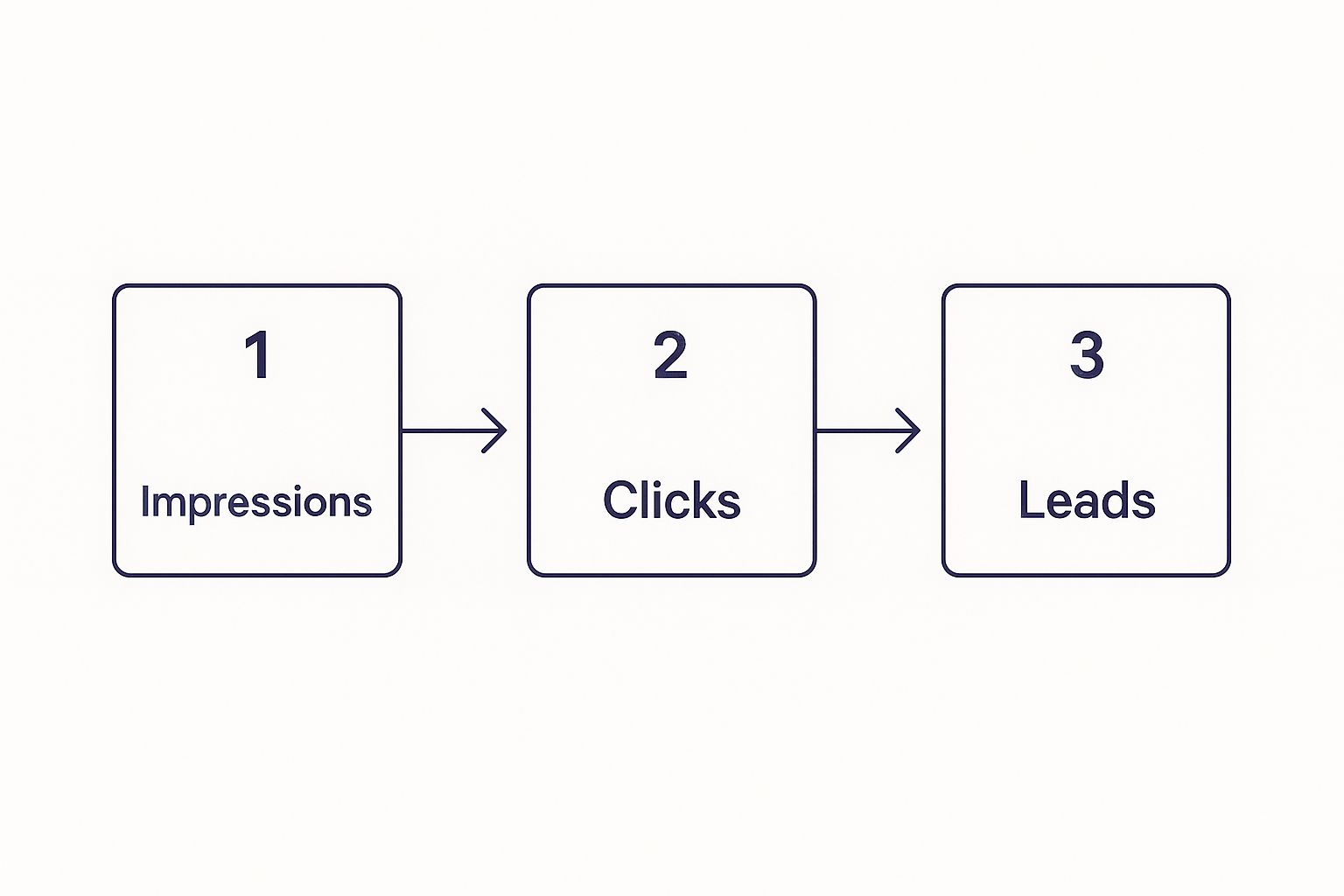
It’s a simple funnel, but it highlights that every step is a filter. Your job is to guide the right people from one stage to the next.
Setting Realistic Budgets and Goals
Finally, you need a budget that’s grounded in reality, not just a number you pulled out of thin air. The best way to do this is to work backward from your goals.
Figure out your target Cost Per Lead (CPL). Then, decide how many qualified leads you need each month. If you know a good lead is worth $75 to you and you need 50 of them, your starting budget is $3,750. It's that straightforward. This simple math connects your spending to real business goals, making it much easier to prove your ROI and justify the investment.
Crafting Ad Campaigns That Actually Convert

This screen? This is your command center. It's where all the strategy we've talked about becomes real, tangible campaigns that either drive serious growth or just burn through your budget.
Moving from planning to execution is a big mental shift. You’re no longer just brainstorming keywords; you're building the exact ads that people will see—the ones they'll either click on or scroll right past. This is where the rubber meets the road.
And the stakes are high. Global paid search spending is projected to hit a staggering $351.5 billion in 2025, with a huge chunk of that coming from small and medium businesses just like yours. That kind of investment shows you just how vital PPC has become. For many businesses, it generates twice the traffic of SEO. You can dive deeper into PPC trends and statistics on Digital Silk to get the full picture.
Choosing the Right Campaign Type
First things first, you have to pick the right tool for the job. Selecting your campaign type is a crucial decision, and getting it wrong is like trying to hammer a nail with a screwdriver. Each format is built for a different purpose.
- Search Campaigns: This is your bread and butter for lead gen. You're targeting people actively typing your solutions into a search bar. It's the most direct path to capturing existing demand.
- Display Campaigns: Think of these for building awareness or running retargeting. They're less about the instant conversion and more about staying top-of-mind with people who’ve already checked you out.
- Social Media Ads (LinkedIn, Meta, etc.): Fantastic for getting in front of very specific audiences based on job titles, interests, or demographics. You're creating demand here, not just capturing it.
If you're just starting out with PPC for lead generation, a Search campaign is almost always the right place to begin. The intent is just too high to ignore.
The Art of Compelling Ad Copy
Your ad copy is your three-second elevator pitch. In just a few lines of text, you have to hook someone, show them you understand their problem, and convince them to click. Drop the corporate jargon. Speak to them like a human.
Every great ad needs these three things:
- A Hook in the Headline: Use your main keyword and either ask a compelling question or state a powerful benefit.
- A Clear Value Prop: What do you do, and why should they care? Be direct.
- A Strong Call-to-Action (CTA): Tell them exactly what to do. "Get a Free Quote" is worlds better than the vague "Learn More."
Pro Tip: Don't sleep on ad extensions. Lead form extensions, for example, are a game-changer. They let users hand over their info right there on the search results page. By removing the friction of a landing page click, you can seriously boost your conversion rates.
By setting up your campaigns logically and writing copy that actually connects, you create a direct line from a person's search query to your sales pipeline. This is how you build a system that doesn't just get clicks—it gets you leads.
Designing Landing Pages That Turn Clicks into Leads
A killer ad campaign is only half the battle. Seriously. You can craft the most persuasive ad copy on the planet, but if it sends people to a clunky, confusing, or uninspired landing page, you’ve just wasted your ad spend. This is the critical moment where a click either becomes a valuable lead or a costly bounce.
Think of your landing page as a dedicated sales pitch with one single, solitary goal. It’s not just another page on your website. Every single element—from the headline down to the button color—has to work together to convince a visitor to give you their information.
It all starts with something called message match. The promise you made in your ad has to be immediately obvious and reinforced the second the page loads. If your ad dangled a "Free Consultation for Small Businesses," your landing page headline better shout that exact same offer. Any disconnect, no matter how small, creates friction and instantly kills trust.
The Anatomy of a High-Converting Page
Beyond nailing the message match, a few core components are absolutely non-negotiable for a landing page built to generate leads from PPC. Think of these as the fundamental building blocks for turning traffic into actual prospects.
- A Compelling Headline: Get straight to the point. Clearly state the number one benefit the user will get.
- Benefit-Oriented Copy: Ditch the jargon and focus on what they get, not just what you do. Use bullet points to make the good stuff easy to scan and digest.
- Engaging Visuals: A high-quality image or a short, punchy video that supports your offer can make all the difference. Help the user visualize the outcome.
- Social Proof: This is huge for building credibility. We're talking testimonials, quick case study snippets, or logos of well-known clients you’ve worked with.
Getting these elements right is a fantastic start. But to really squeeze every drop of ROI from your ad spend, you need to dive deep into robust website conversion rate optimization strategies that consistently turn those clicks into leads.
Optimizing Your Lead Capture Form
Let’s be honest—the lead form is where the magic happens. This is the moment of truth. It's where a visitor decides if what you're offering is actually worth handing over their personal data. The design and length of this form can make or break your conversion rates.
Keep your forms as short as humanly possible. Ask only for what you absolutely need to qualify and contact the lead. Every extra field you add is another reason for someone to bail. For a first touchpoint, a name and email might be all you really need.
Your form's call-to-action (CTA) button is prime real estate. Ditch the generic "Submit." Instead, use action-oriented text that reinforces the value, like "Get My Free Quote" or "Download the Guide Now." This simple tweak frames the action as a benefit for them, not just a task.
At the end of the day, continuous improvement is the name of the game. You can learn more about how to systematically https://frozencrow.com/how-to-improve-website-conversion-rates/ in our in-depth guide. Start by A/B testing just one element at a time—the headline, the CTA text, maybe the number of form fields—and see what your audience responds to. This data-driven approach is how you turn good landing pages into lead-generating machines.
Measuring What Matters for Campaign Growth

You’ve launched the campaigns and your landing pages are live. Now for the fun part—turning all that data into smart decisions that actually grow your business. This is where you shift from just running ads to strategically managing a lead generation machine.
Without solid tracking, you're flying blind. You can't tell which campaigns are bringing in gold and which are just burning cash. The first and most critical step is to set up bulletproof conversion tracking. This means you know exactly when a user fills out a form, downloads a guide, or requests a demo. It’s the only way to tie your ad spend directly to real-world results.
Key Metrics That Drive Decisions
Ad platforms love to drown you in data. But for lead generation, only a handful of metrics truly matter. Ignore the vanity stuff like impressions and focus on what moves the needle.
These are the numbers I live by:
-
Cost Per Lead (CPL): This is your north star. It tells you exactly how much you’re paying to get a single person to raise their hand. A low CPL means you're efficient; a rising CPL is your first red flag that something needs fixing.
-
Conversion Rate: This is the percentage of ad clickers who actually become a lead. A strong conversion rate is proof that your ad message and landing page are perfectly aligned and doing their job.
-
Lead Quality Score: This one isn't a default metric in Google Ads, but it's a game-changer. By working with your sales team, you can score leads based on their likelihood to close. This is how you start optimizing for revenue, not just form fills.
Remember, a "good" CPL is completely relative. The goal isn't to chase some industry benchmark. It's to make sure your CPL is comfortably below what a new customer is actually worth to your business.
Knowing your numbers is everything. The average cost per lead from Google Ads hovers around $70.11 as of 2025, but this swings wildly depending on your industry. It's also worth noting that PPC visitors are 50% more likely to convert than organic traffic, which shows just how powerful these campaigns can be when they're dialed in.
To help you stay focused, here’s a quick breakdown of the essential metrics you should be watching.
Key PPC Metrics for Lead Generation
This table breaks down the essential metrics, what they measure, and why they are so important for optimizing your lead generation campaigns.
| Metric | What It Measures | Why It's Important |
|---|---|---|
| Click-Through Rate (CTR) | The percentage of people who see your ad and click on it. | Indicates ad relevance. A high CTR often means your ad copy and targeting are resonating with the audience. |
| Cost Per Click (CPC) | The average amount you pay for each click on your ad. | Directly impacts your budget efficiency. Lowering your CPC while maintaining traffic quality is a key optimization goal. |
| Conversion Rate (CVR) | The percentage of clicks that result in a lead (e.g., a form submission). | Measures the effectiveness of your landing page and offer. A low CVR might signal a disconnect between your ad and your page. |
| Cost Per Lead (CPL) | The total ad spend divided by the number of leads generated. | Your primary efficiency metric. It tells you exactly how much it costs to acquire one potential customer. |
| Lead Quality | An internal score, often developed with sales, to rate a lead's potential. | Helps you move beyond volume to focus on leads that are most likely to become paying customers, improving ROI. |
Tracking these metrics gives you a clear, data-backed story of your campaign's performance, allowing you to make smarter, more profitable decisions.
From Data to Actionable Optimizations
Data is only useful if you act on it. Your KPIs are the signals telling you where to direct your attention. This isn't a one-and-done task; it's a constant process of tweaking and refining.
Here are a few things you should be doing regularly:
-
Prune Your Search Terms Report: Get in the habit of checking this report weekly. Any irrelevant search that triggered your ad is wasted money. Add those terms to your negative keyword list immediately. It's the fastest way to stop budget leaks.
-
Make Smart Bid Adjustments: Are mobile users converting better than desktop? Do leads from a specific city close at a higher rate? Increase your bids for those high-performing segments to get more of that valuable traffic.
-
Never Stop Testing Ad Copy: Always have at least two ad variations running in every ad group. Constantly test new headlines, different calls-to-action, and unique selling points. Pause the loser and challenge the winner with a new contender.
Ultimately, success comes down to a simple feedback loop: measure, analyze, and optimize. The true win is measuring marketing ROI to ensure every dollar you invest is fueling real growth. This cycle is what transforms a PPC campaign from a simple expense into a dynamic, revenue-driving asset.
Frequently Asked Questions About PPC for Leads
https://www.youtube.com/embed/MnrvnbjfhBA
Even with the best-laid plans, you're bound to hit a few roadblocks when you're in the trenches running a PPC for lead generation campaign. We get it. Here are some of the most common questions we hear, with straightforward answers to help you sidestep the usual pitfalls.
How Much Should I Budget for a PPC Lead Generation Campaign?
There's no magic number here. The biggest mistake you can make is picking a budget that just feels right. A much smarter approach is to work backward from what you need to achieve.
Start by figuring out your target Cost Per Lead (CPL). What are you willing to pay for a solid prospect? Once you have that, ask your sales team how many leads they need each month to hit their goals.
Let's say your ideal CPL is $50, and the team needs 100 leads a month. Just like that, you've got your starting budget: $5,000. This simple math ties your ad spend directly to real business outcomes. Of course, things like keyword costs and how competitive your industry is will affect this, so be ready to adjust once the data starts rolling in.
What’s a Good Conversion Rate for Lead Generation Campaigns?
You'll see benchmarks floating around the 2-5% range, but honestly, "good" is a loaded term here. We've seen top-tier campaigns pull in conversion rates of 10% or higher.
Chasing some universal average is a surefire way to get sidetracked. A "good" rate is all about context—your industry, the quality of traffic you're driving, and how compelling your offer is. A campaign for an emergency plumber is going to convert very differently than one for a free marketing ebook.
Instead of obsessing over industry benchmarks, focus on setting your own baseline. From there, your only job is to beat it. The only way to find out what really works for your audience is through relentless A/B testing of your landing pages, ad copy, and offers.
This data-first mindset will always be more valuable than comparing yourself to an abstract average.
Should I Focus on Google Ads or Social Media Ads for Leads?
This classic question really boils down to user intent. Are you trying to capture demand that already exists, or do you need to create it from scratch?
-
Google Search Ads: For capturing high-intent leads, Google is king. You're getting in front of people who are actively looking for your solution right now. That immediacy is incredibly powerful for generating leads that are ready to talk.
-
Social Media Ads (e.g., LinkedIn, Meta): These platforms are brilliant for generating demand and reaching niche audiences that aren't searching yet. You can get hyper-specific, targeting people by job title, company size, interests, or other demographics to introduce them to your solution.
Most of the time, the strongest play is using both. You can use social ads to build awareness and then hit those same users with Google retargeting ads when they finally start searching. If you're looking to scale fast, it might be worth it to outsource lead generation to a team that lives and breathes these multi-channel strategies.
At Frozen Crow Inc., we build and manage PPC campaigns that do more than just get clicks—they deliver a steady stream of qualified leads that grow your bottom line. Schedule your free marketing audit today and let's turn your ad spend into a predictable engine for revenue.


