


August 20, 2026
Hiring a Marketing Automation Consultant
So, what exactly is a marketing automation consultant?
Think of them as the strategic architect for your company's growth engine. They're the ones who design the systems that finally get your marketing, sales, and customer service teams speaking the same language. They go way beyond just setting up software; their real job is to take your business goals and turn them into automated workflows that attract, nurture, and convert leads with stunning efficiency.
Their main focus is solving those frustrating, money-draining problems: leads falling through the cracks, a clunky customer experience, and sales reps wasting time on lukewarm prospects.
What a Marketing Automation Consultant Really Does

A good way to picture a marketing automation consultant is as a hybrid of a business strategist, a tech guru, and a data nerd. They don't just "do marketing"—they build a self-oiling, self-sustaining machine designed to drive revenue.
It all starts with them getting a deep understanding of your business. They'll dig into your sales process, map out the customer journey, and get crystal clear on your biggest growth goals.
This isn't about just blasting out automated emails. It's about building an intelligent system. When a prospect takes an action—like visiting your pricing page or downloading an ebook—it triggers a specific, helpful, and perfectly timed response. This is how you create a personalized experience at scale, making every potential customer feel seen and understood.
Beyond Software Setup
One of the biggest misconceptions is that a consultant’s job is just the technical setup. And while they are definitely experts at making complex tools play nice together, their true value is in the strategy behind it all.
They ensure your entire tech stack—your CRM, email platform, analytics tools—communicates flawlessly. A huge part of what a marketing automation consultant really does is apply and implement proven marketing automation best practices that lock your technology directly into your revenue goals.
A great consultant ensures that technology serves the strategy, not the other way around. They build systems that empower your team to focus on high-value activities instead of getting bogged down by repetitive manual tasks.
Architecting Your Growth Engine
Ultimately, a marketing automation consultant designs the blueprint for sustainable growth. This isn't a single action but a series of key activities that completely reshape how you engage with your customers:
- Mapping the Customer Journey: They identify every single touchpoint a customer has with your brand. Then, they build automated pathways to guide them smoothly from just browsing to becoming a loyal advocate.
- Integrating Sales and Marketing: This is a big one. They bridge that infamous, often-painful gap between marketing's efforts and sales' follow-up. This ensures hot leads are acted on immediately and that your sales team has all the context they need to close the deal.
- Optimizing for Revenue: The job is never done. They use data to constantly tune the engine, running A/B tests and analyzing performance to squeeze every last drop of ROI from your investment.
For many businesses, especially smaller ones, having this kind of strategic oversight is a total game-changer. You can see how these ideas apply in our guide on https://frozencrow.com/marketing-automation-for-small-business/. Their work transforms your marketing department from a cost center into a predictable, revenue-driving machine.
The Three Core Roles of an Automation Expert

When you bring a marketing automation consultant on board, you’re not just hiring someone to push buttons on a piece of software. You're getting a versatile expert who wears three very different, but equally critical, hats. They seamlessly blend high-level strategy with grounded technical skill and sharp analytical insight.
Think of them as a personal trainer for your business's growth. They don't just show you how to use the equipment; they assess your current state, design a custom plan, and track your progress to make sure you hit your goals. This is what separates a true consultant from a simple technician.
The Strategist: Architect of Your Customer Journey
Before a single email is automated, a good consultant starts with strategy. Their first job is to understand your business, your customers, and what you’re actually trying to achieve. Forget the tech for a minute—this is about the human side of the equation.
They map out the entire customer journey, identifying those make-or-break moments where a bit of automation can create a much more personal and meaningful experience.
As the strategist, their work involves:
- Customer Journey Mapping: Visualizing every single step a person takes, from the first time they hear about you to becoming a loyal fan. This ensures no one falls through the cracks.
- Lead Nurturing Design: Building smart, multi-step campaigns that deliver the right message at the right time. It's about building trust and gently guiding leads toward a decision, not just spamming them.
- Lead Scoring Frameworks: Creating a system to rank leads based on their actions and profile. This lets your sales team stop guessing and focus their precious time on the hottest prospects.
This strategic foundation is everything. Without it, automation is just organized noise.
The Technologist: Master of Your MarTech Stack
Next, the consultant puts on their technologist hat. This is where the strategic blueprint gets built into a real, functioning system. Let’s be honest, the modern marketing tech stack is a tangled web of platforms that all need to talk to each other.
The technologist is the one who handles the messy, intricate details that can bring an entire project to a grinding halt if done wrong. They make sure all the digital plumbing is connected properly.
A consultant's technical skill is the bridge between a great idea and a functional system. They ensure your CRM, email platform, and analytics tools work in harmony, preventing data silos and broken workflows.
This role is absolutely crucial. A poorly configured system can cause more harm than good, leading to misfired emails, lost leads, and a very frustrated team. The technologist makes sure the engine is built to last.
The Analyst: Driver of Continuous Improvement
Finally, a consultant acts as an analyst, obsessively focused on performance and proving ROI. Their job doesn’t end when the system goes live—in many ways, it’s just beginning. They dive deep into the data to see what’s working, what isn’t, and where the next big opportunity for improvement is hiding.
This analytical mindset is what creates long-term success. The digital world is always changing, and your automation strategy needs to adapt right along with it. A sharp analyst will:
- Track Key Metrics: They live in the data, monitoring open rates, click-throughs, conversion rates, and how fast deals are moving through your pipeline. This measures the real-world impact on your bottom line.
- Conduct A/B Testing: They are constantly experimenting. Tweaking subject lines, landing page copy, or calls-to-action to squeeze out better and better results over time.
- Deliver Actionable Reports: They translate walls of numbers into clear, simple insights that help you make smarter strategic decisions and prove the value of your investment.
This data-first approach turns marketing from a guessing game into a science. As the marketing automation market races toward a projected $13.97 billion by 2030, the demand for experts who can prove their worth with cold, hard data is only going to grow. You can explore more on these market trends and see why over 70% of users are choosing cloud solutions to get the job done.
Key Services That Drive Tangible Business Growth
A great marketing automation consultant does far more than just flick switches on a piece of software. They're strategic partners focused on solving real business problems and delivering results you can actually see. It's not about "doing tasks"—it's about building a connected system where every automated email, every workflow, and every piece of data ties back to a core goal, whether that's better leads, a faster sales cycle, or happier, more valuable customers.
This is what separates a true consultant from a platform technician. They don’t just set up the tools; they architect the growth engine. Let's dig into the core services they provide and see how each one directly fuels your bottom line.
Platform Selection and Implementation
Picking the right marketing automation platform is a massive decision. A misstep here can cost you a ton of time and money down the road. A consultant acts as your unbiased guide, digging into your specific needs, your budget, and the tech you already use to find the best-fit solution—not just the one with the most hype.
Once you've made a choice, they take the lead on the entire implementation. That means setting up accounts, wrestling with the technical configurations, and making sure everything launches without a hitch. Their experience helps you sidestep the common setup mistakes that can derail a project before it even starts.
CRM Integration and Data Hygiene
This is one of the most valuable things a consultant does: they get your marketing platform and your CRM to talk to each other seamlessly. When these two systems are siloed, leads fall through the cracks, sales reps fly blind without crucial context, and your customer data turns into an absolute mess.
A consultant builds that bridge, creating a single source of truth for all your customer information. This service alone can fix the age-old problem of sales and marketing teams not being on the same page. They'll also put processes in place for data hygiene, keeping your database clean and accurate so you can actually trust it for personalization.
Lead Nurturing and Scoring Strategy
Getting leads is just the first step. You need a system to guide them from "just looking" to "ready to buy." A marketing automation consultant designs smart lead nurturing campaigns that automatically send the right message to the right person at the right time. It's about building trust and gently guiding them through their decision-making process. You can dive deeper into how to build the foundation for these campaigns in our guide on how to build email lists.
At the same time, they'll build a custom lead scoring model. This system gives points to leads based on who they are and what they do (like visiting your pricing page or downloading a case study). Once a lead hits a certain score, they're automatically flagged as sales-ready and handed off to your sales team. No more cold calls—just conversations with genuinely interested people.
A consultant transforms your marketing from a megaphone blasting one message to everyone into a series of one-on-one conversations held at scale. This personalized approach is what drives conversions and builds lasting customer relationships.
Workflow Automation and Campaign Management
This is where the real magic happens. A consultant will hunt down all the repetitive, soul-crushing tasks your team is doing manually and build automated workflows to handle them. Think about things like sending follow-up emails after a webinar, assigning new leads to the right salesperson, or updating contact records. This frees up your team to focus on strategy and creative work—the stuff humans are actually good at.
The infographic below shows just how powerful these automated systems can be for hitting key business goals.
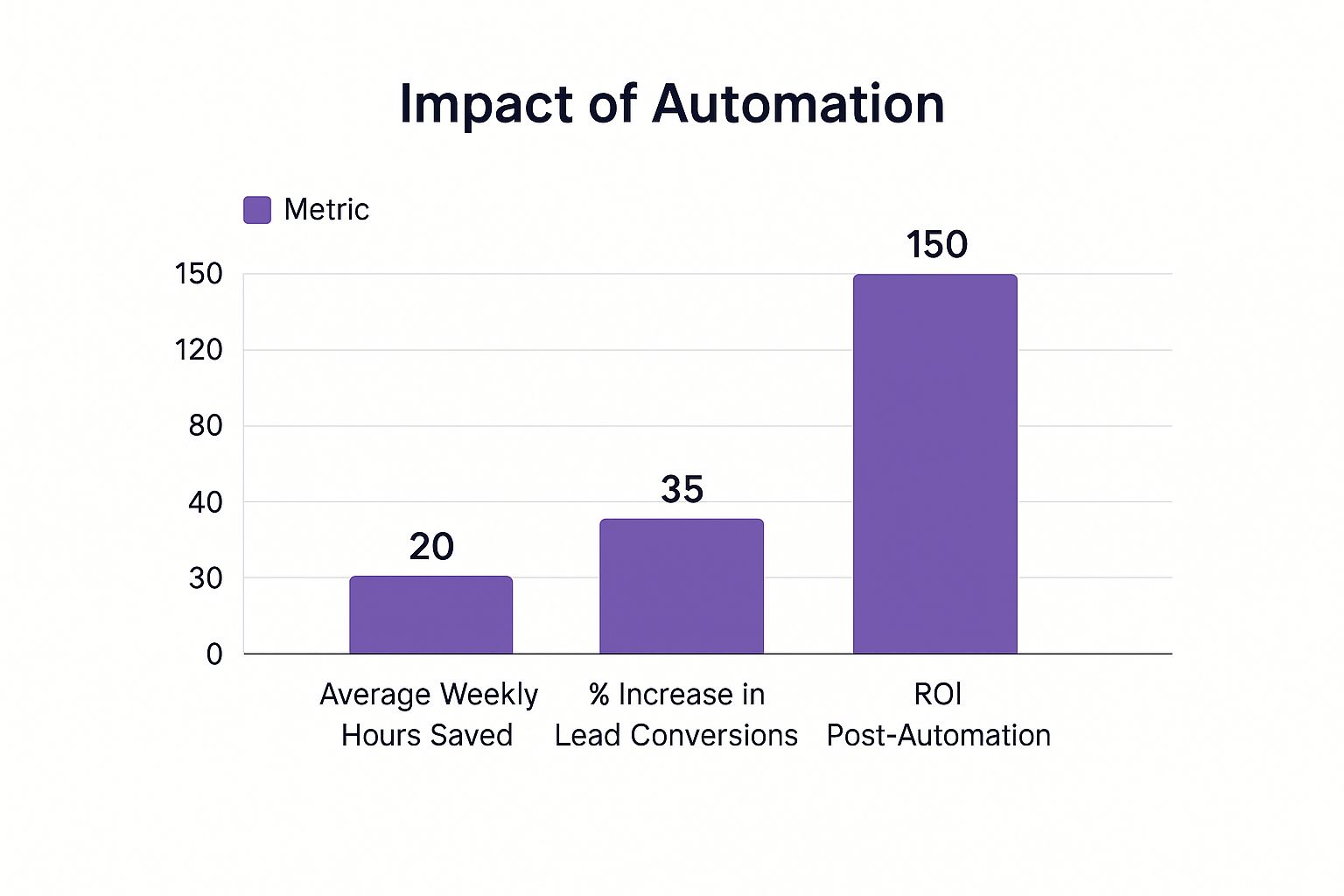
As you can see, the numbers speak for themselves. Businesses are seeing huge returns, converting more leads, and saving a significant amount of time every single week.
The table below breaks down these services and connects them to the real-world business outcomes you can expect.
Core Services and Their Business Impact
| Consultant Service | What It Involves | Direct Business Benefit |
|---|---|---|
| Strategy & Planning | Auditing current processes, defining KPIs, and creating a technology roadmap. | Ensures your automation efforts are aligned with core business objectives, not just tech trends. |
| Platform Implementation | Selecting, configuring, and launching the right marketing automation tool for your needs. | Avoids costly setup errors and ensures you get value from your investment from day one. |
| CRM & Data Integration | Connecting marketing and sales systems for a unified view of the customer. | Creates a single source of truth, eliminates data silos, and improves sales/marketing alignment. |
| Lead Nurturing & Scoring | Building automated campaigns and a scoring model to qualify leads systematically. | Moves leads through the funnel faster and delivers higher-quality opportunities to the sales team. |
| Analytics & Reporting | Creating custom dashboards to track metrics that matter, like revenue and pipeline velocity. | Provides clear proof of marketing ROI and enables data-driven decisions for continuous improvement. |
Ultimately, a consultant's job is to turn your marketing automation platform from a simple tool into a revenue-generating machine.
Performance Analytics and Reporting
Finally, a consultant makes sure you can actually prove that all this marketing activity is working. They set up custom dashboards and reports that track the metrics that your CEO actually cares about—not just fluffy numbers like clicks and opens, but things like pipeline growth, customer acquisition cost, and marketing-generated revenue.
This data-driven focus allows for constant improvement. The research backs this up: 80% of marketers report an increase in leads, and 77% of businesses see higher conversion rates after putting automation in place. Better yet, 76% of companies see a positive ROI within the first year, making a powerful case for bringing in an expert to get it right.
Signs Your Business Is Ready for a Consultant

Knowing when to call in an expert can be the single decision that separates stagnation from serious growth. Most of the time, the need for a marketing automation consultant doesn’t show up as one big, catastrophic failure. Instead, it’s a slow burn—a series of nagging, resource-draining problems your team just can't seem to shake. These are the subtle signs that your current approach has hit its ceiling.
It’s a bit like trying to build a house with only a hammer. Sure, you can get a few walls up, but you’ll eventually realize you don't have the right tools—or the blueprint—to do the job properly. A lot of businesses get to this point without even noticing, chalking up the symptoms to other growing pains.
Your Expensive Software Is Gathering Dust
This is a classic. You invested in a powerhouse platform like HubSpot or Marketo, but you’re only using it as a glorified email blaster. You've essentially bought a Ferrari to drive it in first gear around the neighborhood. These platforms can do amazing things, but tapping into that power requires real expertise.
If you're looking at your software bill and struggling to see a clear return, a consultant can step in. They’re the ones who can turn that underused tool from a line-item expense into a revenue-generating machine by setting up its advanced features for lead scoring, personalization, and sales alignment.
The cost of doing nothing is often way higher than the cost of hiring an expert. Think of a consultant's fee as an investment to finally unlock the value in tools you already own and stop the bleeding from clunky, inefficient processes.
Your Sales Team Complains About Lead Quality
Do your sales and marketing teams feel like they’re speaking different languages? If the sales reps are constantly grumbling that marketing’s leads are weak, unqualified, or just not ready to talk, you’ve got a major breakdown in your funnel. This isn't just a communication problem; it's a system problem.
A marketing automation consultant is a translator and a mechanic. They diagnose the disconnect and fix it by building objective lead scoring models and smart nurturing workflows. This ensures marketing only hands off prospects who are genuinely interested and have been properly warmed up. It stops the finger-pointing and lets both teams get back to what they do best.
Getting this alignment right is absolutely critical if you want to scale the business.
Your Marketing Team Is Overwhelmed
Your marketers might be brilliant, but they’re bogged down in a swamp of manual, repetitive tasks. They’re spending their days exporting spreadsheets, sending one-off follow-up emails, and trying to duct-tape data together from different systems. This leaves them with zero time for the strategic work that actually moves the needle.
A consultant’s job is to automate that grunt work and give your team their time back. By building efficient workflows, they empower your people to focus on creativity, strategy, and big-picture ideas—the stuff that drives real growth. The goal isn’t to replace your team; it’s to elevate them.
Here are a few other scenarios that practically scream "we need a consultant":
- You can't prove ROI: You feel like marketing is working, but you have no solid way to connect your team's efforts directly to revenue.
- The customer experience is disjointed: A prospect gets an email asking them to book a demo… after they’ve already signed the contract. Yikes.
- Your data is a mess: You don't trust your contact lists, and personalization feels impossible because all the information is unreliable or siloed.
If any of this sounds painfully familiar, it's a clear signal that you could use an expert to help build a more effective, scalable, and profitable marketing engine.
How to Choose the Right Automation Consultant
Picking a marketing automation consultant isn’t like hiring a plumber. It’s more like choosing a strategic business partner, and getting it right can mean the difference between a system that pumps out predictable revenue and one that just sits there, collecting dust and costing you money.
A great consultant doesn’t just work for you; they become an extension of your team, someone who is genuinely invested in seeing you win. To find that person, you have to look past the slick resume. You need to dig into their strategic thinking, their technical chops, and their real-world experience to make sure they’re the perfect fit for what you’re trying to build.
Assess Their Platform and Technical Expertise
First things first: you have to vet their technical skills. A consultant might be a wizard with one platform, but if that’s not the one you need, their magic is useless. You need someone whose skills line up with your current (or future) tech stack.
Don't just be impressed by a wall of logos on their website. Ask them to walk you through a complex integration they managed or a messy technical problem they had to solve for another client. The story they tell will reveal far more about their problem-solving abilities than any certificate.
It’s also smart to know where they play. The marketing automation world is dominated by a few big names. HubSpot controls a massive 29.36% of the market, while platforms like Oracle Marketing Cloud and Adobe Experience Cloud trail with just 5.91% and 5.46%, respectively. A consultant who knows a major platform like HubSpot inside and out doesn't just understand the tool—they understand its entire ecosystem of apps and integrations. This is huge, especially when you consider that 87% of marketers using a CRM feel confident in their strategy, compared to only 52% of those going without. You can find more on these marketing automation statistics here.
Evaluate Their Strategic Approach
Here’s the real secret: a top-tier marketing automation consultant is a strategist first and a technician second. Anyone can learn how to drag and drop boxes to build a workflow. A true strategist knows why that workflow exists and how it connects to a core business goal.
Pay close attention to how they talk during your initial conversations. Do they immediately jump into features and software specs? Or do they start by asking about your revenue targets, your sales process, and what keeps your customers up at night?
A great consultant doesn’t sell you automation; they sell you outcomes. They should be more interested in your sales cycle and lead quality than in how many emails you want to send. Their focus is always on connecting their work directly to your bottom line.
Here’s a simple test. Throw a real-world problem at them, like, "Our sales team complains that the leads from marketing are garbage." A technician might suggest building a more complicated lead scoring model. A strategist, on the other hand, will ask why the leads are unqualified, dig into the entire customer journey, and propose a fix that addresses the root of the problem.
Scrutinize Their Track Record and Industry Fit
Experience is crucial, but it has to be the right kind of experience. A consultant who has only ever worked with giant B2B software companies probably isn't the best choice for a small e-commerce brand. You need a partner who gets the unique challenges of your industry and business model.
When you look at their portfolio or case studies, hunt for real results.
- Look past vague claims: "Improved lead generation" is nice. "Increased marketing-qualified leads by 45% in six months" is what you're looking for.
- Ask for relevant examples: Get them to show you work they did for a client with problems similar to yours. This proves they have a playbook that works.
- Actually check their references: A quick call with a past client can tell you everything you need to know about their communication style and what it’s actually like to work with them day-to-day.
Finally, think about how they’ll fit with your team and your existing tools. If you’re a small business just getting started, finding the right CRM software for small businesses is a critical first step, and a good consultant can be your guide. Their ability to adapt to your company's size and culture is every bit as important as their technical skill.
Making the Partnership Work
Hiring a top-tier marketing automation consultant is a huge step, but it’s only half the battle. The real work begins after the contract is signed. Your project's success doesn't just rest on their expertise; it hinges on how well you work together.
Think of your consultant as a skilled co-pilot. They have the technical know-how to navigate complex systems, but you’re still the captain. You set the destination and provide the critical intel they need to get there. To get the results you're paying for, you need to be an active, engaged, and prepared partner. It’s a two-way street built on clear communication and mutual respect.
Set Crystal Clear Goals from Day One
Before your consultant touches a single workflow, they need to know what "success" actually looks like for you. Vague goals like "improve our marketing" won't cut it. To get real results, you need to provide specific, measurable targets that can guide the entire strategy.
Get granular. Instead of just saying you want more leads, aim for something concrete: "Increase marketing-qualified leads (MQLs) from our webinar channel by 30% within six months."
This kind of clarity gives your consultant a North Star. It helps them prioritize tasks, build the right systems, and deliver a solution that directly moves the needle on your most important metrics. Without clear goals, even the best consultant is just flying blind.
Find a Communication Rhythm
Good communication is the lifeblood of any healthy client-consultant relationship. Don't wait for problems to pop up before you get in touch. Set up a regular communication schedule from the start to keep everyone aligned and the project moving forward.
A solid communication plan usually includes:
- Weekly Check-ins: A quick, structured call to review progress, talk through roadblocks, and set priorities for the next week.
- A Centralized Project Hub: Use a tool like Asana, Trello, or a shared Slack channel. This keeps all project-related chats and files in one place, so nothing gets lost in email.
- A Designated Point of Contact: Assign one person on your team to be the main liaison. This prevents mixed messages and keeps things from getting confusing.
Your job as the client is to give timely feedback and clear internal hurdles. If your consultant is constantly waiting on you for an approval or for access to another department, the project will stall. That wastes everyone's time and money.
Give Them the Internal Support They Need
Your marketing automation consultant can't succeed in a vacuum. To do their job well, they need access to your people, your data, and your existing systems. It's on you to be their internal champion and make sure they have what they need.
This means making introductions to key people in sales, IT, and customer service. It also means getting them prompt access to software logins, customer data, and brand assets.
When you treat your consultant like a genuine extension of your team, you empower them to work efficiently and deliver the outcomes you hired them for. By being an engaged and supportive partner, you create an environment where incredible results aren't just possible—they're expected.
Your Questions, Answered
Deciding to bring in a marketing automation consultant is a big step. It’s natural to have questions about the practical side of things—cost, timing, and how they’ll fit in with your current team. Let’s clear those up so you can make the right call.
Getting these details straight from the start helps set everyone up for success.
How Much Does a Marketing Automation Consultant Typically Cost?
There's no single price tag, as the cost really depends on the consultant’s experience and the scope of your project. But generally, the pricing falls into one of three buckets.
For smaller jobs or quick consultations, many charge an hourly rate, which can be anywhere from $100 to over $300. This makes sense when you need targeted help without a massive commitment.
If you’re looking at a bigger undertaking, like a full platform setup or a major campaign overhaul, you’ll likely see a fixed project fee. These can range from $5,000 to $25,000 or more. For ongoing strategy and optimization, a monthly retainer is the way to go, usually landing between $2,000 and $10,000 per month. No matter the model, always ask for a detailed proposal that spells out exactly what you're getting for your money.
How Long Until We See a Return on Investment?
You’ll need a bit of patience, but you won't be waiting forever. The first wins often show up within a month—things like cleaner data, smoother workflows, and less manual work for your team. These are the foundational fixes that pave the way for real growth.
The big-ticket ROI, however—the stuff you can measure in qualified leads, better conversion rates, and a faster sales process—usually starts to become clear within three to six months. That gives the consultant enough time to implement the strategy, run a few campaigns, and start fine-tuning things based on what the data is telling them.
Think of marketing automation as a long-term asset, not a quick fix. While you'll see early improvements, the real financial payoff comes after the system has had time to learn and adapt to how your customers behave.
Will a Consultant Work With Our Existing Team?
Absolutely. A good consultant isn't there to take over; they're there to make your team better. They act as an extension of your crew, working side-by-side with your marketing, sales, and IT folks to make sure everyone is on the same page.
They handle the heavy lifting—the complex technical setup and high-level strategy that your team might not have the time or specialized skills for. A great consultant also makes a point to train your people on the new systems and processes. They build up your team's skills, making your entire operation stronger and more self-sufficient long after the project wraps up.
Ready to unlock what your marketing is truly capable of? The experts at Frozen Crow Inc. specialize in building smart automation systems that deliver real, measurable growth. We’ll audit your current setup, map out a custom strategy, and give you the hands-on support needed to turn marketing into a predictable revenue machine. Get your free marketing audit today and see what a true partnership can do for your business.


