


August 20, 2026
Mastering Lead Generation PPC That Converts
So, what is lead generation PPC? Put simply, it’s using paid ads on platforms like Google to funnel highly motivated traffic to your website, all with the express purpose of getting a potential customer’s contact information.
It’s an incredibly potent strategy because you’re not just throwing ads into the void. You're getting in front of people with a problem, right at the exact moment they’re actively searching for the solution you offer. That’s why it delivers results you can see almost instantly.
Why PPC Is a Powerhouse for Generating Leads
When you need a steady flow of new leads, you can't always afford to wait months for organic strategies like SEO to kick in. This is where Pay-Per-Click advertising completely changes the game. You're not just buying clicks; you're buying speed, precision, and a direct line to your ideal customer.
PPC lets you jump to the front of the line. Instead of hoping people find you, you place your business right in their path as they're looking for answers. It's a proactive approach that taps into existing demand, which is a massive leg up compared to channels that require a long, slow build-up of authority.
The whole premise of Google Ads is built on this idea of capturing intent, as you can see right on their homepage.

This isn't just a platform; it's your command center for launching campaigns that speak directly to users who are ready to take action.
Unmatched Control and Precision
One of the most powerful features of PPC for lead generation is the incredible level of control you have. You get to be the puppet master, dictating exactly who sees your ads, when they see them, and what you’re willing to pay for each interaction.
This isn't broad, spray-and-pray marketing. We’re talking about surgical precision:
- Geographic Targeting: Need to reach customers in a specific neighborhood? You can target by zip code, city, or even a radius around your business.
- Demographic Targeting: Want to reach a specific type of customer? Filter your audience by age, gender, household income, and more to match your ideal buyer persona.
- Keyword Intent: This is the big one. You can target users based on the exact words they're typing into the search bar, allowing you to separate the window shoppers from the ready-to-buy customers.
Think about it this way: a local plumber can run an ad that only shows up for homeowners within a 15-mile radius who search for "emergency plumbing repair near me." That's how you stop wasting money on irrelevant clicks and start generating genuinely qualified leads.
The numbers don't lie. Businesses are projected to spend a massive $351.5 billion on search advertising in 2025. It makes sense when you see that the average return on Google Ads is $2 for every $1 spent, and some finely-tuned campaigns can hit an 800% ROI.
Measuring What Matters Most
Maybe the single greatest advantage of PPC is that everything is measurable. Every cent you spend, every click you get, and every lead you generate is tracked. This creates a data-rich environment that gives you a crystal-clear picture of what’s working and what’s a complete waste of money.
You can instantly see your Cost Per Lead (CPL) and make smart, data-backed decisions to make your campaigns more profitable. PPC is just one piece of the puzzle, of course. To see how it fits into a larger framework, it's worth exploring diverse lead generation strategies to build a more resilient marketing engine.
PPC vs Other Lead Generation Channels at a Glance
To put things in perspective, let's see how PPC stacks up against other popular channels.
| Channel | Speed to Results | Targeting Precision | Cost Control | Best For |
|---|---|---|---|---|
| PPC | Immediate | Very High | High | Quick wins, testing offers, and targeting high-intent users. |
| SEO | Slow (Months) | Moderate | Low (Indirect costs) | Building long-term authority and sustainable, organic traffic. |
| Social Media | Fast | High | Moderate to High | Brand awareness, community building, and targeting based on interests. |
This table makes it clear: when speed and precision are your top priorities for lead generation, PPC is in a league of its own.
This ability to track and measure creates a powerful feedback loop. Is an ad not performing? Pause it. Is a landing page failing to convert? A/B test a new version. This constant cycle of testing and optimizing is what allows you to build a scalable and ruthlessly efficient lead generation machine.
Laying the Foundation for a Killer Campaign
A PPC campaign that actually generates leads doesn't happen by accident. It's built on a rock-solid, strategic foundation. Think of it like building a house—you can't just start throwing up walls and hope for the best. You need a blueprint and a strong concrete base.
Let's walk through that essential groundwork, from digging up the right keywords to crafting ads that people actually want to click. The goal here is to create a seamless journey for your ideal customer, where every single element feels like it was made just for them.
When the keyword they type, the ad they see, and the page they land on all tell the same cohesive story, getting that conversion feels natural. It just works.
Unearthing Keywords That Actually Convert
First things first: you need to get inside your customer's head. What are they really typing into that search bar when they're facing a problem you can solve? We're on the hunt for high-intent keywords—phrases that signal someone is ready to take action, not just window-shopping.
Let's say you're a B2B software company. Someone searching for "what is CRM" is just gathering information. But a search for "best CRM software for small business" or "Salesforce alternative pricing"? That person is actively looking for a solution. They have their wallet out. Those are the golden nuggets.
To find these, you have to think past the obvious. Here are a few ways I like to dig up keywords that drive real business:
- Spy on Your Competitors: See what your competitors are bidding on. Tools like SEMrush are fantastic for this; they'll show you the exact terms sending paying customers to their websites.
- Think in Problems, Not Just Solutions: What's the pain point your product solves? A potential customer might search "how to reduce customer churn" long before they even know they need a CRM.
- Target Comparison Shoppers: Go after users who are in the final stages of making a decision. Keywords like "HubSpot vs Zoho" or "[Your Competitor] alternatives" capture people who are ready to buy.
Focusing on intent over raw search volume is a game-changer. You'll attract fewer tire-kickers and more people who are genuinely ready to become a lead.
Structuring Ad Groups for Maximum Relevance
Once you've got a solid keyword list, whatever you do, don't just dump them all into one giant ad group. It's a classic rookie mistake that absolutely tanks your relevance and drives up your costs. The secret is to create small, tightly-themed ad groups.
Each ad group should focus on a tiny cluster of closely related keywords. A local plumber, for example, would never mix "emergency plumbing repair" with "water heater installation." They're two completely different needs, searched by two different types of customers.
Here's how that might look in practice:
| Ad Group | Keywords | Ad Headline Example |
|---|---|---|
| Emergency Repair | emergency plumber near me, 24/7 plumbing service, burst pipe repair | 24/7 Emergency Plumber |
| Water Heater | water heater installation, tankless water heater cost, new water heater quote | Water Heater Installation |
This tight structure ensures the ad someone sees is hyper-relevant to what they just searched for. And that relevance is a massive signal to Google, directly boosting your Quality Score. A better Quality Score means you pay less per click and get better ad positions. Simple as that.
A high Quality Score is basically Google's way of rewarding you for creating a good user experience. When they see your keywords, ads, and landing pages are all perfectly aligned, they give you a discount on your clicks. It’s a true win-win.
Writing Ad Copy That Demands a Click
Think of your ad copy as a 3-second elevator pitch. On a crowded search results page, you have a tiny window to get noticed, show your value, and convince someone to click your link instead of the nine others on the page. Generic ads are invisible.
Great ad copy for lead gen speaks directly to the user's problem and clearly positions you as the solution. Always, always lead with the benefit. What's in it for them?
Here are the key ingredients for ad copy that works:
- Mirror Their Search: Your headline should feel like an answer to their question. If they searched "CRM for real estate agents," your headline better have those words in it.
- Flaunt Your Unique Selling Proposition (USP): What makes you the obvious choice? A free trial? A money-back guarantee? 24/7 support? Put it front and center.
- Use a Strong Call-to-Action (CTA): Tell them exactly what you want them to do next. Don't be vague. Use action words like "Get Your Free Quote," "Download the Guide," or "Book a Demo Now."
Nailing these three foundational pieces—keywords, ad group structure, and ad copy—creates a powerful alignment that attracts high-quality traffic. This sets you up perfectly for the next critical step: turning that traffic into leads on your landing page.
You can drive all the high-intent traffic in the world, but if your landing page doesn't seal the deal, you're just burning cash. A great landing page isn’t a brochure; it’s a purpose-built machine designed to do one thing: turn a click into a lead.
The most important rule here is message match. The headline, the images, the offer—everything on your landing page needs to feel like a natural continuation of the ad they just clicked. I learned this the hard way years ago, sending traffic from a "Free Trial" ad to a generic homepage. The bounce rate was brutal. It was a classic rookie mistake: I created instant friction because I didn't meet their expectations.
The Anatomy of a High-Converting Landing Page
A PPC landing page needs to be ruthlessly focused. Unlike your website's homepage, which is full of different paths and distractions, a landing page should have a singular goal. Every single element must support that one goal, guiding the visitor straight to your form.
This means you have to get rid of the noise. Ditch the main navigation menu, the footer links, and anything else that could tempt someone to wander off. The user's journey should be a straight line from ad click to lead submission.
Here's a great example from the landing page experts at Unbounce on how they frame this idea. It's all about creating dedicated pages that convert.
See how clean that is? The design funnels your attention directly to the headline and the call-to-action. It's built to answer the user's subconscious question: "Am I in the right place?"
To build that immediate trust and get them to stick around, your page must have a few key elements:
- A Clear, Compelling Headline: It should directly mirror your ad copy and speak to their pain point or what they hope to achieve.
- Trust Signals: This is huge. Show off client logos, customer testimonials, or industry awards. Social proof is your best weapon against skepticism.
- Benefit-Driven Copy: Use short, scannable bullet points to highlight what they'll get. Focus on the outcomes, not just a list of your features.
Crafting the Perfect Lead Capture Form
The form is where the magic happens, but it's also where most people bail. Your job is to find that perfect balance—get enough info to qualify the lead, but keep it simple enough that people don't get spooked.
For most campaigns just starting out, less is more. Seriously. Just ask for a name and email. Every extra field you add introduces friction and kills your conversion rate. I've seen studies show that just cutting a form from four fields down to three can boost conversions by 50%.
Once you're more advanced, you can play with multi-step forms or progressive profiling to gather more data later on without overwhelming new leads right out of the gate. The goal is to make it feel effortless.
Key Takeaway: Think of your lead form like a transaction. The user is "paying" with their personal information. You need to make sure the value of your offer—be it a free guide, a demo, or a consultation—feels way more valuable than the "cost" of filling out that form.
Always Be Testing
A landing page is never really "done." The best lead gen campaigns are built on a foundation of constant testing and tweaking. You should always have an A/B test running to find ways to squeeze more leads out of the traffic you're already paying for.
Don't get bogged down in tiny changes. Start with the big stuff, because that's where you'll see real results.
Here are the first things I always test:
- Your Headline: Pit a benefit-driven headline against one that focuses on a pain point.
- Your Call-to-Action (CTA): Try different button text ("Get My Free Quote" vs. "Request a Quote") and even different colors.
- The Offer Itself: Would a simple checklist convert better than a 30-minute webinar? Test different lead magnets to see what resonates.
Even a tiny lift in your conversion rate can have a massive impact on your Cost Per Lead (CPL) and make your entire campaign more profitable. While general digital ad conversion rates often hover around 2.9%, there's so much room for improvement. As you optimize, every single lead becomes more valuable. To get a better sense of the landscape, you can discover more insights about lead performance on seoprofy.com. By constantly refining your landing pages, you make sure every dollar you spend is working as hard as it possibly can.
Optimizing and Scaling Campaigns for Growth
Getting a PPC campaign live is just the first step. The real work—and the real results—come from what you do next. It’s the constant cycle of optimizing, refining, and scaling that turns a decent campaign into a predictable lead generation machine for your business.
Think of it this way: your initial launch is based on your best-educated guesses. Now, you have real-world data pouring in. It's time to stop guessing and start making data-driven decisions. The two metrics that matter most here are your Cost Per Lead (CPL) and your Conversion Rate. Everything else is just noise.
Refining Your Targeting to Cut Wasted Spend
One of the fastest ways to improve performance is to stop paying for clicks from people who will never become a customer. Your best tool for this is the Search Terms Report in Google Ads. I make it a habit to live in this report.
This is where you see the actual search queries people typed into Google right before they clicked your ad. And trust me, you'll find some wild stuff in there. If you're selling "project management software," you'll almost certainly find you're paying for clicks from searches like "free project management courses" or "project manager jobs." Every one of those is wasted money.
This is where your negative keyword list becomes your shield. Here’s a quick-and-dirty breakdown of how I build mine out:
- Filter out job seekers: Add terms like "jobs," "career," "hiring," and "salary."
- Ditch the info-gatherers: Exclude words like "free," "tutorial," "what is," and "examples."
- Avoid the wrong fit: Add competitor brand names (unless you're running a specific conquesting campaign) or product types you don't offer.
Aggressively building this list is like plugging leaks in a bucket. It ensures every dollar of your budget goes toward clicks with genuine intent, which will bring your CPL down almost immediately.
Making Data-Backed Bidding Adjustments
Your bidding strategy should never be "set it and forget it." Performance isn't uniform; it fluctuates based on the device someone is using, their location, and even the time of day. By digging into your campaign data, you can make smart bid adjustments to pour gas on what's working and pull back on what's not.
For instance, you might notice that leads from mobile devices convert like crazy between 9 AM and 12 PM on weekdays. Great. Let’s act on that. You could apply a +20% bid adjustment for mobile users during that window to make sure your ads show up more prominently. On the flip side, if weekend traffic just burns cash without converting, you can apply a -30% bid adjustment on Saturdays and Sundays.
It's shocking, but something like 72% of companies don't even look at their PPC campaigns on a monthly basis. This is a huge mistake. Constant monitoring is what separates the winners from the losers, especially when you consider that PPC leads are known to convert about 50% better than those from organic search.
To give you a clearer picture of what to watch, I've put together a table of the key metrics we monitor for lead gen campaigns.
Key PPC Metrics for Lead Generation
Here’s a breakdown of the most important metrics to track for lead generation PPC campaigns, what they mean, and the industry benchmarks to aim for.
| Metric | What It Measures | Why It's Important | Good Benchmark |
|---|---|---|---|
| Cost Per Lead (CPL) | The average cost to acquire one new lead from your campaign. | This is your bottom-line metric. It tells you if your campaigns are profitable. | Varies widely by industry, but aim to be below your target customer lifetime value. |
| Conversion Rate | The percentage of clicks that result in a lead (e.g., a form fill). | Measures the effectiveness of your landing page and offer. | Averages around 2-5%, but top performers can hit 10% or more. |
| Click-Through Rate (CTR) | The percentage of impressions that result in a click. | Indicates how relevant and compelling your ad copy is to your target audience. | 2-3% is average for search ads. Aim for 5%+ in a well-targeted campaign. |
| Quality Score | Google's rating (1-10) of the quality and relevance of your keywords and ads. | A higher Quality Score leads to lower costs and better ad positions. | Aim for a score of 7/10 or higher for your most important keywords. |
Tracking these numbers gives you a real-time dashboard on your campaign's health, telling you exactly where to focus your optimization efforts.
Knowing When and How to Scale
Once you have a campaign consistently hitting your CPL and volume goals, the temptation is to just crank the budget way up. Don't do it. Scaling too quickly can throw the algorithm off and actually hurt your performance. Smart scaling is a much more deliberate process.
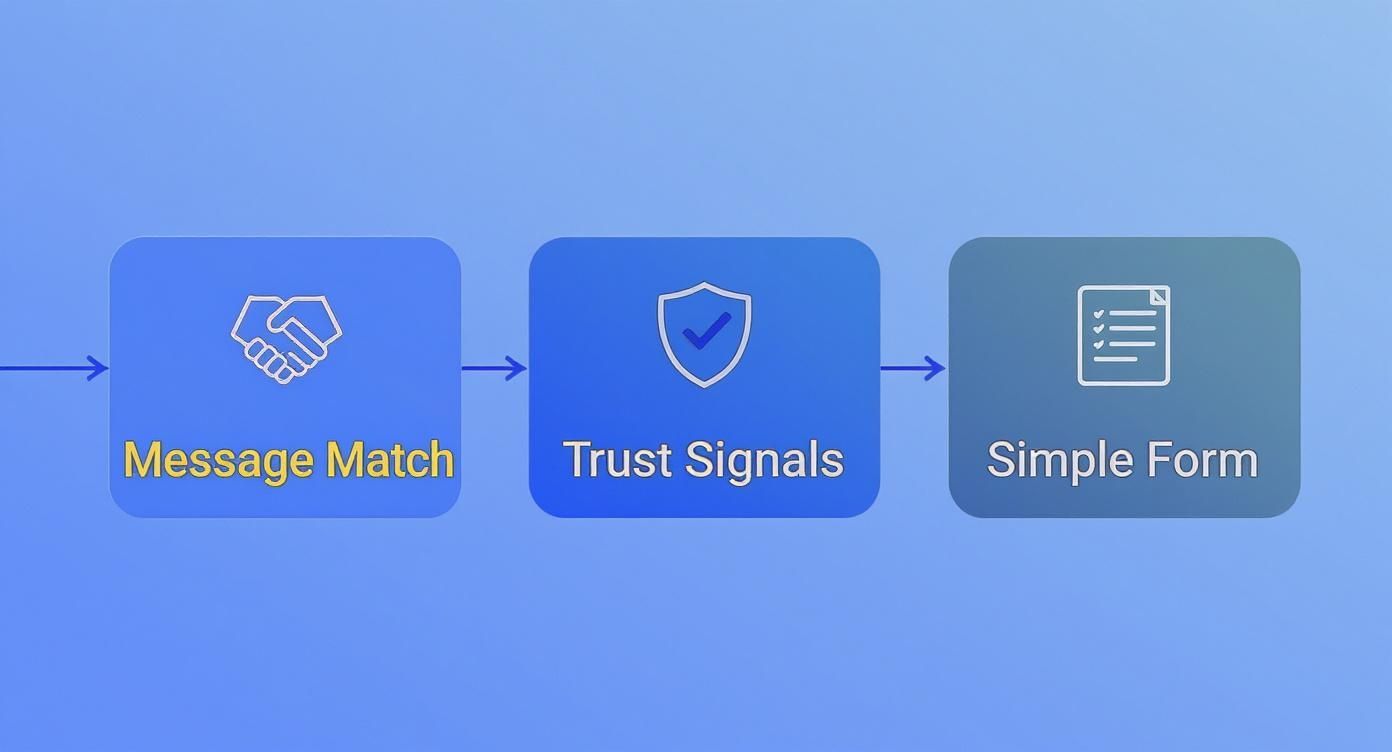
This process is all about maintaining that critical link between your ad's promise and your landing page's experience. You can't scale effectively if that connection is broken.
Here are a few ways to scale your winning campaigns without breaking them:
- Increase Budgets Gradually: I recommend upping the daily budget on your best campaigns by no more than 15-20% at a time. Let it run for a few days, watch the CPL, and if it stays stable, you can increase it again.
- Expand Geographic Targeting: If you’re crushing it in one city, test out neighboring cities or states with similar demographics.
- Explore New Platforms: Got a winning formula on Google Ads? See if you can replicate it on Microsoft Ads or, if you’re in B2B, take that messaging over to LinkedIn Ads.
And finally, remember that getting the lead is only half the battle. What happens next is just as important. All the work you do to generate high-quality leads will be for nothing if your sales process is leaky. Make sure you have a solid follow-up system in place. These Lead Management Best Practices are a great starting point for making sure you turn those hard-won leads into actual revenue.
Advanced Tactics for Maximizing Lead Quality
Getting leads is one thing. Getting good leads? That’s the real game.
Once you’ve got the basics down, it’s time to shift your focus from simply filling the pipeline to actively filtering for your best potential customers. This is where we stop chasing volume and start zeroing in on quality—the kind of leads your sales team will actually thank you for.
This means looking past broad keyword targeting and getting smarter with audience-centric approaches. By layering in more intelligent targeting and letting the ad platforms’ machine learning do the heavy lifting, you can seriously upgrade the quality of leads you generate.
Go Beyond Keywords with Audience Targeting
Keywords are the bedrock of any search campaign, but the most profitable ones I’ve ever managed always add powerful audience layers on top. This is how you stop shouting into a crowd and start having a one-on-one conversation. It allows you to tailor your message based on someone's history with your business, which almost always results in better leads.
Two of my go-to strategies here are Remarketing Lists for Search Ads (RLSA) and custom audiences. They’re a killer combo for grabbing both warm prospects and brand-new ones.
- Remarketing Lists for Search Ads (RLSA): This is your secret weapon, plain and simple. RLSA lets you target people on Google Search who have already visited your website. These are warm leads. They know you. You can bid more aggressively for them or hit them with specific ad copy like, "Still Considering? Get a Free Demo."
- Custom Intent Audiences: When it's time to find new customers, custom intent audiences are incredible. Instead of just bidding on keywords, you build an audience of people who recently searched for your competitor’s brand or other high-intent terms. You're basically intercepting users who are deep in the buying cycle and ready to make a decision.
Imagine you're running ads for a project management tool. You could set up an RLSA list to retarget anyone who hit your pricing page in the last 30 days. At the same time, you could build a custom intent audience of users who recently searched for "Asana alternatives" or "Trello vs Monday," putting your ads right in front of people on the verge of switching.
Let Machine Learning Drive Your Bidding
If you’re still manually managing bids for a serious lead gen campaign, you’re leaving money on the table. The algorithms inside platforms like Google Ads are just way better at optimizing for conversions in real-time. Handing the reins over to automated bidding is how you scale efficiently.
The best strategy for pure lead quality is Target CPA (Cost Per Acquisition). You tell Google the most you're willing to pay for one lead, and its machine learning takes over from there. The algorithm crunches hundreds of signals—device, location, time of day, past behavior—to adjust your bids on the fly, all to get you the most leads possible at your target price.
A word of caution: for automated bidding to work its magic, it needs data. I always recommend having at least 30 conversions in the last 30 days before flipping the switch to Target CPA. Anything less, and the algorithm is just guessing.
Implement Value-Based Conversion Tracking
Here’s a hard truth: not all leads are created equal. A "demo request" is miles more valuable than a "free checklist download." If you treat them the same in your account, you’re telling Google to optimize for quantity, not quality. This is where value-based conversion tracking completely changes the game.
It's an advanced setup, but the concept is simple: you assign a dollar value to each type of conversion. This isn't a random guess; you should work directly with your sales team to figure out what each lead is actually worth to the business.
Here’s what that might look like in practice:
- eBook Download: Worth $5
- Webinar Registration: Valued at $25
- "Contact Us" Form Fill: Worth $100
- Demo Request: The big one, worth $250
Once you feed this value data back into your ad platform, you can graduate from Target CPA to Target ROAS (Return On Ad Spend). Now you're not just telling the algorithm to get you cheap leads; you're telling it to get you the most valuable leads. It will actively prioritize users more likely to complete those high-value actions, fundamentally transforming the ROI of your entire PPC program.
Answering Your Top Lead Gen PPC Questions
Jumping into PPC for lead generation can feel like learning a new language. You're hit with terms, strategies, and a whole lot of questions. It's totally normal. Let's clear up a few of the most common ones I hear all the time.
Think of this as a quick-and-dirty FAQ to help you sidestep common pitfalls and make smarter moves from day one.
How Much Should I Actually Budget for a Lead Gen Campaign?
Ah, the million-dollar question. The honest answer? There's no magic number. Your budget is going to hinge on your industry, how competitive your market is, and what you’re trying to achieve.
For most small to medium-sized businesses dipping their toes in, a budget between $1,000 to $5,000 per month is a solid place to start. It’s enough to get meaningful data on what's working without risking the farm. Treat that initial spend as an investment in learning.
Your real focus shouldn't be the total budget, but your Cost Per Lead (CPL). Once you nail down how much it costs to get a qualified lead—and you know that number is profitable—then you can confidently open up the throttle. Start small, prove the concept, and then scale.
What’s a “Good” Conversion Rate for Lead Gen?
This is a classic trap. A "good" conversion rate for a local HVAC company is going to look wildly different from that of a national B2B SaaS platform. While you'll see industry averages floating around the 2-3% mark, I've seen top-tier campaigns pull in 5-10% or even more.
Forget industry benchmarks. The only metric that truly matters is your own, month-over-month improvement. A "good" conversion rate is one that steadily improves and, more importantly, generates leads at a cost your business can actually sustain.
The fastest way to get there? Relentless A/B testing. Test your landing pages. Test your ad copy. Test your offers. Small, consistent tweaks are what lead to those big wins over time.
Should I Use Google Ads or Social Media?
This isn't an either/or question; it's a "when and why" question. It all comes down to intent. Are you trying to capture existing demand or create it?
-
Google Ads is for capturing demand. You’re getting in front of people who are actively looking for a solution right now. Someone typing "emergency roof repair" into Google has a clear and urgent need. This is why Google is almost always the go-to for service-based businesses and B2B companies.
-
Social media ads (like Facebook Ads or LinkedIn Ads) are for creating demand. You're not waiting for them to search; you're putting your solution in front of your ideal customer profile before they even know they need you. It’s about targeting job titles, interests, and behaviors to build awareness.
Honestly, the smartest play is to use both. Hit the high-intent searchers on Google while you build an audience and nurture future leads on social. Covering both angles means you’re always where your next customer is.
At Frozen Crow Inc., we turn these complex questions into clear, actionable strategies. If you're ready to build a PPC campaign that drives measurable growth and delivers high-quality leads, we can help. Schedule your free marketing audit with us today!


