


November 17, 2026
10 Ways to Increase Ecommerce Conversion Rate in 2025
Welcome to your definitive guide on turning more browsers into buyers. In the competitive ecommerce landscape, a high conversion rate isn't a luxury; it's the engine of sustainable growth. The average ecommerce conversion rate often hovers around a mere 2-3%, which means that for every 100 visitors, 97 leave without making a purchase. Imagine reclaiming even a fraction of that lost revenue simply by optimizing the experience you already offer.
This article moves beyond generic advice to provide a comprehensive roundup of 10 proven, data-backed strategies designed specifically for Small and Medium-sized Businesses (SMBs). We will dissect each tactic, offering step-by-step implementation plans, key metrics to track, and real-world examples to help you systematically increase your ecommerce conversion rate. For a holistic approach to boosting your online store's performance, delve into these tips on how to improve website conversion rates.
You won't find vague suggestions here. Instead, this is an actionable blueprint covering everything from optimizing product pages and checkout processes to leveraging social proof and personalization. We’ll explore:
- Quick Wins: High-impact changes you can implement immediately.
- Long-Term Initiatives: Foundational strategies for sustainable growth.
- A/B Testing Ideas: Data-driven methods to validate your changes.
Whether you're looking to recover abandoned carts or refine your pricing strategy, this guide will equip you with the tools to optimize every stage of the customer journey, stop leaving money on the table, and unlock your store's full potential. Let's begin.
1. A/B Testing and Multivariate Testing
Guesswork has no place in a high-performing ecommerce strategy. To truly increase your ecommerce conversion rate, you need data-driven insights, which is where A/B and multivariate testing become indispensable. This scientific approach allows you to test changes to your website and marketing materials by showing different versions to different segments of your audience, letting their behavior dictate the winning design.
A/B testing, also known as split testing, is a direct comparison between two versions of a single element. For example, you might test a red "Buy Now" button (Version A) against a green one (Version B) to see which color generates more clicks. Multivariate testing is more complex, allowing you to test multiple variables simultaneously, such as a headline, an image, and a button color all at once, to identify the most effective combination.
How to Implement A/B and Multivariate Testing
Getting started with testing doesn't have to be complicated. Tools like Google Optimize (which is sunsetting but its features are being integrated into Google Analytics 4), Optimizely, and VWO provide user-friendly platforms to set up and run experiments.
To ensure your tests are meaningful, follow these best practices:
- Test One Major Element at a Time: In A/B testing, isolating a single variable (like a headline or call-to-action) ensures you know exactly what caused the change in performance.
- Ensure Statistical Significance: Don't end a test prematurely. Run it long enough to gather a sufficient sample size, which will confirm that your results aren't due to random chance. Most testing tools will tell you when you've reached this point.
- Run Tests for Full Cycles: A test should typically run for at least one to two full business weeks. This helps smooth out anomalies caused by daily traffic variations (e.g., higher traffic on weekends vs. weekdays).
- Document Everything: Keep a detailed log of every test you run, including your hypothesis, the variants tested, the duration, the results, and the final decision. This creates a valuable knowledge base for your team.
2. Optimized Product Page Design and User Experience
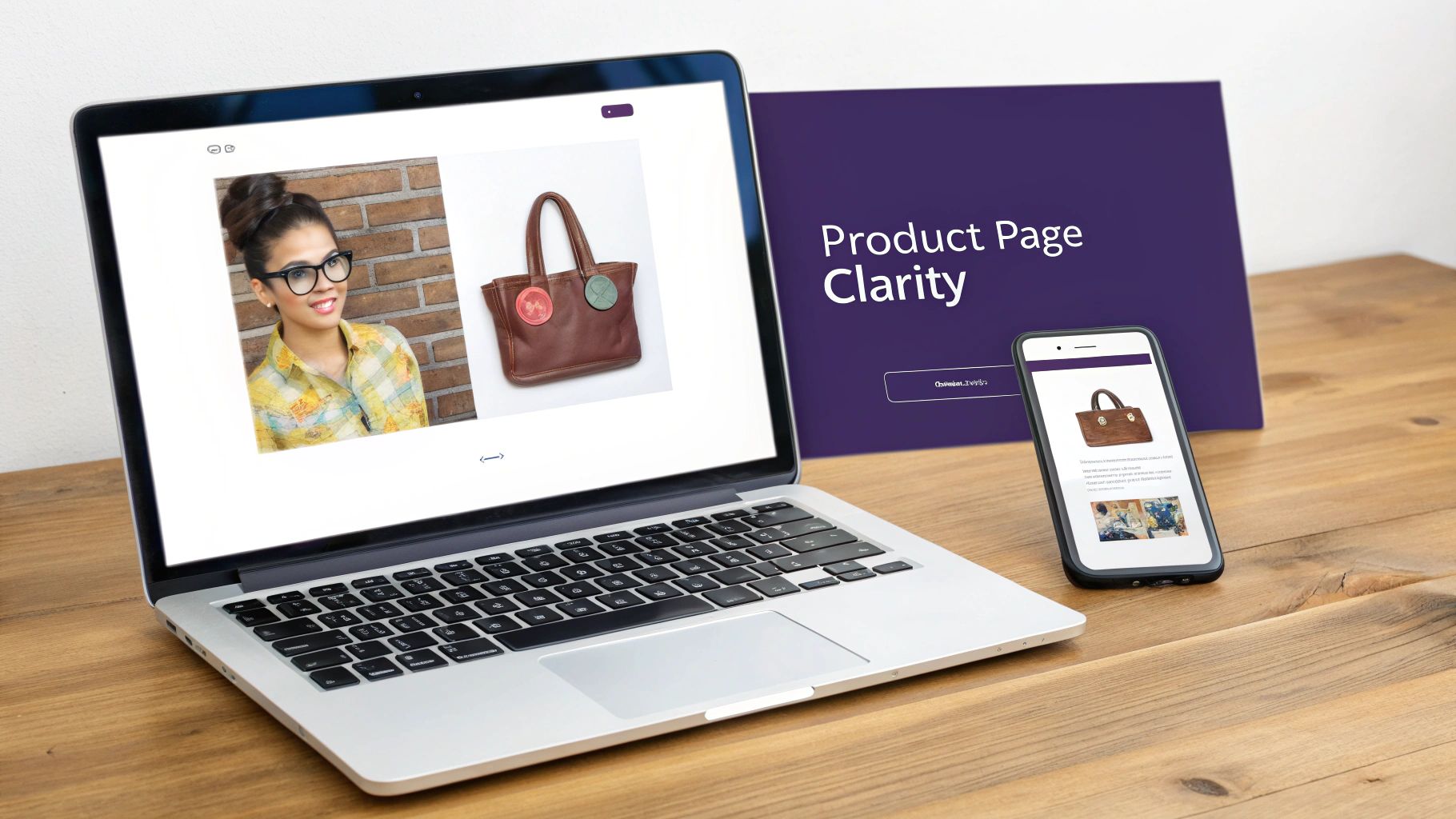
Your product page is the final frontier before a customer decides to add an item to their cart. A confusing, slow, or untrustworthy page can derail a sale in seconds. To increase your ecommerce conversion rate, you must create an intuitive and visually compelling user experience that clearly communicates the product's value, builds confidence, and guides the user effortlessly toward making a purchase.
A well-optimized product page functions like a knowledgeable in-store salesperson. It answers questions before they are asked, showcases the product from every angle, and reassures the customer they are making a smart decision. This involves a strategic combination of layout, high-quality media, clear information hierarchy, and mobile-first design, as seen in Apple's minimalist pages or Zappos' detail-rich layouts.
How to Implement Product Page Optimization
Focusing on clarity and friction reduction is key to transforming your product pages into conversion machines. Start by analyzing your current pages from a new visitor's perspective: is every piece of essential information easy to find?
To effectively enhance your product page design, follow these best practices:
- Prioritize High-Quality Visuals: Use professional, high-resolution photos and videos showing the product from multiple angles, in context, and in detail. Optimizing visual content is paramount, as demonstrated by brands seeing a 15% conversion lift by implementing actionable photoshoot ideas for male apparel brands.
- Write Compelling, Clear Copy: Go beyond basic specs. Use descriptive language that highlights benefits, solves customer pain points, and tells a story. Use bullet points for easy scanning of key features.
- Display Trust Signals Prominently: Showcase security badges (SSL certificates), money-back guarantees, customer reviews, and testimonials. These elements reduce perceived risk and build credibility.
- Ensure Mobile Responsiveness: Your page must look and function flawlessly on all devices. Test button sizes, text readability, and navigation on smaller screens to ensure a smooth mobile shopping experience.
3. Strategic Pricing and Price Presentation
Your product pricing isn't just a number; it's a critical marketing message that directly influences a customer's decision to buy. Strategic pricing and its presentation go beyond simple cost-plus models, tapping into consumer psychology to frame your products in the most appealing way possible. How you display a price can be just as important as the price itself, helping to highlight value, create urgency, and ultimately increase your ecommerce conversion rate.
This strategy involves using proven psychological tactics to make prices seem more attractive. For example, Amazon often shows a "was" price next to the current price to highlight savings, while many SaaS companies use tiered pricing to anchor customers to a higher-value option. The goal is to remove price as a barrier and transform it into a compelling reason to purchase.
How to Implement Strategic Pricing
Implementing effective pricing strategies requires a blend of psychology and clear communication. The key is to build trust and clearly convey the value customers receive for their money.
To get started, focus on these best practices:
- Use Charm Pricing: Ending a price with .99 or .95 (e.g., $29.99 instead of $30.00) is a classic tactic. Known as "charm pricing," it makes the price feel significantly lower at a glance, even though the difference is minimal.
- Show Value with "Compare At" Prices: When offering a discount, always display the original price crossed out next to the sale price. This technique, used by retailers like Target, quantifies the savings and makes the deal feel more substantial.
- Be Transparent About All Costs: Unexpected shipping fees and taxes are a primary cause of cart abandonment. Display the full, all-inclusive price early in the checkout process or offer a shipping calculator on the product page to build trust.
- Communicate Value Beyond Price: Don't just show the price; show what the customer gets for it. Break down costs where applicable (e.g., "$1.25 per serving") or bundle products to showcase a higher perceived value, encouraging a purchase decision based on more than just the bottom line.
4. Social Proof and Customer Reviews Implementation
In the absence of a physical product to touch and feel, online shoppers rely on the experiences of others to make confident buying decisions. Implementing social proof and customer reviews is a powerful strategy to build trust, reduce purchase anxiety, and ultimately increase your ecommerce conversion rate. This tactic leverages the psychological principle that people are more likely to take an action if they see others doing it, acting as a powerful form of validation for your products.
From Amazon's comprehensive rating system to Airbnb's host and guest reviews, social proof validates quality and reassures hesitant buyers. It transforms anonymous product pages into trustworthy resources, showing that real people have purchased and enjoyed what you offer. This transparency is crucial for turning browsers into loyal customers.

How to Implement Social Proof and Customer Reviews
Integrating social proof effectively involves more than just enabling a reviews feature. It requires a proactive strategy to gather, manage, and display customer feedback. Platforms like Yotpo, Trustpilot, and Bazaarvoice can automate much of this process.
Follow these best practices to maximize the impact of your social proof efforts:
- Actively Solicit Reviews: Don't wait for reviews to trickle in. Use post-purchase email automations to request feedback when the customer's experience is still fresh. Consider offering a small, non-monetary incentive like a discount on their next purchase.
- Showcase Reviews Prominently: Your product pages should feature the average star rating and review count directly below the product title. Display detailed written reviews, customer photos, and videos further down the page to provide in-depth information.
- Respond to All Feedback: Engage with both positive and negative reviews. Thanking customers for positive feedback shows appreciation, while addressing negative comments professionally demonstrates excellent customer service and a commitment to improvement.
- Leverage User-Generated Content (UGC): Encourage customers to share photos and videos of themselves using your products on social media. Feature this authentic content on your product pages and marketing channels to create a powerful, relatable form of social proof.
5. Simplified and Optimized Checkout Process
A clunky, confusing, or lengthy checkout process is one of the biggest conversion killers in ecommerce. Customers who have committed to buying can easily be deterred by unnecessary steps or unexpected costs, leading directly to cart abandonment. Simplifying and optimizing your checkout is a high-impact strategy to increase your ecommerce conversion rate by removing friction at the final, most critical stage of the buyer's journey.
The goal is to make purchasing as effortless as possible. This means reducing the number of form fields, being transparent about all costs upfront, and offering convenient payment options. Companies like Amazon, with its patented 1-Click ordering, and Shopify, with its highly refined default checkout, have set the industry standard for a frictionless experience that customers now expect.
How to Implement a Simplified Checkout Process
Streamlining your checkout is an ongoing process of removing barriers. The less work a customer has to do, the more likely they are to complete their purchase. This is a critical area to focus on to significantly boost conversions.
Follow these best practices to optimize your checkout flow:
- Offer Guest Checkout: Forcing users to create an account is a major point of friction. Always provide a prominent guest checkout option to expedite the process.
- Minimize Form Fields: Only ask for essential information. Use tools like address auto-fill to reduce typing and speed up the process. Every field you remove is a potential conversion saved.
- Provide Multiple Payment Options: Cater to user preferences by offering a variety of payment methods, including credit cards, digital wallets like PayPal and Apple Pay, and "Buy Now, Pay Later" services.
- Be Transparent with Costs: Display all costs, including shipping fees and taxes, early in the process. Unexpected charges at the final step are a leading cause of cart abandonment.
- Show Progress Indicators: Use a simple visual bar (e.g., "Step 1 of 3") to show users where they are in the process and how much is left. This manages expectations and reduces frustration.
6. Personalization and Dynamic Content
A one-size-fits-all shopping experience is a relic of the past. To genuinely increase your ecommerce conversion rate, you must treat customers as individuals, and that’s where personalization and dynamic content become game-changers. This strategy involves tailoring the user experience in real-time based on visitor data, such as their browsing history, past purchases, location, or even the device they are using.
Personalization makes the shopping journey feel uniquely relevant and intuitive. Instead of showing every visitor the same generic homepage, you can display products and offers that align with their specific interests. Think of Amazon’s famous "Customers who bought this also bought" section or Netflix's personalized content carousels; these features aren't just convenient, they are powerful conversion engines built on understanding individual user behavior.
How to Implement Personalization and Dynamic Content
Integrating personalization can range from simple tweaks to sophisticated, AI-driven systems. Many modern ecommerce platforms and marketing automation tools have built-in capabilities to help you get started.
To effectively leverage this strategy, consider these best practices:
- Start with Simple Segmentation: Begin by personalizing experiences for broad segments. You could show different homepage banners to new vs. returning visitors or tailor email campaigns based on past purchase categories.
- Leverage Behavioral Data: Use browsing history to recommend related products or show recently viewed items when a user returns. Reminding a visitor of a product they showed interest in is a simple yet powerful way to increase ecommerce conversion rate.
- Use Geolocation for Relevance: Display location-specific offers, shipping information, or even currency and language based on the user's IP address. This small touch removes friction and builds immediate trust.
- Respect User Privacy: Personalization relies on data, so be transparent about what you collect and how you use it. Always provide clear opt-out options and comply with privacy regulations like GDPR and CCPA to maintain customer trust.
7. Urgency and Scarcity Tactics
Procrastination is a major conversion killer. Customers often add items to their cart intending to buy later, only to forget or change their minds. Urgency and scarcity tactics directly combat this behavior by introducing a compelling reason to act now. By leveraging psychological principles like the fear of missing out (FOMO), you can motivate shoppers to complete their purchase immediately rather than putting it off.
These tactics work by creating the perception that a product, offer, or opportunity is in limited supply or available for a short time. Scarcity refers to limited quantity (e.g., "Only 3 left in stock"), while urgency relates to a time constraint (e.g., "Sale ends in 2 hours"). When used ethically, these strategies can significantly increase your ecommerce conversion rate by reducing hesitation and accelerating the decision-making process.
How to Implement Urgency and Scarcity Tactics
Integrating these psychological triggers requires a delicate balance; they must feel authentic to be effective. Dishonest tactics, like fake countdown timers that reset on refresh, will quickly erode customer trust and damage your brand's reputation.
To implement these strategies correctly, focus on genuine opportunities:
- Display Real-Time Stock Levels: Use messaging like "Only 2 left in stock" or "Low Stock" on product pages. This is highly effective for popular items and encourages customers to buy before it's gone.
- Use Countdown Timers: Add a prominent countdown timer to your product pages or a site-wide banner for special promotions, flash sales, or holiday offers. Seeing the time tick away creates a powerful visual cue to act fast.
- Highlight Limited-Time Offers: Clearly communicate deadlines for your sales. Instead of a vague "Sale on now," use specific language like "Deal ends tonight at midnight" or "Free shipping offer expires in 3 hours."
- Show Social Proof and Demand: Display how many other people are currently viewing a product or how many have purchased it recently. Phrases like "25 people have this in their cart" signal high demand and imply scarcity.
8. Targeted Landing Pages and Campaign Alignment
Directing all your marketing traffic, whether from a specific email campaign or a targeted Google Ad, to your generic homepage is a common but costly mistake. To truly increase your ecommerce conversion rate, you must create a seamless journey from ad to purchase. Targeted landing pages achieve this by providing a dedicated, focused experience that aligns perfectly with the visitor's initial intent and the message that brought them there.
This strategy involves creating unique landing pages for specific traffic sources, campaigns, or audience segments. When a user clicks an ad for "vegan leather boots," they should land on a page showcasing only vegan leather boots, not your entire shoe collection. This alignment between ad copy, keywords, and landing page content reduces cognitive dissonance and friction, making the path to conversion clear and compelling. The result is a higher relevance score, lower bounce rates, and a significant boost in conversions.
How to Implement Targeted Landing Pages
Creating effective, high-converting landing pages is a systematic process. Tools like Unbounce, Leadpages, and Instapage offer drag-and-drop builders that make it easy to launch pages without needing a developer.
To ensure your landing pages are optimized for success, follow these best practices:
- Match the Message: The headline on your landing page should mirror the headline of the ad the user clicked. This immediate confirmation tells visitors they are in the right place.
- Focus on a Single Goal: Remove all distractions. A dedicated landing page should have a single, clear call-to-action (CTA). Eliminate the main navigation menu and any other links that could divert the user from the primary conversion goal.
- Align Keywords and Imagery: Use the same keywords from your ad campaigns within the landing page copy. The imagery and overall design should also be consistent with the creative used in the ad, reinforcing the visual journey.
- Segment by Source: Create different landing pages for your major traffic channels. A visitor from a social media ad has different expectations than someone who clicked a link in a detailed email newsletter. Tailor the content accordingly.
9. Cart Abandonment Recovery and Email Sequences
A staggering 70% of online shopping carts are abandoned before a purchase is completed. This represents a massive pool of potential customers who were interested enough to add items to their cart but left for one reason or another. Implementing an automated cart abandonment recovery strategy is one of the most direct and highest ROI methods you can use to increase your ecommerce conversion rate, often recovering 10-30% of otherwise lost sales.
The core of this strategy involves sending a series of timely, automated emails to shoppers who have abandoned their carts. These emails serve as a gentle reminder, often including incentives to encourage them to complete their purchase. This approach reconnects with high-intent visitors at a critical moment, turning a near-miss into a successful conversion. For example, a retailer like Sephora sends emails featuring images of the exact products left behind, making it incredibly easy for the customer to return and finalize the transaction.
How to Implement Cart Abandonment Recovery
Most modern ecommerce platforms like Shopify have built-in tools for this, while dedicated email marketing platforms like Klaviyo or Omnisend offer more advanced segmentation and customization options. An effective sequence recaptures attention without being intrusive.
To ensure your recovery campaigns are successful, follow these best practices:
- Act Quickly: Send the first email within one hour of abandonment. This is when the purchase intent is still at its highest. A simple reminder is often all that's needed.
- Create a Multi-Email Sequence: A single email is good, but a series is better. A common, effective sequence is: Email 1 (1 hour later), Email 2 (24 hours later), and Email 3 (48-72 hours later), which might include a small incentive like free shipping or a 10% discount.
- Make it Effortless: Each email must include a clear, one-click link that takes the user directly back to their pre-populated shopping cart. The goal is to remove all friction.
- Personalize and Persuade: Use compelling subject lines like "Did you forget something?" or "Your items are waiting!" and always include images of the products left in the cart. This visual reminder is a powerful motivator.
10. Exit-Intent Technology and Popup Optimization
Losing a potential customer just as they are about to leave your site is a common challenge. Exit-intent technology provides a final, valuable opportunity to re-engage them. This strategy uses cursor tracking to detect when a user is about to navigate away from your page, triggering a targeted popup or overlay at that precise moment to present a compelling offer.
Instead of interrupting a user’s browsing experience, exit-intent popups appear only at the moment of abandonment. This makes them a less intrusive yet highly effective tool to recover potentially lost sales, capture leads, or gather feedback. When implemented thoughtfully, these popups can significantly increase your ecommerce conversion rate by giving visitors a strong reason to reconsider and stay.
How to Implement Exit-Intent Technology
Tools like OptinMonster, Sumo, and ConvertKit make it easy to design and launch exit-intent campaigns without needing to code. The key is to provide genuine value in that final interaction, transforming a potential bounce into a conversion.
To ensure your exit-intent strategy is effective, follow these best practices:
- Offer Irresistible Value: The offer must be compelling enough to stop a visitor from leaving. Common high-value offers include an exclusive discount (e.g., "15% off your first order"), free shipping, or a valuable content download like a style guide.
- Keep It Simple and Clear: Your popup needs a strong, attention-grabbing headline, concise copy explaining the benefit, and a very clear call-to-action (CTA). The user should understand the offer and how to claim it in seconds.
- Optimize for Mobile: On mobile devices, exit-intent can be triggered by actions like hitting the back button or switching tabs. Ensure your popups are designed for smaller screens, are easy to close, and do not disrupt the user experience.
- Test and Refine Your Offers: Don't just set it and forget it. A/B test different headlines, offers, images, and CTA button text to discover what resonates most with your audience. For example, test a 10% discount against a free shipping offer to see which one performs better.
Top 10 Ecommerce Conversion Tactics Comparison
| Approach / Method | Implementation complexity 🔄 | Resource requirements ⚡ | Expected outcomes 📊 | Ideal use cases 💡 | Key advantages ⭐ |
|---|---|---|---|---|---|
| A/B Testing and Multivariate Testing | Moderate–High: experiment design, tracking, statistical analysis | Testing tools, sufficient traffic, analyst time | Measurable conversion lifts; statistically validated changes | High-traffic pages, major UX or copy changes | Data-driven decisions; clear ROI; reduces guesswork |
| Optimized Product Page Design and User Experience | Medium: design, asset creation, frontend dev | Designers, photographers, developers, ongoing maintenance | Higher conversions, lower bounce, improved trust | Ecommerce product pages, mobile-first experiences | Direct UX impact; boosts trust and reduces support load |
| Strategic Pricing and Price Presentation | Medium: pricing strategy, testing, coordination with finance | Pricing analysts, A/B tests, analytics | Increased AOV and perceived value; conversion change (often +5–15%) | Promotions, tiered offerings, SaaS plans | Raises AOV; clarifies value; can reduce cart abandonment |
| Social Proof and Customer Reviews Implementation | Low–Medium: integration and moderation | Review platform, moderation effort, UGC collection | Significant trust increase; higher conversions (often +20–40%) | New stores, trust-building for high-consideration products | Builds credibility, supplies authentic content, improves SEO |
| Simplified and Optimized Checkout Process | High: backend, payments, security, integrations | Payment gateways, dev effort, compliance (PCI, SSL) | Large reduction in abandonment; higher completion rates (≈+25–35%) | Sites with high cart abandonment, mobile shoppers | Fewer friction points; faster purchases; improves revenue |
| Personalization and Dynamic Content | High: data pipelines, segmentation, ML/integration | Data infrastructure, personalization platform, privacy controls | Improved engagement, AOV (+10–30%), higher retention | Large catalogs, repeat customers, cross-sell campaigns | Greater relevance; increases repeat purchases and AOV |
| Urgency and Scarcity Tactics | Low: UI elements and messaging, inventory sync | Frontend dev, accurate stock/offer data | Short-term conversion spikes (up to +10–50%); faster clearance | Flash sales, limited-stock items, email promotions | Immediate lift; simple to deploy when honest and accurate |
| Targeted Landing Pages and Campaign Alignment | Medium: page creation, copy, tracking | Copywriters, designers, landing-page tools | Higher ad conversion rates; lower CPA (often +20–50%) | Paid campaigns, segmented traffic sources, lead magnets | Better message-match; improved attribution and analytics |
| Cart Abandonment Recovery and Email Sequences | Low–Medium: automation setup and sequence optimization | Email platform, templates, deliverability management | Recovers ~10–30% of carts; high ROI channel | Ecommerce with notable abandonment rates | Passive revenue recovery; cost-effective and measurable |
| Exit-Intent Technology and Popup Optimization | Low: plugin/config + UX testing | Exit-intent tools, creative assets, frequency controls | Captures emails and prevents some bounces; variable conversion | Lead capture, first-time visitors, promo offers | Quick list growth and last-chance conversion opportunities |
From Insight to Action: Building a High-Conversion Future
You now have a powerful arsenal of ten proven strategies to increase your ecommerce conversion rate. We’ve moved beyond generic advice, diving deep into the practical mechanics of A/B testing, the psychology of social proof, the seamless flow of an optimized checkout, and the targeted precision of cart abandonment recovery. The journey from a browsing visitor to a loyal customer is paved with intentional, data-driven decisions, and the tactics outlined in this guide are your roadmap.
However, knowledge without execution is merely potential. The true catalyst for growth is action. The sheer volume of options, from implementing exit-intent popups to overhauling product page UX, can feel overwhelming. The key is not to implement everything at once but to adopt a strategic, iterative approach. Begin by identifying the most significant points of friction in your current customer journey. Is your analytics data screaming about a high drop-off rate on the cart page? Are customer surveys revealing a lack of trust due to minimal reviews? Your data holds the clues to your first move.
Your Immediate Next Steps
To transform these insights into measurable results, follow this simple framework:
- Prioritize One Area: Choose the single strategy from this list that addresses your biggest bottleneck. If your checkout process is clunky, start there. If your product pages lack compelling imagery and reviews, focus your energy on that.
- Formulate a Hypothesis: Create a clear, testable statement. For example: "By adding customer-submitted photos and a five-star rating system to our product pages, we can increase add-to-cart clicks by 15% because it will build trust and provide authentic social proof."
- Implement and Test: Use A/B testing tools to run a controlled experiment. Don't guess; let your customers' behavior tell you what works. Measure the impact against your baseline metrics.
- Analyze and Iterate: Whether your test succeeds or fails, you gain valuable insight. Use that learning to inform your next hypothesis and your next test.
This cycle of prioritizing, hypothesizing, testing, and iterating is the engine of conversion rate optimization (CRO). It’s not about finding a single magic bullet; it's about making a series of incremental, evidence-based improvements that compound over time. Consistently applying these principles will do more than just increase your ecommerce conversion rate for a single quarter. It will cultivate a superior customer experience that builds trust, fosters brand loyalty, and drives sustainable, long-term revenue growth for your business. You're building a system, not just launching a campaign.
Remember, every visitor to your site presents an opportunity. By systematically removing friction, building trust, and creating a more personalized, intuitive shopping experience, you ensure that more of those opportunities are converted into tangible success.
Ready to turn your conversion rate strategy into a powerful growth engine but need an expert partner to guide the way? The team at Frozen Crow Inc. specializes in data-driven CRO, helping businesses like yours analyze, strategize, and implement high-impact optimizations that deliver measurable results. Visit Frozen Crow Inc. to learn how we can help you build a high-conversion future, faster.


