


October 13, 2026
Boost Business Growth by Improving Customer Lifetime Value
If you're stuck on the hamster wheel of customer acquisition, you're not alone. So many businesses pour their time, money, and energy into finding that next customer, often forgetting about the ones they already have. While finding new people is always part of the game, the real secret to durable, long-term growth isn't in acquisition—it's in retention.
Shifting your focus from one-off sales to building genuine, long-term relationships is how you increase customer lifetime value (CLV). It’s about creating an experience so good—so personalized and rewarding—that people just keep coming back. This isn't just a nice-to-have; it's the bedrock of a truly profitable business.
Why Customer Lifetime Value Is Your Growth Compass
It’s easy to get caught in the "acquisition trap." You launch new campaigns, tweak your ads, and celebrate every new customer that walks through the door. But that's an expensive, and often unpredictable, way to build a company.
The real engine of a resilient business is hiding in plain sight: the value you cultivate from the customers you've already won over. Making CLV your north star isn't just a feel-good initiative; it's a core financial strategy. When you nail the customer journey after that first purchase, you create a powerful cycle of repeat business that directly fuels your bottom line.
The Economic Case for Retention
Let's talk numbers, because they don't lie. Acquiring a new customer is wildly more expensive than keeping an existing one. That simple fact makes every dollar you invest in loyalty one of the highest-return moves you can make.
The data is almost hard to believe. A mere 5% increase in customer retention can boost your profits anywhere from 25% to 95%, depending on your industry. Why? Because loyal customers spend more over time, they’re less fussy about price, and they often become your best salespeople. You can dig into more data-driven insights on maximizing CLV to see just how powerful this is.
The core truth is simple: your most valuable asset isn't your next customer; it's the one you just served. Nurturing that relationship is where sustainable profitability is born.
Pillars of a Strong CLV Strategy
A winning CLV strategy isn't about chasing every new marketing trend. It’s built on a few timeless principles. If you focus on getting these right, you'll build lasting relationships and drive predictable revenue.
- Exceptional Customer Experience: Every single touchpoint matters. From the first time someone lands on your site to the moment they contact customer support, the experience needs to be seamless and positive. This is how you build trust and make people want to come back.
- Meaningful Personalization: This goes way beyond using their first name in an email. Use the data you have to deliver relevant product recommendations, tailored offers, and communication that feels like it was made just for them.
- Rewarding Loyalty: Think beyond basic discounts. Create loyalty programs that offer exclusive access, recognize your best customers, and foster a real sense of community around your brand.
To help you get started, here's a quick rundown of the core pillars we'll be diving into throughout this guide.
Core Pillars for Improving Customer Lifetime Value
This table summarizes the key strategies we'll explore, giving you a quick overview of each approach and its primary impact on your business.
| Strategy Pillar | Core Action | Expected Impact on CLV |
|---|---|---|
| Exceptional Experience | Make every customer interaction seamless, positive, and memorable. | Increases satisfaction and builds trust, encouraging repeat purchases. |
| Meaningful Personalization | Use data to tailor recommendations, offers, and communication. | Boosts relevance and engagement, leading to higher average order values. |
| Rewarding Loyalty | Implement programs that offer exclusive benefits and build community. | Fosters a strong emotional connection, reducing churn and driving advocacy. |
By mastering these fundamentals, you’ll start moving your business from a purely transactional model to a relational one. The rest of this guide will give you the actionable steps to make it happen, turning one-time buyers into lifelong fans and securing a more predictable, profitable future for your brand.
Getting a Handle on Your Customer Lifetime Value (CLV)
Before you can even think about improving your CLV, you have to know where you stand. Calculating this number isn't about getting lost in a spreadsheet vortex; it's about gaining real clarity on the health of your customer relationships. The goal here is to land on a figure that tells a story about your business and points directly to your biggest growth opportunities.
At its core, the idea is simple. You're just trying to figure out how much revenue a typical customer brings in over their entire time with your brand. Once you know that, you can make much smarter decisions about everything from your marketing spend to product development.
The Building Blocks of CLV
When you boil it down, CLV is really just a combination of three key metrics. Get a grip on these, and you'll immediately see which levers you can pull to drive that final number up.
This flow is pretty straightforward, showing how individual customer actions build on each other to create a predictable, long-term value metric.
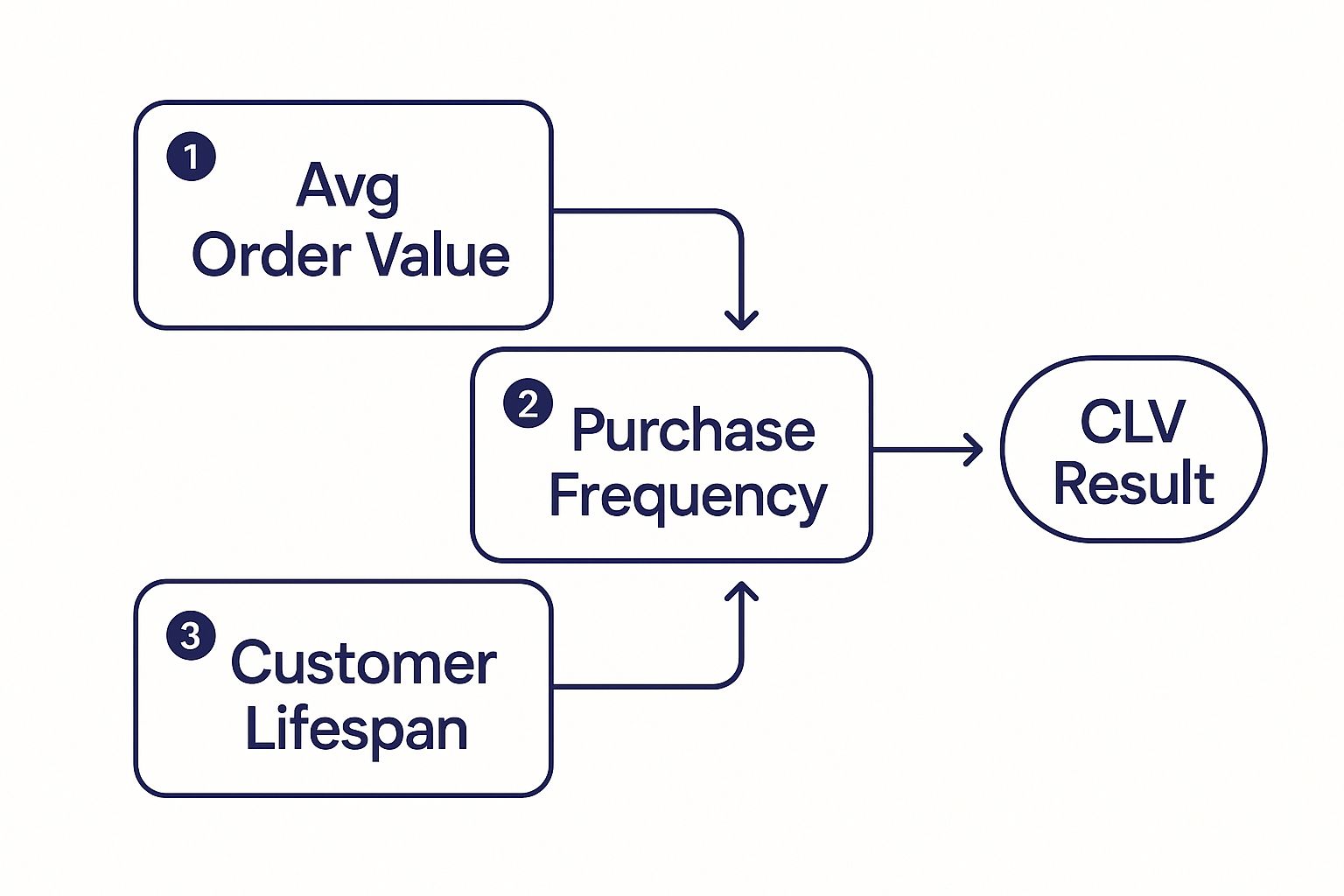
Let's break down how you find these numbers.
-
Average Purchase Value (APV): This is just what it sounds like—how much a customer spends in a single transaction, on average.
APV = Total Revenue / Total Number of Purchases -
Purchase Frequency (PF): This one tracks how often your average customer buys from you within a set timeframe, like a year.
PF = Total Number of Purchases / Total Number of Unique Customers -
Customer Lifespan (CL): This is the average amount of time a customer sticks around and keeps buying from you. It can be tricky to nail down perfectly, but a solid estimate is all you need to get started.
Once you’ve got those three pieces, you just plug them into the formula:
CLV = (Average Purchase Value x Purchase Frequency) x Customer Lifespan
So, let's say your average customer spends $75 per order (APV), buys 4 times a year (PF), and typically stays with you for 3 years (CL). Your CLV would be $900. Just like that, you have a baseline.
What CLV Looks Like in the Real World
The formula is simple enough, but how you use it depends entirely on your business model. A SaaS company and an ecommerce store are going to look at this very differently.
-
For a SaaS Business: Imagine a subscription company charging $50 a month. If the average customer stays for 24 months, their CLV is $1,200. For them, the game is all about reducing churn to stretch that lifespan out as long as possible.
-
For an Ecommerce Store: An online clothing shop might see an APV of $100, but customers only buy twice a year. Their main goal is to find creative ways—like loyalty programs or targeted marketing—to get people to come back more often.
Your CLV calculation isn't just a number—it's a diagnostic tool. It tells you whether you should be pushing to increase order values, drive more frequent purchases, or build longer-lasting customer relationships.
Turning Your Calculation into Action
Knowing your CLV is a great first step. But the real magic happens when you start segmenting that data. Not all customers are created equal, and understanding the differences is how you actually start improving customer lifetime value.
A great way to start is by grouping your customers into tiers based on their CLV:
| Customer Segment | Characteristics | Primary Goal for This Segment |
|---|---|---|
| High-Value VIPs | Frequent, high-value purchasers with a long history. | Retain and turn them into brand advocates. |
| Growth Potential | Mid-range CLV, but show signs of increased engagement. | Nurture and upsell with personalized offers. |
| At-Risk Customers | Low CLV, infrequent purchases, or recent inactivity. | Re-engage with targeted win-back campaigns. |
As you dig in, it's also critical to think about how your pricing impacts these numbers. Different ecommerce pricing strategies can dramatically change both your Average Purchase Value and retention rates, which are the core ingredients of your CLV.
By breaking down your customer base like this, you can stop using a one-size-fits-all approach and start putting your effort where it will make the biggest difference.
Crafting an Experience That Builds Loyalty

The CLV numbers you calculate are just the scoreboard. The real game is won or lost in the day-to-day customer experience. A single frustrating checkout or a slow support ticket can be all it takes to send a once-promising customer straight to your competition.
Great experiences are the bedrock of loyalty. They turn a simple transaction into a real relationship, transforming one-time buyers into genuine fans who stick around, spend more, and tell their friends. This is where you move past the spreadsheets and start building connections that last.
It’s not just about having the best product anymore. Customer experience (CX) is the new competitive battleground—a staggering 89% of businesses now say they compete primarily on CX. The financial incentive is crystal clear: poor experiences put an estimated $3.8 trillion in global sales at risk every year. That’s a powerful reason to get this right.
Map the Journey to Find the Friction
To improve the experience, you have to see it through your customer's eyes. This is where a customer journey map comes in. It’s a visual breakdown of every single interaction someone has with your brand, from their first ad impression to their post-purchase follow-up.
The goal isn't to create some overly complex chart. It's to find the moments that cause friction—the "pain points."
Think about a customer trying to make a return. Is your policy buried on your website? Is the process a huge hassle? Each one of those little hurdles chips away at their goodwill and makes them think twice about buying from you again. Mapping it out shows you exactly where things need to be smoothed over.
Get Ahead of Problems with Proactive Support
Good customer service solves problems. Exceptional customer service solves problems before the customer even knows they have one. That’s the core of proactive support, and it’s a massive loyalty driver.
It’s all about anticipating needs and reaching out with a solution, not just waiting for the complaint to roll in.
- Shipping Delay? Don't wait for the "Where is my order?" email. Send a heads-up explaining the delay and maybe offer a small discount on their next purchase for the trouble.
- Complex Product? A few days after they buy something with a learning curve, send a quick email with a link to a "getting started" guide or a video tutorial.
- Subscription Renewal? Give them a reminder a week before their plan auto-renews, with an easy way to manage it. That transparency builds serious trust.
Proactive support sends a simple but powerful message: "We're looking out for you." This shift in mindset can completely change the customer relationship, turning a potential complaint into a moment that strengthens their loyalty.
To make sure these efforts stick, it helps to have a system. Implementing solid customer retention management strategies gives you a framework for making these proactive tactics a core part of your business.
Create Memorable Post-Purchase Moments
The experience doesn’t stop once the payment goes through. Honestly, the post-purchase phase is your single biggest opportunity to boost CLV. This is where you reinforce their decision to buy from you and pave the way for their next purchase.
A generic "Thank You" email is just noise. A memorable experience goes further. For instance, an online pet store could send an email a week after delivering a new brand of dog food asking, "How is Fido enjoying the new kibble?" It’s a small, automated touch that feels incredibly personal.
This kind of care shows you see them as a person, not just an order number. These are the moments people remember—and talk about.
Turn Happy Customers into Your Best Marketers
The ultimate goal of a fantastic customer experience isn't just to keep customers. It's to create advocates. When a customer feels genuinely looked after, they become your most powerful marketing channel. They're the ones leaving glowing reviews, recommending you on social media, and singing your praises to their friends.
This kind of organic word-of-mouth is priceless. You earn it through every smooth, proactive, and personalized interaction. By consistently delivering a great experience, you’re not just keeping a customer; you're creating an advocate who will help you grow.
Technology: Your Engine for Meaningful Personalization
Let's be honest: your customers don't just appreciate personalization anymore—they flat-out expect it. A generic, one-size-fits-all email is a one-way ticket to the spam folder. If you're serious about boosting customer lifetime value, you have to show customers you get them as individuals.
This is where technology stops being a buzzword and starts being your most valuable player. Tools like a solid Customer Relationship Management (CRM) platform and marketing automation software are what let you deliver those personal touches at scale. They pull all your customer data into one place, giving you a complete picture of every interaction, purchase, and preference. That data is gold.
It All Starts with a Unified Customer View
Think of your CRM as less of a digital rolodex and more like the central nervous system for your entire customer experience. It’s not just for sales. It should track every single touchpoint—website visits, email clicks, support tickets, and purchase history. Having this complete, holistic view is the only way to keep your communication consistent and, more importantly, relevant.
When all your data lives in one place, you can finally stop batch-and-blasting your email list. Instead, you can create hyper-targeted campaigns. Imagine sending a special offer for hiking boots only to customers who previously bought outdoor gear. That’s not just marketing; it’s a conversation. It makes people feel seen, not sold to.
Here’s a look at how the moving parts of a CRM typically fit together:
This diagram shows how a CRM unites different parts of your business around the customer. When sales, marketing, and support are all working from the same playbook, the customer gets a seamless, personalized experience every time.
Put Personalization on Autopilot with Smart Workflows
Once your data is organized, automation is how you put it to work. Marketing automation platforms let you build smart workflows that send personalized messages based on what a customer actually does. This means you’re always sending the right message at the right time, without having to do it all by hand.
These tools are a game-changer for smaller businesses trying to punch above their weight. If you're just getting started, we have a whole guide on marketing automation for small business that breaks it down.
Here are a few classic examples of automated personalization that just plain work:
- The Abandoned Cart Nudge: Someone adds items to their cart but gets distracted. An hour later, an automated email pops into their inbox with a friendly reminder—maybe even a small discount to sweeten the deal. Simple, but incredibly effective.
- The Post-Purchase Check-in: A week after an order arrives, an automated message asks for feedback or shares a few tips on using the new product. It shows you care about their experience long after the credit card swipe.
- Birthday & Anniversary Deals: It might seem small, but an automated "Happy Birthday!" email with a special offer is a gesture that builds a ton of goodwill.
The point of automation isn't to be robotic. It’s to deliver the right human touch at the right time, over and over again. It’s how you turn raw data into a real engagement strategy.
Look Into the Future with AI
The next level of personalization is all about predicting what your customers will want before they even know they want it. Artificial Intelligence (AI) and machine learning can analyze mountains of data to spot patterns and predict future behavior with scary-good accuracy.
For an e-commerce store, this is the magic behind those "you might also like" product recommendations. By analyzing a customer's browsing history, past purchases, and what similar people bought, an AI engine can surface products they're almost guaranteed to love.
This isn't just theory. Companies that lean into AI and machine learning are seeing real lifts in CLV. They're able to fine-tune their marketing, provide proactive support, and deliver recommendations that feel genuinely helpful, which keeps customers coming back.
This is what it means to be proactive. Instead of just reacting to what a customer does, you can anticipate their needs and offer a solution. That kind of foresight is what builds unbreakable loyalty and is a cornerstone of any modern growth strategy.
Designing Loyalty Programs That Actually Work

A truly great loyalty program feels less like a marketing tactic and more like a genuine thank you. It’s the difference between a flimsy punch card you forget in your wallet and an exclusive membership that makes customers feel like they're part of an inner circle.
When done right, these programs are absolute powerhouses for boosting customer lifetime value, turning one-time buyers into genuine brand advocates.
The secret isn’t just about dangling discounts. It's about building a system that rewards customers in ways that actually matter to them, forging a real emotional bond. The numbers don't lie—reports show that well-executed loyalty programs can generate an average ROI of 4.9 times more revenue than their expenses.
Why? Because a thoughtful program shifts the customer relationship from purely transactional to something more personal and reciprocal.
Beyond Points and Punches
The classic "buy ten, get one free" model is a start, but let's be honest, it rarely builds deep-seated loyalty. To create a program that actually sticks, you have to think beyond simple transactions. The goal is to reward engagement and cultivate a sense of belonging.
The best modern loyalty programs layer different types of rewards to appeal to a wider range of customer motivations. They often include a few key elements:
- Tiered Rewards: Think Bronze, Silver, and Gold levels. Customers unlock better perks—like early access to sales, exclusive products, or free shipping—as they spend more or engage more frequently.
- Experiential Rewards: This is where you can really stand out. Go beyond discounts and offer something unique, like a one-on-one consultation, a behind-the-scenes tour, or an invite to a special event. These non-monetary rewards create memorable moments people love to talk about.
- Community Building: Use the program to connect your best customers. It could be a private Facebook group for top-tier members or a dedicated forum where they can chat with each other and your team.
This multi-faceted approach ensures you're not just rewarding spending; you're building a stronger, more resilient customer base.
Make Rewards Aspirational and Attainable
The best loyalty programs strike a delicate balance. The rewards need to feel valuable enough to motivate people, but they also have to be attainable. If your top-tier perks seem completely out of reach for the average customer, you'll see engagement plummet.
The goal is to create a clear and motivating path forward. Customers should always know what the next reward is and feel like it’s just around the corner. This "gamification" keeps them engaged and actively participating.
A perfect example is a tiered system where the first level-up is relatively easy to achieve. That initial win hooks the customer, gives them a taste of the exclusive benefits, and makes them more likely to stick around and aim for the next tier. This is a core component of many successful customer retention marketing strategies, as it builds momentum right from the start.
Act on Feedback to Show You Care
A loyalty program is also a direct line to your most valuable customers. Don’t let that opportunity go to waste. Use it as a channel to actively solicit feedback through surveys, polls, or just direct conversations.
But here’s the most important part: when you get that feedback, act on it. And then let them know you did.
Imagine a customer in your top loyalty tier suggests a new product feature. If you actually implement it and send them a personal thank-you note (maybe with a few bonus points), you’ve created a fan for life. It shows them that their membership means more than just discounts; it means they have a real voice in the brand's direction.
Subscriptions: The Ultimate Loyalty Program
For many businesses, a subscription model is the ultimate form of a loyalty program. It completely transforms the customer relationship from a series of individual purchases into a continuous, predictable stream of value for both sides. The customer gets convenience and consistent access, and you get reliable, recurring revenue.
The key to a successful subscription is making sure the value consistently outweighs the cost. This could mean:
- Replenishment: Automatically shipping essentials like coffee or skincare so customers never run out.
- Curation: Delivering a hand-picked selection of new items each month to create a sense of discovery and delight.
- Access: Providing unlimited access to digital content, software, or an exclusive community.
By building a program that delivers tangible value time and time again, you create a powerful incentive for customers to stick around, deepening their loyalty and significantly boosting their lifetime value.
How to Measure and Refine Your CLV Strategy
Improving customer lifetime value isn't a "set it and forget it" kind of thing. It’s a constant loop of listening, testing, and tweaking your approach. The strategies you start with are just that—a starting point. The real growth comes from building a culture where you're always trying to get a little bit better.
That means you can't just calculate CLV once a year and call it a day. Think of it less like a final grade and more like a live health monitor for your customer relationships. To get a clear reading, you have to track the specific KPIs that feed into that final number.
The Metrics That Actually Matter
Your CLV dashboard needs to tell a story. To understand what's really going on, you have to look beyond the final number and dig into the components that build it.
- Churn Rate: This is the big one, especially if you're a subscription business. A climbing churn rate is your canary in the coal mine—it’s the earliest sign that your CLV is about to take a hit.
- Repeat Purchase Rate (RPR): For any e-commerce brand, this is gold. RPR tells you exactly what percentage of customers liked their first experience enough to come back for more. It's a direct reflection of that crucial first impression.
- Average Order Value (AOV): Are those upsells and cross-sells you're pushing actually moving the needle? AOV gives you the straight answer.
Watching these metrics gives you a much clearer map of where to focus your energy. If your RPR is low, it’s time to obsess over the post-purchase experience. If your AOV is flatlining, you've got opportunities to improve product recommendations or create smarter bundles.
Stop Guessing, Start Testing
Once you've spotted a weak point, the worst thing you can do is guess at a fix. This is where A/B testing becomes your best friend for anything related to retention. It allows you to systematically try out different ideas and see what your customers actually respond to.
For instance, you could run tests on:
- Two completely different "win-back" email campaigns to see which one brings lapsed customers back.
- Different discount tiers or rewards in your loyalty program.
- The product recommendations you show on your order confirmation pages.
By testing one thing at a time, you get clean, undeniable data on what drives behavior. This data-first mindset pulls the guesswork out of the equation and ensures your efforts are actually making a difference to your bottom line.
If you want to get even more granular, start looking at which touchpoints are contributing the most to long-term value. Taking the time to understand what is attribution modeling can show you which marketing channels aren't just bringing in customers, but bringing in your best high-CLV customers.
At the end of the day, refining your CLV strategy is all about staying agile. It means constantly listening to what your customers are telling you, using data to make your next move, and never assuming that yesterday's winning play will work tomorrow. This continuous cycle of measuring, testing, and refining is what separates a good business from a great one.
A Few Common Questions We Hear About CLV
When you start digging into customer lifetime value, a lot of practical questions pop up. We get it. Moving from theory to action is where the real work begins. Here are a couple of hurdles we see businesses face all the time, and how we recommend tackling them.
I’m a Small Business—Where Do I Even Start?
This is the big one. The good news is you don’t need some expensive, complex system right out of the gate. The most important first step is simply to start collecting and organizing your customer data.
Seriously, a basic spreadsheet will do. Track what people buy, how often they come back, and any interactions you have. This isn't just busywork; it's the raw material you'll use to figure out a baseline CLV. From there, you can start seeing who your best customers actually are. It’s how you stop guessing and start making decisions with real numbers behind them.
How Can I Actually Improve CLV if I'm on a Tight Budget?
You don't need a massive budget to make a real impact. A lot of the time, the highest-impact strategies are also the cheapest. Start with the human stuff. Focus on genuinely great customer service—be the company that replies quickly and helpfully on email and social media.
Instead of a fancy marketing automation platform, you can manually segment your email list. Group customers based on what they've bought before and send them offers that actually make sense for them. Ask for feedback, and when you get it, respond. These things show people you're listening and that you value them. It’s that foundation of loyalty that really drives lifetime value, and it costs more in time than it does in cash.
It's important to remember that seeing a big lift in CLV is a long game. You might get some quick wins, but the foundational stuff—building real loyalty and trust—can easily take 6-12 months to show up in the numbers. Consistency is everything.
Ready to turn these strategies into real, measurable growth? At Frozen Crow Inc., we live and breathe data-driven marketing that builds lasting customer relationships and boosts your bottom line. We can help you put these ideas into action.


