


August 20, 2026
Improve ecommerce conversion rates: A proven playbook to boost sales
Before you can boost your conversion rate, you need a brutally honest look at where you stand right now. Jumping into optimization without a proper diagnostic is like trying to find your way in a new city without a map—you’ll burn a lot of fuel and probably end up right back where you started.
The goal is to get a clear, data-driven baseline of your store’s current performance. This isn't just about one big number; it's about digging into the specifics to find the real friction points in your customer's journey.
Finding Your True Conversion Health Baseline
Think of this initial phase as becoming a data detective. You’re moving past surface-level assumptions to uncover the hidden story your analytics are telling.
It’s the difference between saying, "Our store has a 2% conversion rate," and knowing, "Mobile visitors from our Instagram ads are abandoning their carts 85% of the time on our main product page." The first is a vanity metric; the second is a real, actionable insight that you can actually fix.
Moving Beyond the Average Rate
That single, site-wide conversion rate? It’s dangerously misleading. It smooths everything out, hiding both your biggest wins and your most critical weaknesses. The real insights come from segmentation.
Start by slicing your conversion data by:
- Traffic Source: Are visitors from organic search converting better than those from your paid social campaigns? This tells you where your most motivated buyers are hanging out.
- Device Type: How do your conversion rates on desktop compare to mobile? A big gap almost always points to user experience (UX) issues on one device or the other.
- User Type: Are new visitors buying on their first trip, or are returning customers doing all the heavy lifting? This will shape your retargeting and customer loyalty strategies.
This chart shows just how different the conversion story can be between desktop and mobile users. It's a classic example of why segmentation is so important.
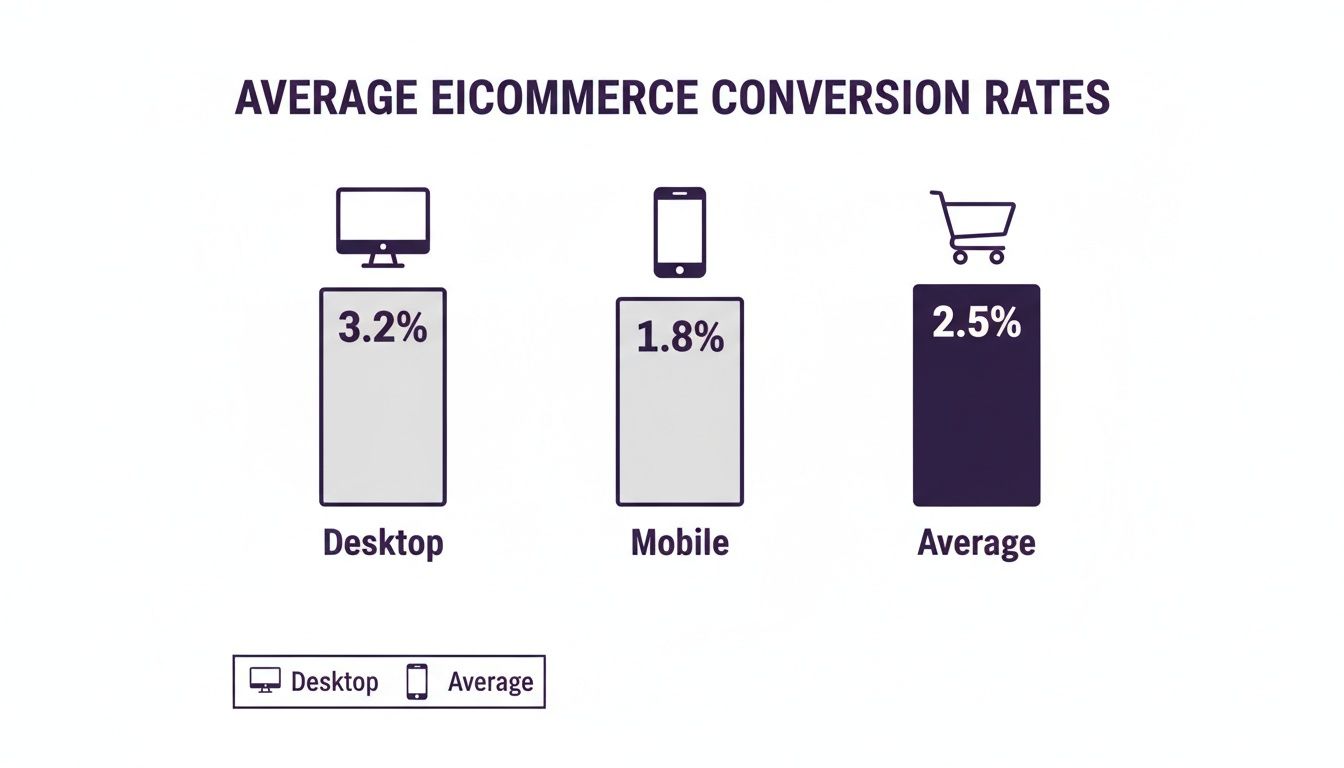
As the data shows, even though mobile often drives more traffic, desktop users consistently convert at a much higher rate. This points to a massive opportunity for anyone willing to nail their mobile optimization.
Understanding benchmarks is also key. For 2025, the global average e-commerce conversion rate sits between 2% and 4%. But the top-tier stores? They’re hitting 5% or even double digits with a killer user experience. The device split is telling: desktop converts at 4.8% versus just 2.9% on mobile, even with mobile traffic dominating.
Combine that with a staggering 77.2% cart abandonment rate on mobile, and it’s clear: a lot of stores are failing to create a smooth mobile shopping experience. This is one of the biggest leaks you can plug.
Ecommerce Conversion Rate Benchmarks by Industry and Device
This table provides a snapshot of average conversion rates, highlighting the performance differences across various industries and devices to help you benchmark your own store.
| Category | Benchmark Conversion Rate |
|---|---|
| Overall E-commerce Average | 2.5% – 3% |
| Top Performing Stores | 5.3%+ |
| Desktop Conversion Rate | 4.8% |
| Mobile Conversion Rate | 2.9% |
| Arts & Crafts | 4.0% |
| Food & Beverage | 3.6% |
| Health & Beauty | 3.1% |
| Fashion & Apparel | 2.4% |
| Home & Garden | 1.8% |
These numbers aren't meant to be absolute rules, but they give you a solid reference point. If your numbers are way off, you know exactly where to start digging.
Identifying Your Biggest Leaks
Once you've segmented your data, it's time to map the user journey and find out where people are bailing. Tools like Google Analytics' Behavior Flow report are great for this, as they visualize the exact paths users take through your site—from the moment they land to the moment they leave.
Pay close attention to pages with unusually high exit rates.
A high exit rate on your "Thank You" page is perfectly normal. A high exit rate on the first step of your checkout process is a massive red flag. It’s a sign of a major friction point that needs to be fixed immediately.
Running this kind of deep dive is what separates guessing from a real, data-backed optimization strategy. It’s exactly what a professional marketing audit is designed to uncover, giving you a clear, prioritized list of problems to solve so you can build a roadmap for genuine, sustainable growth.
Crafting a High-Impact Optimization Roadmap

You've done the diagnostic work. The data is in. You've moved past guesswork and now have a real list of friction points, high-exit pages, and user segments that just aren't performing.
So, what's next? The real challenge is turning all that raw data into a prioritized action plan. A truly effective optimization roadmap isn’t just a random to-do list; it’s a strategic sequence of fixes designed to tackle the biggest needle-movers first.
This is where you start plugging the most critical leaks in your sales funnel. We'll kick things off with the fundamentals—making the user journey seamless—before diving into product pages, the checkout process, and the foundational elements of trust and speed.
Streamlining the User Journey
Before a visitor can even think about your product, they have to be able to find it. Confusing navigation is a certified conversion killer. If users can't intuitively browse categories or get what they need from your search bar, they're gone.
In fact, after a single unsuccessful search on a site, a staggering 81% of U.S. shoppers are more likely to just leave and buy from a competitor. Your goal is to create the path of least resistance from discovery to purchase.
Here's where to put your energy:
- Intuitive Menus: Keep your main navigation simple. Use the language your customers actually use, not internal jargon or clever category names that no one understands.
- Effective Site Search: A solid search function is non-negotiable. It’s no surprise that visitors who use site search are often 1.8 times more likely to convert—they know what they want.
- Logical Product Filters: Let people narrow down their choices easily. Size, color, price, brand… make it simple for them to find their perfect fit.
Think of your site navigation like a helpful guide in a physical store. If the guide is confusing, the shopper walks out. A clear, logical journey keeps them moving toward the register.
Designing High-Converting Product Pages
The product page is where the sale is won or lost. It's your digital salesperson, and it needs to be compelling, informative, and completely trustworthy. Every single element has to work together to answer questions and crush hesitation.
A great product page does more than just list features; it sells a solution. It connects the product's attributes to the customer's needs, building a case for why this is the right choice for them.
To get your product pages firing on all cylinders, focus here:
- Compelling Visuals: High-quality images and videos are everything. A full 73% of consumers prefer watching a short video to learn about a product. Show it from all angles, show it in use, and put it in a lifestyle context.
- Benefit-Driven Copy: Don't just list specs. Translate every feature into a direct benefit for the customer. Instead of "10,000 mAh battery," try "All-day power so you're never caught without a charge."
- Prominent Social Proof: Get those customer reviews and ratings front and center. Shoppers trust other shoppers, and seeing positive reviews can make customers 71% more comfortable buying something.
- Clear Call-to-Action (CTA): Your "Add to Cart" or "Buy Now" button should be impossible to miss. Use a color that pops and stick to clear, action-oriented text.
Fixing the Leaky Checkout Process
The checkout is the final hurdle, and it’s where an unbelievable number of sales simply evaporate. The average cart abandonment rate is hovering around 70%, and a clunky, complicated checkout is often the culprit.
Your mission here is simple: make giving you money as fast and painless as possible.
Research shows that 17% of shoppers ditch their carts just because the process is too long or complex. To stop the bleeding, you need to:
- Offer Guest Checkout: Forcing people to create an account is a major roadblock. Always give them a guest option to speed things up.
- Simplify Your Forms: Only ask for what you absolutely need to process the order. The sweet spot for a checkout form is between 7-8 fields, not the 15+ that so many sites are still using.
- Be Upfront About Costs: Surprise shipping fees and taxes are the #1 reason for cart abandonment. Show all costs clearly and as early as you can.
Building Trust and Boosting Site Speed
Finally, two foundational elements hold up your entire conversion strategy: trust and speed. Without them, even the most beautifully designed store will fall flat.
Trust is built through transparency and security. Display your security badges (like SSL certificates) and offer trusted payment methods like PayPal or Shop Pay. A clear return policy or a money-back guarantee also does wonders for reassuring hesitant buyers.
Site speed is just as critical. A site that loads in one second can have a conversion rate three times higher than one that takes five seconds. Even a tiny 0.1-second improvement in speed can lead to a significant lift in sales. Compress your images, use browser caching, and make sure your hosting can handle the traffic. These technical fixes have a direct, measurable impact on your bottom line.
Driving Growth Through Testing and Personalization

Real, sustainable growth in ecommerce doesn’t come from a single home run or getting lucky. It’s built on a steady cycle of learning, tweaking, and improving based on what your customers actually do. This is where testing and personalization stop being buzzwords and become your most powerful tools for growth.
Making big decisions based on what you think customers want is a fast track to wasting time and money. What you need is a system that lets your customers tell you exactly what works through their clicks and conversions. A/B testing is that system, letting you make data-backed changes that directly lift your bottom line.
Embracing the A/B Testing Mindset
At its heart, A/B testing is a beautifully simple idea. You show two different versions of a page element to two similar groups of visitors and see which one performs better. It completely removes the guesswork.
The whole process kicks off with a clear, testable hypothesis. A good one is always specific and measurable. It's the difference between a vague hope and a strategic experiment.
For example:
- Weak Hypothesis: "A new button will get more clicks."
- Strong Hypothesis: "Changing the ‘Add to Cart’ button color from gray to a vibrant orange will increase add-to-cart clicks by 10% because it will stand out more against our white product page background."
See the difference? This format—If I change [X], then [Y] will happen, because [Z]—gives your test a clear goal and a logical reason. It turns a random idea into a structured experiment. To really get into the weeds of the methodology, you can check out our guide on what A/B testing in marketing really involves.
Building Your First Experiment Roadmap
Getting started with testing can feel a little daunting, but you don’t have to test everything at once. Start with the high-impact areas that directly influence a customer's decision to buy. The best way to stay organized is to build a simple testing roadmap that prioritizes changes based on their potential impact and how easy they are to implement.
To give you a better idea, we've put together a sample roadmap. This kind of structured plan helps you focus your energy on tests that are most likely to move the needle, so you aren't just spinning your wheels on minor tweaks.
Sample A/B Testing Roadmap for an Ecommerce Store
A structured plan outlining potential A/B tests, their hypotheses, and key metrics to track, helping you prioritize your optimization efforts effectively.
| Test Idea | Hypothesis | Primary Metric | Priority Level |
|---|---|---|---|
| Homepage Headline | A benefit-driven headline will reduce bounce rate compared to the current feature-focused one. | Bounce Rate | High |
| Product Image Gallery | Adding a short product video will increase the 'Add to Cart' rate. | Add-to-Cart Rate | High |
| CTA Button Text | Changing "Buy Now" to "Get Your Gadget" will increase checkout starts. | Checkout Starts | Medium |
| Trust Badge Placement | Moving security badges directly under the CTA will decrease checkout abandonment. | Cart Abandonment | Medium |
| Shipping Information | Displaying "Free Shipping" in the header will increase overall conversion rate. | Conversion Rate | High |
By following a roadmap like this, you ensure you're always tackling experiments with real potential.
The Power of Personalization
While A/B testing optimizes for the "average" user, personalization takes it a huge step further by tailoring the experience to the individual. It's all about showing the right thing to the right person at exactly the right moment.
Personalization isn't a luxury anymore; it's a baseline expectation. When a customer comes back to your store, they expect you to remember them. Not doing so is like their favorite local coffee shop owner asking, "Have you been here before?" It just feels wrong.
Even simple personalization tactics can have a massive impact. Think about:
- Displaying recently viewed items for returning visitors to keep products top-of-mind.
- Using geolocation to show location-specific shipping deals or promotions.
- Tailoring product recommendations based on what they've looked at or bought before.
A fantastic way to drive this kind of engagement is by using tools like ecommerce live chat solutions, which allow for immediate, one-on-one conversations that can guide a user straight to a purchase.
Ultimately, the goal is to make every visitor feel like your site was built just for them. This creates a stickier, more compelling experience that naturally boosts conversion rates over time. In a crowded market, that level of personal touch is what sets you apart. When you combine a disciplined testing culture with smart personalization, you build a powerful, self-improving engine that turns more of your hard-earned traffic into revenue.
Measuring What Matters for Conversion Optimization
Fixing friction points and running tests is a great start, but how do you prove your efforts are actually working? A rising overall conversion rate is nice, but it doesn't tell the whole story. To really move the needle, you need a solid measurement framework that tracks the metrics directly tied to profitability and growth.
This is all about moving beyond that one big number. You need to build a dashboard of Key Performance Indicators (KPIs) that gives you a complete picture of your store's health. It’s how you connect a specific change—like a new product page layout—to a tangible business outcome, proving the real-world value of your optimization work.
Looking Beyond the Basic Conversion Rate
Focusing only on the main conversion rate is like judging a car's performance by its top speed. Sure, it's an interesting number, but it ignores acceleration, handling, and fuel efficiency—the things that actually matter day-to-day.
In ecommerce, the real story is told through a handful of crucial metrics that signal genuine business growth. These are the numbers that should live on your primary dashboard.
Here are the essential KPIs you should be watching:
- Average Order Value (AOV): This tells you how much customers are spending per transaction. A higher AOV often means you're getting customers to buy more, which is a much faster path to revenue growth than just getting more orders.
- Customer Lifetime Value (CLV): This metric predicts the total revenue a single customer will generate over their entire relationship with your brand. It’s the ultimate measure of customer loyalty.
- Cart Abandonment Rate: What percentage of shoppers add items to their cart but bail before paying? A high rate is a massive red flag pointing to friction in your checkout process that needs immediate attention.
- Page-Specific Conversion Goals: Don't just track the final sale. Set up micro-conversions for key steps in the funnel, like adding an item to the cart, starting checkout, or signing up for your newsletter.
Tracking these KPIs helps you understand the quality of your conversions, not just the quantity.
Setting Up Your Performance Dashboard
The key here is having all your critical data in one place. Tools like Google Analytics 4 (GA4) are perfect for this. You can build out custom dashboards that pull in your most important metrics, letting you see performance at a glance and spot trends before they become problems.
For example, you could create a dashboard widget that tracks AOV and Add-to-Cart Rate specifically for visitors who landed on a newly designed product page. If both of those numbers climb after the redesign, you have clear evidence your changes worked.
Your measurement framework should be designed to answer one simple question for every change you make: "Did this specific action lead to a positive, measurable impact on our business goals?" If you can't answer that with data, you're just guessing.
To accurately gauge the impact of your marketing, it's crucial to understand where sales are coming from. Exploring marketing attribution software can help connect your marketing activities to actual sales, so you know which channels are truly driving value.
Connecting Actions to Outcomes
A solid measurement plan transforms your optimization work from a series of random tasks into a strategic, data-driven process. It creates a powerful feedback loop where you can directly link your actions to tangible results.
Imagine you implement a one-click checkout option. Your measurement framework should allow you to see:
- A drop in the Cart Abandonment Rate for users who see the new option.
- A decrease in the average Time to Purchase.
- Potentially even a slight lift in overall Conversion Rate from mobile devices, where checkout friction is often highest.
This level of detailed tracking empowers you to make smarter decisions, confidently invest in changes that work, and build a powerful case for continued optimization efforts. If you're looking for more guidance on what to track, our complete guide on measuring digital marketing performance offers a deeper dive into setting up your KPIs for success.
Building a Long-Term Strategy for Sustainable Growth

Getting your e-commerce store optimized isn't a project you finish and walk away from. It's a discipline. All the things we’ve covered—the initial audit, the quick fixes, the A/B testing—aren’t just items on a to-do list. They’re all part of a continuous cycle of improvement.
This is where we tie it all together. The real goal is to shift from putting out fires to building a proactive system for growth. It’s about creating a business that’s not only more profitable today but also tougher and more adaptable for whatever comes next.
Creating a Culture of Optimization
The biggest change you can make isn't on your website; it's in how your team thinks about growth. A true optimization culture is one where data-driven decisions and constant experimentation are just how you operate. It's about empowering your team to ask, "How can we test that?" instead of just going with a gut feeling.
This shift starts when data becomes accessible to everyone, not just locked away with the marketing folks. When your whole team—from product developers to customer service reps—sees how their work impacts key metrics like Average Order Value or Cart Abandonment Rate, they become part of the solution.
The ultimate goal is to build a constant feedback loop: you pull data from user behavior, turn it into a hypothesis, test it, and then feed what you learn right back into the strategy. That cycle is what drives real, sustainable growth.
This is how you bake the drive to improve ecommerce conversion rates into the very DNA of your business.
From One-Off Fixes to a Repeatable System
Let’s connect all the dots and turn this into a framework you can use again and again. Think of it not as a straight line but as a circle, where every step informs the next.
This system really boils down to four key phases:
- Diagnose: Get in the habit of regularly auditing your analytics to spot new friction points. Customer behavior is always changing, so that first audit is just a snapshot in time. You should be revisiting your conversion funnels, device performance, and high-exit pages every quarter.
- Prioritize: Use a simple impact-versus-effort model to decide what to work on next. A small tweak to the checkout page that could lift conversions by 5% is a way better use of your time than a massive homepage redesign that might only give you a tiny bump.
- Experiment: This is where your A/B testing and personalization efforts live. Keep a steady stream of controlled tests running based on your priority list. Every test, win or lose, teaches you something valuable about your customers.
- Measure & Learn: Dig into the results. Did your change just affect conversions, or did it also move the needle on Customer Lifetime Value? Document everything you learn and use those insights to kick off your next diagnostic phase.
Building Your Long-Term Optimization Roadmap
A sustainable strategy means looking past the quick wins and planning for steady, incremental improvements over the long haul. Your optimization calendar should never be empty—it should be mapped out with future tests and focus areas.
Here's what that looks like in the real world:
- Quarterly Focus Themes: Dedicate each quarter to a specific part of the customer journey. Q1 could be all about improving mobile product discovery, while Q2 is laser-focused on streamlining the checkout flow.
- A Centralized Idea Backlog: Create one place—a spreadsheet, a Trello board, whatever works—where anyone on the team can drop ideas for tests. This keeps the good ideas flowing so you never run out of hypotheses to test.
- Scheduled Performance Reviews: Hold regular meetings (monthly or bi-monthly) just to review your optimization efforts. Go over what you’ve learned from recent tests and decide which experiments to launch next.
When you adopt this kind of structured, cyclical approach, you stop chasing shiny objects. You start building a resilient, data-informed business that consistently adapts to what your customers actually want. You turn conversion rate optimization from a one-time project into a core business competency—and that's the foundation for lasting success.
Answering Your Top Ecommerce Conversion Questions
Diving into conversion optimization always brings up a few common questions. We hear them all the time from store owners who are trying to figure out where to focus their energy. To help clear things up, here are some straight answers to the questions we get asked the most.
Think of this as your back-pocket guide for making smarter calls on your optimization journey, from setting realistic benchmarks to deciding what to A/B test first.
What’s a Good Ecommerce Conversion Rate, Anyway?
Everyone wants to know the magic number, but a "good" conversion rate is a bit of a moving target. If you need a solid baseline, aim for somewhere between 2% and 4%. But honestly, that number can swing wildly depending on your industry, traffic source, the price of your products, and even what device someone is using.
For instance, a store selling low-cost craft supplies might easily hit 4% because it's an impulse buy. Meanwhile, a high-end furniture brand could see much lower rates, and that’s perfectly normal. The real goal isn't to hit some universal average; it's to beat your own baseline, month after month. The top-tier stores we see consistently hitting 5% or higher are the ones who never stop tweaking and improving their user experience.
How Can I Get a Quick Win on Mobile Conversions?
If you're looking for the lowest-hanging fruit, it's almost always mobile. Over half of your traffic is likely coming from a phone, so even tiny improvements here can make a huge difference to your revenue.
Want a fast win? Focus on these three things:
- Kill the Complicated Checkout: Shrink your checkout down to a single page or an accordion-style flow. More importantly, give people mobile-native payment options like Apple Pay, Google Pay, or Shop Pay. Letting someone pay with their thumbprint can cut the checkout process down to a few seconds.
- Speed Things Up: Mobile users have zero patience. We've seen sites that load in one second convert three times higher than those that take five. Compress your images and get rid of any heavy page elements that are slowing you down.
- Make it Thumb-Friendly: Take out your phone and try to buy something. Are the buttons and links big enough? Is there enough space around them so you don't accidentally tap the wrong thing? Nothing sends a mobile shopper running faster than a frustrating, clumsy interface.
What Are the Most Important Things to A/B Test First?
It's easy to get lost in the weeds with A/B testing. When you're just starting out, you need to go where the money is. Prioritize tests on the elements that have the most direct impact on a customer’s decision to buy.
Your product page is the final sales pitch before a customer commits. It's the highest-leverage place to start your testing. Focus your experiments here first to see the most significant initial gains in your add-to-cart and conversion rates.
Here’s a prioritized list of where to start for the biggest impact:
- The Call-to-Action (CTA) Button: This is your "money" button. Test everything: its color, size, where it sits on the page, and the words you use. "Add to Cart" vs. "Buy Now" vs. "Get Yours Today" can make a surprising difference.
- Product Photos and Videos: How are you showing your product? Pit your clean, studio shots against lifestyle photos. Try adding a short product video or a 360-degree view and see if it gets more people to add the item to their cart.
- Headlines and Descriptions: Test a headline that focuses on the benefits against one that just lists features. Try breaking up a dense paragraph of text with easy-to-scan bullet points.
- Trust Signals: Where are your customer reviews, security badges, or money-back guarantees? Try moving them closer to the CTA button and measure what happens.
Ready to stop guessing and start growing? The team at Frozen Crow Inc. specializes in data-driven strategies that turn more of your visitors into loyal customers. Our comprehensive audits and hands-on optimization services are designed to build a powerful, sustainable growth engine for your business. Discover how we can help you achieve your conversion goals.


