


November 17, 2026
10 Ways to Improve Ecommerce Conversion Rate in 2025
Getting visitors to your online store is only half the battle. The real challenge, and where sustainable growth truly happens, is turning those visitors into paying customers. The metric that defines this success is your conversion rate. Focusing on how to improve your ecommerce conversion rate is the single most impactful activity you can undertake to boost revenue without proportionally increasing your ad spend.
Many businesses pour resources into acquiring new traffic, but a leaky sales funnel means that investment is wasted. A low conversion rate indicates friction in the customer journey, from unclear product information to a cumbersome checkout process. Fixing these issues directly translates to higher revenue from the traffic you already have, maximizing the return on your marketing efforts. While driving traffic is crucial, converting it is what builds a profitable business. For a comprehensive exploration of various strategies, refer to this guide on proven tactics to improve ecommerce conversion rates.
In this guide, we'll break down 10 data-backed strategies you can implement to plug those leaks and capture more sales. We are moving beyond generic advice to provide a prioritized, actionable roadmap. You will learn specific tactics covering everything from checkout streamlining and A/B testing to leveraging social proof and implementing advanced personalization. By the end of this article, you will have a clear blueprint to optimize your sales funnel, enhance the user experience, and transform more browsers into loyal customers.
1. A/B Testing (Split Testing)
A/B testing, or split testing, is a foundational method to improve ecommerce conversion rate by eliminating guesswork. It involves creating two versions of a single webpage or element (a "control" and a "variation"), then splitting your traffic between them to see which one performs better against a specific goal, such as clicks, form submissions, or sales. By changing only one variable at a time, you can attribute any change in performance directly to that specific modification.
This disciplined, data-driven approach allows you to make incremental improvements backed by real user behavior. For instance, Amazon famously tests everything from the color of its checkout buttons to the placement of customer reviews, ensuring every change contributes positively to the user journey and revenue. Similarly, Netflix continuously A/B tests thumbnail images to determine which visual is most likely to compel a user to watch.
Key Insight: A/B testing transforms optimization from an art based on hunches into a science based on hard data. It is the most reliable way to understand what your specific audience responds to.
How to Implement A/B Testing
Getting started with A/B testing requires a structured process to ensure your results are reliable and actionable.
- Prioritize High-Impact Pages: Begin with pages that have the most significant impact on your conversion funnel. These typically include your homepage, product pages, and checkout process. Small wins on high-traffic pages yield substantial results.
- Isolate a Single Variable: For a true A/B test, change only one element at a time. This could be a headline, a call-to-action (CTA) button's text, an image, or a form field. Testing multiple changes at once (multivariate testing) is more complex and requires significantly more traffic.
- Achieve Statistical Significance: Run your test long enough to collect sufficient data for a statistically significant result, typically a 95% confidence level. Tools like Optimizely or VWO handle this calculation, preventing you from making decisions based on random chance.
- Document and Learn: Meticulously document every test, including your hypothesis, the variations, the results, and key learnings. This creates an invaluable internal knowledge base that informs future optimization strategies and helps your team understand customer behavior more deeply.
2. Checkout Optimization & Streamlining
Checkout optimization is the process of reducing friction and simplifying the steps a customer must take to complete a purchase. A complex, lengthy, or confusing checkout is one of the leading causes of cart abandonment, making its streamlining a direct and high-impact way to improve ecommerce conversion rate. By removing unnecessary fields, clarifying costs, and building trust, you can guide more shoppers from cart to confirmation.
The goal is to make the final transaction as effortless as possible. Amazon’s patented one-click checkout set the gold standard by demonstrating how removing barriers leads to a dramatic increase in completed sales. Similarly, Shopify’s focus on a clean, intuitive, and mobile-friendly checkout process has helped millions of merchants reduce abandonment and boost revenue.
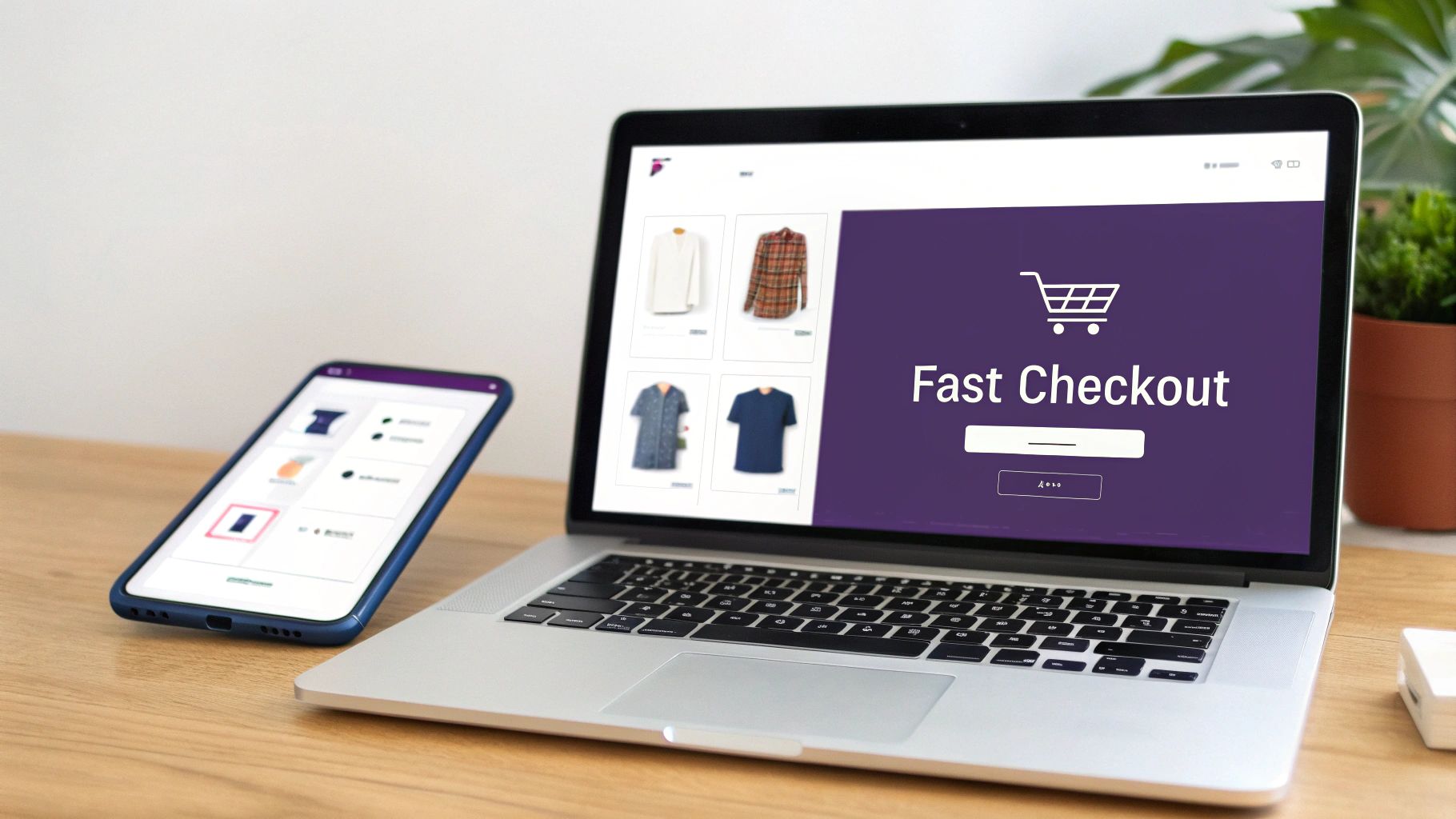
Key Insight: Every field, click, or page load in your checkout process is a potential exit point for a customer. Optimizing this flow isn't just a user experience improvement; it's a direct investment in your bottom line.
How to Implement Checkout Optimization
A streamlined checkout feels seamless to the user but requires a deliberate, user-centric design process.
- Offer Guest Checkout: Forcing account creation is a major conversion killer. Prominently display a "Guest Checkout" option to allow new customers to purchase quickly without commitment. You can always offer them the chance to create an account on the post-purchase confirmation page.
- Minimize Form Fields: Only ask for information that is absolutely essential to process the order. Use tools like address auto-fill (e.g., Google Places API) to reduce typing and errors. Every field you can eliminate makes the process faster and less intimidating.
- Provide Payment Flexibility: Cater to user preferences by offering multiple payment options, including major credit cards, digital wallets like PayPal, Apple Pay, and Google Pay, and "Buy Now, Pay Later" services. This ensures you don't lose a sale because a customer's preferred method is unavailable.
- Build Trust and Transparency: Display security badges (SSL certificates, payment processor logos) and be upfront about all costs, including shipping and taxes, early in the process. Unexpected fees revealed on the final step are a primary driver of cart abandonment.
3. High-Quality Product Photography & Visuals
In ecommerce, your product visuals are your storefront, showroom, and salesperson all in one. Since customers cannot physically touch or inspect products, high-quality photography and video are essential to improve ecommerce conversion rate by bridging that sensory gap. Professional, high-resolution images, 360-degree views, and lifestyle shots build trust, answer questions, and allow shoppers to visualize the product in their own lives.
Compelling visuals are often the primary factor driving a purchase decision. Retailers like ASOS use detailed runway videos and multiple model photos to show fit and drape, while REI uses action shots to demonstrate gear performance in its intended environment. This level of detail reduces uncertainty and hesitation, directly encouraging customers to add items to their cart.

Key Insight: Product visuals do more than just display an item; they sell a solution and an experience. Investing in high-quality imagery is a direct investment in customer confidence and conversion.
How to Implement High-Quality Visuals
Implementing a strong visual strategy involves more than just pointing a camera. It requires a thoughtful approach to presentation and technology.
- Cover All Angles: Provide a comprehensive set of images including front, back, side, and detailed close-ups. Use a clean, consistent background for core product shots and enable zoom functionality so users can inspect texture and details. Zappos mastered this by showing shoes from every conceivable angle, reducing return rates.
- Show Products in Context: Use lifestyle photography and video to show your product in a real-world setting. This helps customers understand its scale, use-cases, and how it might fit into their lives. For example, a furniture store should show a sofa in a fully decorated living room.
- Leverage Video and 3D Models: Product videos can demonstrate functionality and features more effectively than static images. Furthermore, technologies such as virtual try-on can significantly boost buyer confidence and decrease post-purchase issues, improving overall conversion success. Discover how virtual try-on reduces fashion returns and its impact on customer satisfaction.
- Optimize for Performance: High-resolution images are crucial, but large file sizes can slow down your site and hurt conversions. Use modern image formats (like WebP) and compression tools to reduce file size without a noticeable loss in quality, ensuring a fast-loading experience for all users.
4. Clear Value Proposition & Product Descriptions
A compelling value proposition is the cornerstone of any strategy to improve ecommerce conversion rate. It concisely answers a customer’s primary question: “Why should I buy from you?” When combined with benefit-driven product descriptions, this approach preemptively addresses customer pain points and builds the confidence needed to make a purchase, directly distinguishing your brand from the competition.
This is not just about listing features; it’s about translating those features into tangible benefits. For instance, Dollar Shave Club didn't just sell razors; they sold convenience and a humorous, relatable brand experience. Similarly, Slack’s value proposition focuses on productivity gains and reduced email clutter, not just on being a messaging app. This clarity eliminates friction in the decision-making process.
Key Insight: Customers don’t buy products; they buy better versions of themselves. Your value proposition and descriptions must clearly articulate how your product delivers that transformation.
How to Implement Clear Value Propositions & Descriptions
Crafting messaging that resonates requires a deep understanding of your customer’s needs and motivations.
- Lead with Benefits, Not Features: Instead of saying a laptop has an "M3 processor" (a feature), explain that it "lets you edit 4K video without lag" (a benefit). Always connect the "what" to the "so what."
- Use Your Customer’s Language: Scour customer reviews, support tickets, and social media comments to understand the exact words your audience uses to describe their problems and desires. Integrate this language into your copy.
- Create Scannable Descriptions: Shoppers rarely read every word. Use bullet points, bold text, and short paragraphs to highlight the most crucial benefits. This makes information easy to digest, especially on mobile devices.
- Answer Core Questions: A great product description implicitly answers three key questions: What is it? Who is it for? Why is it the best choice for them? Basecamp excels at this by clearly explaining how its project management tool brings calm and order to chaotic workflows.
5. Social Proof & User-Generated Content
Social proof is a psychological phenomenon where people assume the actions of others reflect correct behavior for a given situation. In ecommerce, this translates to leveraging customer reviews, testimonials, ratings, and user-generated content (UGC) to build trust and validate purchase decisions. When a potential buyer sees that others have purchased and enjoyed a product, it reduces their perceived risk and anxiety, making them more likely to convert.
This strategy is highly effective because it replaces polished marketing messages with authentic, relatable endorsements from real customers. For instance, Amazon's extensive review system is a core part of its product pages, allowing shoppers to weigh pros and cons based on hundreds of experiences. Similarly, beauty brand Glossier heavily features customer photos on its product pages and social media, showing how products look on real people, not just models.

Key Insight: Social proof is the digital equivalent of a word-of-mouth recommendation. It is one of the most powerful tools to improve ecommerce conversion rate because it builds credibility and demonstrates product value through an unbiased, trusted source: other customers.
How to Implement Social Proof & UGC
Integrating social proof effectively requires a systematic approach to encourage, collect, and display customer content.
- Automate Review Requests: Use post-purchase email or SMS flows to automatically ask for a review a week or two after the product is delivered. Make it easy for customers to leave a review with a direct link, simplifying the process.
- Showcase Reviews Prominently: Place star ratings and review counts directly below the product title, "above the fold." Feature a dedicated section for detailed reviews and customer photos further down the product page.
- Encourage and Curate UGC: Launch a branded hashtag campaign on social media, encouraging customers to share photos or videos using your product. Run contests or offer small incentives for the best content, and then repurpose that UGC in your ads, emails, and on your website.
- Respond to All Feedback: Actively manage and respond to both positive and negative reviews. Thanking customers for positive feedback and publicly addressing issues in negative reviews shows you are engaged and builds trust with future buyers. Platforms like Trustpilot are excellent for aggregating and managing third-party verified reviews.
6. Personalization & Recommendation Engines
Personalization uses customer data, like browsing history and past purchases, to tailor the shopping experience to the individual. A key component of this is the recommendation engine, an algorithm that suggests relevant products, a strategy that can significantly improve ecommerce conversion rate by making shoppers feel understood and guiding them toward items they are likely to buy. Instead of a one-size-fits-all storefront, each visitor receives a unique, curated experience.
This approach creates a powerful connection with the customer. Amazon’s legendary "Customers who bought this also bought" feature is a prime example, driving a substantial portion of its sales. Similarly, Netflix attributes over 80% of its content views to its sophisticated recommendation algorithm, demonstrating how effective personalization is at capturing and retaining user attention. This transforms the shopping journey from a search into a discovery.
Key Insight: Personalization shifts your store from a static catalog to a dynamic, personal shopping assistant that anticipates customer needs and guides them to relevant products, increasing both conversion rates and average order value.
How to Implement Personalization & Recommendation Engines
Deploying an effective personalization strategy requires leveraging customer data to create relevant, timely, and helpful interactions.
- Start with Behavioral Data: Begin by collecting and analyzing user behavior data. Track which products are viewed, what's added to the cart, and past purchases. Use this information to power simple recommendation widgets on product pages and in the shopping cart, such as "You might also like" or "Frequently bought together."
- Segment Your Audience: Group customers into segments based on shared characteristics like purchase history, browsing behavior, or location. You can then create targeted campaigns, homepage banners, and email offers tailored to each segment's specific interests, making your marketing efforts far more effective.
- Leverage Personalization Tools: Implementing a robust engine from scratch is complex. Utilize powerful third-party platforms like Nosto or Dynamic Yield. These tools integrate with major ecommerce platforms and offer a suite of features, including personalized product recommendations, pop-ups, and email content.
- Test and Measure Impact: Just like any other optimization effort, A/B test your personalization tactics. Create a control group that sees a generic experience and compare their conversion rate and average order value against a group that sees personalized recommendations. This proves the ROI of your strategy and helps refine your algorithms.
7. Mobile Optimization & Responsive Design
With mobile commerce now accounting for the majority of online traffic, mobile optimization is a critical factor to improve ecommerce conversion rate. This practice ensures your website provides a seamless, intuitive, and efficient experience on smartphones and tablets. It goes beyond simply shrinking your desktop site; it involves responsive design, fast load times, simplified navigation, and touch-friendly interfaces to meet the expectations of on-the-go shoppers.
A poor mobile experience is a direct path to abandoned carts and lost revenue. In contrast, a well-optimized site builds trust and reduces friction. For instance, Target's mobile site handles billions in transactions by offering an experience that is as clean and easy to navigate as its dedicated app. Similarly, Shopify's entire platform is built on a mobile-first philosophy, empowering merchants to deliver exceptional experiences out of the box.
Key Insight: Mobile optimization is no longer a feature but a fundamental requirement. If your store is difficult to use on a smartphone, you are actively turning away the largest segment of your potential customers.
How to Implement Mobile Optimization
Building a high-converting mobile experience requires a deliberate and user-centric approach.
- Adopt a Mobile-First Design: Instead of designing for desktop and adapting down, start by designing for the smallest screen. This forces you to prioritize essential elements and create a lean, focused user journey that scales up effectively to larger devices.
- Prioritize Performance and Speed: Mobile users are often on slower networks and have less patience. Optimize images by compressing them and using modern formats like WebP, implement lazy loading so images load as users scroll, and minimize code to ensure lightning-fast page loads.
- Simplify Navigation and Forms: Use recognizable patterns like hamburger menus to save screen space. Ensure all buttons and links are large enough to be easily tapped (Google recommends a minimum size of 48×48 pixels). For forms, reduce the number of fields and enable features like auto-fill to make checkout effortless.
- Test on Real Devices: Emulators are useful, but nothing beats testing on actual smartphones and tablets. This helps you identify real-world usability issues, from awkward touch targets to slow performance on different connections. Use free tools like Google's Mobile-Friendly Test to get a quick baseline analysis.
8. Exit-Intent & Retargeting Popups
Exit-intent and retargeting popups are powerful tools to improve ecommerce conversion rate by recovering potentially lost customers. Exit-intent technology tracks user mouse movements and triggers a popup message or offer just as they are about to leave your site. This provides a final opportunity to present a compelling reason to stay, such as a discount, a free shipping offer, or a prompt to subscribe to a newsletter.
This strategy works by intercepting abandonment at the critical moment. For example, BuzzFeed uses exit-intent popups to capture newsletter signups, turning fleeting visitors into long-term subscribers. Similarly, many fashion retailers like Grailed present a last-chance discount to users who are about to close their cart, successfully converting a hesitant shopper into a buyer. When implemented thoughtfully, these tactics provide a significant lift without being overly intrusive.
Key Insight: Exit-intent and retargeting popups are your last line of defense against cart abandonment and visitor loss. They re-engage users who have shown interest but are on the verge of leaving, effectively salvaging otherwise lost revenue.
How to Implement Exit-Intent & Retargeting Popups
To use popups effectively, you must balance conversion goals with user experience to avoid frustrating visitors.
- Offer Genuine, Timely Value: Your offer must be compelling enough to stop a user from leaving. A 10-15% discount, free shipping, or exclusive content works far better than a generic "Don't Go!" message. Test the timing to ensure the popup doesn't appear too early and disrupt the browsing experience.
- Segment Your Audience: Don't show the same popup to every visitor. Create different offers based on user behavior. For instance, show a cart-specific discount to someone abandoning checkout, but a newsletter signup form to a first-time blog reader. This makes the interruption feel relevant and helpful.
- Make Closing Easy: The most frustrating popups are those with a hidden or delayed "X" button. Ensure your close button is immediately visible and easy to click on both desktop and mobile. A negative user experience will harm your brand more than the potential conversion is worth.
- Monitor Brand Impact and Performance: Use tools like OptinMonster or Privy to build and test your popups. Track not only conversion rates but also bounce rates and time-on-page for pages with popups. This helps ensure your strategy is boosting sales without alienating your audience.
9. Trust Signals & Security Reassurance
Trust signals are visible cues on your website that build credibility and reassure visitors that their personal and financial information is safe. These elements, such as security badges, SSL certificates, transparent return policies, and clear guarantees, address customer anxiety head-on. Building this psychological safety is essential to improve ecommerce conversion rate, as it removes one of the biggest mental barriers preventing a visitor from becoming a customer.
For new or lesser-known brands, establishing trust is not optional; it's a prerequisite for a transaction. A first-time buyer has no reason to believe your site is secure or that you will deliver on your promises. High-profile examples like Zappos' legendary 365-day return policy or REI's 100% satisfaction guarantee became core to their brand identity, proving that a strong commitment to customer security and satisfaction directly fuels growth.
Key Insight: Every transaction is an act of trust. Explicitly showing customers why they can trust you with their money and data is a direct and powerful conversion driver, especially at the checkout stage.
How to Implement Trust Signals
Integrating trust signals effectively involves placing them at critical decision points throughout the user journey to continuously reinforce customer confidence.
- Display Security Badges Strategically: While an SSL certificate (https) is a basic requirement, visually reinforcing security is crucial. Place well-known security logos like Norton, McAfee, or PayPal in your site footer and, most importantly, near "Add to Cart" buttons and payment fields in the checkout process.
- Showcase Guarantees & Clear Policies: Don't hide your money-back guarantee or return policy. Feature it prominently on product pages, in the cart, and during checkout. A clear, risk-free policy like "30-Day Money-Back Guarantee" or "Hassle-Free Returns" directly counters purchase hesitation.
- Be Transparent About Your Business: An "About Us" page with your company story, physical address, and team photos adds a human element. Make your phone number and email support easily accessible. This shows you are a legitimate, reachable business, not a fly-by-night operation.
- Leverage Multiple Payment Options: Displaying logos for trusted payment gateways like Visa, Mastercard, American Express, and PayPal acts as a powerful trust signal. It shows you are integrated with established, secure financial institutions, which provides an implicit endorsement of your store's legitimacy.
10. Strategic Pricing & Scarcity Tactics
Strategic pricing and scarcity are powerful psychological tools that can improve ecommerce conversion rate by directly influencing a customer's perception of value and urgency. This approach moves beyond simple cost-plus pricing, leveraging principles like price anchoring, tiered options, and bundling to frame your offer in the most compelling way possible. When combined with genuine scarcity, such as limited stock or time-sensitive deals, it creates a powerful incentive for customers to stop procrastinating and complete their purchase.
This strategy is about guiding the customer's decision-making process. For example, Booking.com masterfully uses scarcity with messages like "Only 2 rooms left at this price!" to accelerate booking decisions. Similarly, fashion retailers use seasonal sales with prominent countdown timers to create a fear of missing out (FOMO), driving immediate action and clearing inventory.
Key Insight: Price is not just a number; it is a signal of value, quality, and opportunity. Strategic pricing and authentic scarcity motivate customers by framing the purchase as an intelligent, timely decision.
How to Implement Strategic Pricing & Scarcity
Implementing these tactics requires a thoughtful, ethical approach to build excitement without eroding customer trust.
- Anchor Prices to Showcase Value: Always show the original or "list" price next to the discounted price. This "price anchoring" effect makes the current offer seem significantly more attractive, highlighting the savings and increasing the perceived value of the deal.
- Create Strategic Tiers and Bundles: Instead of a single price, offer tiered options (e.g., Basic, Pro, Premium) to guide customers toward a preferred choice, often the middle one. Create product bundles that offer a slight discount compared to buying items individually, which increases Average Order Value (AOV).
- Implement Genuine Urgency: Use countdown timers for legitimate, time-limited sales or promotions. Displaying accurate, low stock levels ("Only 3 left in stock") can also be highly effective. The key is authenticity; using fake scarcity will damage brand credibility and customer trust.
- Test and Segment Your Pricing: Don't set your prices in stone. Systematically A/B test different price points (e.g., $49 vs. $59) to find the sweet spot between conversion rate and profitability. Consider offering special pricing for specific segments, like a "welcome" discount for first-time buyers.
Top 10 Ecommerce Conversion Strategies Comparison
| Strategy | Implementation Complexity 🔄 | Resources & Setup 💡 | Expected Impact 📊 ⭐ | Speed to Results ⚡ | Ideal Use Cases |
|---|---|---|---|---|---|
| A/B Testing (Split Testing) | Medium–High 🔄 — requires tracking & stats setup | Medium — traffic, testing tool, analyst time | 📊 Measurable lift; ⭐⭐⭐⭐ — depends on traffic and test scope | ⚡→⏳ Slow to medium — needs sufficient sample size | Data-driven optimization of CTAs, layouts, pricing |
| Checkout Optimization & Streamlining | Medium 🔄 — UX + payment integration work | Medium — dev effort, payment providers, QA | 📊 High lift; ⭐⭐⭐⭐⭐ — reduces abandonment 15–40% | ⚡ Fast — changes often show quick gains | High-cart-abandonment stores, mobile checkouts |
| High-Quality Product Photography & Visuals | Medium 🔄 — production workflow & editing | High — photographers, equipment, retouching | 📊 Strong impact on trust/returns; ⭐⭐⭐⭐ | ⚡→⏳ Slow — production and cataloging time | Apparel, high-AOV goods, visual-first marketplaces |
| Clear Value Proposition & Product Descriptions | Low–Medium 🔄 — copy strategy and QA | Low — copywriters, product knowledge, SEO | 📊 Improves clarity & conversions; ⭐⭐⭐⭐ | ⚡ Medium — can implement quickly and iterate | New products, complex features, large catalogs |
| Social Proof & User-Generated Content | Low–Medium 🔄 — moderation & integration | Medium — review platforms, community management | 📊 Very strong trust signal; ⭐⭐⭐⭐⭐ (20–90% lift reported) | ⚡→⏳ Medium — builds over time but can accelerate with requests | New-customer trust building, social-driven brands |
| Personalization & Recommendation Engines | High 🔄 — data pipelines, ML models | High — data, engineering, ML tools, privacy compliance | 📊 High AOV & retention impact; ⭐⭐⭐⭐⭐ | ⚡→⏳ Medium–Slow — needs data collection and tuning | Large catalogs, repeat customers, marketplaces |
| Mobile Optimization & Responsive Design | Medium–High 🔄 — redesign, cross-device QA | Medium — dev resources, testing tools, image optimization | 📊 Critical for mobile traffic; ⭐⭐⭐⭐ | ⚡ Medium — improvements visible after deployment | Sites with 60%+ mobile traffic, apps & PWAs |
| Exit-Intent & Retargeting Popups | Low 🔄 — tool configuration and creative | Low–Medium — popup tools, ad spend, email flows | 📊 Recovers abandoners; ⭐⭐⭐ — ~15–30% recovery | ⚡ Fast — immediate results when implemented | Cart abandonment recovery, list growth campaigns |
| Trust Signals & Security Reassurance | Low 🔄 — add badges, policies, contact info | Low–Medium — SSL, certifications, clear policies | 📊 Boosts conversions on high-value buys; ⭐⭐⭐⭐ | ⚡ Fast — quick to implement if infrastructure exists | High-ticket items, first-time buyers, new brands |
| Strategic Pricing & Scarcity Tactics | Medium 🔄 — pricing logic & inventory ties | Medium — analytics, CMS/pricing systems, training | 📊 Raises AOV & urgency; ⭐⭐⭐⭐ | ⚡ Fast — immediate when deployed and tested | Promotions, clearance sales, tiered/SaaS pricing |
From Clicks to Customers: Putting Your Plan into Action
The journey to a higher ecommerce conversion rate isn’t about finding a single magic bullet. Instead, it’s a strategic process of continuous improvement, built on understanding your customers, testing your assumptions, and refining every touchpoint of their digital experience. We've explored ten powerful levers you can pull, from the foundational necessity of A/B testing and mobile optimization to the nuanced art of personalization and strategic scarcity. Each tactic represents a distinct opportunity to remove friction, build trust, and create a more compelling path from browsing to buying.
The key is to move from passive knowledge to active implementation. Reading about these strategies is the first step, but the real growth happens when you start applying them. Don't feel overwhelmed by the need to tackle all ten at once. The most effective approach is methodical and data-driven. Start by diagnosing your biggest pain points using analytics, heatmaps, and customer feedback. Is your cart abandonment rate unusually high? Focus on checkout optimization first. Are visitors bouncing from product pages? It's time to elevate your visuals and value propositions.
Your Roadmap to Higher Conversions
To truly improve your ecommerce conversion rate, you must adopt a mindset of perpetual optimization. Your customers' expectations are always evolving, and your website must evolve with them. Think of this process not as a project with an end date, but as a core business function, much like marketing or inventory management.
Here is a practical, step-by-step plan to put these insights into action:
- Establish Your Baseline: Before you change anything, know your numbers. What is your current overall conversion rate? What are the conversion rates at each stage of your funnel (e.g., from product page view to "add to cart," and from "add to cart" to purchase)? Document these metrics so you can accurately measure the impact of your changes.
- Identify the Low-Hanging Fruit: Review your analytics to find the most significant drop-off point. This is your starting line. A high cart abandonment rate might point to issues with shipping costs or a complicated checkout, making checkout streamlining and trust signals your top priorities.
- Formulate a Hypothesis: Based on your data, create a clear hypothesis for your first test. For example: "By adding customer testimonials (social proof) directly below the 'Add to Cart' button, we can increase product page conversions by 5% because it will address buyer hesitation at the point of decision."
- Implement and Test: Choose one strategy from our list that directly addresses your hypothesis. Use A/B testing tools to run a controlled experiment, ensuring you have a large enough sample size to get statistically significant results.
- Analyze, Learn, and Iterate: Did your change work? Whether it succeeded, failed, or had no impact, you've learned something valuable about your audience. Document the results and use that learning to inform your next test. This iterative loop of Hypothesize -> Test -> Learn -> Repeat is the engine of conversion rate optimization.
The Lasting Impact of Optimization
Mastering these concepts goes far beyond just a number on your analytics dashboard. A higher conversion rate is a direct reflection of a better customer experience. It means you’re communicating your brand’s value more effectively, making it easier for shoppers to find and purchase what they need, and building the kind of trust that turns one-time buyers into loyal advocates. This creates a powerful ripple effect, improving your return on ad spend (ROAS), increasing customer lifetime value, and building a more resilient, profitable business. Every incremental improvement you make is an investment in a more sustainable future.
Feeling overwhelmed by the data or unsure where to start your optimization journey? The experts at Frozen Crow Inc. specialize in turning analytics into actionable strategies that drive real growth. They can help you diagnose funnel leaks, design and implement A/B tests, and build a high-converting ecommerce experience.


