


November 17, 2026
How to Write Product Descriptions That Sell
Think of your product description as your best salesperson. The one that never sleeps, never takes a day off, and is always ready to close a deal.
But let's be honest, most product descriptions are treated like an afterthought—a quick box to check before a product goes live. They end up being a dry list of features and specs, completely missing the chance to actually sell. It’s time to stop thinking of this as a chore and start seeing it for what it is: your most powerful conversion tool.

Exceptional copy does more than just describe what something is. It persuades. It connects. A great description anticipates a shopper's questions and answers them before they're even fully formed. It helps them visualize the product in their own life, making that "Add to Cart" click feel like the most natural next step. This isn't about just saying your product is "high-quality"; it's about showing them why it will make their life better.
Your Words Have a Real-World Impact
Putting real effort into your descriptions isn't just about making things sound nice—it delivers a tangible return. Seriously, this is one of the highest-impact things you can do for your store. When you nail the copy, you'll see a direct effect on your bottom line.
A well-written product description:
- Boosts conversion rates by bridging the gap between "just looking" and "I need this."
- Reduces returns because customers know exactly what they're getting, setting clear expectations.
- Builds your brand identity by letting your unique voice and personality shine through.
- Improves your SEO by naturally weaving in the keywords people are actually searching for.
We've all been there—hovering over the buy button, not quite sure. A product description is often that final nudge. It's your last, best shot to convince a shopper that your product is the solution they’ve been looking for. Every word has a job to do.
This isn’t just a hunch; the entire industry is betting on it. The global market for content writing services—which is largely driven by the need for great product copy—is projected to skyrocket from $19.9 billion in 2023 to a massive $38.6 billion by 2033. You can read more about the growth of the content services market here. Businesses are pouring money into this because they know it works.
To see just how much of a difference quality makes, let's break it down.
The Impact of Product Description Quality
| Metric | Impact of Poor Descriptions | Impact of Great Descriptions |
|---|---|---|
| Conversion Rate | Low. Shoppers are left with unanswered questions and uncertainty. | High. Clear benefits and persuasive language drive confident purchases. |
| Return Rate | High. Product doesn't meet the mismatched expectations set by vague copy. | Low. Customers receive exactly what they were promised, leading to higher satisfaction. |
| Brand Perception | Weak or generic. The brand feels forgettable and untrustworthy. | Strong and memorable. A unique voice builds trust and customer loyalty. |
| SEO Ranking | Poor. Missed keyword opportunities mean less organic traffic from search engines. | Improved. Strategic keyword use attracts qualified buyers directly from search. |
| Customer Engagement | Low. Shoppers bounce quickly due to uninspired, boring text. | High. Compelling stories and vivid language keep shoppers on the page longer. |
Ultimately, a poor description leaves money on the table. A great one becomes an asset that keeps paying you back.
So, forget the boring spec sheets. Your real goal is to translate features into benefits, address your customer's pain points, and paint a picture so vivid they can already imagine owning your product. That’s how you turn a simple block of text into a sales machine.
Know Your Customer Before You Write a Word
Great copy isn't written out of thin air; it's assembled from a deep understanding of the person you're trying to reach. Before you type a single headline or bullet point, you absolutely have to know who you’re talking to. This isn't just a warm-up exercise—it's the foundational work that separates copy that gets ignored from copy that actually converts.
A lot of marketers stop after creating a generic "buyer persona"—some semi-fictional character they call "Marketing Mary." While that’s a decent start, it rarely goes deep enough to fuel truly persuasive writing. You need to get past the demographics and into your customer's head.
What keeps them up at night? What are their secret ambitions or biggest frustrations related to the problem your product solves? The answers are marketing gold, giving you the raw material for descriptions that connect on a much deeper, emotional level.
Digging for Customer Insights
To really get your audience, you need to put on your detective hat. Your mission is to uncover their true pain points, what drives them, and—most importantly—the exact language they use to talk about it all. Remember, people don't buy products; they buy solutions to their problems.
Here are a few practical ways I like to gather this kind of intel:
- Scour Customer Reviews: Start with your own, but don't stop there. Dig into the reviews of your direct competitors. Look for recurring phrases, complaints, and compliments. What specific words do happy customers use? What frustrations do the unhappy ones keep mentioning?
- Talk to Your Sales and Support Teams: These folks are on the front lines, talking to customers every single day. They know the most common questions, the biggest objections, and those "aha!" moments people have. They have a direct line into your customer's mindset.
- Lurk in Online Communities: Find out where your target audience hangs out online. It could be specific Reddit subreddits, Facebook groups, or niche industry forums. Just listen to how they talk about their challenges. Their unprompted, unfiltered language is invaluable.
Before putting pen to paper, it's critical to define who you're speaking to. You can formalize this process by creating an Ideal Customer Profile. It's a structured way to consolidate your research into a guide you can actually use.
The Features-to-Benefits Bridge
Once you've got a solid grasp of your customer's world, it's time to build the most critical part of any compelling product description: the "Features to Benefits" bridge. It's a simple but powerful exercise that forces you to translate what your product does into why your customer should care.
A feature is a factual statement about your product—what it is or has. A benefit is the positive outcome or emotional payoff the customer gets from that feature. The truth is, customers don't buy features; they buy the better version of themselves that those features promise.
Your customer doesn't buy a drill bit. They buy the hole it creates. The benefit isn't the tool; it's the outcome—like finally hanging a cherished family photo on the wall.
Let’s see how this plays out with a real-world example for a pair of noise-canceling headphones.
| Product Feature | The "So What?" Question | Customer Benefit |
|---|---|---|
| Dual-Mode Active Noise Cancellation | So what? | Focus without interruption during your workday or find peace on a crowded commute. |
| Plush Memory Foam Earcups | So what? | Enjoy hours of comfortable listening without the pinching or pressure of other headphones. |
| 24-Hour Battery Life | So what? | Travel confidently knowing your headphones won't die mid-flight; no more charging anxiety. |
This simple translation is the heart of effective product description writing. It shifts the focus from your product's specs to the customer's emotional and practical needs. By constantly asking "So what?" for every single feature, you ensure your copy speaks directly to your customer's desires, making your product feel less like an object and more like a genuine solution.
Writing Copy That Actually Converts
Okay, so you've done the research and have a solid handle on who your customer is. Now for the fun part: turning those insights into words that actually sell. This is where you shift from just listing specs to telling a story that makes someone feel like your product is the only solution for them.
The goal here is simple but crucial. We need to stop talking about what your product is and start showing what it does for the customer. Think magnetic headlines, benefit-first bullet points, and language that paints a picture so vivid they can't resist.
Crafting a Magnetic Headline and Subheading
You've got less than 15 seconds to hook someone. Seriously. Your headline and subheading are the first things they'll see, making them the most important bit of text on the page. They have one job: to immediately answer the visitor's silent question, "Is this for me?"
A great headline doesn't try to be clever; it gets straight to the point. It either highlights the product's biggest benefit or solves a nagging problem head-on.
Your subheading is where you back it up and build instant trust. This is the perfect spot to sprinkle in some social proof or hard numbers to prove your headline isn't just marketing fluff.
- Social Proof: "Loved by over 10,000 home baristas" feels way more compelling than "a popular choice." It shows real people are already on board.
- Real Numbers: Data just hits differently. "Trusted by over 4,000,000 marketers worldwide" has a weight and authority that "Trusted by many marketers" completely lacks.
- Authority: If you've got it, flaunt it. Mentioning a feature in a well-known publication or an endorsement from an expert can be a massive trust signal.
Combine a benefit-driven headline with a proof-packed subheading, and you've got a one-two punch that makes people want to scroll down and learn more.
Using Proven Copywriting Formulas
Look, you don't have to reinvent the wheel every time you sit down to write. Battle-tested formulas exist for a reason—they work with human psychology, not against it. One of the simplest and most effective is the PAS formula.
PAS: Problem, Agitate, Solve
This three-step framework is pure gold because it follows the natural path of a customer's thinking.
- Problem: Kick things off by calling out a pain point they know all too well. You want them nodding along, thinking, "Yep, that's me."
- Agitate: Now, don't just leave it there. Twist the knife a little. Remind them of the frustration, the annoyance, and the negative feelings that come with that problem. Why is it so irritating?
- Solve: And just when they're feeling the pain, you swoop in with your product as the hero—the clear, obvious solution. You show them the way out.
Let's imagine we're selling a smart coffee mug that keeps drinks hot.
Problem: Sick of your morning coffee turning lukewarm before you can even finish it?
Agitate: That first sip is perfect, but by the time you're settled into your work, it’s a disappointing, tepid brew you have to choke down or throw away. Your morning ritual deserves better.
Solve: The Ember Mug² keeps your drink at the perfect temperature from the first sip to the last. Set your ideal heat and enjoy perfectly hot coffee for hours.
See how that works? It connects emotionally before even talking about the product. It validates their frustration and then hands them the perfect answer.
Weaving in Sensory Words and Social Proof
Facts are fine, but feelings are what drive sales. To make your product truly irresistible, you have to help your customer imagine what it’s like to own and use it. That's where sensory words come into play.
These are words that appeal to our five senses: sight, sound, smell, taste, and touch. They jolt the reader out of just browsing and pull them into an experience.
| Instead of This (Generic) | Use This (Sensory) |
|---|---|
| "High-quality fabric" | "Buttery-soft, breathable bamboo fabric" |
| "Good-smelling candle" | "A warm blend of smoky cedarwood and vanilla" |
| "Nice-looking watch" | "A sleek, polished stainless steel case" |
Suddenly, the product feels real, tangible. As you describe these benefits, strategically drop in bits of social proof—a powerful customer quote here, a 5-star review snippet there. Placing a short, punchy testimonial right after you make a key claim reinforces what you just said with real-world validation.
This combination of a solid structure, vivid language, and authentic proof is what dismantles doubt and gives a shopper the confidence they need to finally click "Add to Cart."
Make Sure Search Engines (and Shoppers) Can Find You
Incredible copy is worthless if no one ever sees it. Writing for your ideal customer is only half the battle—you also have to make sure your product pages show up when they search. The real goal is to create descriptions that work hard for both the bots crawling your site and the humans ready to buy.
This isn't about stuffing your text with awkward phrases. It's about finding a strategic balance. You want to use the same language your customers naturally use to find products like yours, while also checking all the technical boxes for platforms like Google, Amazon, and Etsy.
Find the Keywords Your Customers Actually Use
Before you can optimize anything, you need to know what you're optimizing for. The easiest way to start is by thinking like your customer. What words would they type into a search bar to find your product?
Start with the obvious, then get specific. If you're selling a "water bottle," your customers are probably searching for more descriptive, long-tail keywords. Think about their specific needs.
- "insulated stainless steel water bottle for hiking"
- "leak-proof kids water bottle for school"
- "lightweight glass water bottle with silicone sleeve"
These longer phrases show much higher purchase intent. Someone searching for a "water bottle" is just browsing. But someone searching for a "24oz insulated bottle for hot yoga" knows exactly what they want.
Use tools like Google Keyword Planner or Ahrefs to uncover these terms, but don't stop there. Dig into your own customer reviews and check out competitor pages to see the real-world language people use.
Once you have a primary keyword and a few secondary ones, weave them into your description naturally. Your main keyword should absolutely appear in your product title, the first paragraph, and ideally in a subheading.
Get Your On-Page SEO in Order
Beyond the main body of your copy, several other elements on your product page send strong signals to search engines. A surprising number of sellers overlook these, which gives you an easy advantage.
A simple copywriting formula like Problem-Agitate-Solve can help structure your thinking here, ensuring your copy is not just keyword-rich but also genuinely persuasive.
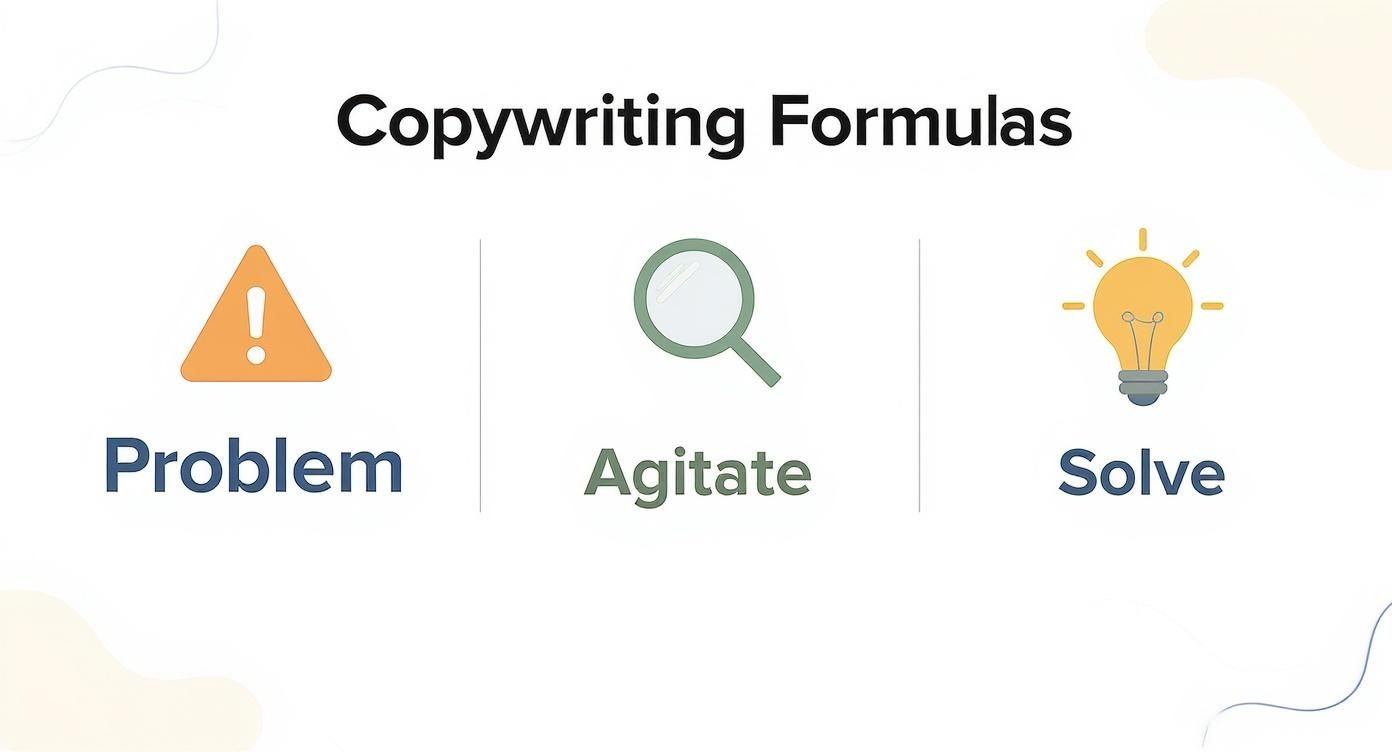
This flow mirrors the customer's own journey from recognizing a need to finding the perfect solution in your product.
Make sure you've optimized these critical areas:
- Meta Title: This is the blue link people see in search results. Keep it under 60 characters and always include your primary keyword and brand name.
- Meta Description: This is the short text snippet under the title in search results. You've got about 160 characters—treat it like a mini-ad. Use benefit-driven language to earn that click.
- Image Alt Text: Describe your product images for visually impaired users and, of course, for search engines. Instead of "IMG_1234.jpg," write something descriptive like, "red insulated travel mug with spill-proof lid."
- Product URLs: Keep your URLs clean, simple, and keyword-rich. A URL like
yourstore.com/products/insulated-travel-mugis way better thanyourstore.com/products/item-8675309.
On-page SEO isn't a one-and-done task. It's about sending consistent, clear signals to search engines about what your page is about. That's how they learn to match your product to the right search queries.
Many modern retailers are also using AI tools like Jasper or Writesonic to generate accurate, SEO-optimized product descriptions more efficiently. In fact, one fashion retailer reported a 25% increase in organic traffic after implementing AI-generated descriptions.
Play by the Rules of Each Platform
Every e-commerce platform has its own quirks and, most importantly, character limits. A description that looks perfect on your Shopify store might get cut off on Amazon or look like a wall of text on Etsy. You have to know the rules of the playground you're in.
For those looking to get a bit more technical, you can give search engines richer context about your products and potentially earn "rich snippets" in search results. Learning how to add schema markup to boost SEO is an advanced technique that can really make your listings stand out.
Here’s a quick reference guide for some of the biggest platforms to help you stay within the lines.
Platform Character Count Quick Reference
This table provides a quick look at the title and description guidelines for major e-commerce platforms.
| Platform | Title Limit (Characters) | Description Guidance |
|---|---|---|
| Shopify | Up to 70 (for SEO) | No hard limit, but keep key benefits "above the fold." Use headings and bullets. |
| Amazon | Varies by category, often ~200 | Use the five bullet points for your most important benefits. The main description allows for more detail. |
| Etsy | 140 | Descriptions must be scannable. Use short paragraphs and lists to break up the text. |
Of course, you should always check the most current guidelines for each platform, as they can change.
Tailoring your descriptions for each channel doesn't just improve your visibility—it creates a better experience for the shopper. When you combine customer-focused keywords with technical best practices, your descriptions will start attracting both shoppers and search engines, driving more qualified traffic right to your products.
Testing and Refining Your Product Copy
Getting a product description live is just the beginning. The best brands I’ve worked with treat their copy as a living document—something that can always be stronger, clearer, and more persuasive.
This is where the real magic happens. Through testing and refining, good copy becomes great copy.
You don’t need a fancy data science setup to get this right. The idea is simple: make small, controlled changes to your product copy and measure whether those changes actually lead to more sales. We call this A/B testing. You create two versions of a page, show them to different groups of visitors, and see which one gets the job done better.
What Elements Should You Test?
Trying to overhaul an entire product page at once is a recipe for confusion. If you change everything, you'll never know what actually worked. The key is to test one single element at a time for clean, actionable insights.
Start with the highest-impact components. These are the parts of your description that can trigger the biggest shifts in customer behavior.
Not sure where to begin? Here are a few great starting points for your tests:
- Headlines: Does a benefit-driven headline like "Stay Energized and Productive All Day" outperform a feature-focused one like "Adjustable Height Standing Desk"?
- Calls to Action (CTAs): Try out different button text. Does a standard "Add to Cart" convert better than something more active like "Get Yours Today" or "Buy Now"?
- Story vs. Bullets: For a key product, pit a short, narrative-style opening against a scannable list of benefits right at the top. See which one grabs your audience faster.
- Social Proof Placement: What happens if you move a powerful customer testimonial right below the headline? Does it boost trust and convince more people to buy?
The trick is to have a clear hypothesis for every test. Frame it like this: "I believe changing the CTA from 'Shop Now' to 'Claim Your Discount' will increase clicks because it creates a sense of urgency and immediate value."
Common and Costly Mistakes to Avoid
As you get better at writing descriptions that sell, it’s just as important to know what not to do. I’ve seen countless brands make the same simple errors that quietly kill their sales. Avoid these, and you’ll already be ahead of most of the competition.
One of the worst mistakes is just copying and pasting the generic manufacturer description. It fails to connect with your specific audience and, even worse, creates duplicate content that can sink your SEO rankings.
Another one? Poor quality control. Typos and grammatical errors are instant trust-killers. A quick proofread should be a non-negotiable step before anything goes live. The impact here is huge—industry data shows nearly 90% of shoppers consider product content extremely important when deciding to buy. In fact, poorly written descriptions are a major driver of returns, which can hit a staggering 64% for online purchases. You can see more data on the impact of product content on returns at Axite.io.
Finally, make sure you're tracking the right numbers to see if your changes are actually working. Focus on the metrics that directly impact your bottom line:
- Conversion Rate: The percentage of visitors who actually buy something.
- Add-to-Cart Rate: How many people are adding the item to their cart? This shows interest.
- Time on Page: If people are sticking around longer, it’s a good sign your new copy is more engaging.
By testing methodically and steering clear of these common mistakes, you turn copywriting from a guessing game into a data-backed strategy for real growth.
Your Burning Product Description Questions, Answered
Even when you’ve got the basics down, a few nagging questions always seem to pop up right when you’re in the zone. Nailing the answers to these common hurdles is often the difference between copy that just sounds good and copy that actually sells.
Let's dig into some of the questions we hear most often.
How Long Should a Product Description Be?
There’s no magic number. A simple t-shirt needs a lot less explanation than a high-tech drone, right? The ideal length completely depends on your product's complexity and what your audience needs to feel confident.
Instead of chasing a specific word count, stick to this principle: be as long as necessary, but as short as possible.
Your description needs to be thorough enough to answer every question and squash any hesitation a customer might have. At the same time, it can't be a giant wall of text that sends them running. It has to be scannable.
The real goal isn't hitting a word count; it's giving a customer just enough information to click "buy" without a second thought. For most ecommerce products, that sweet spot tends to be somewhere between 100 and 300 words.
Should I Use Bullet Points or Paragraphs?
Honestly? You should almost always use both.
Think about it: some shoppers are scanners who just want the facts, fast. Others are readers who want to connect with the story behind the product. A hybrid approach gets the best of both worlds and speaks to everyone.
Here’s a structure that works like a charm for most products:
- Start with a punchy paragraph. Kick things off with 2-3 sentences that set the scene, tap into an emotion, and introduce the core benefit. This is your hook.
- Follow up with a bulleted list. This is where you lay out the scannable, need-to-know details. Think features, specs, dimensions, materials, or what’s in the box. It’s perfect for the shopper who just wants the data.
- Wrap it up with a final paragraph. A concluding sentence or two can seal the deal, reinforcing the value and nudging them toward that "Add to Cart" button.
This combo lets you tell a great story while making the hard facts impossible to miss.
How Do Visuals and Copy Work Together?
Your photos and your words aren't two separate things—they're two halves of the same story. Your product images, videos, and 3D models are there to prove what your copy promises. They work as a team to build trust and eliminate any doubt in the shopper's mind.
Here’s how I think about it:
- Copy handles what you can't see. It describes the feeling of a soft fabric, the peace of mind from a lifetime warranty, or how a gadget solves a problem over time.
- Visuals provide the tangible proof. They show texture, scale, and what the product actually looks like in a real-world setting.
A stainless steel water bottle is a perfect example. The photo shows its slick design, but the copy delivers the knockout punch the image can't: "Double-wall insulation keeps your water ice-cold for 24 hours, even in a hot car." One without the other is an incomplete pitch. Your copy should fill the gaps your images leave behind.
How Often Should I Update My Descriptions?
Product descriptions are not "set it and forget it" content. They’re living assets that need attention. As a general rule, we recommend reviewing your top-sellers every quarter and your entire catalog at least once a year.
But you should jump in and make updates immediately if:
- The product itself changes. Did you upgrade a material or add a new feature? Your copy has to reflect that—instantly.
- Customer feedback gives you gold. Reviews and customer questions are a goldmine. They often highlight benefits you hadn't thought of or pain points you can address more directly in the copy.
- Performance is slipping. If a product that used to convert well starts to see a drop in sales, tired or outdated copy could be the reason.
Treat your descriptions as an active part of your marketing strategy. Keeping them fresh is what keeps them working hard for your brand.
At Frozen Crow Inc., we turn underperforming product pages into sales machines. Our team combines persuasive copy with data-backed strategy to create descriptions that don’t just rank—they convert. If you're tired of leaving money on the table, let us show you what truly optimized copy can do.
Get your free marketing audit today at https://frozencrow.com


