


November 17, 2026
How to Increase Website Traffic That Actually Converts
Growing your website traffic is about more than just a numbers game. It's about creating a sustainable ecosystem where new visitors discover you and existing ones keep coming back. This means blending channels like organic search, social media, and paid advertising into a cohesive strategy.
The real magic happens when your site’s technical health, fantastic content, and a great user experience all work together, building momentum that fuels continuous growth.
Building Your Foundation for Sustainable Traffic Growth
Before you chase that one viral post or sink a ton of money into ads, you need to build a solid foundation. The websites that win in the long run aren't just lucky; they’ve intentionally built a traffic system where every part supports the others.
This requires a shift in thinking. You're not just running a website; you're cultivating an online destination that people want to visit. The goal is to see traffic not as a single metric, but as the natural result of a well-oiled machine where organic search, social proof, and direct visits feed into each other.
Diversify Your Traffic Sources
Putting all your eggs in one basket is a risky game. A sudden Google algorithm update could tank your rankings, or a change in a social media platform's rules could dry up your leads overnight. A diversified approach is your best defense, creating stability and opening up multiple paths for growth.
If you’re new to paid ads, a great starting point is understanding how Google PPC works—it can bring highly targeted visitors to your site while your organic efforts build steam.
For most businesses I’ve worked with, a healthy mix of traffic sources is key. This chart shows a common breakdown for a resilient strategy.
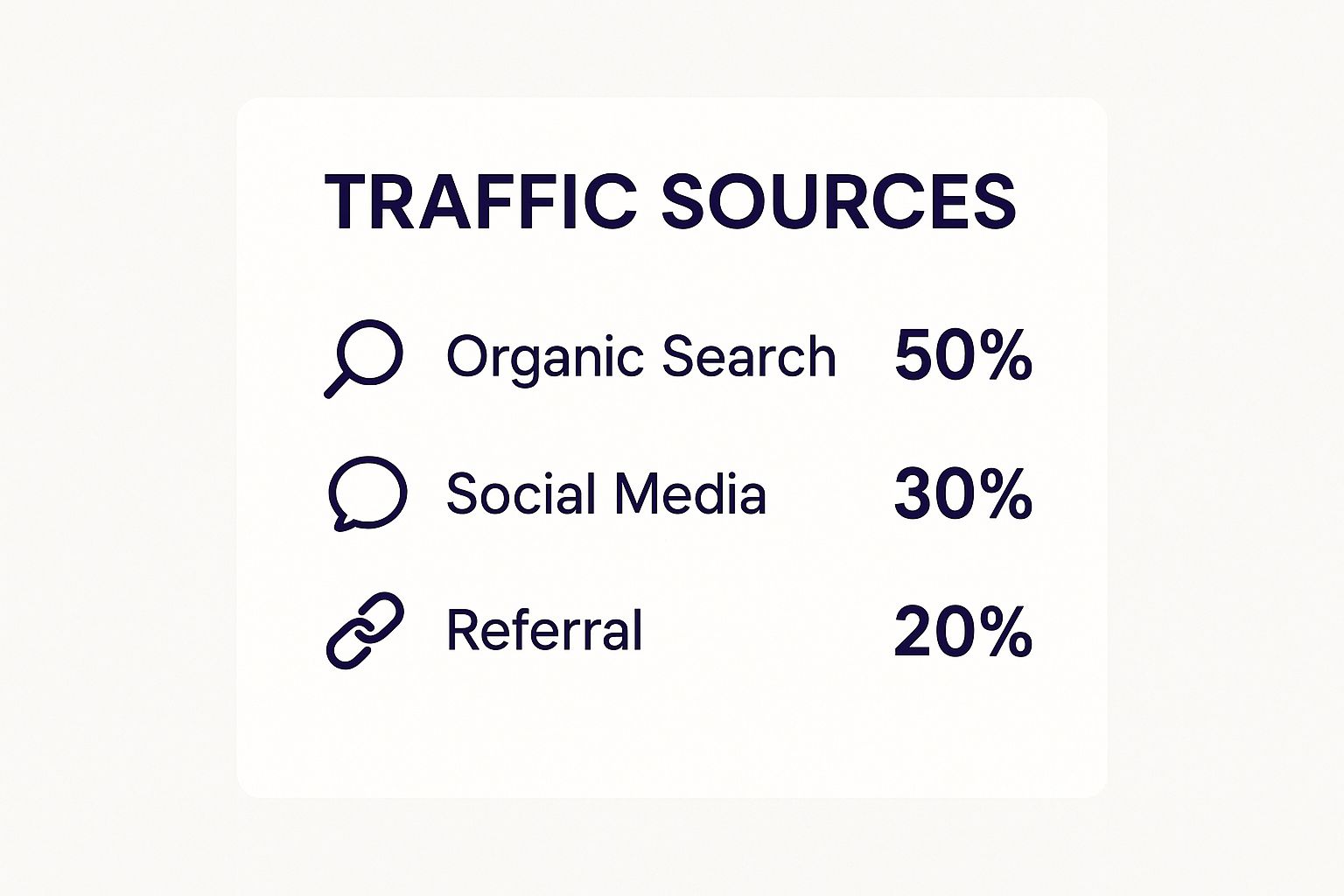
While organic search often makes up the biggest piece of the pie at 50%, you can see how vital social media (30%) and referral traffic (20%) are. They create a much more stable and robust online presence.
Core Pillars of a Growth Strategy
To get real results, you need a plan. Every single action you take should tie back to a specific goal, whether that’s ranking higher, getting more shares, or improving user engagement. When you focus on the right pillars, you ensure every ounce of effort leads to measurable traffic growth.
The most effective way to grow is to have a marketing plan for every single piece of content you create. Ask yourself: who is this for, and how will they find it on an ongoing basis? Hope is not a strategy.
This mindset turns content from something you just publish into an active marketing tool. To help you build this plan, I've broken down the fundamental areas of traffic growth into three core pillars.
Core Pillars of Website Traffic Growth
This table summarizes the foundational areas you need to focus on to increase your website's traffic. Think of it as your strategic checklist, outlining the primary goal and the key metrics to watch for each pillar.
| Pillar | Primary Goal | Key Metrics to Track |
|---|---|---|
| Technical SEO | Ensure search engines can crawl, index, and understand your site. | Site Speed, Core Web Vitals, Crawl Errors, Index Coverage |
| Content Quality | Create valuable, relevant content that satisfies user intent. | Time on Page, Bounce Rate, Keyword Rankings, Backlinks |
| User Experience | Make your site easy and enjoyable to navigate on any device. | Mobile Usability, Click-Through Rate (CTR), Pages per Session |
Nailing these three areas—Technical SEO, Content Quality, and User Experience—is non-negotiable. They are the bedrock of any successful traffic strategy, creating the stable platform you need for sustainable growth.
How to Win at SEO and Capture Organic Traffic

Let's get one thing straight: SEO isn't about tricking Google's algorithm anymore. Those days are long gone. Today, winning at SEO means earning genuine trust—from both the people searching and the search engines themselves. If you want to see a meaningful increase in website traffic, you have to stop thinking about loopholes and start building real authority.
This means moving beyond old-school tactics like stuffing keywords into your pages. The real goal is to figure out the questions your audience is actually asking and then deliver the absolute best, most helpful answers they can find anywhere online. That's the core of a strategy that pulls in a steady stream of high-quality organic visitors.
Find What Your Audience Actually Searches For
Great SEO doesn't start with writing. It starts with listening. Before you even think about a blog post, you have to get inside your audience's head and understand their user intent—the "why" behind every single search.
Are they looking to buy something right now? Are they trying to learn a skill? Or do they just need a quick answer to a nagging question? Knowing this shapes your entire approach.
For instance, someone searching "best running shoes for flat feet" is in a completely different mindset than someone searching "what are flat feet." The first query is commercial and ready to compare options. The second is purely informational. If your content doesn't match that specific intent, you're not going to rank. It's that simple.
Keyword research tools are your best friend here, but don't just chase the terms with the biggest search volume. Dig for the long-tail keywords. These are the longer, more specific phrases that signal a user knows exactly what they want. They might have less traffic, but the visitors they bring are often far more motivated and ready to act.
Optimize Your Pages for Clicks and Clarity
Once you know what to write about, you need to structure your page so that both people and search engine crawlers can make sense of it instantly. This is where on-page SEO comes in. And no, it’s not just about keywords. It's about clarity and creating a user experience that doesn't make people want to hit the "back" button.
The most powerful on-page elements are the ones that serve the user first. A well-crafted title tag and a clear heading structure don't just help with rankings—they guide your visitors through the content, keeping them engaged and on your page longer.
Start with your title tag. That's the blue link people see in the search results. It's your one and only shot to earn their click. Make it compelling, work in your main keyword naturally, and keep it around 50-60 characters so it doesn't get cut off.
Next, use headings (H2s, H3s, etc.) to break your article into logical, scannable sections. Think of them like chapter titles in a book. They help readers jump to the parts they care about most and tell Google what your content is all about. For a much deeper look, our full guide explains in detail what is search engine optimization and breaks down these foundational pieces.
Master the Technical Signals of Trust
Technical SEO is the foundation your entire content strategy is built on. If search engines can't crawl, index, and understand your site properly, even the most brilliant article will be lost in the void. You don't need to become a developer, but a few key areas are non-negotiable.
Pay close attention to these three things:
- Site Speed: People are impatient. They expect a page to load in under three seconds. A slow site sends users bouncing, which signals to Google that your page isn't helpful.
- Logical Site Structure: Your website's navigation should be so intuitive that people don't even have to think about it. A clear hierarchy and smart internal linking help search engines find all your pages and understand how they relate to each other.
- Schema Markup: This is a bit of code that gives search engines extra context about your content. It’s what powers those "rich snippets" in search results—like star ratings, event times, or FAQs—that can make your listing stand out and seriously boost your click-through rate.
Getting these technical elements right sends powerful signals of quality and credibility. It shows Google you run a professional, well-maintained site that deserves a top ranking.
Build Authority to Solidify Your Rankings
Getting to the first page is hard. Staying there is even harder. Long-term SEO success all comes down to building authority, and the primary way to do that is by earning high-quality backlinks—links from other respected websites pointing to yours.
Think of every backlink as a vote of confidence. When another site in your space links to your content, they're vouching for you. The key is to stop "building" links and start earning them by creating unique, valuable content that people genuinely want to reference and share.
Search visibility remains a massive driver of traffic. While its total dominance has dipped slightly, Google still handled over 93% of all mobile web traffic searches in 2023. This just underscores why having a strong presence on Google is absolutely vital. You can explore more data on website traffic statistics to see how the whole search landscape breaks down.
Creating Content That Attracts and Retains Visitors
While strong SEO lays the groundwork, it’s your content that actually convinces someone to click—and more importantly, to come back. Think of your content as the engine driving your entire traffic strategy.
Just publishing random articles whenever inspiration strikes isn't going to cut it. That approach won’t build momentum. To see real growth, you need a deliberate plan to create content that speaks directly to your audience’s needs and pushes your business forward.
The real goal here is to build deep topical authority. When you pull this off, your website becomes the definitive resource in your niche. People trust you. They seek you out. This is how you build a sustainable stream of high-quality traffic.
Develop a User-Focused Content Plan
A winning content strategy doesn’t start with writing. It starts with listening. You have to get inside the heads of the people you’re trying to reach and truly understand what they're struggling with. Stop guessing what they want to read and start building your plan around real data.
Every single article, video, or guide you create should have a clear purpose and a marketing plan baked in from the start. Before you even think about an outline, ask yourself these questions:
- Who is this really for? Don't settle for "small business owners." That’s too vague. Get specific. "New e-commerce store owners struggling with cart abandonment" is a much better target.
- What problem am I solving for them? Your content absolutely must provide a solution, answer a burning question, or fill a specific need. No fluff.
- How will they find this in six months? This question forces you to look beyond the initial social media blast and think about long-term discoverability through search.
Having a marketing plan for every post is a secret weapon. It shifts your mindset from "publish and pray" to a strategic approach where every piece of content becomes a long-term, traffic-generating asset.
Brainstorm Topics with Built-In Demand
The best content ideas aren’t born from a sudden flash of genius; they’re uncovered through methodical research. You're looking for that sweet spot where your expertise overlaps with what your audience is actively searching for. Wasting time and energy on topics nobody cares about is a fast track to zero traffic.
One of the easiest ways to find these topics is to see what's already working for your competitors. Look at their articles. Which ones get the most social shares, comments, and backlinks? This gives you a proven blueprint for what resonates in your industry. If you need a framework for this, our guide provides actionable steps on how to conduct competitive analysis to uncover these content goldmines.
Don't just copy what your competitors are doing. Find a way to make it better. Can you create a more comprehensive guide? Add an original video? Include unique data or a free template? This "skyscraper" technique is all about creating the undisputed best resource on a topic.
Beyond spying on the competition, you need to go where your audience lives. Spend time in forums like Reddit, Quora, and niche Facebook groups. The questions people ask again and again are pure gold—they're content ideas with guaranteed, built-in demand.
Mix Your Content Formats for Maximum Reach
If you're only writing standard blog posts, you're leaving traffic on the table. Different people absorb information in different ways. A varied content mix not only keeps your existing audience engaged but also opens up entirely new channels for growth.
Try weaving some of these formats into your strategy:
- Comprehensive Guides: These are the long-form, deep-dive articles that cover a topic from every angle. They are magnets for backlinks and do wonders for establishing your authority.
- Engaging Videos: Video is fantastic for breaking down complex ideas into something simple and digestible. Plus, it's highly shareable on YouTube and social media.
- Actionable Checklists: People love simple, downloadable resources they can put to use right away. These are also excellent for growing your email list.
- Case Studies: Nothing builds trust like a real-world success story. Case studies provide powerful social proof by showing your product or service in action.
The data is clear: engagement and relevance are what drive both new and repeat visitors. For example, in some regions like Africa, a staggering 69.13% of all internet traffic now comes from mobile devices. This means your content has to work beautifully on every screen.
Focusing on a fast, mobile-friendly experience improves key metrics like bounce rate and session duration, which are directly tied to traffic. In fact, websites that nail this user experience can see traffic increases of 20% to 50% year-over-year. You can explore more mobile internet traffic insights on ExplodingTopics.com to see just how critical these trends are. By creating content in multiple formats, you cater to these diverse behaviors and preferences, dramatically expanding your potential audience.
Winning with a Mobile-First Experience
Let's be blunt: for most of your audience, your mobile website is your website. This isn’t some future trend; it's the reality right now. A clunky, slow-loading mobile page is one of the fastest ways to kill your traffic growth before it even gets started.
So, if you're serious about increasing website traffic, thinking mobile-first isn't just an option—it’s absolutely essential. This goes way beyond a simple responsive design that just shrinks to fit a smaller screen. A truly great mobile experience is built from the ground up, designed with the mobile user's context in mind—everything from their network speed to how they actually hold their phone.
Why Mobile Dominates Everything
The shift to mobile browsing happened faster and more completely than many businesses were ready for. As of 2025, mobile devices drive about 64.35% of all global web traffic. That's a mind-boggling jump from just 0.72% in 2009. This explosive growth signals a fundamental change in how people get their information. You can dig into the numbers and see the full mobile traffic statistics on Tekrevol.com.
What does this mean for you? It means for every ten people visiting your site, at least six are probably on their phone. If that experience is frustrating, they won't just leave—they probably won't ever come back.
A great desktop site with a poor mobile version is a failing website. But a great mobile site that also works well on desktop is a winning formula for traffic growth. The priority has officially flipped.
This shift is so profound that Google now uses mobile-first indexing. In plain English, Google primarily looks at the mobile version of your site to decide how to rank it. If your mobile site is missing content or is a pain to use, your rankings will take a hit across all devices.
Designing for Touch and Speed
A fantastic mobile experience really boils down to two things: lightning-fast speed and effortless navigation. Think about it—people on their phones are often on the move, dealing with spotty connections, and have far less patience than someone sitting at a desktop.
Your design has to be built for thumbs, not a mouse cursor. This means focusing on practical details that are surprisingly easy to get wrong:
- Large, Tappable Buttons: Buttons and links need to be big enough to tap easily without accidentally hitting something else. White space is your friend here.
- Simplified Navigation: That complex dropdown menu that works perfectly on a desktop? It’s a nightmare on mobile. Streamline it with a "hamburger" icon and keep the choices focused and clear.
- Readable Fonts: Nobody wants to pinch and zoom just to read your content. Use a base font size of at least 16px and make sure there’s high contrast between your text and the background.
This image perfectly illustrates the mobile-first philosophy. You start with the tightest constraints (a small mobile screen) and expand outward from there.

Starting with mobile forces you to prioritize what's truly essential. The result is a cleaner, more focused experience that benefits users on every single device.
Optimizing for Real-World Mobile Use
Beyond the visual design, you have to get technical. You need to optimize your site's performance for people on slower cellular networks, not just those on high-speed Wi-Fi.
Here's a practical checklist I use to guide mobile optimization:
- Compress Your Images: Large, unoptimized images are the #1 killer of mobile page speed. Use modern formats like WebP and run your images through a compression tool. You can shrink file sizes dramatically without a noticeable drop in quality.
- Minimize Code: Every line of CSS and JavaScript adds to your load time. Minify your code and get rid of any unnecessary scripts that are weighing the page down.
- Prioritize Above-the-Fold Content: Make sure the most important content and your main call-to-action load instantly. A user should be able to see and interact with the top of your page immediately, even if the rest is still loading in the background.
- Avoid Intrusive Pop-ups: We’ve all been there. Full-screen pop-ups that are impossible to close on a small screen are incredibly frustrating and can even get you penalized by Google. Just don't do it.
By focusing on these core elements, you create a seamless experience that respects your users' time and context. This not only keeps them happy in the moment but also builds the trust that turns a one-time visitor into a loyal fan, steadily increasing your website traffic for the long haul.
Promoting Content and Building Real Authority
Creating brilliant content is only half the battle. If you publish a fantastic article and just hope people find it, you’re setting yourself up for disappointment and zero traffic.
The most successful websites I've worked with operate like media companies. They have a marketing plan for every single piece of content they create. It’s a shift in mindset—from just being a content creator to becoming a content marketer. Your job isn't done when you hit "publish." That’s when the real work begins.
Turn Social Media Into a Community Engine
Too many businesses use social media as a simple broadcast tool, dropping links and praying for clicks. This almost never works because it completely ignores the "social" part of social media. To actually drive website traffic, you need to apply proven strategies to boost social media engagement.
Instead of just posting a link to your latest blog, use that content to start a conversation. Ask your audience questions, run a poll related to the article's topic, or share a compelling visual with a key stat that makes people curious. The goal is to build a community that feels connected to your brand, not just a list of followers who passively see your links.
When you foster genuine interaction, people are far more likely to click through to your site. They trust you and are actually invested in what you have to say.
Think of it this way: stop using social media to push content out. Start using it to pull an audience in. Listen, engage, and build real relationships that naturally lead people back to your website.
A great practical example is to create a short video clip for Instagram summarizing your article's main point. Or, you could break down the key takeaways into a thread on X (formerly Twitter). These native formats work because they encourage engagement right on the platform, which then fuels clicks back to the full article on your site.
Earn High-Quality Backlinks That Drive Traffic
On the web, backlinks are the currency of authority. A link from another respected website is more than just an SEO signal—it's a direct pipeline for referral traffic and a powerful endorsement of your content.
But the days of begging for links are long gone. Today, it's all about earning them.
You do this by creating "linkable assets"—pieces of content so genuinely valuable that others in your industry feel compelled to link to them. This can take a few different forms:
- Original Research: Run a survey in your industry and publish the findings. This unique data instantly becomes a primary source that other blogs will want to cite.
- Comprehensive Guides: Create the single best, most detailed resource on a specific topic. Make it the go-to guide that others link to because trying to replicate it would be too much work.
- Free Tools & Templates: Build a simple calculator, a handy checklist, or a useful template that solves a common problem for your audience. These are incredibly effective link magnets.
Strategic guest posting on reputable blogs in your niche is still a solid tactic, too. Just don't do it for the link alone. Write a genuinely helpful article that provides immense value to the other site's audience. A single, well-placed guest post can send a surge of highly relevant traffic your way for months.
Leverage Email to Create On-Demand Traffic
Your email list is your single most valuable promotional asset. Why? Because you own it. You aren't at the mercy of social media algorithms or shifting Google rankings. You have a direct, unfiltered line to your most engaged audience.
This allows you to drive repeat, on-demand traffic whenever you publish something new.
Don't just send a newsletter with a list of your latest posts. Set up an automated welcome series for new subscribers that introduces them to your best, most foundational content. This builds the relationship from day one and drives traffic to older articles that are still incredibly valuable.
As your business grows, exploring the world of marketing automation for small business can be a game-changer. It helps you segment your list and send the right content to the right people at the right time.
By treating your email list as a core part of your promotion strategy, you create a powerful distribution engine. You're no longer dependent on other platforms; you have a built-in audience ready to read, share, and act on your content.
Answering Your Top Traffic Questions
Putting these traffic strategies into motion is where the real work begins. It’s one thing to understand the theory, but navigating the real-world bumps and questions that pop up is something else entirely.
This last section is dedicated to the most common questions we get from businesses just like yours. We'll give you straight, practical answers to help you troubleshoot common issues and feel confident about where you're putting your energy.
How Long Does It Realistically Take to See Traffic Growth?
This is the big one, and the honest answer is always: it depends. The timeline for seeing a real jump in website traffic really hinges on your approach.
If you’re running paid ads on Google or social media, you can start seeing traffic within hours. The results are immediate, but they also stop the second you turn off the spending. It's a fantastic way to get quick data or test an offer.
On the other hand, organic strategies like SEO and content marketing require a different mindset. You're building a long-term asset, not flipping a switch. You should expect it to take 4 to 6 months to see noticeable traction from SEO, especially if your website is new. Some bloggers have shared it took them over a year to hit big milestones, like 100,000 organic pageviews.
The key is to think of it as building momentum. The gains are slow at first, but they compound over time, eventually leading to a steady, sustainable stream of "free" traffic.
Which Is Better: Paid Traffic or Organic Traffic?
Framing this as an either/or choice is a common mistake. Neither is inherently "better"—they just have different jobs, and they work best when they work together.
A smarter way to look at it is understanding how they complement each other.
- Paid Traffic (PPC, Social Ads): Use this for speed and precision. It's perfect for validating a new product, pushing a time-sensitive promo, or getting immediate feedback on your messaging. You control the targeting and can turn the traffic flow on and off like a tap.
- Organic Traffic (SEO, Content): This is your long-term play for building authority and trust. It has a higher upfront cost in time and resources, but the payoff is a durable, predictable stream of visitors that doesn't vanish when you stop paying for ads.
A powerful strategy often involves using paid ads to generate initial traffic and sales while your organic SEO foundation is being built in the background.
How Often Should I Be Publishing New Content?
This is a classic "quality over quantity" dilemma, and the consensus has definitely shifted over the years. A while back, publishing daily was a popular tactic. Today, that's a fast track to burnout and a library full of mediocre content that nobody actually reads.
It's far smarter to write fewer, better articles and spend more time promoting them. Publishing one high-quality, in-depth, and well-marketed article per week is infinitely more effective than churning out five short, uninspired posts.
A winning content strategy isn’t just about creating content; it’s about having a marketing plan for every single piece you publish. If no one sees your brilliant article, it doesn't matter how great it is.
Pour your energy into creating the absolute best resource on a topic, then spend just as much time getting it in front of people as you did writing it. For a closer look at different promotional tactics, this practical guide to improving website traffic has some great, actionable ideas.
Should I Focus on One Traffic Channel or Many?
When you're starting out, trying to be everywhere at once is a recipe for disaster. You'll spread yourself way too thin and won't make a dent on any single channel.
The best approach is to master one channel first. Pick the platform where your ideal customer hangs out the most and go all-in. If you're in a visual niche, that could be Instagram or Pinterest. If you serve a B2B audience, SEO or LinkedIn might be a much better fit.
Once you have a predictable system for driving traffic from that single channel, then you can start to expand. Layer on a second channel, maybe email marketing or a YouTube channel. This focused, methodical approach ensures you build a strong, stable foundation before you diversify. It's how you build real, lasting momentum instead of diluting your efforts into nothing.
At Frozen Crow Inc., we believe that growing your website traffic is the first step toward achieving your broader business goals. Our team combines data-driven strategy with hands-on implementation to create marketing ecosystems that don't just attract visitors—they convert them. If you’re ready to move beyond guesswork and build a predictable engine for growth, let's talk. Learn how our integrated digital marketing and IT services can help you at https://frozencrow.com.


