


November 17, 2026
how to increase organic search traffic: Proven strategies
Driving more organic traffic is all about a smart mix of keyword research, creating genuinely helpful content, and building your site's authority. It's not about gaming the system; it's about systematically showing up for people who are actively looking for what you offer.
Why Organic Search Is Still Your Best Bet
Forget the temporary buzz from social media or the high cost of paid ads for a second. If you're looking to build a real, long-term asset for your business, nothing beats organic search. The magic word here is intent.
When someone types a query into Google, they have a problem to solve or a question that needs an answer. They aren't just scrolling past your ad in a feed. When your website pops up with the solution, you're not an interruption—you're a welcome answer.
This kind of high-intent traffic is priceless. It's the difference between a random browser and a qualified lead who's already decided they need help. The data backs this up, too. Organic search still dominates, driving about 53% of all website traffic. That single statistic shows just how critical it is to get your SEO strategy right.
Your Roadmap to Organic Traffic Growth
So, how do you actually make it happen? It’s not about finding one secret trick. It's about consistently executing on the core pillars of SEO. If you're new to this, our guide on what is search engine optimization is a great place to start.
Here's a quick overview of the essential strategies we'll be covering. Think of this table as your high-level map for the journey ahead.
Your Roadmap to Organic Traffic Growth
| Strategy Pillar | Primary Goal | Key Activities |
|---|---|---|
| Keyword Research | Discover what your audience is searching for. | Identify topics, analyze search volume, assess keyword difficulty. |
| On-Page SEO | Make your content easy for users and Google to understand. | Optimize titles, write compelling meta descriptions, use headers. |
| Content Creation | Become the best answer for your target keywords. | Write in-depth articles, create guides, design infographics. |
| Technical SEO | Ensure your website is fast, secure, and crawlable. | Improve site speed, fix broken links, implement schema markup. |
| Link Building | Build your website's authority and credibility. | Earn backlinks, conduct outreach, create linkable assets. |
Each piece of this puzzle builds on the others, creating a powerful system for growth.
The infographic below gives you a visual breakdown of how these components fit together.
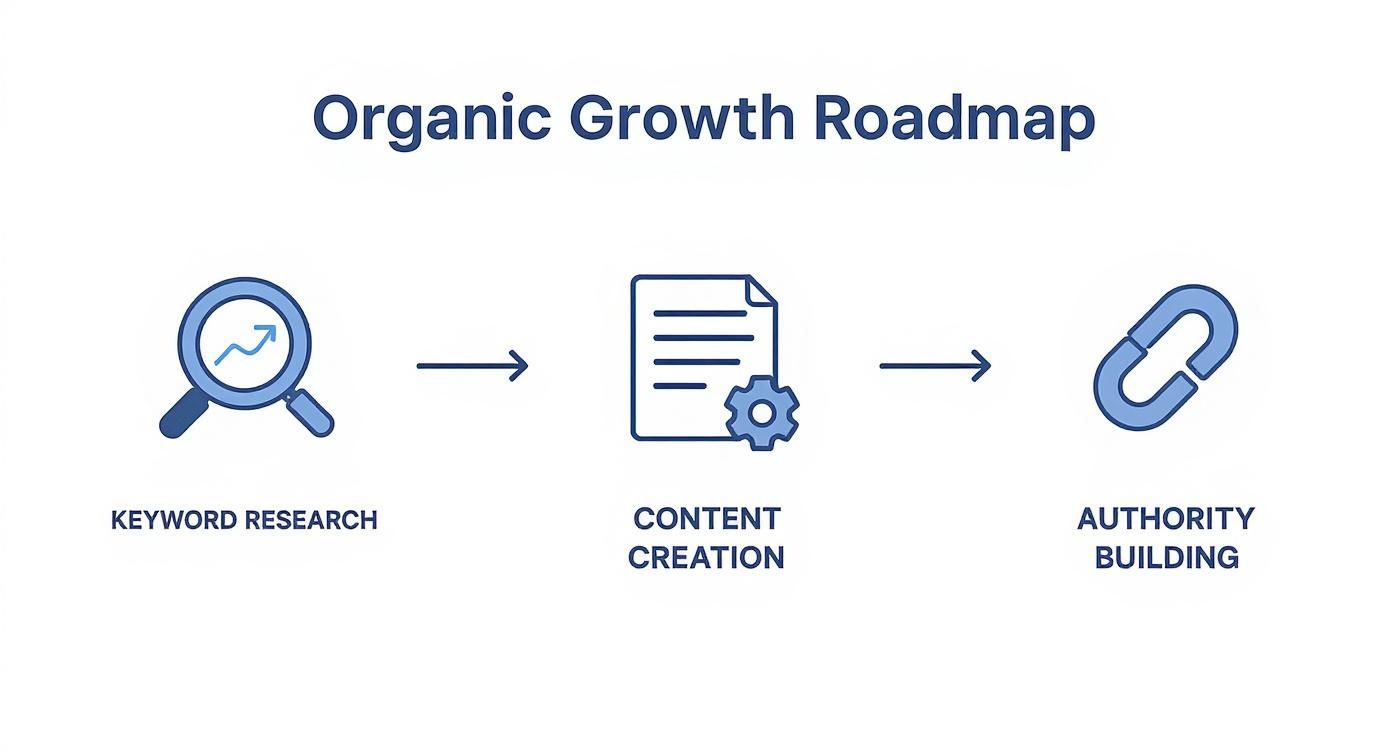
As you can see, it all begins with understanding your audience and ends with establishing your website as a go-to resource in your niche. In the rest of this guide, we'll dive deep into each of these areas with actionable steps you can start using today.
Finding Keywords That Actually Drive Traffic

Most SEO strategies start and stop with chasing high-volume keywords. It's a classic mistake, but I get it. Big numbers look impressive. The problem is, that's only half the story.
To actually grow your organic traffic in a meaningful way, you have to look past the raw search volume and get inside the head of the searcher. What problem are they trying to solve? What question are they dying to have answered? That’s where the real gold is.
Think about a term like "CRM software." It gets a ton of searches, sure, but the intent behind it is all over the place. Is it a student writing a paper? A Fortune 500 company comparing enterprise vendors? A small business owner who just heard the acronym for the first time? Targeting that keyword is like shouting into a hurricane and hoping the right person hears you.
Now, consider a more specific phrase—a long-tail keyword—like "best CRM for small real estate teams." The search volume is tiny in comparison, but the person typing that into Google has a crystal-clear need. Attracting that visitor is infinitely more valuable because you’re offering the perfect solution to their exact problem.
Moving Beyond the Obvious Keywords
I've found that the most valuable traffic often comes from long-tail keywords your competitors are completely ignoring. These are the detailed, conversational queries that signal a user is much closer to making a decision. The trick is knowing how to uncover these gems systematically.
Let's say we're working with a B2B software company that sells project management tools for creative agencies. Their obvious target keyword would be "project management software," which is an absolute bloodbath in terms of competition. Instead of trying to win that impossible fight, they can dig deeper.
Your goal isn't just to find keywords; it's to map out the entire user journey. You want to capture attention at the 'I have a problem' stage all the way through to the 'I need this specific solution' stage.
One of my favorite places to start this discovery process is right inside Google's search results. Seriously. Type in a broad industry term and scroll down to the "People Also Ask" (PAA) box. These are the literal questions your audience is asking.
For our software company, the PAA section for "project management software" might reveal questions like:
- How do creative agencies track client feedback?
- What is the best way to manage multiple design projects?
- Is Asana or Trello better for marketing teams?
Boom. Each of these questions is a potential long-tail keyword and a fantastic topic for a blog post. They speak directly to the pain points of their ideal customer.
A Practical Framework for Keyword Discovery
To turn these ideas into a real strategy, you need a repeatable process. This usually involves using a good SEO tool to validate your ideas and find opportunities your competitors have slept on. Running a competitive analysis is a fantastic starting point; our guide on https://frozencrow.com/how-to-conduct-competitive-analysis/ can walk you through that process step-by-step.
Here's a simple workflow I use, often with a tool like Ahrefs:
- Hunt for Competitor Gaps: Don't just see what keywords your competitors rank for. Look for the keywords they don't rank for, but you could. Use a content gap tool to plug in your domain and a few of your rivals. It will spit out a list of queries they're ranking for that you aren't, giving you a clear list of targets.
- Hang Out in Online Forums: Go to where your audience lives. Search for your topic on sites like Reddit, Quora, or niche industry forums. The raw, unfiltered language people use here is a goldmine for long-tail keywords. You'll find their biggest challenges laid bare.
- Play with Keyword Modifiers: Start with a core "seed" keyword (e.g., "project management tool") and start tacking on modifiers. Think questions (how, what, why), comparisons (vs, alternative), or qualifiers (for small business, for agencies).
This methodical approach helps you build a keyword list that attracts the right kind of attention. It’s not just theory—data shows that 69% of all search traffic comes from these specific, long-tail keywords. And since around 70% of clicks go to the top five results, ranking for these less competitive terms gives you a much better shot at actually getting seen.
Turning Your Research into Action
Once you've got your list, the final step is to bring some order to the chaos. Group your keywords into "clusters" around a central topic. This is how you build topical authority and signal to Google that you're an expert on a subject.
For our B2B software example, they might build a "pillar" page on "Project Management for Creative Agencies." This core page would then link out to more specific "cluster" articles targeting the long-tail keywords they found, like "How to Track Client Feedback" and "Managing Multiple Design Projects." To take this even further, a great Competitive Intelligence Tools Overview can reveal broader market trends you can tap into.
This interconnected content structure isn't just great for SEO—it serves your audience better by guiding them to the exact answers they need.
Creating Content That Ranks and Converts

Alright, you've got your keywords. Now comes the part where most businesses stumble: creating content that actually does something. It's not enough to just publish a blog post and hope it hits the SEO jackpot. That’s a lottery ticket, not a strategy.
The real goal is to create content that serves your audience so incredibly well that Google has no choice but to see you as an authority. To do that, you need to stop thinking in terms of one-off articles and start building topical authority.
Think of it as creating an interconnected web of content around a core topic. This approach tells search engines that you have deep, meaningful expertise, which helps all your related pages rank higher and pull in more organic search traffic.
Build Authority with Content Clusters
Your blog shouldn't be a random collection of articles; it should be a well-organized library. In a library, you have main sections and then more specific books within each one. A content cluster strategy works exactly the same way.
You start with a "pillar page." This is a massive, comprehensive guide that covers a broad topic from every angle. Then, you create shorter, more focused "cluster" articles that dive deep into the subtopics mentioned on your pillar page.
Here’s what that looks like in practice:
- Pillar Page: The Ultimate Guide to Project Management for Small Businesses
- Cluster Content: How to Choose the Right Project Management Software
- Cluster Content: 5 Time-Tracking Tips That Actually Work for Remote Teams
- Cluster Content: Mastering Client Communication: A Step-by-Step Guide
Every cluster post links back to the main pillar page. This creates a clean, logical site structure that search engines can easily understand. But more importantly, it gives your visitors a great experience, letting them seamlessly move from a broad overview to the specific answers they need.
The Anatomy of a High-Ranking Article
Writing a huge pillar page or a detailed cluster post isn't just about word count. The structure and on-page elements are what make or break its performance, both for your readers and for Google. A well-organized article is easy to scan, engaging, and simple for search engine crawlers to make sense of.
Here are the non-negotiable components of any page you want to rank:
- A Compelling Title: It has to be click-worthy and include your main keyword. Keep it under 60 characters so it doesn’t get cut off in the search results.
- Strategic Headings (H2s & H3s): Use headings to break your content into logical, bite-sized sections. Sprinkling related keywords into your headings helps Google understand the page's structure and depth.
- Short, Scannable Paragraphs: Nobody wants to read a wall of text. Seriously. Keep your paragraphs to 1-3 sentences maximum. This is critical for mobile users, which is likely a huge chunk of your traffic.
- Visuals, Visuals, Visuals: Break up the text with images, custom infographics, or even embedded videos. Visuals boost engagement and can even help you show up in image and video search results.
- Internal Links: Always link out to other relevant articles on your own site. This simple tactic keeps people on your site longer and spreads "link equity" around, boosting the authority of your other pages.
Every single piece of content you publish needs a clear job. It should answer a specific question, solve a distinct problem, or offer a unique perspective no one else has. That relentless focus on value is what ultimately drives rankings.
The Overlooked Power of Refreshing Old Content
One of the absolute fastest ways to get more organic search traffic is by updating content you've already published. Too many businesses have a "publish and forget" mindset, leaving a goldmine of untapped potential just sitting there.
Content gets stale. Statistics become outdated, links break, and new competitors publish better stuff. By regularly giving your old posts a facelift, you can reclaim lost rankings and often push them even higher than before.
Here's a quick-and-dirty process for a content refresh:
- Find the Low-Hanging Fruit: Dive into Google Search Console and find pages that are stuck on page two or three for valuable keywords. These are perfect candidates.
- Spy on the Winners: Search your target keyword and see what the top-ranking pages are doing. What topics are they covering that you missed? How is their content structured?
- Beef Up Your Post: Add new sections to make your article more comprehensive. Update any old stats, fix broken links, and drop in new images or examples.
- Re-Optimize the Basics: Tweak your title, meta description, and headings to better match what searchers are looking for today.
- Hit Republish and Promote: Change the publication date to the current date and share the updated article everywhere as if it's brand new.
This process sends a strong signal to Google that your content is fresh, relevant, and more valuable than it was before, which often leads to a nice little ranking boost. Creating a framework for these efforts can make a huge difference, and this content marketing strategy template is a great place to start.
When you combine the topical authority model with well-structured articles and a consistent refresh process, you build a powerful, self-reinforcing system for sustainable organic growth.
Technical SEO Wins That Will Actually Move the Needle
Technical SEO has a reputation for being complicated, but honestly, it’s just the invisible stuff holding your traffic back. Think of it like the foundation of your house. You can have the best furniture and paint, but if the foundation is cracked, the whole structure is unstable. That’s technical SEO.
The good news? You don’t need to be a developer to make a real difference. Many of the highest-impact fixes are simply about making it easier for search engines to find, crawl, and understand your content. If Google can't do that efficiently, your best content might as well not exist.
Your first stop should always be Google Search Console. It’s completely free and is basically Google’s way of telling you what it thinks of your site. It flags everything from slow pages to broken links that are quietly killing your rankings.
Prioritize Site Speed and Core Web Vitals
In a world where attention spans are measured in seconds, speed is everything. Google gets this, which is why they made Core Web Vitals a confirmed ranking factor. These aren't just abstract metrics; they measure the real-world user experience of your site, zeroing in on loading speed, interactivity, and visual stability.
A slow site doesn’t just annoy visitors—it actively signals to Google that you’re providing a poor experience. It’s been shown that even a one-second delay in page load time can lead to a 7% drop in conversions. That's a direct hit to your business.
You can find a full report on your Core Web Vitals right inside Google Search Console, which will even list the specific URLs that need work. The usual suspects are:
- Massive, unoptimized images: Always compress your images before uploading them.
- Bloated code: Clunky JavaScript or CSS can bring your site to a crawl.
- Slow server response time: Your choice of web host really matters here.
Fixing these is a direct line to a better user experience and stronger signals to Google. It’s one of the clearest ways to boost your organic traffic.
Make Sure Your Mobile Experience Is Flawless
This isn't a suggestion anymore. Google now uses mobile-first indexing, meaning it primarily looks at the mobile version of your site for indexing and ranking. If your site is amazing on a desktop but a disaster on a phone, your rankings will suffer. Period.
And this goes way beyond a simple responsive design. The mobile experience needs to be fast, easy to use, and fully functional. Think about it from a user's perspective: pop-ups you can't close, tiny buttons you can't tap, and text you have to pinch-and-zoom to read are all instant red flags for a bad mobile experience.
Technical SEO is all about removing friction. Every single barrier you remove for a search engine crawler is also a barrier you’re removing for a real person. When you make your site easier for Google to understand, you almost always make it better for your audience, too.
For those who want unparalleled control over these technical foundations, building a custom CMS is an option. It gives you the ultimate flexibility to fine-tune every part of your site’s performance, from how it renders on mobile to how efficient the code is, ensuring every technical detail aligns perfectly with your SEO goals.
Build a Logical and Crawlable Site Structure
Your site’s architecture—how your pages are organized and linked together—is literally the roadmap you give to search engines. A messy, chaotic structure makes it tough for crawlers to find all your important content. But a clean, logical hierarchy helps Google instantly understand which pages matter most.
The ideal structure looks like a simple pyramid:
- Homepage: The peak.
- Categories/Pillar Pages: The next level down, linked directly from the homepage.
- Sub-categories/Cluster Pages: More focused topics that branch off from the main categories.
- Individual Posts/Pages: The base of the pyramid, all neatly organized under the right sub-category.
This flow is intuitive for both people and search engine bots. A huge part of this is internal linking. When you link from your high-authority pages (like your homepage) to other relevant pages on your site, you pass along "link equity" and show Google how all your content is related. It's a surprisingly powerful way to boost rankings for your key pages.
Building Authority with Smart Link Building
Let's cut through the noise: backlinks are still a massive signal to Google that your content is legit. But the game has completely changed. The old-school approach of blasting out hundreds of low-quality links is dead and buried.
Today, it's a quality-over-quantity world. A single, powerful link from a respected industry site is worth more than a thousand links from spammy directories. This shift is everything if you want to figure out how to increase organic search traffic for the long haul. You're not trying to trick an algorithm anymore; you're earning genuine endorsements from other credible sources.
This means your strategy needs a serious update. Modern link building is about two things: creating stuff people actually want to link to and building real relationships.
Create Linkable Assets First
Before you even dream of sending an outreach email, you have to ask a brutally honest question: "Why would anyone care enough to link to this?" If your content is just a rehash of the top 10 search results, they won’t. Simple as that.
Every great link building campaign starts with a linkable asset. This is a piece of content so valuable that other creators and journalists feel compelled to share it. It becomes a resource for them, making their own work better.
Here are a few types of assets that consistently pull in high-quality backlinks:
- Original Research & Data: Run a survey, analyze your company's internal data, or compile unique industry stats. When you're the source of new information, people have to link to you when they cite it.
- Free Tools & Calculators: A simple tool that solves a nagging problem can be a link magnet. Think of a mortgage calculator on a real estate blog or a simple ROI calculator for a marketing site.
- The Definitive Guide: Create the most comprehensive, detailed, and genuinely helpful resource on a specific topic in your niche. When your guide is clearly the best one out there, it becomes the default reference people link to.
These assets take more work upfront, no doubt. But the payoff is huge—they attract links passively over time and position you as a leader.
The best link building happens when your content is so good that linking to it is a no-brainer. Your asset should make someone else's article better just by being there.
Master the Art of Targeted Outreach
Once you’ve built your incredible asset, it's time to let the right people know it exists. This is where strategic outreach comes in, and it's 100% about building relationships, not begging for links. Forget those generic, mass-emailed templates. They don't work.
Let’s walk through a real-world scenario. Say you run a small e-commerce store selling sustainable pet products, and you just published a groundbreaking study on the environmental impact of common pet foods. That study is your linkable asset.
Here's how you'd approach outreach with surgical precision:
- Find Relevant Prospects: Don't just Google "pet blogs." Instead, look for writers and journalists who have recently covered topics like sustainable living, pet nutrition, or eco-friendly products. Tools like Ahrefs or BuzzStream can show you exactly who is linking to similar articles.
- Find the Right Person: Forget generic "info@" or "contact@" email addresses. You need to find the specific author who wrote the article you found. An individual connection is always more powerful.
- Craft a Personal Email: Your email needs to prove you've done your homework. Reference their recent article, briefly explain why your data study would be valuable to their audience, and make your ask simple and clear.
This method transforms a cold pitch into a genuine value exchange. You're not just asking for a favor; you're offering them a resource that makes their content better. It's a slower, more deliberate process, but it's how you earn the kind of authoritative links that truly move the needle.
Still Have Questions About Organic Traffic? Let's Clear Them Up
Even with the best game plan, you're going to run into questions as you start putting all this into practice. That’s perfectly normal. Let's tackle some of the most common ones I hear, so you can move forward with confidence.
Think of this as our final huddle—a chance to reinforce the core ideas and get you ready for the real-world challenges of SEO.
How Long Until I Actually See Results?
This is the big one, and the only honest answer is: it depends. SEO is a marathon, not a sprint. Generally, you can expect to see some real movement and early wins within three to six months of consistent work.
But that timeline can shift based on a few key things:
- Your Starting Point: An established website with some authority and a healthy backlink profile will get traction much faster than a brand-new domain starting from scratch.
- The Competition: Trying to rank for a term like "credit cards"? That’s going to take a lot longer than ranking in a smaller, more niche market.
- Your Hustle: The speed of your results is tied directly to how consistently you’re publishing great content, earning links, and fixing technical hiccups.
Patience is probably the most underrated skill in SEO. The strategies that build lasting, sustainable growth don't create flashy, overnight spikes. They build a foundation that pays off for years. Trust the process, and the traffic will come.
What's More Important: Content or Backlinks?
This is like asking what’s more important for a car—the engine or the wheels? You can’t get anywhere without both.
Incredible content with no backlinks is like a billboard in the desert. It might be amazing, but no one will ever see it because it lacks the authority signals Google needs to trust it.
On the flip side, a bunch of backlinks pointing to mediocre, unhelpful content is just as useless. People will land on your page, hit the back button, and signal to Google that your result isn't a good one.
The two work together in a powerful loop: amazing content naturally earns quality backlinks, and those backlinks help more people discover your amazing content.
Should I Bother with International SEO?
Expanding your reach globally can be a massive lever for growing organic traffic, especially as the world gets more connected. But international SEO isn't just about translating your pages. It’s about true localization—understanding cultural quirks, different search habits, and language preferences.
For example, a staggering 75% of users prefer to buy products in their native language. It's not surprising that websites investing in proper SEO localization have seen traffic jump by as much as 70% in a single year. You can read more about these findings and see just how powerful geo-targeting can be.
A great place to start is in your Google Analytics. If you're already seeing a solid chunk of traffic from a non-English-speaking country, that’s your sign. It’s a clear signal that it's time to create content specifically for that audience. It’s a smart way to tap into a whole new market that’s already looking for what you offer.
At Frozen Crow Inc., we turn these strategies into measurable results. If you're ready to stop guessing and start growing, let's build a data-driven plan to systematically increase your organic traffic. https://frozencrow.com


