


October 13, 2026
How to Improve Click Through Rate with Proven Strategies
Before we dive into tweaking headlines and ad creative, let's get one thing straight: your click-through rate (CTR) is more than just another number on your dashboard. It’s a direct pulse on how well your message is resonating. A high CTR tells you you've hit the mark—that you’re connecting with what people actually want.
This single metric echoes across all your marketing channels. In Google Ads, a solid CTR directly fuels your Quality Score. A better score means lower ad costs and better placements. It’s that simple. For SEO, a CTR that beats the average can signal to search engines that your result is the best answer for a query, which can give your rankings a nice little bump over time.
Why Your Click-Through Rate is the Ultimate Gut Check
To actually improve your CTR, you need to know what a "good" one even looks like. Benchmarks are all over the place because they depend entirely on the channel, your industry, and what a user is trying to do. Someone actively searching for a product on Google is obviously far more likely to click than someone idly scrolling through their Instagram feed.
This is where looking at industry data gives you a much-needed reality check. It helps you set goals that are ambitious but not delusional.
A high CTR is fundamentally a measure of trust. It means your audience trusts that clicking your link will actually deliver on the promise you made in your headline or ad.
What Does "Good" Actually Look Like?
Knowing the averages helps you spot your biggest opportunities right away. If your paid search CTR is in the gutter, that’s a flashing red light telling you to fix your ad copy or keyword targeting.
Here's a quick rundown of what to aim for:
- Google Search Ads: A good CTR is usually in the 4-6% range. If you're hitting 8% or more, you're crushing it.
- Social Media Ads (Facebook/Instagram): The average tends to be around 1-2%, but top-tier campaigns can push past 2.5%.
- Display Ads: These are naturally lower. Consider 0.5-1% good, and anything over 1.5% is exceptional.
Cross-Channel CTR Benchmarks at a Glance
This table gives you a quick reference for average vs. exceptional CTRs across the major digital marketing channels. Use it to help set realistic goals for your own campaigns.
| Channel | Good CTR (%) | Exceptional CTR (%) | Key Optimization Lever |
|---|---|---|---|
| SEO (Organic Search) | 3-5 | 7+ | Title Tags & Meta Descriptions |
| Paid Search (Google) | 4-6 | 8+ | Ad Copy & Keyword Relevance |
| Display Ads | 0.5-1 | 1.5+ | Creative & Audience Targeting |
| Social Media Ads | 1-2 | 2.5+ | Creative & Audience Targeting |
| Email Marketing | 15-25 | 30+ | Subject Lines & Personalization |
Think of these numbers as your starting point. They're not rigid rules, but they provide the context you need to measure your own performance and identify which channels need the most attention.
Recent data shows the average Google Ads CTR climbed to 6.66% in 2025, with some highly optimized campaigns seeing their CTRs jump by a massive 40%. You can explore more benchmarks and what they mean for your strategy. This is how you move from just guessing to making smart, data-backed decisions that actually move the needle.
Finding Your Biggest CTR Opportunities
Before you can fix anything, you have to know what's broken. The fastest way to stop guessing and start making smart moves is with a systematic audit. Our goal is simple: find the assets that are getting seen but not getting clicked.
This means digging into your analytics to find the biggest gaps between impressions and clicks. For organic search, we're hunting for a page that ranks on the first page of Google but has a dismal CTR. For paid ads, we're flagging ad groups that burn cash on impressions but fail to get that all-important click.
This whole process really boils down to three stages: analyze, optimize, and then build trust.
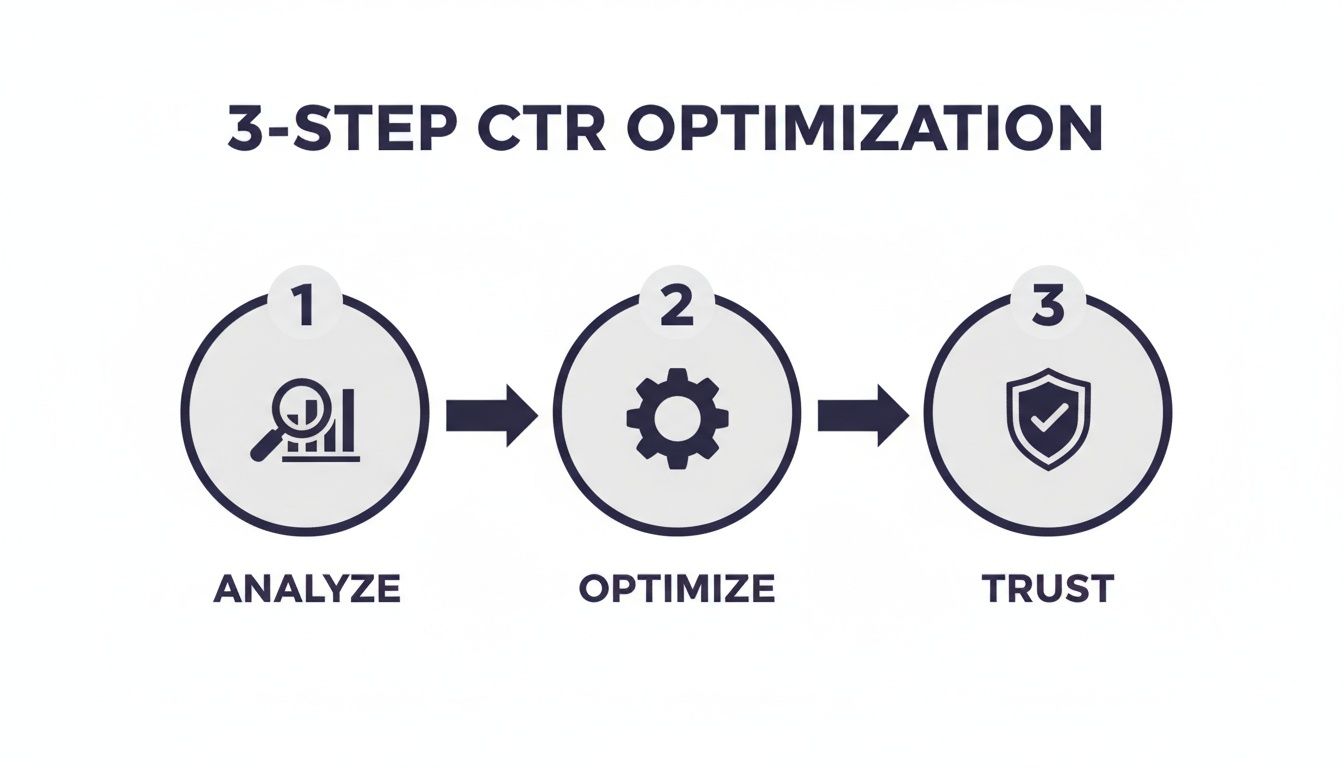
Moving from analysis to action isn’t just a technical checklist. It's how you start building a stronger connection with your audience—by giving them what they actually want to click on.
Uncovering SEO Low-Hanging Fruit
For any organic CTR audit, your best friend is Google Search Console (GSC). It's a free tool that shows you exactly how your site performs in search, and it gives us the two metrics that matter most for this job: total impressions and average CTR.
Your mission, should you choose to accept it, is to find pages with tons of impressions but a below-average click-through rate. This combo is a dead giveaway of a weak title tag or a boring meta description. Google thinks the page is relevant enough to show people, but the snippet in the search results just isn't doing its job.
Here’s a quick-and-dirty way to find these opportunities:
- In Google Search Console, head to the "Performance" report.
- Click the "Pages" tab to see data for individual URLs.
- Filter for pages with a high number of impressions (say, over 1,000 in the last 90 days).
- Now, sort the results by CTR from lowest to highest.
The pages that bubble up to the top of this list are pure gold. A blog post with 50,000 impressions but a 0.8% CTR is a massive opportunity just sitting there.
Pro Tip: Always prioritize pages with high impressions. A tiny CTR bump on a page getting tons of visibility will drive way more traffic than a huge increase on a page nobody ever sees. Focus your effort where it counts.
Auditing Your Paid Ad Campaigns
The same logic applies to your paid campaigns, whether you're on Google Ads or running social ads. The big difference here is that every wasted impression costs you cold, hard cash and tanks your campaign's performance metrics. We're hunting for ads or ad groups with terrible engagement.
For paid search, drill down into your keyword-level data in Google Ads. You’re looking for keywords that have a solid impression share but a lousy CTR. This almost always points to a disconnect between what the user searched for and what your ad copy says.
Think about it. Someone searching for “buy running shoes for flat feet” has a very specific, high-intent need. If your ad copy is a generic “Quality Running Shoes for Sale,” you’ve completely missed the mark. That's why the CTR is low. A simple tweak to “Shop Running Shoes Designed for Flat Feet” could change everything.
Here’s what to look for in your ad accounts:
- Low CTR Keywords: Pinpoint keywords where the ad copy clearly isn't resonating.
- Underperforming Ad Variants: In an A/B test, you have a winner and a loser. Find the loser and figure out why it's failing.
- Audience Mismatches: Is a specific audience segment ignoring your ads? It might be time to refine your targeting or your creative.
Once you’re done with this audit, you should have a clear, prioritized list. This isn't just a random to-do list; it’s your strategic roadmap. It tells you exactly which headlines, meta descriptions, and ad copy to rewrite for the biggest, fastest impact on your traffic.
Writing Copy That Demands a Click

Let’s be honest, at the heart of every single click is a message that connected with a real person. Your copy—whether it's a headline, a meta description, or the text in a display ad—is the engine that drives your CTR. It’s where you make a promise, and if that promise is compelling enough, you earn that click.
Good copy isn't about using fancy words. It’s about getting inside a user’s head and speaking directly to their needs, their fears, or just their curiosity. You’ve got maybe three seconds to convince someone your link is the best possible answer to their problem. That’s it.
To get this right, you have to understand that what we're doing here is persuasion. It's not just about describing something; it's about motivating action. If you really want to move the needle on your CTR, you need to master the nuances of copywriting.
Crafting Headlines That Hook the User
Your headline is everything. On a crowded search results page or a noisy social feed, it does 80% of the heavy lifting. If the headline bombs, the rest of your content might as well not exist, because no one is going to see it.
Think about it. A headline like "Our New Software" is DOA. It's forgettable and tells the user nothing about why they should care.
Now, what if we tried something like, "Finally, a CRM That Won't Make You Hate Mondays." See the difference? That one connects on an emotional level because it hits a very real pain point.
Here are a few proven ways to write headlines that actually get noticed:
- Use Numbers: Our brains love numbers. They suggest something tangible and organized, and time and time again, headlines with numbers just get more engagement.
- Lean on Emotional Triggers: Words that stir up a feeling—good or bad—are incredibly powerful. Think "Proven," "Effortless," "Secret," or even "Warning." They stop the scroll.
- Ask a Question: A good question makes someone pause and think. It creates a little bit of intrigue that they feel a need to resolve… by clicking.
A headline should be a micro-advertisement for your content. Its only job is to get that initial click. Don't try to summarize everything; your goal is to spark enough curiosity to get them to the next step.
Transforming Meta Descriptions into Mini-Ads
Your meta description is your sales pitch on Google. Way too many people treat it like an afterthought, either just summarizing the page or, even worse, letting Google pull a random snippet. This is a massive missed opportunity to win the click.
A great meta description builds on the promise your headline made and gives the searcher a clear reason to pick your link over the nine others staring back at them. It needs to be short, focused on the benefit, and have a clear (even if subtle) call to click.
Let's look at a page about financial planning for young professionals.
- Boring Meta: This article discusses financial planning. We cover topics like budgeting, investing, and retirement savings.
- Compelling Meta: Take control of your financial future. Our step-by-step guide shows you how to budget smarter, invest with confidence, and retire early. Start building wealth today.
The second one is active, speaks directly to a goal ("retire early"), and ends with a clear, empowering action. That's the one that gets the click.
Writing Ad Copy That Speaks to Pain Points
When you're paying for placement, your copy has to be even sharper. Every single word needs to earn its spot. The key here is to stop listing features and start talking about the transformation you provide.
Nobody buys a drill because they want a drill; they buy it because they want a hole.
Your ad copy needs to be about the "hole." What's the problem they're trying to solve? What frustration are they trying to escape?
For instance, if you're selling project management software, don't just say it has "Gantt charts and task dependencies." Talk about the outcome: "Stop missing deadlines and wrangling chaotic projects. Get your team aligned and deliver on time, every time." This hits the user's pain point head-on and offers the cure.
This is where you guide them to the finish line. Your copy should lead right into a clear directive, because a strong call-to-action is the final nudge they need. To dive deeper on this, check out our guide on what is a call to action and how to write ones that actually convert.
Advanced Targeting and Technical SEO Boosts
Killer copy is only half the battle. If it doesn't reach the right people, it might as well not exist. Once you've nailed your headlines and descriptions, it's time to start pulling the technical levers that can have a massive impact on who clicks and why. This is about getting surgical with your audience and completely changing how your website shows up in search.

For paid ads, that means diving deep into audience segments. On the organic side of the house, it’s all about giving search engines the structured information they crave so they can feature your content in much more eye-catching ways.
Precision Targeting in Paid Campaigns
Blasting a generic ad to a massive, undefined audience is a surefire way to torch your budget and get a pathetic CTR. The real key to moving the needle is layering advanced targeting methods to make sure your message is hyper-relevant to every single person who sees it. When the ad perfectly syncs up with a user's intent, the click just feels like the obvious next step.
You have to move beyond basic demographics. It’s all about intent and behavior now.
- Lookalike Audiences: This is a game-changer. You can upload a list of your absolute best customers, and the ad platform's algorithm will go out and find new people who share their characteristics. It’s one of the most effective ways to find a highly qualified audience at scale.
- In-Market Segments: Why not target people who are already shopping for what you sell? Google and other platforms know when users are actively researching products or services like yours, letting you get in front of people with their wallets out.
- Strategic Remarketing: Don’t just throw the same ad at everyone who’s ever visited your site. Get granular. Create specific lists for "cart abandoners" or "users who viewed X product category," then hit them with tailored copy that speaks directly to their last action.
These methods all fall under the umbrella of behavioral targeting—a strategy that uses real user data to serve up more relevant ads. By focusing on what people do, you align your ads with their immediate needs. Our complete guide goes deeper into what behavioral targeting is and how to put it to work.
Winning the Click with Structured Data
When it comes to organic search, one of your most powerful weapons for boosting CTR is structured data, often called schema markup. Think of it as a special code you add to your website's HTML that translates your content for search engines. When Google truly understands your page, it often rewards you with rich snippets.
Rich snippets are those jazzed-up, visually enhanced search results that can include:
- Star ratings for products or reviews
- Pricing and availability info
- FAQ accordions that users can open right in the search results
- Event dates and locations
These little additions make your listing pop. They make it instantly more useful and trustworthy, helping it stand out from a boring sea of plain blue links. A search result with a five-star rating is just fundamentally more compelling than one without—even if it ranks a spot or two lower.
A recent analysis of Google's search landscape revealed surprising CTR shifts. In Q3 2025, websites in positions 2-6 for branded searches saw a combined 8.71 percentage point boost in CTR, driven by a 49.25% surge in search demand. This shows that non-top positions can still win big, especially when enhanced with features like rich snippets that capture attention.
Real-World Example: A Local Business Schema
Imagine a local bakery trying to get more online orders. By adding LocalBusiness and Review schema to their site, their Google search result can completely transform. Suddenly, it's showing off their average star rating and their business hours right on the SERP.
This one technical tweak accomplishes two huge things. First, it builds instant social proof and trust. Second, it answers critical questions before the user even has to click, which means the traffic you do get is far more qualified. The person who clicks already knows the bakery is well-rated and open for business, making them a much warmer lead.
The same ideas that drive clicks on the web work on other platforms, too. For example, just as great copy is critical for web CTR, understanding App Store Optimization (ASO) is the equivalent for mobile apps, where you optimize listings to get more people to tap that "Install" button. No matter the channel, giving people clear, relevant information upfront is how you earn the click.
Building a System for Continuous Improvement
Boosting your click-through rate isn't about one-off tweaks or lucky guesses. Real, sustainable growth comes from building a disciplined system for testing, every single time. It's about shifting your mindset from "I think this will work" to "The data proves this works."
Every change to your copy, creative, and targeting needs to be validated.
This all starts with a strong hypothesis. A weak hypothesis is just a guess, like, "Maybe changing the button color will get more clicks." It's vague. A strong one, on the other hand, is specific, measurable, and tied directly to an outcome you want.
For example, a solid hypothesis looks like this: "Adding a specific benefit like 'Free Next-Day Shipping' to our ad headline will increase clicks from qualified users by 15% because it directly addresses a top purchase consideration." Now you have a clear benchmark to measure against.
Establishing a Testing Framework
Before you jump in and start changing things, you need a process. A good framework ensures your experiments are organized, prioritized, and actually produce results you can trust. It’s how you learn from both your wins and your losses, building a library of what truly resonates with your audience.
Your framework should cover a few key areas:
- A Prioritization Model: Let's be real—you can't test everything at once. Focus your efforts by prioritizing tests based on potential impact (how much traffic does this page get?) and how easy it is to implement (can you change a headline in five minutes, or does it need a developer?).
- Clear Success Metrics: Define what a "win" looks like before you start. Is it a higher CTR? A lower bounce rate on the landing page? Get specific.
- Simple Documentation: Keep a log of every experiment. You'll want to track the hypothesis, the change you made, the results, and what you learned from it.
A systematic testing process transforms marketing from an art into a science. Every test, whether it succeeds or fails, provides a valuable insight that makes your next move smarter.
This systematic approach has never been more critical. Just look at the rise of AI Overviews (AIOs), which have completely upended the SERPs. In September 2025, queries with AIOs saw organic CTR plummet to a shocking 0.61%.
But smart, strategic testing reveals a way forward. Data shows that simple tweaks, like using larger CTA buttons, can boost clicks by a massive 90%. And button-shaped CTAs consistently outperform text links by 45%. This is proof that you can reclaim engagement by methodically testing every visual and copy element. You can discover more insights on AIO impact from Seer Interactive.
Choosing Your Tools and Ensuring Significance
You don't need a huge budget to start testing. Most of the platforms you already use have built-in A/B testing features, like Google Ads and pretty much every major email marketing service. For changes to your website, tools like VWO are great options.
The most important feature of any tool is its ability to measure statistical significance. This is just a mathematical way of confirming your results were due to the change you made, not just random chance. Aim for a confidence level of 95% or higher—that's the industry standard for declaring a clear winner. For a deep dive into the methodology, our article explaining what A/B testing in marketing is is a great place to start.
Sample A/B Testing Plan
To help you stay organized, here's a simple template you can adapt for your own testing log. This table turns random ideas into a structured, repeatable process for improving your CTR.
| Test Idea | Hypothesis | Channel/Asset | Metric (KPI) | Status |
|---|---|---|---|---|
| Use Question in Title Tag | Asking a question will increase curiosity and boost organic CTR by 10%. | SEO / Blog Post | Organic CTR | Running |
| Add Urgency to Ad Copy | Using "Limited Time Offer" in ad copy will lift paid search CTR by 20%. | Google Ads / Ad Group | Ad CTR | Complete – Winner |
| Test Button vs. Text CTA | A button-style CTA will outperform a plain text link in the email body. | Email / Newsletter | Email CTR | Complete – Winner |
| Change Hero Image | A lifestyle image will get more clicks than a product-focused one. | Social Ad / Facebook | Ad CTR | Inconclusive |
Keeping a simple log like this is how you turn one-off tactics into a long-term strategy. This is how you systematically learn what works and build a real engine for growth.
Common Questions About Improving CTR
Even with the best strategy in place, a few common questions always seem to pop up once you start digging into CTR optimization. Let's run through a few of the most frequent hurdles and clear them up so you can keep moving forward.
How Long Until I See CTR Improvements?
This really depends on the channel you're working in.
With paid channels like Google Ads or Facebook Ads, the feedback loop is incredibly fast. You can launch an A/B test on your ad copy or creative and often see a meaningful impact on your CTR within a few days to a week. The main requirement is just having enough traffic to get statistically significant results.
Organic search is a different beast altogether. When you update things like meta titles and descriptions, you have to wait for Google to get around to re-crawling your pages. Only then will those changes show up in the search results and start to affect your organic CTR. This can take several weeks. SEO is a long game, so patience is absolutely critical. Focus on making small, consistent, data-backed tweaks over time.
A high CTR from the wrong audience is just a vanity metric. If those clicks never lead to conversions, you're essentially paying for traffic that doesn't contribute to your business goals. Always analyze CTR alongside your conversion rates and cost per acquisition.
Can a High CTR Ever Be a Bad Thing?
You bet. A high CTR can be incredibly misleading if it's not pulling in the right people.
Think about it: you could have an ad with a phenomenal click-through rate but a conversion rate that's flatlining at zero. All that means is you’re paying for clicks that don't generate a single dime of value.
This usually happens when your ad copy is way too broad, uses clickbait language, or makes a promise that the landing page can't deliver on. The goal isn't just getting clicks; it's getting clicks from a qualified audience that is actually likely to become a customer.
What Is a Simple, High-Impact Change I Can Make Today?
If you want the biggest bang for your buck, go straight to your Google Search Console data. It’s a goldmine.
Pull up a report of your pages with the highest impressions but the lowest CTR. These are the pages that Google already likes and is showing to people, but your snippet isn't compelling enough to earn the click.
Here’s your action plan:
- Tweak the Title: Add numbers, brackets, or compelling words like "Proven," "Step-by-Step," or "Ultimate" to your title tags.
- Refine the Description: Make sure your meta description clearly states a benefit and includes a soft call-to-action, like "Discover how…" or "Explore the complete guide."
This is a high-leverage move that can produce real results without needing any developers or complex tools.
At Frozen Crow Inc., we turn data-driven insights into measurable growth. If you're ready to move beyond guesswork and build a systematic approach to improving your CTR and conversions, explore our strategic digital marketing services at https://frozencrow.com.


