


August 20, 2026
How to Generate SEO Leads: Proven Strategies to Boost Your Results
If you're trying to generate leads with SEO, your focus needs to shift. It's not about chasing traffic anymore; it’s about attracting people who are actually ready to buy.
This means you have to create content that solves a very specific problem for your ideal customer. From there, you optimize your website to turn that highly-targeted traffic into real business opportunities. It's a fundamental pivot—away from vanity metrics and toward measurable growth.
Why Most SEO Lead Strategies Fail
Let's be blunt. Getting people to your website is the easy part. The real challenge, where most businesses get stuck, is turning those visitors into paying customers.
Too many SEO campaigns get trapped in a cycle of celebrating high traffic numbers or top keyword rankings, while the sales pipeline stays frustratingly empty. This happens when the strategy is built on a shaky foundation that prioritizes clicks over actual conversions.
The core issue is a total disconnect between the SEO work and the business's bottom-line goals. Sure, ranking #1 for a blog post feels like a win. But if that post only attracts an audience with zero interest in buying, it generates absolutely no business value. This is the classic "vanity metrics" trap, and it’s a costly one.
The Shift to a Conversion-First Mindset
A successful SEO lead generation strategy demands a different way of thinking. You have to stop asking, "How can we get more traffic?" and start asking, "How can we attract the right traffic and make it easy for them to take action?"
This change means every single piece of content, every on-page tweak, and every technical fix must serve one ultimate purpose: generating a lead. For a deeper dive into the mechanics, understanding what search engine optimization is provides the crucial context you need to build a strategy that’s actually tied to your business objectives.
The real measure of success isn't your rank on Google; it's the number of qualified leads entering your sales funnel. Every other metric is just a stepping stone toward that goal.
So, how do we build a system that works? This guide breaks it down into three core pillars of a modern, effective SEO lead generation strategy:
- High-Intent Content Creation: This is about moving past generic blog posts and creating assets that speak directly to the pain points of potential buyers.
- Conversion-Focused Optimization: We’ll look at how to design your website experience to seamlessly guide visitors from discovery to action.
- Smart Automation: You'll see how to use technology to nurture prospects and scale your efforts without burning out your team.
Master these three areas, and you can build a sustainable engine that doesn't just drive clicks—it consistently delivers qualified leads ready for a sales conversation.
To put it all together, here’s a quick overview of how these pieces fit into a cohesive strategy.
Core Pillars of a Modern SEO Lead Generation Strategy
This table summarizes the essential components and their primary goals in generating qualified SEO leads.
| Pillar | Primary Goal | Key Tactics |
|---|---|---|
| High-Intent Content | Attract visitors who are actively looking for a solution. | Bottom-of-funnel keyword targeting, case studies, comparison pages, service-specific articles. |
| Conversion Optimization | Make it easy and compelling for visitors to become leads. | Clear calls-to-action (CTAs), lead magnets, simple forms, trust signals (reviews, testimonials). |
| Technical & On-Page SEO | Ensure search engines can find and understand your content. | Site speed optimization, mobile-friendliness, structured data, internal linking. |
| Nurturing & Automation | Guide prospects through the sales funnel efficiently. | Email sequences, remarketing ads, CRM integration, lead scoring. |
By focusing on these four pillars, you create a holistic system where each part supports the others, turning your website into a reliable lead-generation machine.
Building a Content Engine That Actually Attracts Buyers

Here's a hard truth: generic content attracts a generic audience—if it attracts anyone at all. To generate real SEO leads, you need to build a content engine that acts as a magnet for your ideal buyers, pulling them in by solving their most pressing problems.
This means you have to stop chasing keywords and start creating strategic assets. The goal isn't just to get clicks; it's to create content that actively qualifies your audience at every step of their journey.
The first move is to dig deeper with your audience research. Don't just ask, "what are they searching for?" Instead, ask, "what problem are they desperately trying to solve with that search?" This one shift in perspective is what separates traffic-generating blogs from lead-generating machines.
For example, someone in the early stages might search for "how to improve warehouse efficiency." A generic blog post will get you traffic, sure. But a downloadable guide titled, "The SMB's Ultimate Guide to Warehouse Automation," speaks directly to a specific buyer with a serious problem. That’s a lead magnet.
Mapping Your Content to Buyer Intent
You wouldn't propose on a first date, right? The same logic applies here. You can't shove a product demo in front of someone who is just starting to figure out what their problem even is. Aligning your content with their intent is absolutely crucial for guiding them from "just looking" to "ready to buy."
Here’s a practical way to think about it:
-
Awareness Stage (They have a problem): At this point, your prospects feel the pain but don't know the solution. Your job is to educate, not sell.
- What to create: In-depth blog posts, checklists, educational articles, and sharp infographics.
- Real-world example: A software company could publish a post on "7 Signs Your Manual Inventory System Is Costing You Money."
-
Consideration Stage (They're looking for solutions): Now they get it. They understand the problem and are actively hunting for the best way to solve it.
- What to create: Detailed case studies, comparison guides, webinar recordings, and insightful whitepapers.
- Real-world example: That same company could follow up with a case study showing how a similar business cut operational costs by 20% using their software.
-
Decision Stage (They're ready to buy): The prospect is narrowing down their options and is about to make a choice. Your content needs to build trust and make it obvious why you're the best option.
- What to create: Free trials, live demos, clear pricing pages, and detailed service breakdowns.
From Good Idea to Solid Execution
The data backs this up. Heading into 2025, around 72% of companies say content marketing directly increases their lead count. And get this—businesses that publish at least 16 blog posts per month generate 4.5 times more leads than those publishing less frequently. Consistency and strategy are a powerful combination.
Key Takeaway: Stop writing for everyone. Start creating targeted assets for your ideal buyers. A single, high-value case study that converts one decision-maker is infinitely more valuable than a fluffy blog post that attracts thousands of uninterested readers.
This targeted approach doesn't just pull in better SEO leads; it builds a stronger foundation for your entire digital presence. Once you have this engine running, you'll need to get the right eyes on your content. Our guide on how to increase website traffic offers practical strategies that pair perfectly with a solid content plan.
Of course, leads are just one part of the equation. If you’re thinking about the bigger picture, check out this Ultimate Guide to Driving Traffic and Earning an Income through Blogging. It’s a great resource for connecting your content efforts to real revenue.
Turning Your Website Into a Conversion Machine

Getting high-intent visitors to your site is a huge win. But it's only half the battle.
If your website drops the ball, all that hard-earned traffic vanishes. This is where we stop focusing on just attracting an audience and start obsessing over converting them. It’s how you turn a digital brochure into an actual lead-generation powerhouse.
This whole process is called conversion rate optimization (CRO). In simple terms, it's about tweaking your site’s user experience (UX) to gently guide visitors toward taking a specific action.
And it starts before they even click. Your title tags and meta descriptions shouldn't just aim to rank; they need to sell the click to the right person.
A title like "Our Marketing Services" is lazy. Something like "Data-Driven Marketing Services That Boost ROI," on the other hand, promises a real outcome. It qualifies the visitor before they even land on your page.
Making that First Impression Count
Once someone arrives, you have just a few seconds to prove they’re in the right place. Nothing sends a potential lead running faster than a slow-loading page.
It’s not a minor issue. We’ve seen that even a one-second delay in page load time can slash conversions by up to 7%.
Just as critical is your mobile experience. Over half of all web traffic now comes from mobile devices, so a clunky, hard-to-navigate mobile site isn’t just an annoyance—it's a direct roadblock to getting SEO leads. Your forms, buttons, and text have to be dead simple to use on a small screen.
Key Insight: Your website’s speed and mobile design aren't just technical SEO boxes to tick. They are the foundation of the user experience and directly dictate your ability to turn a visitor into a paying customer.
Guiding Visitors to Take Action
A well-designed site should feel like a guided tour, not a maze. Every page, especially your key landing pages, needs one clear purpose and one compelling call-to-action (CTA).
Here are the non-negotiables for a page that actually converts:
- A Crystal-Clear Call-to-Action: Ditch passive words like "Submit." Use action-focused language like "Get Your Free Audit" and make the button pop with a contrasting color.
- Frictionless Forms: Stop asking for everything at once. A form with ten fields feels like an interrogation. One with three fields feels like a simple request. Only ask for what you absolutely need to start the conversation.
- Strategic Landing Pages: Never send targeted traffic from a specific ad or social post to your generic homepage. Build dedicated landing pages that perfectly match the user's intent, strip out all distractions, and focus entirely on that single conversion goal.
Think of it this way: if your content is the magnet pulling prospects in, your website's design is the machine that actually captures them. Without a smooth, fast, and intuitive experience, even the most qualified traffic will bounce, leaving you with great vanity metrics but an empty sales pipeline.
Using Automation to Scale Your Lead Generation
Trying to manually track and nurture every single prospect is a fast track to burnout. It just doesn't scale. As your lead volume grows, you need a smarter way to handle follow-up without letting good opportunities die on the vine. This is exactly where marketing automation becomes your secret weapon.
Instead of trying to be everywhere at once, automation lets you build systems that work for you around the clock. You can set up workflows that deliver the right message at the right time, guiding prospects with helpful content until they're actually ready to talk. This frees you up to focus on the big picture—strategy and closing deals.
The concept is simple: let software handle the repetitive, time-consuming tasks that turn a curious visitor into a qualified lead.
Let AI Pinpoint Your Best Leads
One of the best uses of modern tech is lead scoring. Let's be honest, not all leads are created equal. Some are just browsing, while others are a hair's breadth away from a buying decision. AI-powered tools are getting incredibly good at telling the difference.
These systems look at user behavior—like which pages someone visits, what they download, and how often they open your emails—to assign a score to each lead. A prospect who grabbed a pricing guide and then spent ten minutes on your case studies page is a much hotter lead than someone who just read a single blog post.
This data-first approach means your sales team can stop guessing and start prioritizing. They can pour their energy into the leads who show the highest intent, which is a game-changer for efficiency and conversion rates.
AI is making a huge impact here. Its algorithms can chew through massive datasets to predict who is most likely to convert, which helps you personalize content and score leads more accurately. It's not just hype; marketing execs have reported a 68% positive ROI from their AI investments, and 62% of consumers are cool with AI in marketing as long as it improves their experience. You can find more on how AI is shaping 2025 lead generation strategies in our full report.
Building Simple and Effective Email Workflows
You don't need a monstrous, 20-branch email sequence to see results. A simple, automated workflow for new leads who download a resource can be incredibly effective.
A classic, battle-tested workflow might look something like this:
- Instant Delivery: The user immediately gets an email with the link to the resource they asked for. No waiting.
- Follow-Up Value: Two days later, they get a friendly follow-up with a related blog post or case study.
- Problem Agitation: A few days after that, an email zeroes in on the core problem your service solves, connecting with their pain points.
- Soft Pitch: Finally, you send an email with a low-pressure next step, like a free consultation or a quick demo.
This infographic shows a simplified flow for another key SEO task—acquiring high-quality backlinks.
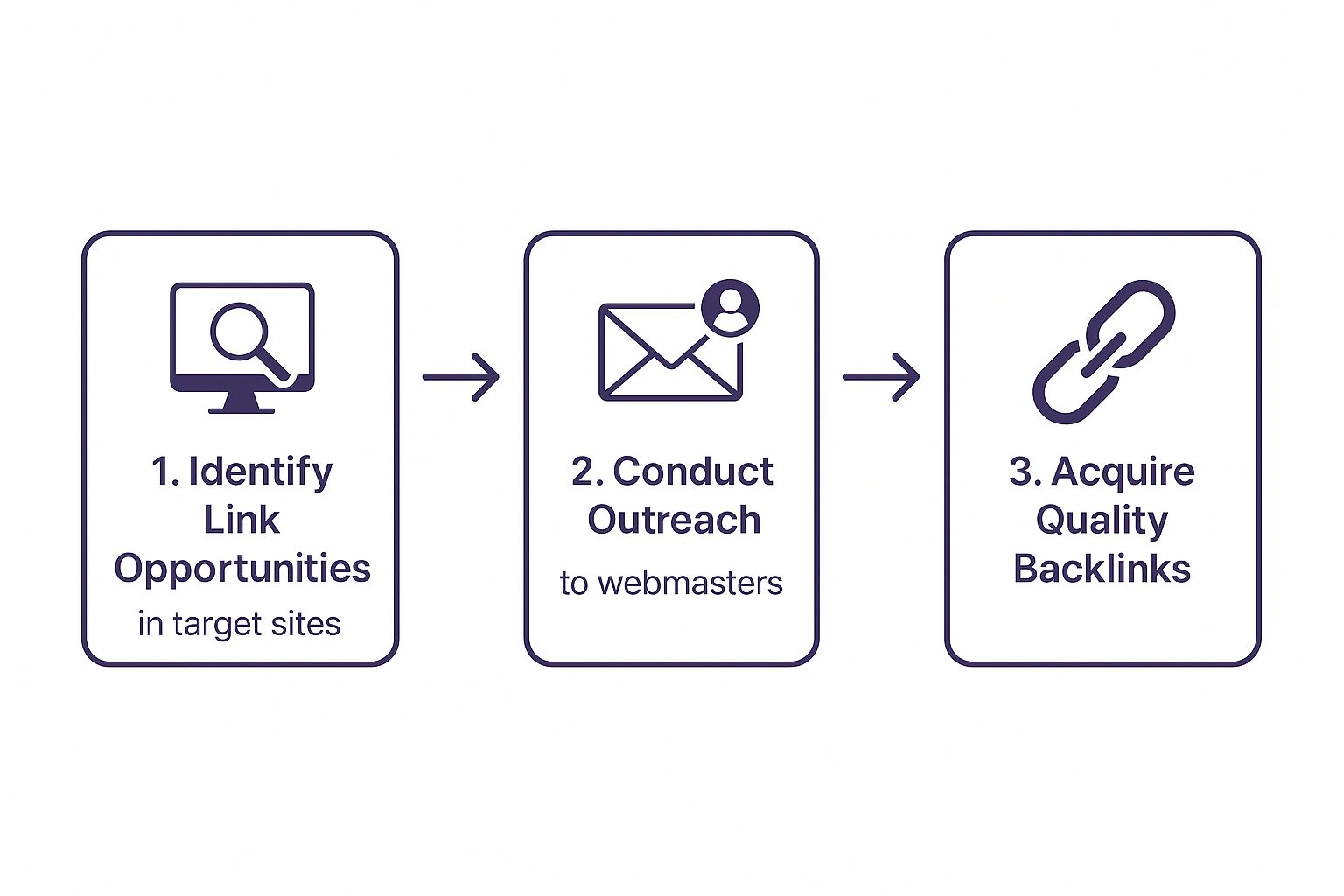
Just like the infographic breaks a complex process into clear stages, a good automation workflow simplifies lead nurturing.
Tools like HubSpot make building these visual workflows pretty straightforward. You can map out automated actions based on what a user does, ensuring every lead gets a timely, relevant message without you lifting a finger. Automating the process creates a consistent experience, builds trust over time, and keeps your brand top-of-mind.
How to Measure and Budget for Real Results

A strategy is only as good as the results you can prove. Let's be honest—throwing money at SEO without a clear way to measure its impact is just expensive guesswork. If you're serious about generating real SEO leads, you need a straightforward plan for your budget and a laser focus on the metrics that actually matter to your bottom line.
It's easy to get bogged down by surface-level data like keyword rankings or total traffic. While those can be useful health indicators, they don't tell the full story. The real value is in tying your SEO efforts directly to business outcomes.
That means shifting your attention to the KPIs that connect directly to revenue. This isn't just a trend; it's becoming the standard. In fact, around 53% of marketers now dedicate at least half their budget specifically to lead generation. You can see more on how priorities are shifting with these lead generation insights on GrowthList.co.
Key Metrics That Truly Matter
To justify your budget and make your campaigns smarter, you have to track the right data. I recommend building a simple dashboard—you can use tools like Google Analytics and your CRM—that shows the direct line between your SEO work and actual business growth.
Your reporting should focus on these essentials:
-
Cost Per Lead (CPL): This is your bottom line. It's the total cost to acquire one new lead from your organic efforts. You calculate it by dividing your total SEO spend by the number of leads generated. A consistently low CPL is a powerful sign that your strategy is efficient.
-
Lead-to-Customer Conversion Rate: This metric cuts through the noise and reveals the quality of the leads you're attracting. It answers the most important question: "What percentage of our SEO leads are actually becoming paying customers?"
-
Customer Lifetime Value (CLV): This is the ultimate measure of success. CLV tells you the total revenue a customer is expected to bring your business over their entire relationship. When you compare the CLV of customers from SEO to what it cost to acquire them, you see your true return on investment.
Tracking these three metrics changes the conversation. You go from saying, "we got more traffic" to "we generated X dollars in revenue from a Y dollar investment." This is how you confidently prove the value of SEO.
Building a Justifiable SEO Budget
Once you have these KPIs in hand, budgeting stops being a blind guess and becomes a strategic exercise.
You can start with a modest budget, track your CPL and conversion rates, and then scale your investment based on what's been proven to work. For a more detailed breakdown, our guide on how to calculate marketing ROI offers a practical framework for connecting your spending to real returns.
This approach gives you the data you need to make smart decisions, double down on what’s working, and confidently justify every dollar you spend on SEO to anyone who asks.
Still Have Questions About SEO Lead Gen? Let's Clear Them Up.
Even when you have a solid plan, a few questions always pop up. It’s natural. Getting into the weeds of SEO lead generation means running into some common hurdles.
This is where we tackle the stuff we hear all the time. Think of it as a quick-fire round to help you sidestep common roadblocks and keep your strategy on track.
"So, How Long Until the SEO Leads Actually Start Coming In?"
This is the million-dollar question, isn't it? The honest-to-goodness answer is: it depends. SEO is a long game, not a quick fix.
You might see a trickle of traffic and a few small wins in the first 4-6 months. But if you're looking for a consistent, reliable flow of quality leads, you need to think bigger.
Realistically, you should give yourself a 6 to 12-month runway. That’s the time it takes to build a real content foundation and earn the domain authority that Google respects. SEO isn’t a faucet you can just turn on and off.
The payoff for your patience is huge, though. Once that SEO engine is humming, the leads it generates are incredibly sustainable. They also come with a much lower long-term cost per acquisition than anything you’ll get from paid ads. You're building a business asset, not just running a short-term campaign.
"What’s the Real Difference Between a 'Lead' and a 'Qualified Lead'?"
This distinction is absolutely crucial. Getting it right is the difference between an efficient sales team and one that's just spinning its wheels. Not all leads are created equal, and knowing who's who saves everyone from chasing prospects that are a dead end.
Let's break it down simply:
- A Lead: This is anyone who gives you their contact info. They downloaded a checklist or signed up for your newsletter. They've shown a flicker of interest, but that’s about it.
- A Qualified Lead: This is someone who not only shared their details but also looks like your ideal customer. More importantly, they've shown a much higher level of intent.
We usually split qualified leads into two camps:
- Marketing Qualified Leads (MQLs): They've engaged deeply—maybe they attended a webinar or downloaded a detailed guide—but they're not quite ready for a sales call.
- Sales Qualified Leads (SQLs): They've raised their hand and signaled they want to buy. They've requested a demo, asked for pricing, and are ready for a real conversation with your sales team.
Focusing your energy on attracting and identifying qualified leads is what makes your entire SEO effort profitable. Everything else is just noise.
"Which Content Formats Actually Generate the Most Leads?"
The "best" format is always tied to your audience and your industry. There's no single magic bullet. What works is a strategic mix of content that meets people at different stages of their journey.
In-depth blog posts and massive guides are fantastic for pulling in top-of-funnel traffic and proving you know your stuff. But to actually turn that traffic into a contact in your CRM, you need dedicated lead magnets.
From our experience, these formats are consistent winners:
- Checklists and Templates: These are super practical and offer instant value. It's an easy "yes" for someone to trade their email for a tool that makes their job easier.
- Ebooks and Whitepapers: A slam dunk for B2B. These let you go deep on complex topics and capture leads who are in a serious research phase, comparing their options.
- Webinars and Case Studies: These are powerhouses for generating high-quality leads who are much closer to making a decision. They’re actively looking for a solution just like yours.
Ready to stop chasing vanity metrics and start generating real, qualified leads? At Frozen Crow Inc., we build data-driven marketing strategies that connect with your ideal customers and drive measurable growth. Book your free marketing audit with us today and discover how we can turn your website into a powerful lead generation engine.


