


August 20, 2026
How to choose a digital marketing agency: A quick guide
Picking the right digital marketing agency really comes down to one simple thing: finding a true strategic partner who actually gets your business. This isn't just about outsourcing tasks. It's about translating your big-picture business objectives into tangible marketing goals and then finding an agency with the chops to make it happen. Get this right, and you’re not just hiring a vendor—you’re aligning with a team that will drive measurable growth.
Finding the Right Agency Partner for Your Business
Diving into the search for a digital marketing agency can feel overwhelming. You’re not just picking a name out of a hat; the market is massive and incredibly competitive. In the U.S. alone, we're talking about a digital advertising agency market worth around $58.2 billion. It's been growing at a rate of 13.6% over the last five years, which tells you everything you need to know about the demand.
What’s interesting is that no single agency holds more than 5% of the market share. For you, that's great news—it means you have a ton of specialized options to choose from. You can dig deeper into these industry stats in this detailed market analysis.
The goal here is to find an extension of your team, not just someone to run your ads or post on social media. You need a group that understands your vision and has the skills to bring it to life. And honestly, the most important work happens internally before you even look at a single agency website or hop on a discovery call.
Define What Success Looks Like
First things first, you have to turn your high-level business goals into specific, measurable marketing targets. An agency can’t hit a target you haven’t even defined. It’s like asking a contractor to build a house without giving them a blueprint.
Think of it this way:
- Business Goal: Boost annual revenue by 20%.
- Marketing Goal: Generate 500 marketing-qualified leads (MQLs) each quarter with a 10% lead-to-customer conversion rate.
Or maybe it's about expansion:
- Business Goal: Break into a new geographic market.
- Marketing Goal: Secure a top-three search ranking for five of our core keywords in that new region within nine months.
Getting this clarity upfront sets the entire foundation for your search.
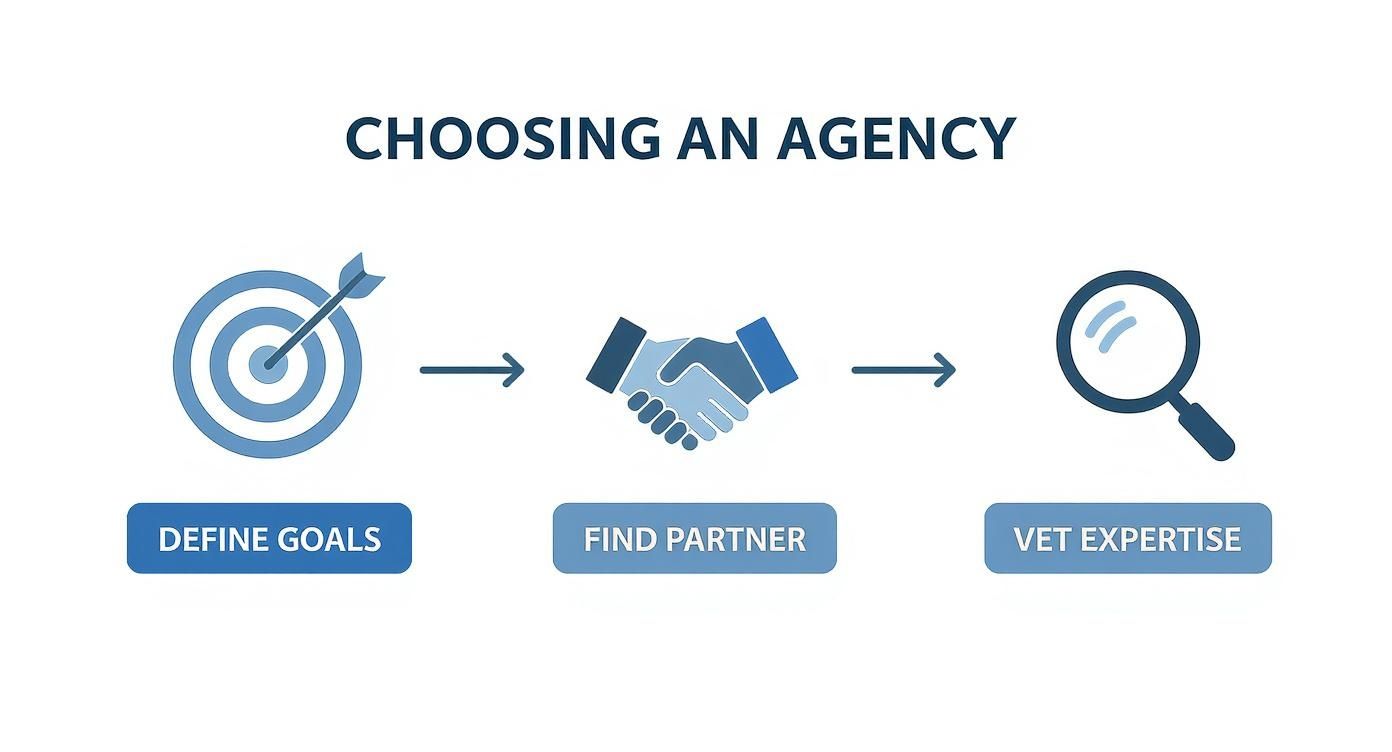
This visual really drives the point home: a successful partnership starts with internal clarity before you even begin the search. When you define your goals first, you create a scorecard to evaluate every potential partner against.
To help streamline your thinking as you start looking, here’s a quick checklist to keep in your back pocket. It covers the essential areas you'll want to dig into when you're vetting potential agencies.
Quick Agency Vetting Checklist
| Evaluation Area | What to Look For | Why It Matters |
|---|---|---|
| Industry Experience | Case studies and client testimonials in your specific niche or a similar one. | An agency that knows your industry already understands your customers, competitors, and challenges. |
| Service Specialization | Do they claim to do everything, or do they have deep expertise in the specific channels you need (e.g., SEO, PPC, Content)? | "Full-service" can sometimes mean "master of none." You want an expert, not a generalist. |
| Team & Culture | Who will be on your account? Are they transparent about their team structure? Do their values align with yours? | You'll be working closely with these people. A good cultural fit makes communication and collaboration much smoother. |
| Reporting & KPIs | Ask for sample reports. Do they focus on metrics that matter to your business goals (leads, revenue) or just vanity metrics (impressions, clicks)? | Clear, goal-oriented reporting ensures accountability and shows you exactly what your ROI is. |
| Communication Style | What's their process for updates and meetings? Do they seem proactive or reactive? | You need a partner who keeps you in the loop, not one you have to chase down for answers. |
This checklist isn't exhaustive, but it provides a solid framework. Using it will help you move beyond the flashy sales pitches and get to the core of whether an agency is truly the right fit for your business.
Key Takeaway: The best agency relationships are built on a foundation of shared goals. When you know precisely what you need to achieve, you can find a partner with the specific expertise to get you there, moving beyond a simple service agreement to a true strategic alliance.
Vetting an Agency’s Real-World Expertise

A slick sales pitch and a gorgeous website don't pay the bills. If you want to know how to choose a digital marketing agency that will actually move the needle, you have to get your hands dirty and dig into their real-world experience.
Here’s the thing: not all expertise is created equal. An agency that’s a rockstar for e-commerce brands on TikTok might be completely lost trying to handle technical SEO for a B2B SaaS company.
Your mission, should you choose to accept it, is to look past the promises and verify their track record. That means getting into the weeds of their past work to see if it truly lines up with your industry, your business size, and your specific goals.
Analyze Their Case Studies for Real Results
Let's start with their case studies, but you need to read them with a healthy dose of skepticism. A good case study does more than just tell a feel-good story; it lays out a clear problem, details the strategy they used, and—most importantly—proves it worked with hard numbers.
Look for metrics that actually matter to your business, not just vanity stats. A 50% increase in website traffic sounds nice, but a 35% increase in qualified leads is what really hits the bottom line.
When you're sifting through their work, ask yourself:
- Can they prove ROI? Look for a direct line connecting their marketing efforts to a client's revenue growth. Anything less is just noise.
- Are the clients like you? Getting results for a Fortune 500 company is a different ballgame than helping a startup scale. Look for examples of businesses that look and feel like yours.
- What was the timeline? How long did it take to get those results? This is critical for setting realistic expectations from the get-go.
If their case studies are full of fluff like "increased brand awareness," push them for the real data. A great agency will be proud to show you the numbers that back up their claims.
Don't get distracted by a wall of impressive client logos. The real test of an agency's expertise is the tangible, measurable outcomes they delivered for businesses facing challenges just like yours.
Go Beyond the Portfolio and Talk to People
Case studies are, by nature, curated success stories. They’re never going to show you the campaigns that flopped. To get the full picture, you have to talk to their current and former clients.
Any agency worth its salt will have no problem providing references. When you get someone on the phone, you can finally ask the questions their polished portfolio will never answer.
Here are a few must-ask questions:
- How was the communication and reporting? Were they proactive and transparent, or did you constantly have to chase them down for updates?
- How did they handle bumps in the road? Ask about a campaign that didn't perform as expected. This reveals a ton about their problem-solving skills and accountability.
- Would you hire them again? This is the ultimate gut-check question. The answer tells you everything you need to know.
While you're at it, look for third-party validation. Certifications like being a Google Premier Partner or having HubSpot-certified team members aren't just fancy badges. They mean the agency has met tough performance and training standards set by industry leaders, adding another layer of confidence to your decision.
Gauging an Agency's Technical and AI Proficiency

Sure, creativity is a big deal, but these days, it’s the tech that actually turns those brilliant ideas into results you can measure. When you're trying to figure out how to choose a digital marketing agency, you have to look under the hood. You need to see what they're really working with, technically speaking.
An agency clinging to last year's tools is going to get you last year's results—and frankly, probably worse.
You’re not just looking for a long list of software subscriptions they pay for. The real goal is to see how they use technology in their day-to-day strategy. A great partner uses their tech stack to stay ahead of the curve, not just to tread water.
What’s in Their Tech Stack?
Every agency runs on a "tech stack"—their go-to collection of tools for everything from analytics and automation to just plain getting stuff done. Don't be afraid to ask them to get specific here. The point isn’t to give them a pop quiz, but to get a feel for their entire philosophy.
Are they using industry-standard SEO tools like Ahrefs or Semrush? What about for project management? A messy internal process almost always spills over and becomes a messy client experience.
Here’s a quick list of what you should be digging for:
- Analytics and Reporting: How are they actually tracking performance? Ask for a sample report. Is it a clean, simple dashboard that clearly connects the dots back to your business goals? Or is it a 20-page data dump designed to confuse you?
- Automation Tools: Find out what they automate. This can be anything from email marketing workflows to social media posting. Good automation frees up their best people to focus on high-level strategy for you.
- Adaptability: How often are they trying out new tools? An agency that’s constantly experimenting is one that’s dedicated to getting better, not just staying comfortable.
This conversation will tell you pretty quickly if they’re proactive strategists or just button-pushers. You want a team that uses technology to hunt for new opportunities, not just report on what’s already happened.
Key Insight: A solid tech stack is a dead giveaway of an efficient, data-driven agency. It proves they invest in the right resources to deliver precise, measurable results.
How Do They Really Feel About AI?
Let's be real, artificial intelligence isn't some futuristic buzzword anymore; it's actively changing the marketing game right now. An agency that isn’t already weaving AI into its process is falling behind, period. The explosion of generative AI, in particular, is a massive factor to consider.
It's not just me saying this. A recent poll of agency leaders showed that 73% believe generative AI has completely shaken up the search marketing world. This means agencies need to be creating totally new kinds of content—think detailed Q&A formats and highly structured data—to keep up with how people are searching. You can get the full scoop on how AI is impacting 2025 agency trends on Digital Agency Network.
So, ask them directly. How are you using AI to make ad campaigns better, to build out smarter content briefs, or to analyze what the competition is doing? Their answer will tell you everything you need to know about whether they're leading the charge or just trying to catch up. An agency that can't give you a clear, confident answer on their AI strategy probably isn't ready for what's coming next.
Decoding Agency Pricing and Calculating True ROI
Let's talk about the money. When you’re figuring out how to choose a digital marketing agency, the conversation around pricing is about so much more than just finding the cheapest option. It’s really about connecting the cost to actual, tangible business value.
Sticker shock is a real thing, but you can usually sidestep it by having frank conversations upfront about how an agency structures its fees and what you get for your investment.
Understanding the Common Pricing Structures
Most agencies use one of a few common models, and each has its own rhythm and reason. Getting a feel for which one suits your business is a massive step toward building a partnership that actually works.
To make sense of it all, here's a quick breakdown of the pricing structures you'll most likely run into.
Comparing Common Agency Pricing Models
A breakdown of different pricing structures to help you understand which best fits your business needs and budget.
| Pricing Model | Best For | Potential Pitfalls |
|---|---|---|
| Monthly Retainer | Businesses needing ongoing, consistent effort for long-term strategies like SEO, content marketing, or social media management. It ensures a dedicated team and predictable monthly costs. | Scope creep can be an issue if the deliverables aren't clearly defined from the start. You might pay for services you don't fully use in a slow month. |
| Project-Based Fee | Companies with a specific, one-off goal, like a website redesign, a new product launch campaign, or a comprehensive brand audit. It provides total cost clarity upfront. | It's less flexible. If the project's needs change or expand, you'll likely need to renegotiate the fee or create a new scope of work. |
| Hourly Rate | Consulting engagements, quick-turnaround tasks, or when you need specialized expertise for a limited time. It's flexible and you only pay for the work that's done. | This model can lead to unpredictable costs and budget overruns if the project isn't managed tightly. It can also incentivize inefficiency. |
Ultimately, the best model really just depends on your immediate and long-term goals. If you're a startup trying to build momentum, a retainer makes a lot of sense. But if you're an established company launching a single new product, a project-based fee might be a much better fit.
Calculating the Real Return on Your Investment
The price on a proposal is only one part of the equation. The real question is about the potential return on that investment (ROI). This is precisely why having clear key performance indicators (KPIs) is a complete non-negotiable. Before you even think about signing a contract, you and the agency have to be on the same page about what success looks like—in hard numbers.
This means you need to shift the conversation away from costs and toward outcomes. For example, a $5,000 monthly retainer might feel like a big number, but if it's pulling in $25,000 in new revenue every month, the ROI is a no-brainer.
The pressure to make every dollar count is higher than ever. Agency hourly rates are climbing, with most now charging somewhere between $175 and $249 per hour. At the same time, a recent study found that only 24% of CMOs feel they have enough budget to actually pull off their strategies. This squeeze means you absolutely need a partner who knows how to maximize your spend.
You can dig deeper into these numbers in this 2025 digital agency industry report. A good agency will be using automation and AI to make their own operations more efficient, which translates to better results for you without just bloating the invoice.
So when you’re looking at that proposal, don't just ask, "How much?"
Instead, ask, "What business results can this investment realistically produce?"
Frame the discussion around core business metrics like Customer Acquisition Cost (CAC), Lifetime Value (LTV), and your lead-to-customer conversion rates. An agency that leans into that conversation is one that’s focused on being a real partner, not just another vendor.
Making Your Final Choice and Building a Strong Partnership

You’ve done the heavy lifting. You’ve vetted the candidates, sifted through proposals, and called the references. Now it’s time to make the final call and lay the groundwork for a relationship that actually works.
This last phase isn't so much about evaluation anymore. It’s about getting everything in writing so everyone starts on the same page.
The bridge from "prospect" to "partner" is crossed the moment you sign the contract, often called a Statement of Work (SOW). Think of this document as the blueprint for your entire partnership, so don’t just give it a quick once-over. A solid SOW is your best defense against misunderstandings, scope creep, and disappointment down the road.
A good contract should be painfully clear. Before you put pen to paper, you need to be able to give a confident "yes" to a few key questions.
Your Pre-Signature SOW Checklist
- Are all deliverables spelled out? The SOW needs to state exactly what the agency is going to produce. Is it 4 blog posts a month? A one-time, comprehensive website audit? Management of a $10,000 ad spend? Get specific.
- Are timelines and milestones actually defined? Look for a realistic schedule that maps out key phases and deadlines. This isn't just for them; it’s for you. It holds both sides accountable and gives you a clear way to track progress.
- Is the reporting cadence set in stone? How often will you get performance reports—weekly, bi-weekly, monthly? More importantly, what specific KPIs will those reports cover?
- What are the termination clauses? You need to understand how to part ways if things don't work out. Check for fair notice periods and clear terms for both sides.
Getting these details buttoned up isn't about a lack of trust. It's about building a foundation of clarity that allows trust to grow in the first place. Once the ink is dry, the real work begins: bringing your new partner into the fold.
Kicking Off a Strong Partnership
The first 90 days are everything. A great agency won’t just dive in and start pulling levers. They’ll have a structured onboarding process designed to get them completely up to speed on your business, your brand, and how you operate.
A seamless onboarding process is one of the strongest indicators of an agency’s professionalism and long-term potential. It shows they are organized, methodical, and genuinely invested in understanding your business from the inside out.
Expect the agency to take the lead here. They should have a clear plan for getting access to all the necessary tools—your website's backend, Google Analytics, ad accounts, you name it. They should also be scheduling kickoff meetings to meet your key team members, get a real feel for your brand voice, and confirm the strategic goals you've already discussed.
This initial period sets the tone for the entire relationship. Treat it as a chance to build open, transparent communication channels. When you nail the communication and build a collaborative spirit from day one, you move past a simple client-vendor dynamic. You start building a true, results-driven partnership. And that's the whole point of this exercise.
Got Questions? Let's Cover the Common Ones.
https://www.youtube.com/embed/WOmUA7THTXg
Even after doing all your homework, a few questions are bound to pop up. It's totally normal. Getting these last few things cleared up can give you the final bit of confidence you need before signing on the dotted line.
Let's walk through some of the questions we hear all the time.
What Are the Biggest Red Flags to Watch Out For?
This is a big one. You need to be super skeptical of any agency that makes concrete guarantees, especially something like a "#1 Google ranking." Anyone who's actually worked in digital marketing knows it’s way too unpredictable for promises like that.
Another huge warning sign is a lack of transparency. If they're cagey about their process or can't give you a straight answer on how they measure success, that's a problem. You should always know what they're doing for you and how it connects back to your actual business goals.
And finally, be wary of teams that hide behind a wall of confusing jargon. Their job is to explain the business impact, not just throw buzzwords at you. If an agency can’t show you relevant case studies or connect you with client references to back up their claims, it probably means they don't have the experience they say they do.
Should I Go with a Niche Specialist or a Full-Service Agency?
Honestly, this completely boils down to what you need right now.
If you're staring down a very specific, thorny challenge—think technical SEO for a massive e-commerce site or a hyper-focused B2B lead gen campaign just on LinkedIn—a niche specialist can be a lifesaver. Their deep, focused expertise often gets you better results, faster.
On the other hand, if your bigger goal is building a solid, integrated strategy across multiple fronts (SEO, PPC, social media, content, etc.), a full-service agency is almost always the smarter play. They make sure all your marketing efforts work together, which saves you the massive headache of trying to coordinate a bunch of different vendors who aren't talking to each other.
Here’s how I think about it: A specialist agency is the surgeon you call for a specific, complex operation. A full-service agency is your primary doctor, managing your overall marketing health and bringing in specialists when they're needed.
How Long Does It Really Take to See Results?
This is the million-dollar question, and the answer depends entirely on the marketing channel.
With something like Pay-Per-Click (PPC) ads, the feedback is almost immediate. You can start seeing traffic, clicks, and even potential leads within hours of a campaign going live.
But for the long-haul strategies like Search Engine Optimization (SEO) and content marketing, you have to play the long game. These are true investments. You're typically looking at four to six months just to start seeing real, meaningful traction. Seeing a significant, lasting return often takes closer to a year.
A good agency will be completely upfront about these timelines. They won't just tell you to be patient; they'll give you a clear roadmap with short-term wins and long-term milestones to track progress.
What's My Role in All of This?
Your involvement is not just helpful—it's absolutely critical for success. You are the expert on your own business. No agency can replace that.
Your main job is to arm the agency with clear business goals, deep insights into who your customers are, and provide timely, honest feedback on their work. You know your brand, your product, and your industry inside and out.
The best agency-client partnerships we've ever seen are true collaborations. They're built on open communication, regular check-ins, and a healthy dose of mutual respect. The more you can share, the better your agency will be at creating campaigns that actually hit the mark and drive results.
Ready to partner with an agency that gets it? Frozen Crow Inc. offers a free marketing audit to find your biggest growth opportunities. We don't just take on clients; we build strategic partnerships, handling everything from high-level strategy to the hands-on work of implementation and optimization.


