


August 20, 2026
Email List Building Strategies That Actually Work
Email list building is simply the process of gathering email addresses from people interested in your business. You offer them something valuable (a "lead magnet") in exchange for their contact info, which opens up a direct line for you to build a relationship and, eventually, make a sale.
Why Your Email List Is Your Most Valuable Asset
Let’s be real for a second: building your brand on social media is like building a house on rented land. One little algorithm change can completely tank your reach overnight, and suddenly you're cut off from the very audience you spent months or years building.
This is precisely why an "owned" audience is so critical.
Growing your email list isn't just another box to check on your marketing to-do list. It's a strategic move to build a stable, predictable, and profitable asset for your business. When you own the list, you own the conversation. You get a direct, unfiltered line to your most engaged followers, and you don't have to worry about the whims of some third-party platform.
This graphic breaks it down beautifully—turning rented platforms into owned assets that generate real revenue.
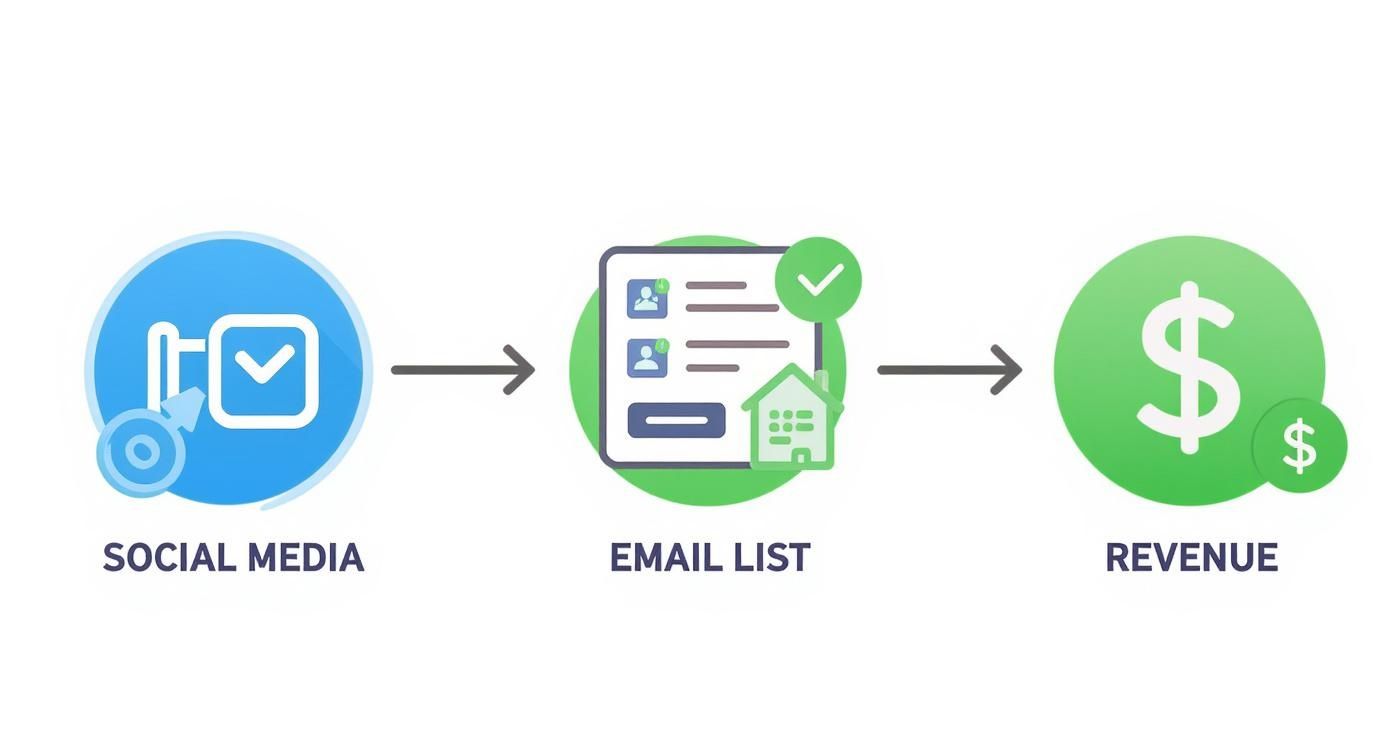
The big takeaway here? Social media should be the bridge that leads people to your email list, not the final destination.
The Unmatched ROI of an Owned Audience
The numbers don't lie. The return on investment for email marketing is consistently one of the highest you'll find anywhere. For every $1 you spend, you can expect an average return of over $40. It's incredibly efficient because email is just so personal and direct.
Think about it: a social media post is gone in a flash, but an email sits right there in someone's inbox, waiting for them. This gives you a unique chance to build a much deeper connection by sending:
- Personalized content that actually speaks to what a subscriber is interested in.
- Targeted promotions to specific groups of people on your list.
- Direct requests for feedback that help you understand your customers on a whole new level.
Owning your email list is the closest thing you can get to a guaranteed audience. It’s a direct line to people who have explicitly raised their hand and said, "Yes, I want to hear from you."
Building a Foundation for Sustainable Growth
A healthy email list is the foundation of a business built to last. It’s how you nurture curious visitors over time, turning them into loyal customers who tell their friends about you.
With the global email user base expected to hit over 4.8 billion by 2027—and 78% of all emails now being opened on mobile—this channel is more powerful than ever.
Having this direct line gives you control over your own revenue, making your business far more resilient. You can learn more about the overall effectiveness of email marketing in our detailed guide. It's not just about blasting out newsletters; it's about building a community and a reliable engine for growth.
Crafting Lead Magnets People Actually Want

Let’s be honest: the generic "Subscribe to our newsletter" CTA is dead. It's just not enough to earn a spot in someone's already crowded inbox anymore. If you want to build a quality email list, you have to offer a compelling reason for someone to hand over their contact info.
That’s where a high-value lead magnet comes in. Think of it as the ethical bribe that kicks off your relationship with a potential customer. It needs to be so relevant and solve such a specific problem that they feel like they’re getting an incredible deal just for typing in their email.
It All Starts With Your Audience
Before you even think about creating a checklist or an ebook, you have to get inside your audience's head. What’s keeping them up at night? What’s the one small win they need right now to feel a sense of progress? Your lead magnet has to be the answer to that question.
A classic mistake is creating something that appeals to everyone, which ultimately attracts people who will never buy from you. Your goal isn't just a bigger list; it's a better list filled with qualified leads. Your lead magnet should act as a filter, pulling in the right people and gently repelling the wrong ones.
For example, if you sell high-end project management software, a generic "10 Productivity Hacks" checklist is way too broad. A much stronger approach would be a "Customizable Project Kickoff Template for Creative Agencies." It solves a very specific problem for a very specific audience, which ties directly back to your product.
A great lead magnet doesn't just promise a solution; it delivers one. It should provide an immediate "aha!" moment that builds trust and leaves your new subscriber eager to hear more from you.
The data backs this up. A huge 60% of consumers prefer getting business communications through email over any other channel. Even better, that preference leads to action—50% of consumers report they've purchased a product directly from a marketing email. You can dig into more of these consumer email stats on Designmodo.com.
High-Impact Lead Magnet Ideas That Work Today
The days of a simple PDF being enough to capture attention are long gone. To stand out, you need to offer something with a higher perceived value. Here are a few modern formats that consistently perform well:
- Interactive Quizzes or Assessments: These are fantastic because they're engaging and deliver personalized results. A skincare brand could offer a "What's Your Skin Type?" quiz that recommends products, while a financial advisor might create a "Retirement Readiness Score" assessment.
- Exclusive Video Workshops or Mini-Courses: Video just feels more valuable than text. Offer a short, pre-recorded workshop that teaches a specific skill, like "5 Simple SEO Fixes You Can Make in 15 Minutes."
- Templates and Swipe Files: People love resources that save them time. Think ready-to-use spreadsheets, a series of email templates for a common business scenario, or a pack of social media graphic templates.
- Early Access or Exclusive Deals: This is an absolute powerhouse for e-commerce. Offering a 15% discount on their first order, early access to a new product launch, or a free gift with purchase is a no-brainer for most shoppers.
The right format always comes down to your business and your audience. A SaaS company will likely see more success with a free tool or an in-depth case study, while a consultant will probably get better results from a webinar.
What works for one business might not work for another. The key is to match the format to the specific problem you're solving for your ideal customer. Here’s a quick breakdown to get you started.
Lead Magnet Ideas for Different Business Types
| Business Type | High-Impact Lead Magnet | Key Benefit |
|---|---|---|
| E-commerce | Coupon Code (e.g., 15% Off) or Free Shipping | Drives an immediate purchase by lowering the barrier to entry. |
| SaaS | Free Tool or Interactive Assessment | Provides instant value and demonstrates the product's core functionality. |
| Service-Based | Checklist, Template, or Case Study | Establishes expertise and provides a tangible "quick win" for the prospect. |
Ultimately, the best lead magnet is one that gives your audience a taste of the value you provide, leaving them wanting more.
A Simple Framework for Creating Your Lead Magnet
Ready to build one? Don't just jump in and start writing. A little structure goes a long way.
- Identify a Hyper-Specific Problem. Don't try to solve everything at once. Focus on one small, nagging pain point.
- Promise a Quick Win. Your lead magnet needs to be easily consumable. They should get a tangible result in under 15 minutes.
- Choose the Right Format. Now, select the format that best delivers that solution. Is it a visual guide? A spreadsheet? A short video?
- Create a Compelling Title. Make the benefit crystal clear. Instead of "Marketing Guide," try "The 5-Step Framework for Your First Profitable Ad Campaign."
- Design It Professionally. Even a simple checklist should look clean and reflect your brand. A sloppy design can kill trust before you’ve even had a chance to build it.
Turning Your Website Into a Signup Machine
Think of your website as your digital storefront. It should be your single best tool for growing your email list. Far too many businesses bury a lonely signup form in the footer, treating it like an afterthought. If you’re serious about growth, you need to transform your site into an optimized, polite, and persuasive signup machine.
This isn't about blasting annoying popups on every page. It’s about strategy—placing the right offer in the right place at the right time. A visitor deep into a blog post has a completely different mindset than someone about to abandon your pricing page, and your approach needs to reflect that.
The real goal is to make signing up feel like the most natural next step for someone who’s already engaged. By weaving these opt-in opportunities seamlessly into the user experience, you can see a massive lift in subscribers without being pushy or breaking trust.
Strategic Placement of Your Opt-In Forms
Where you ask for an email is just as critical as how you ask. Different spots on your site catch people at different stages of their journey, and you need to capitalize on that. Let's break down the most effective placements I've seen work time and time again.
- Embedded Within Blog Posts: When someone is engrossed in a helpful article, their engagement is at its peak. This is the perfect moment to offer a "content upgrade"—like a checklist or template directly related to the post—right there in the middle of the content. It’s incredibly effective.
- Sticky Announcement Bar: That thin bar across the top of your site? It's a persistent, non-intrusive way to promote your main lead magnet. It’s always visible but never gets in the way, making it a fantastic "always-on" list-building tool.
- Exit-Intent Popups: These are the only popups that get a pass in my book. They trigger only when a user's cursor signals they're about to leave, giving you one last chance to grab their attention. A compelling offer here, like a one-time discount, can easily turn a lost visitor into a new subscriber.
For your most valuable offers, though, nothing beats a dedicated landing page. These pages have one job and one job only: to turn visitors into subscribers. To really dig into what makes them work so well, check out our guide on the best practices for landing page design.
Reducing Friction and Building Trust Instantly
Every extra field on your signup form is another reason for someone to walk away. Seriously. For most lead magnets, all you truly need is an email address. Asking for a first name is fine if you plan to personalize your emails, but anything more will almost certainly hurt your conversion rate.
Keep it simple. The path of least resistance always wins. If a user can sign up in five seconds flat with just their email, they're far more likely to do it.
Building trust is just as important as reducing friction. Nobody wants more spam. You can calm this fear with a few simple additions right next to your form.
- Add Social Proof: Saying "Join 20,000+ other marketers" feels much more compelling than a generic "Join our newsletter." It shows you're a trusted resource.
- Use a Reassuring Privacy Statement: A short, simple line like, "We hate spam and promise to keep your email safe," can make a huge difference in a user's confidence.
- Set Clear Expectations: Be upfront about what they'll get and how often. For instance, "Get our weekly roundup of marketing tips delivered every Tuesday."
Crafting Copy That Converts
The words you use on your forms and buttons can make or break your success. Generic phrases like "Sign up" or "Submit" are boring and do nothing to motivate people. Your copy needs to focus on the benefit and create a sense of urgency or excitement.
Use action-oriented language that puts the value front and center.
Weak Copy vs. Strong Copy
| Weak Call to Action | Strong, Benefit-Driven Call to Action |
|---|---|
| Submit | Get My Free Checklist |
| Subscribe | Send Me the 15% Discount! |
| Download | Unlock the Video Workshop |
See the difference? The stronger examples focus on what the user gets, not what they have to do. This small shift in perspective frames the entire exchange as a clear win for the subscriber.
The Power of Continuous Improvement
Your first attempt at an opt-in form won't be your best. I promise. The real secret to turning your website into a signup machine is to test, measure, and iterate constantly. A/B testing is your best friend here.
Just make sure you test one element at a time to get clean, reliable data. You could test:
- Your Headline: Pit a question-based headline against a bold statement.
- Your Call to Action (CTA) Button: Test different colors, sizes, and of course, copy.
- Your Offer: Does a checklist convert better than an ebook? Test it and find out.
Even tiny improvements can have a massive impact over time. I’ve seen forms that convert at 2% get optimized to hit 4% or 5% with consistent testing. That’s double the signups every single day, without needing a single extra visitor.
Growing Your Email List Beyond Your Website

Getting your website optimized for signups is a great start, but let's be honest—it's a passive game. You're basically waiting for people to stumble upon your digital doorstep. To really kick your list growth into high gear, you need to get proactive and go where your ideal subscribers are already hanging out.
This is all about diversifying your acquisition channels. It's a core principle of resilient email list building. When you promote your lead magnets on social media, team up with other brands, and run smart, targeted ads, you build multiple streams of new subscribers. It's your best defense against random traffic dips and your ticket to reaching entirely new audiences.
Turn Social Media Into a Lead Generation Engine
Your social media profiles are more than just a place for company updates; they're powerful lead-gen tools waiting to be used. Stop just asking people to "join our newsletter." That's boring. Instead, start promoting your best lead magnets directly. Create posts that grab attention by focusing on the specific problem your freebie solves.
An e-commerce store, for example, could host a giveaway for a hot-ticket item, with an email signup as the entry fee. A B2B consultant could promote a free webinar digging into a trending industry topic. The goal is to make the value so obvious and the signup so easy that they can't say no. For a deeper look at getting this right, check out these proven social media engagement strategies.
Here are a few practical ways to make this happen:
- "Link in Bio" Power-Up: Use a tool that lets you put multiple links in your Instagram or Twitter bio. This gives your top lead magnets a permanent, high-visibility spot.
- Scroll-Stopping Posts: Design eye-catching graphics or short videos for Facebook, LinkedIn, or Pinterest. Tease the value of your lead magnet and send followers to a dedicated landing page to get it.
- Get Interactive: Use features like Instagram Stories polls or quizzes to warm up your audience before you hit them with the call-to-action for a related resource.
Run Paid Ads That Actually Convert
Organic reach is a rollercoaster. Paid ads, on the other hand, give you a direct, scalable path to get your lead magnet in front of exactly the right people. Platforms like Facebook and Instagram have incredible targeting tools that let you pinpoint users based on their interests, behaviors, and demographics.
The best lead-gen ads don't look or feel like ads. They show up as a helpful solution to a real problem, right when the person needs it most.
Start with a small budget. Test everything—different images, headlines, and audiences. Pick one killer lead magnet and drive all that traffic to a single, high-converting landing page. Remember, you're not chasing clicks; you're hunting for cost-effective email signups. Keep a close eye on your cost per lead (CPL) to make sure your campaigns are actually making you money.
Tap Into New Audiences with Strategic Partnerships
One of the most powerful, and often overlooked, growth hacks is collaborating with complementary, non-competing brands. It’s a shortcut to tapping into an established audience that already trusts the person making the introduction. You get an implied endorsement and immediate access to a fresh pool of potential subscribers.
Finding the right partners is everything.
Effective Partnership Opportunities
| Partnership Type | How It Works | Why It's Effective |
|---|---|---|
| Co-Hosted Webinars | You and another expert present on a topic you both know well. Both of you promote the event to your own lists and social channels. | You split the work but double the exposure to a highly relevant, engaged audience. Webinar attendees are often fantastic leads. |
| Guest Blogging | Write a genuinely useful article for a respected blog in your space. In your author bio, include a CTA that links directly to your lead magnet. | This move positions you as an expert and drives super-targeted traffic right to your opt-in form. It’s a classic for a reason. |
| Joint Giveaways | Team up with a few other brands to create an irresistible prize package. Everyone contributes a prize and promotes the giveaway, with email entry required. | This can create massive buzz and grow your list incredibly fast. It's a brilliant way to cross-promote with businesses that share your audience. |
The best partnerships are built on mutual value. Make sure your collaborator gets just as much out of the deal as you do. For a complete look at building out your strategy, this modern guide to email list building and growth is a great resource. When you get them right, these off-site tactics can easily become your most reliable source of high-quality subscribers.
Building a Solid Technical Foundation
A powerful email list runs on more than just great content. It needs a solid technical backbone to make sure your messages actually get delivered, opened, and acted upon. Getting this foundation right from the start will save you massive headaches later. Trust me, it's a non-negotiable part of building an email list like a pro.
This doesn't mean you need to be a technical wizard. It’s really just about making a few smart choices upfront, setting up simple systems to welcome new subscribers, and understanding the basic rules of the road. Nail this, and you'll keep your sender reputation pristine and your efforts compliant.
Choosing the Right Email Service Provider
Your Email Service Provider (ESP) is the engine of your entire email marketing operation. It’s the platform you'll use to store contacts, design emails, launch automations, and track what’s working. It’s tempting to just pick the cheapest or most popular option, but the right ESP for a solo creator is worlds apart from the best choice for a growing e-commerce store.
When you're evaluating your options, think beyond just the monthly fee. Ask yourself these questions:
- Is it easy to use? Can you build an email and understand the analytics in a few minutes, or is the interface a confusing mess?
- How good are the automations? Does it offer simple but powerful automation flows, like a welcome series? This is absolutely crucial for nurturing new leads without lifting a finger.
- Can you segment your list? How easily can you group subscribers based on their interests or actions (like what they've purchased or which links they clicked)?
- Will it scale with you? Check the pricing tiers. What happens when your list hits 5,000 subscribers? 10,000? You don't want to be forced into a painful migration down the line.
For most small businesses, platforms like Mailchimp, ConvertKit, or Klaviyo (especially for e-commerce) offer a fantastic balance of powerful features and user-friendliness.
Setting Up a Powerful Welcome Series
The moment someone subscribes is the peak of their engagement. You have their full attention. Failing to capitalize on this is one of the biggest missed opportunities in email marketing. A single welcome email is good, but an automated welcome series is exponentially better for building a real relationship from day one.
This is just a short sequence of emails, automatically sent to new subscribers over a few days. Its job is simple: introduce your brand, deliver the goods you promised, and set expectations for what's to come.
Your welcome series is your one chance to make a perfect first impression. It should do more than just say thanks; it should confirm the subscriber made a smart decision and hint at the value still to come.
A simple but incredibly effective 3-email welcome series could look something like this:
- Email 1 (Sent Immediately): Deliver the goods! Give them the link to the lead magnet they signed up for. Keep it short, sweet, and focused on delivering that immediate value.
- Email 2 (Sent 1 Day Later): Share your story. Who are you, and why do you do what you do? This is how you start building a genuine connection. People buy from people they know and trust.
- Email 3 (Sent 3 Days Later): Showcase your greatest hits. Point them toward a popular blog post, a helpful case study, or a best-selling item. Guide their next step and show them the best of what you offer.
This simple automation works tirelessly in the background, ensuring every new subscriber gets a consistent and warm introduction to your brand.
Protecting Your Email Deliverability
Deliverability is the unsung hero of email marketing. It’s the simple measure of whether your emails land in the primary inbox or get buried in the spam folder or promotions tab. A poor sender reputation can derail your entire strategy, no matter how brilliant your emails are.
You don't have to be an expert, but you do need to follow a few key practices:
- Use a Professional Email Address: Sending from a free address like
@gmail.comis a massive red flag for spam filters. Always, always use an email tied to your own domain (e.g.,hello@yourbrand.com). For reliable communication, exploring professional email hosting solutions is a critical first step. - Authenticate Your Domain: Set up SPF and DKIM records. Don't let the acronyms scare you. These are just technical standards that prove to inbox providers that you are who you say you are, which gives your trustworthiness a major boost. Your ESP will have simple, step-by-step guides to get this done.
- Clean Your List Regularly: Every so often, it's good practice to remove subscribers who haven't opened your emails in a long time (say, 90 days). Sending to unengaged contacts hurts your open rates and signals to providers that your content might be irrelevant.
Staying Compliant with GDPR and CAN-SPAM
Last but not least, legal compliance is not optional. Building your list ethically is essential for building trust and avoiding some seriously hefty fines. The two most important regulations to be aware of are the CAN-SPAM Act (in the U.S.) and GDPR (in the EU).
While the specifics differ, they share a common spirit: transparency and consent. Here are the core principles you absolutely have to follow:
- Get Explicit Consent: Never, ever add someone to your list without their clear permission. That means no pre-checked boxes on your forms.
- Provide an Easy Opt-Out: Every single email must include a clear and simple way for people to unsubscribe. No exceptions.
- Identify Yourself: Your emails must include your physical business address.
- Don't Use Deceptive Subject Lines: Your subject line needs to accurately reflect what's inside the email.
By following these guidelines, you're doing more than just staying on the right side of the law—you're building a healthier, more engaged email list founded on respect for your audience. And that's always a winning strategy.
A Few Common Questions About Building an Email List
Jumping into email marketing always brings up a few key questions. We've seen them come up time and time again. Below are some straight-up answers to the most common sticking points we see, designed to give you clarity and get you moving in the right direction.
How Often Should I Actually Email My List?
This is the million-dollar question, and the only honest answer is: it depends. There’s no magic number that works for everyone.
But if you’re looking for a solid starting point, once a week is a great place to begin.
That cadence usually strikes the right balance. It’s frequent enough to keep your brand top-of-mind, but not so often that you start annoying people. The real secret isn't frequency, though—it's consistency and value. One genuinely helpful email that lands in their inbox every Tuesday morning is infinitely better than three random, sales-heavy emails fired off whenever you feel like it.
Keep a close eye on your open rates and, more importantly, your unsubscribe rates. Those metrics are your audience voting with their clicks. If you test sending twice a week and see a spike in people unsubscribing, that’s a loud and clear signal to pull it back.
Is It Ever Okay to Buy an Email List?
Let me make this simple: No. Never, ever, ever buy an email list.
I know it sounds like a tempting shortcut to immediate growth, but it's one of the fastest ways to completely torpedo your marketing efforts before they even get off the ground.
Think about it: these people never gave you permission to contact them. That means your email is, by definition, spam. This decision triggers a cascade of negative consequences:
- It demolishes your sender reputation. Email providers like Gmail and Outlook are smart. They'll quickly flag your domain as a source of spam, and soon even your legitimate emails to real customers will start landing in the junk folder.
- Your engagement will be abysmal. Since these recipients have no idea who you are, they won't open your emails. Rock-bottom open rates are another red flag that tells providers you're a spammer.
- It violates the law. You'll be on the wrong side of regulations like GDPR and the CAN-SPAM Act, which can lead to some seriously hefty fines.
The only sustainable path is organic growth. You need a list of people who have explicitly raised their hand and said, "Yes, I want to hear from you." Trust is the entire foundation of good email marketing.
Put your energy into creating lead magnets that solve a real problem for your audience and promote them properly. It's slower, yes, but the quality of your list will be in a different league, leading to real engagement, trust, and sales down the road.
What’s a Good Conversion Rate for an Opt-In Form?
A "good" conversion rate for an email signup form can be all over the map. It's influenced by dozens of factors, from your industry and where the traffic is coming from to the quality of your offer.
That said, a solid general benchmark to shoot for is somewhere in the 2-5% range. So, for every 100 people who see your form, you get two to five new subscribers. Of course, a highly optimized landing page with a truly killer lead magnet can blow that out of the water, sometimes pushing conversion rates past 10%.
But here's a better way to think about it: instead of obsessing over some generic industry average, focus on improving your own baseline. If your form is converting at 1% right now, your only goal should be getting it to 2%. You can do that by A/B testing your headline, your call-to-action, or the offer itself. A single percentage point increase might not sound like much, but it literally doubles your daily signups without needing a single extra visitor.
At Frozen Crow Inc., we transform your marketing challenges into growth opportunities. Our data-driven strategies and integrated IT services are designed to build your audience, boost conversions, and deliver measurable results. Discover how we can elevate your brand today.


